Blog

  • Amazon Rainforest Birds: Pictures, Names, Facts, Sounds and the Most Beautiful Species

    Amazon Rainforest Birds: Pictures, Names, Facts, Sounds and the Most Beautiful Species

    The Amazon rainforest birds are among the most spectacular animals found anywhere on Earth. From brilliantly colored macaws and toucans to powerful birds of prey, tiny hummingbirds, parrots, tanagers, and secretive forest species, the Amazon is home to an astonishing diversity of birds.

    For travelers and wildlife enthusiasts, discovering Amazon rainforest birds pictures with names is an exciting way to learn about the species they may encounter in the jungle. Some birds are easy to recognize because of their vivid colors or enormous bills, while others are masters of camouflage and require patience and a trained eye to find.

    Birdwatching in the Amazon is also about more than simply looking for colorful species. The sounds of birds calling through the forest, the sudden flight of a flock of parrots, or the sight of a macaw crossing the canopy can become some of the most memorable moments of an Amazon adventure.

    This guide explores Amazon rainforest birds names, pictures, facts, sounds, birds of prey, rare species, toucans, macaws, and some of the most beautiful birds found throughout the Amazon rainforest.


    Amazon Rainforest Birds at a Glance

    The Amazon rainforest supports an extraordinary variety of bird species across an enormous range of habitats.

    You can find birds living in:

    • The upper rainforest canopy
    • Forest understory
    • Riverbanks
    • Flooded forests
    • Wetlands
    • Amazonian lakes
    • Clay licks
    • Forest clearings
    • Palm swamps
    • Bamboo forests
    • Open river islands

    Some species spend most of their lives high above the forest floor, while others rarely leave the dense vegetation below.

    Popular Amazon rainforest birds include:

    1. Scarlet Macaw
    2. Blue-and-yellow Macaw
    3. Harpy Eagle
    4. Toucan
    5. Channel-billed Toucan
    6. Hoatzin
    7. Hummingbirds
    8. Great Potoo
    9. Amazon Kingfisher
    10. Capped Heron
    11. Sunbittern
    12. Blue-gray Tanager
    13. Paradise Tanager
    14. Oropendolas
    15. Parrots
    16. Parakeets
    17. Motmots
    18. Jacamars
    19. Antbirds
    20. Curassows

    These represent only a small selection of the remarkable birds that inhabit the Amazon.


    Amazon Rainforest Birds Pictures With Names

    For beginners, seeing Amazon rainforest birds pictures with names is one of the easiest ways to begin learning the differences between species.

    Color, body shape, beak size, tail length, habitat, and behavior can all help with identification.

    Here are some of the most recognizable species.

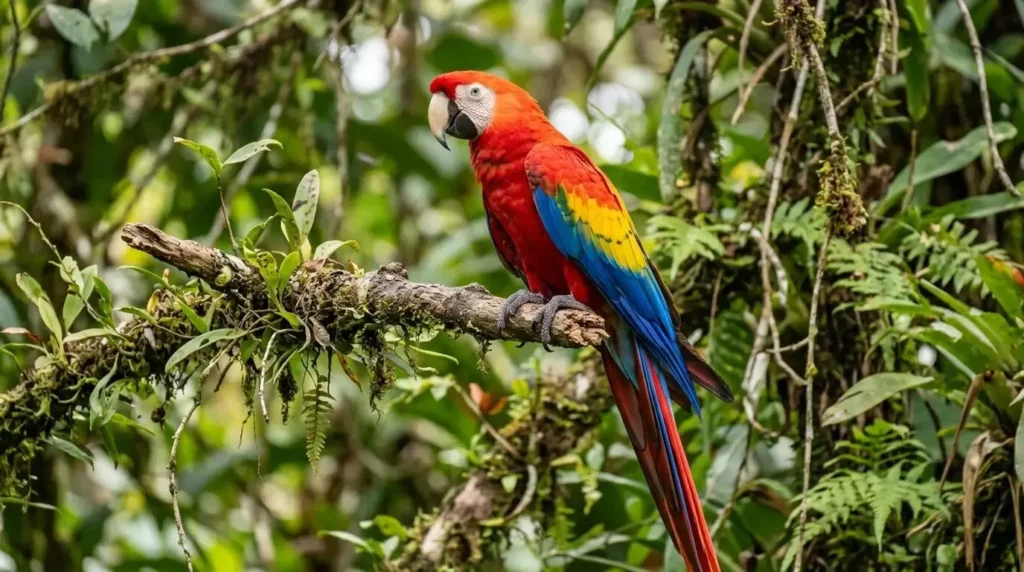
    1. Scarlet Macaw

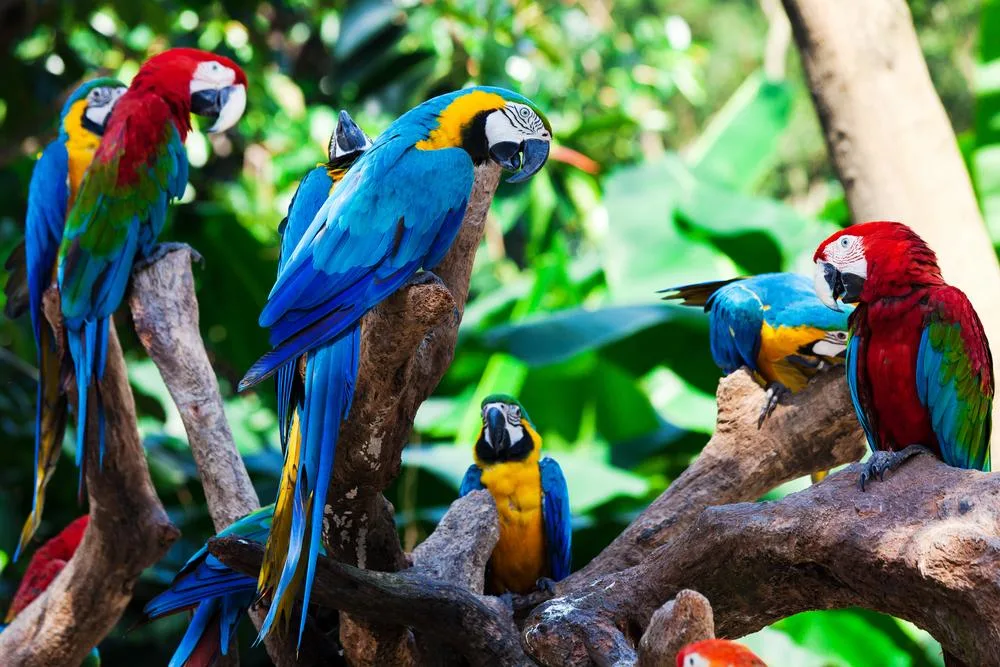
    The Scarlet Macaw is one of the most iconic Amazon rainforest birds.

    Its brilliant red plumage is combined with yellow and blue feathers on the wings, creating one of the most spectacular color patterns in the rainforest.

    Scarlet Macaws are highly social and are often seen flying in pairs or small groups.

    Their loud calls can carry through the forest, making them easier to detect before they appear overhead.


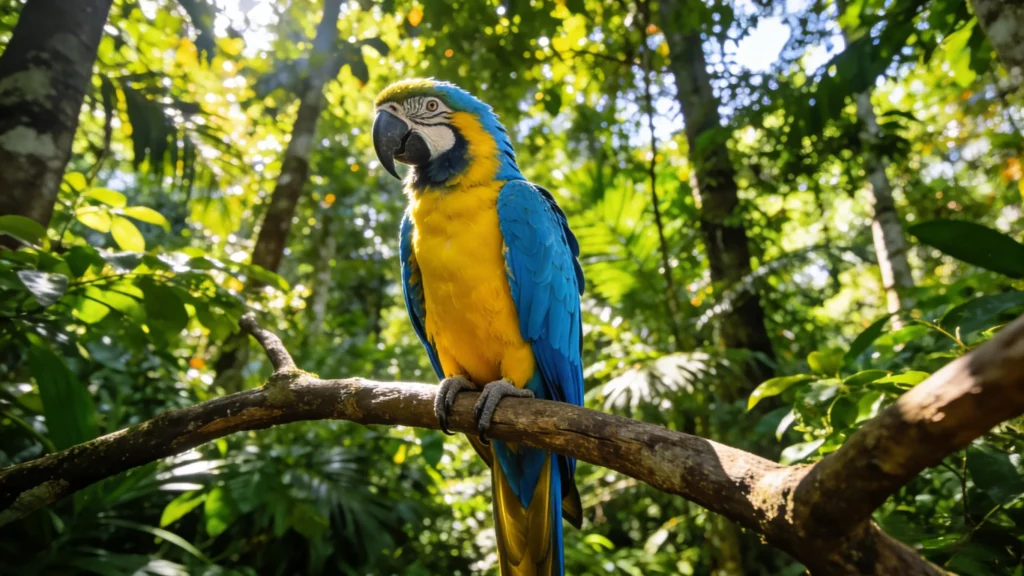
    2. Blue-and-Yellow Macaw

    The Blue-and-Yellow Macaw is another unforgettable rainforest bird.

    Its bright blue wings and back contrast dramatically with its yellow chest.

    These large parrots have strong, curved bills that allow them to crack hard nuts and seeds.

    They are often seen flying above rivers or forest clearings.


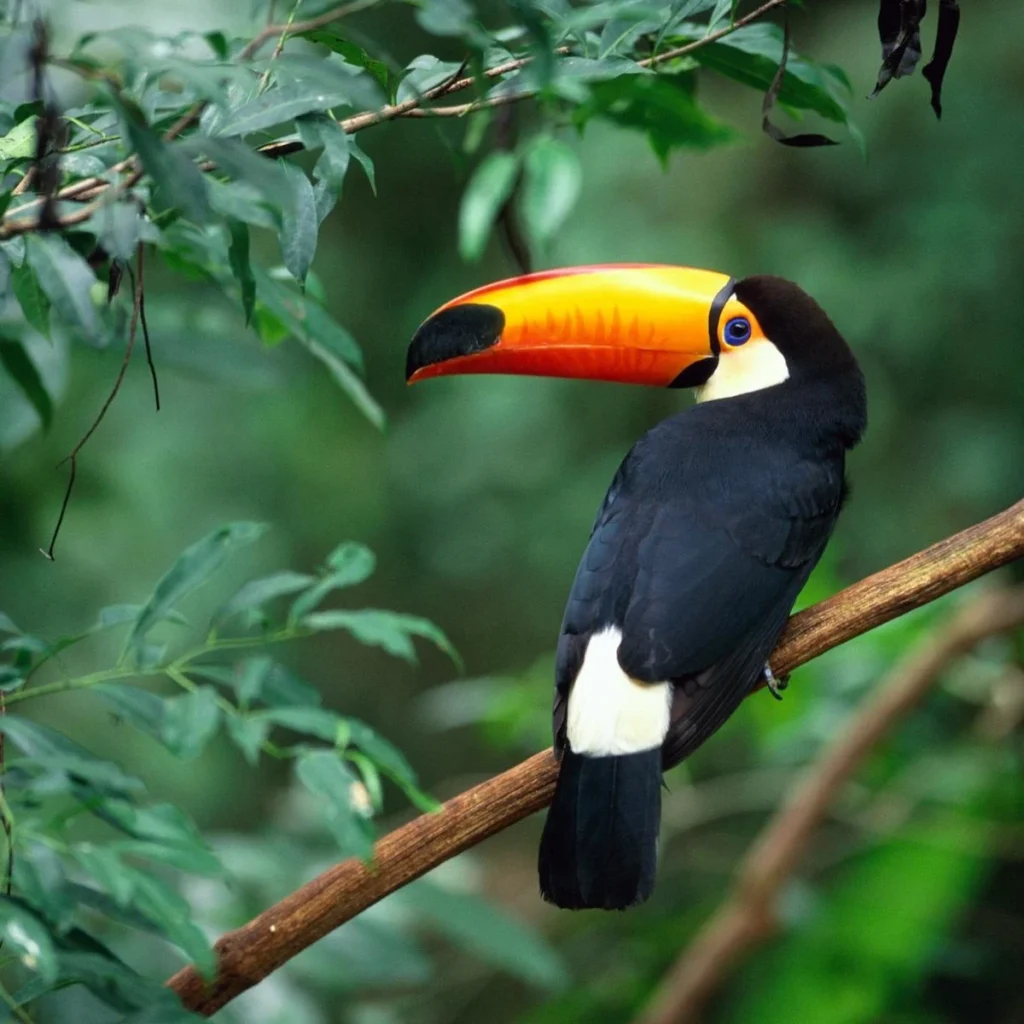
    3. Toucan

    Few birds are as immediately recognizable as a toucan.

    Their enormous colorful bills are their most distinctive feature.

    Despite their large appearance, a toucan’s bill is relatively lightweight because it contains a honeycomb-like internal structure.

    Toucans spend much of their time in trees, feeding on fruit, insects, eggs, and small animals.


    Toucan Amazon Rainforest Birds

    The phrase toucan Amazon rainforest birds refers to several species of toucans and related birds found throughout the region.

    Toucans belong to the family Ramphastidae.

    Among the better-known Amazonian species are:

    • Keel-billed Toucan
    • Channel-billed Toucan
    • White-throated Toucan
    • Yellow-ridged Toucan
    • Chestnut-eared Aracari
    • Many-banded Aracari

    Aracaris are smaller relatives of the larger toucans.

    Their bills can also be remarkably colorful.


    Why Do Toucans Have Such Large Bills?

    A toucan’s bill serves several purposes.

    It helps the bird:

    • Reach fruit on thin branches
    • Manipulate food
    • Defend itself
    • Display to other birds
    • Regulate heat

    The bill is also an important part of the toucan’s visual identity.

    When searching for Amazon rainforest birds pictures, toucans frequently appear because their dramatic appearance makes them particularly photogenic.


    Macaw Amazon Rainforest Birds

    Macaws are among the most beautiful and recognizable Amazon rainforest birds.

    These large parrots are famous for:

    • Brilliant colors
    • Strong curved bills
    • Long tails
    • Loud calls
    • Intelligence
    • Social behavior

    Several macaw species can be found in the Amazon.

    Important Amazonian macaws include:

    • Scarlet Macaw
    • Blue-and-Yellow Macaw
    • Red-and-Green Macaw
    • Blue-winged Macaw
    • Chestnut-fronted Macaw
    • Military Macaw

    One of the most spectacular places to observe macaws is an Amazonian clay lick.


    Why Do Macaws Visit Clay Licks?

    Clay licks are exposed areas of mineral-rich soil where parrots and macaws gather to eat clay.

    These locations can become important social gathering places.

    At certain sites, dozens or even hundreds of colorful parrots may arrive, creating one of the most impressive wildlife spectacles in the rainforest.

    Clay lick visits are particularly famous in parts of the Peruvian Amazon.

    The sight of red, blue, yellow, and green birds gathering against a backdrop of dense rainforest is one of the reasons birdwatchers travel to the region.


    Amazon Rainforest Birds List

    If you are building an Amazon rainforest birds list, it is useful to organize species according to their appearance, behavior, and ecological role.

    Parrots and Macaws

    • Scarlet Macaw
    • Blue-and-Yellow Macaw
    • Red-and-Green Macaw
    • Blue-winged Macaw
    • Mealy Amazon
    • Orange-winged Amazon
    • White-eyed Parakeet

    Toucans and Aracaris

    • Keel-billed Toucan
    • Channel-billed Toucan
    • White-throated Toucan
    • Chestnut-eared Aracari
    • Many-banded Aracari

    Birds of Prey

    • Harpy Eagle
    • Crested Eagle
    • Ornate Hawk-Eagle
    • Black-and-white Hawk-Eagle
    • Roadside Hawks
    • Black Vulture
    • King Vulture

    Forest Birds

    • Hoatzin
    • Great Potoo
    • Motmots
    • Jacamars
    • Antbirds
    • Manakins
    • Oropendolas
    • Curassows

    Water and Wetland Birds

    • Amazon Kingfisher
    • Green Kingfisher
    • Cocoi Heron
    • Capped Heron
    • Sunbittern
    • Anhinga

    This list represents only a fraction of the Amazon’s bird diversity.


    Amazon Rainforest Birds Facts

    The Amazon rainforest birds facts that surprise many visitors are not always related to colors.

    Birds have evolved extraordinary adaptations to survive in one of the world’s most complex ecosystems.

    Fact 1: Many Birds Spend Their Lives in the Canopy

    The rainforest canopy creates an enormous three-dimensional habitat.

    Many species rarely descend to the forest floor.

    Instead, they feed, nest, and interact high above the ground.


    Fact 2: Bird Calls Are Essential for Communication

    Dense vegetation makes visual communication difficult.

    Bird calls therefore become extremely important.

    Birds use sounds to:

    • Find mates
    • Defend territories
    • Warn of predators
    • Communicate with partners
    • Keep contact with groups
    • Announce food sources

    This is why Amazon birdwatching often begins with listening rather than looking.


    Fact 3: Bright Colors Have Many Functions

    The spectacular colors of macaws and other birds can help individuals recognize members of their species.

    Colors may also play a role in courtship and social communication.

    However, not every Amazon bird is brightly colored.

    Many species are brown, gray, green, or olive-colored, allowing them to disappear into the forest.


    Amazon Rainforest Birds Sounds

    Amazon rainforest birds sounds are one of the defining characteristics of the jungle.

    The rainforest can seem visually quiet from a distance, but once you stop and listen, it becomes a constantly changing soundscape.

    You may hear:

    • Macaw calls
    • Parrot chatter
    • Toucan calls
    • Hummingbird wing sounds
    • Pigeon calls
    • Hawk cries
    • Woodpecker tapping
    • Oropendola songs
    • Antbird calls
    • Insect sounds
    • Frog calls

    Some bird calls are loud and unmistakable, while others are soft and difficult to locate.

    For birdwatchers, identifying a bird by sound can be just as rewarding as seeing it.


    Amazon Rainforest Birds of Prey

    The Amazon rainforest birds of prey occupy important positions within the ecosystem.

    These predators hunt other animals and help regulate populations.

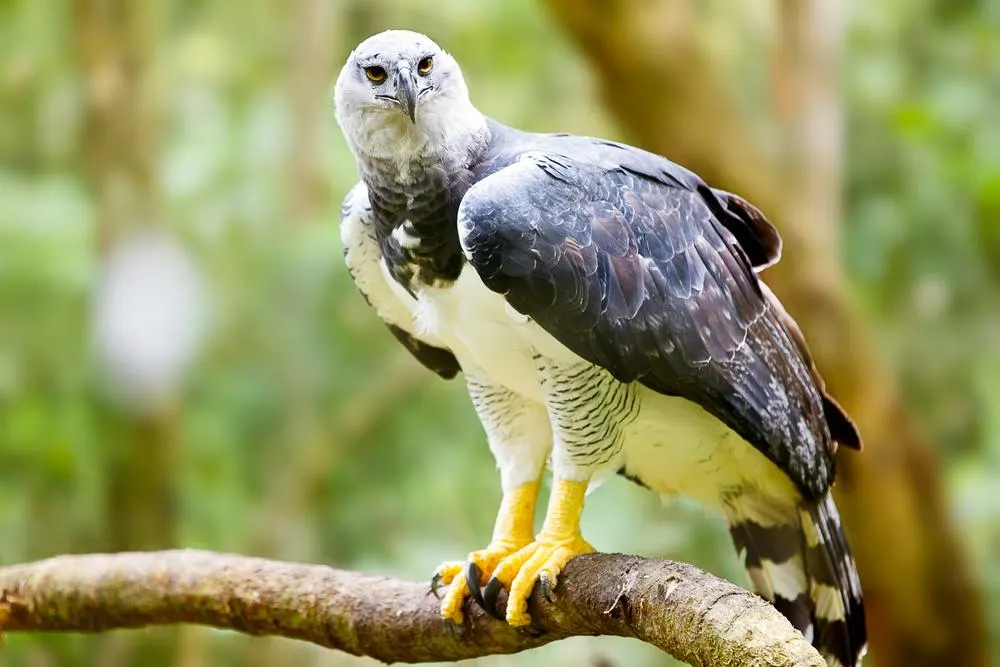
    Among the most impressive is the Harpy Eagle.

    Harpy Eagle

    The Harpy Eagle is one of the most powerful eagles associated with tropical American forests.

    It has:

    • Massive talons
    • Broad wings
    • A powerful hooked bill
    • A prominent crest
    • Exceptional hunting ability

    Harpy Eagles are specialized forest predators.

    Their prey can include arboreal mammals and birds.

    Seeing one in the wild is considered a remarkable experience because these eagles require large areas of suitable forest.


    Other Amazon Birds of Prey

    The Amazon supports numerous raptors beyond the Harpy Eagle.

    These include:

    Crested Eagle

    A forest predator capable of hunting birds and other animals.

    Ornate Hawk-Eagle

    A beautifully patterned raptor associated with forest habitats.

    Black-and-White Hawk-Eagle

    A striking species with contrasting plumage.

    King Vulture

    A large scavenging bird with a distinctive appearance.

    Black Vulture

    Often seen soaring above open areas and settlements.

    Birds of prey demonstrate that the Amazon ecosystem contains predators at many levels, from tiny insect hunters to powerful canopy eagles.


    Rare Amazon Rainforest Birds

    The term rare Amazon rainforest birds can refer to species that are genuinely uncommon, difficult to observe, restricted to specific habitats, or simply difficult to locate.

    Some birds may be relatively widespread but rarely seen because they live deep inside dense forest.

    Others have specialized habitat requirements.

    Examples of birds that can be challenging for birdwatchers include:

    • Harpy Eagle
    • Crested Eagle
    • Great Potoo
    • Rufous Potoo
    • Various antbirds
    • Forest-falcons
    • Specialized cotingas
    • Certain manakins
    • Some ground-dwelling species

    Birding in the Amazon often requires patience.

    A rare bird may be heard several times before it is finally visible.


    Beautiful Amazon Rainforest Birds

    The Amazon contains some of the world’s most beautiful birds.

    Beauty is subjective, but several species are especially famous for spectacular coloration.

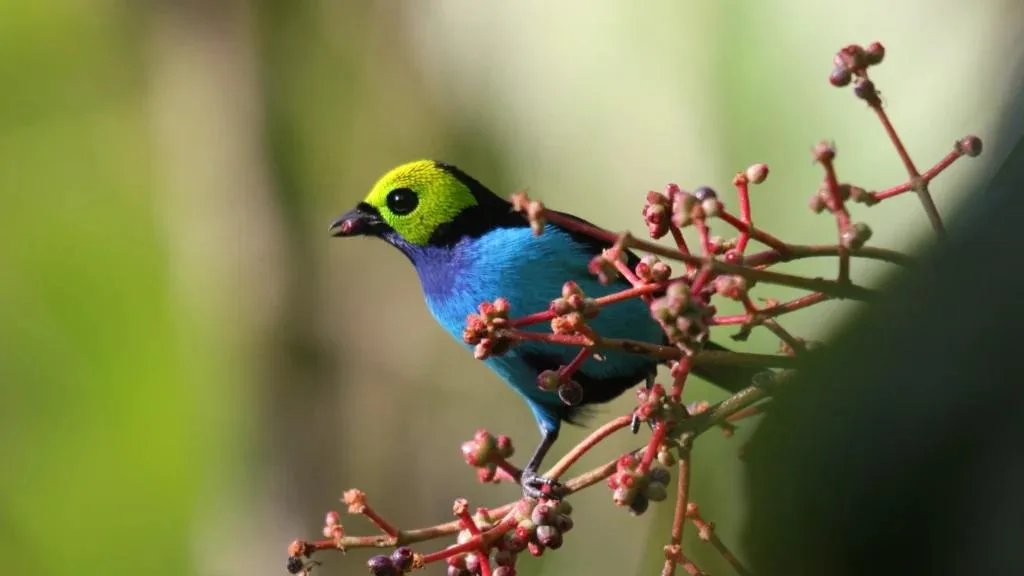
    Paradise Tanager

    The Paradise Tanager is one of the most colorful birds in the Amazon.

    Its contrasting blue, green, red, and yellow coloration makes it a favorite among photographers and birdwatchers.

    Scarlet Macaw

    Its intense red, yellow, and blue feathers make it one of the rainforest’s most recognizable birds.

    Blue-and-Yellow Macaw

    The dramatic contrast between blue and yellow creates a striking appearance.

    Toucans

    Their oversized bills and contrasting plumage make them exceptionally photogenic.

    Hummingbirds

    Small but brilliantly colored, hummingbirds can display metallic greens, blues, purples, and reds depending on the species and lighting.


    Amazon Rainforest Animals: Birds Are Only Part of the Story

    The phrase Amazon rainforest animals encompasses much more than birds.

    Birds form one of the most visible groups, but the rainforest is also home to:

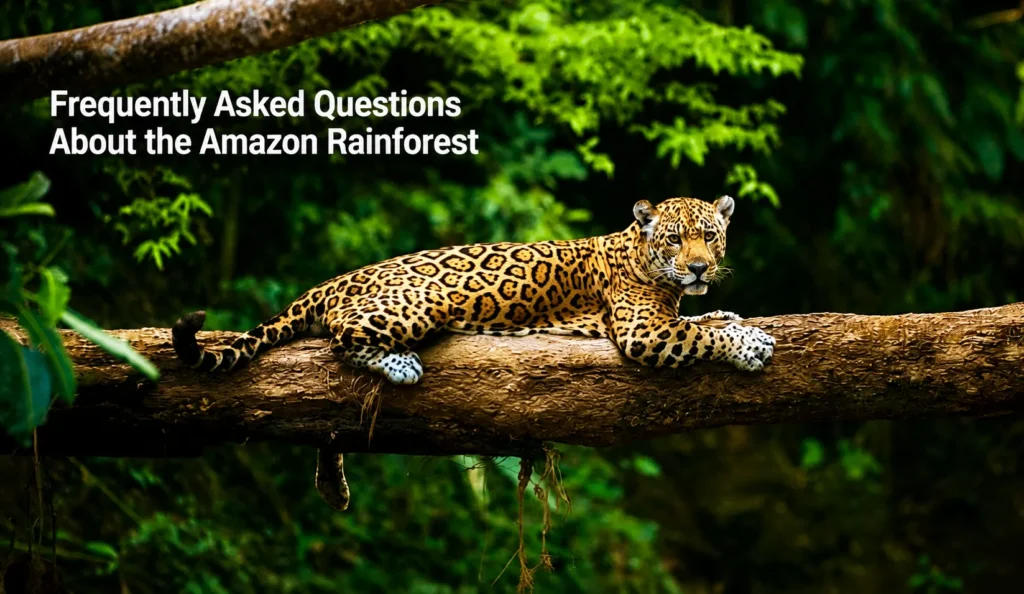
    • Jaguars
    • Giant river otters
    • Sloths
    • Monkeys
    • Tapirs
    • Capybaras
    • Anacondas
    • Caimans
    • Tree frogs
    • Turtles
    • Bats
    • Thousands of insects

    Birds interact with many of these animals.

    For example, some birds eat insects disturbed by mammals, while others feed on fruits that help disperse seeds.

    This makes birds an important component of the Amazon’s ecological network.


    How Birds Help the Amazon Rainforest

    Birds perform several essential ecological functions.

    Seed Dispersal

    Fruit-eating birds consume fruits and transport seeds to new locations.

    Toucans, macaws, cotingas, and many other birds contribute to this process.

    Pollination

    Some birds, especially hummingbirds, visit flowers and can contribute to pollination.

    Pest Control

    Insect-eating birds consume enormous numbers of insects.

    Scavenging

    Certain birds help recycle nutrients by consuming carrion.

    Food Webs

    Birds are both predators and prey.

    Their presence connects insects, plants, reptiles, mammals, and larger predators.


    Birds From the Amazon Canopy to the Forest Floor

    One of the most fascinating things about Amazonian birdlife is vertical diversity.

    Imagine the rainforest as a multi-story building.

    Upper Canopy

    The highest layers receive intense sunlight and contain:

    • Macaws
    • Toucans
    • Parrots
    • Eagles
    • Large fruit-eating birds

    Middle Canopy

    This zone contains:

    • Tanagers
    • Woodpeckers
    • Cotingas
    • Hummingbirds
    • Smaller parrots

    Understory

    Here you may encounter:

    • Antbirds
    • Manakins
    • Small insectivores
    • Forest-falcons

    Forest Floor

    Some birds forage near the ground, including certain:

    • Curassows
    • Tinamous
    • Antbirds
    • Pigeons

    This vertical structure explains why a single forest trail can contain many different bird communities.


    Amazon Birdwatching: How to Find Birds

    Birdwatching in the Amazon requires a different strategy from birdwatching in an open landscape.

    Instead of simply scanning a distant horizon, listen carefully and search systematically.

    Start Early

    The early morning is often one of the best periods for bird activity.

    Birds are calling, feeding, and moving through the forest.

    Listen Before Looking

    A bird call can reveal where a bird is located.

    Once you hear it, follow the sound and search the vegetation carefully.

    Look for Movement

    Instead of searching for an entire bird, watch for:

    • Moving leaves
    • Flying silhouettes
    • Branch movement
    • Flashing colors
    • Birds crossing gaps between trees

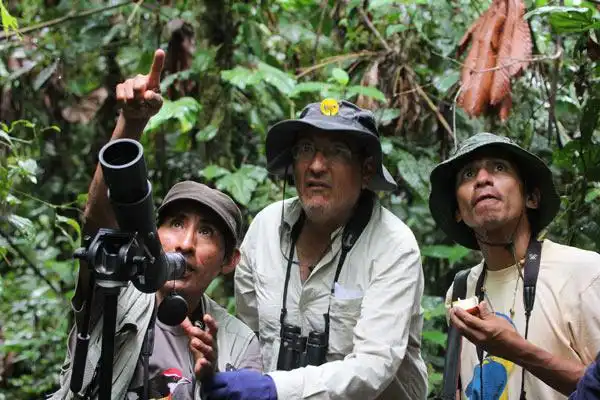
    Bring Binoculars

    Many Amazonian birds remain high in the canopy.

    Binoculars can turn an indistinct shape into a clearly identifiable species.


    Why Amazon Bird Photography Is Challenging

    Taking Amazon rainforest birds pictures can be surprisingly difficult.

    Dense vegetation, low light, high humidity, and fast-moving birds create significant challenges.

    A bird may appear for only a few seconds before disappearing behind leaves.

    Photographers often need:

    • Patience
    • Long lenses
    • Fast shutter speeds
    • Good fieldcraft
    • Knowledge of bird behavior
    • Early starts

    Some of the best photographs are captured at forest edges, riverbanks, clay licks, and clearings because these areas provide better visibility.


    Amazon Birds and Seasonal Changes

    Bird activity can change throughout the year.

    Rainfall influences:

    • Fruit availability
    • Flowering
    • Insect abundance
    • River levels
    • Flooding
    • Bird movement

    During certain periods, flooded forests create temporary feeding habitats.

    When rivers rise, some forest areas become submerged.

    When water levels fall, beaches, mudflats, and exposed riverbanks may appear, creating new feeding opportunities for other species.

    This dynamic environment contributes to the extraordinary diversity of Amazonian birdlife.


    Amazon Rainforest Birds Eye View

    The phrase Amazon rainforest birds eye view can describe two different ideas.

    First, it can mean viewing the rainforest from above, such as from a canopy tower or elevated observation point.

    Second, it can refer to birds themselves flying above the rainforest canopy.

    From an elevated viewpoint, visitors can see how enormous and continuous the forest really is.

    Instead of seeing individual trees, you may see a seemingly endless sea of green extending toward the horizon.

    Macaws and other large birds sometimes cross this landscape at eye level or below elevated observation points, creating spectacular photographic opportunities.


    Amazon Rainforest Birds Eye: Seeing the Jungle Differently

    An elevated perspective also reveals the structure of the forest.

    From ground level, vegetation can seem dense and almost impenetrable.

    From above, you can see:

    • Canopy layers
    • River channels
    • Forest clearings
    • Palm crowns
    • Wetlands
    • Distant hills
    • Forest edges

    This perspective is especially valuable in regions where canopy towers or elevated platforms are available.


    Best Places to See Amazon Rainforest Birds

    Different Amazon destinations provide different birdwatching opportunities.

    Peruvian Amazon

    Peru is an excellent destination for birdwatching because its Amazonian forests contain tremendous habitat diversity.

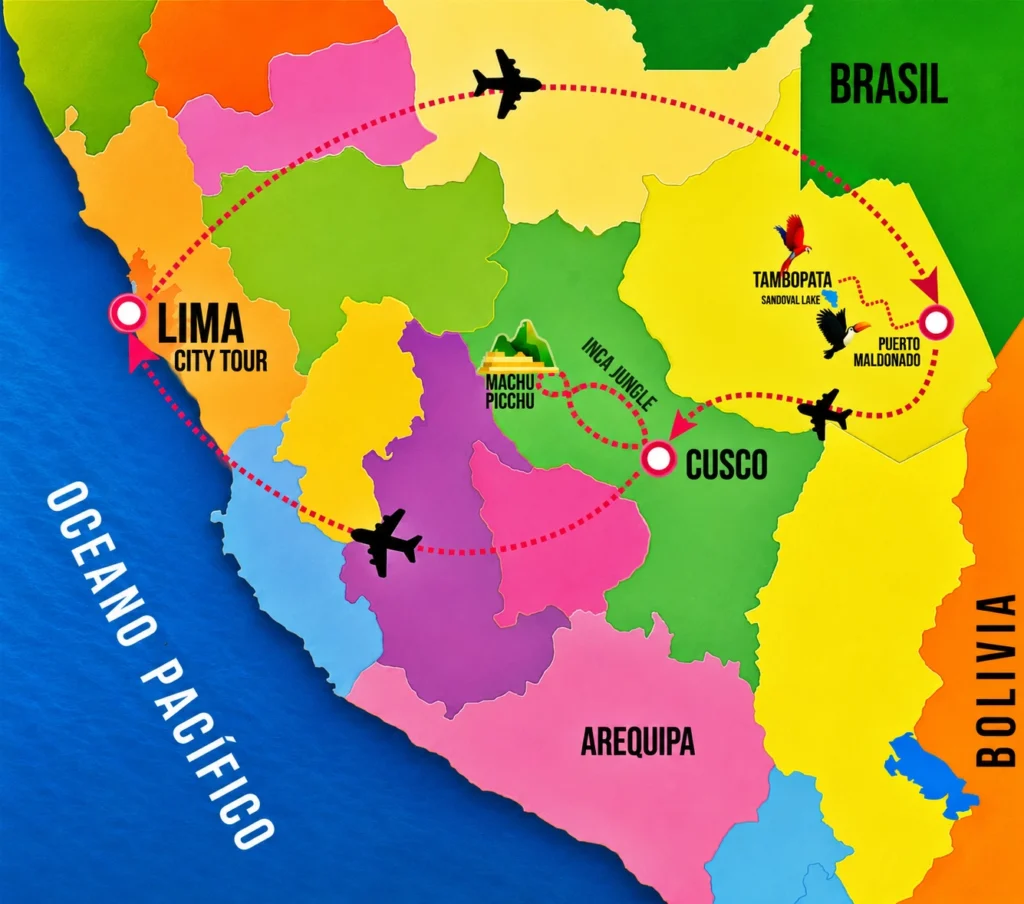
    Southern Peru, including areas around Puerto Maldonado and Tambopata, is particularly attractive to wildlife enthusiasts.

    Possible sightings include:

    • Macaws
    • Toucans
    • Parrots
    • Tanagers
    • Hummingbirds
    • Raptors
    • Hoatzins
    • Kingfishers

    Why the Peruvian Amazon Is Special for Birdwatching

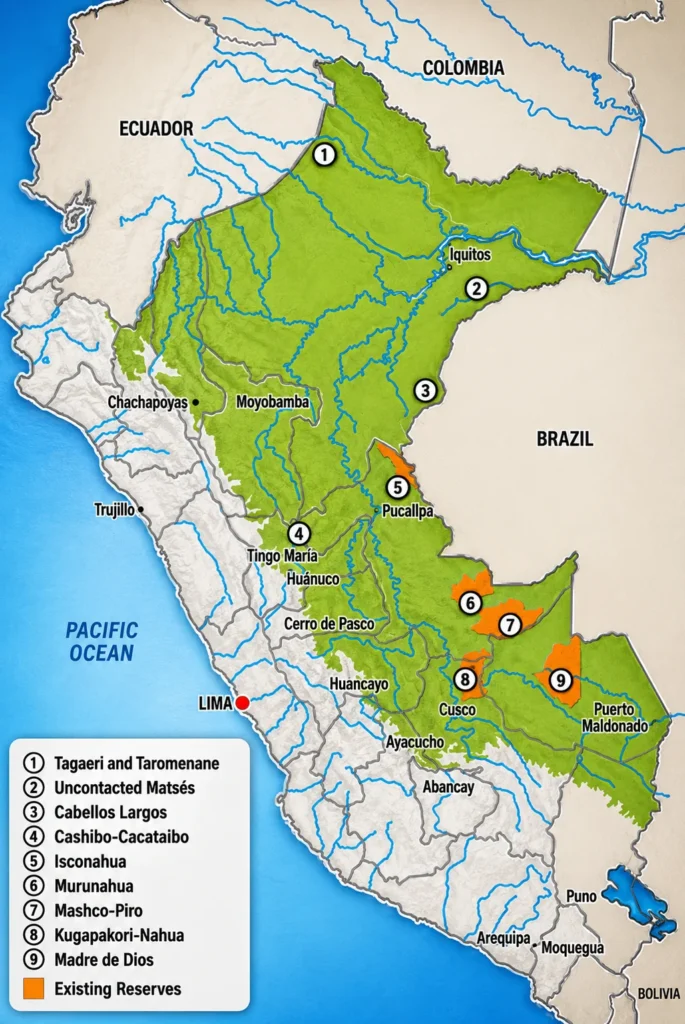
    A Peruvian Amazon map with cities shows how southern and northeastern Peru provide different entry points into the rainforest.

    The region around Puerto Maldonado is particularly well known for wildlife tourism.

    The combination of rivers, oxbow lakes, clay licks, wetlands, and primary rainforest creates numerous bird habitats.

    For visitors, this means a relatively short trip can potentially produce a surprisingly long Amazon rainforest birds list.

    The experience is not simply about counting species.

    It is about being surrounded by the sounds, movement, colors, and rhythms of a living rainforest.


    Frequently Asked Questions About Amazon Rainforest Birds

    How many bird species live in the Amazon rainforest?

    The Amazon supports an extraordinary number of bird species, with estimates varying depending on the geographic definition of the Amazon region and the taxonomic treatment used. It is considered one of the richest bird regions on Earth.

    What is the most famous Amazon rainforest bird?

    Macaws and toucans are among the most famous because of their spectacular colors and distinctive shapes. The Harpy Eagle is another iconic Amazonian bird.

    What are the most colorful Amazon rainforest birds?

    Paradise Tanagers, macaws, toucans, parrots, cotingas, and hummingbirds are among the most colorful groups.

    What Amazon bird has the biggest beak?

    Toucans are famous for their enormous bills relative to their body size.

    What is the largest bird of prey in the Amazon?

    The Harpy Eagle is one of the largest and most powerful forest eagles in the Americas.

    Are Amazon rainforest birds dangerous?

    Most Amazonian birds pose little threat to humans. Even large birds generally avoid people. The primary challenge for birdwatchers is finding and identifying them.

    When is the best time to see Amazon rainforest birds?

    Early morning is generally excellent for birdwatching because many species are active and vocal. Local conditions, season, habitat, and weather also influence sightings.

    Why are Amazon birds so colorful?

    Color can help birds recognize members of their species, attract mates, communicate, and blend into particular environments. The exact function varies among species.

    Can you hear Amazon rainforest birds before seeing them?

    Absolutely. Many species are easier to detect by sound first. Experienced birdwatchers often identify a bird from its call before locating it visually.


    Final Thoughts on Amazon Rainforest Birds

    The Amazon rainforest birds represent one of the most extraordinary parts of the Amazon ecosystem.

    From the brilliant feathers of macaws and tanagers to the enormous bills of toucans and the powerful talons of the Harpy Eagle, Amazonian birds demonstrate an incredible range of adaptations.

    For anyone searching for Amazon rainforest birds pictures with names, studying photographs is a great first step, but seeing these animals in their natural habitat offers something much more powerful.

    A macaw flying above the canopy is not simply a colorful photograph.

    A toucan calling from a distant branch is not simply a bird identification.

    A Harpy Eagle hidden somewhere in the forest is not simply another item on a checklist.

    Together, these encounters reveal how interconnected the Amazon ecosystem really is.

    The best way to experience Amazon rainforest birds is to slow down and listen. The jungle constantly communicates through calls, wingbeats, movement, and color. Sometimes you will see a brilliant macaw immediately. Other times, you may hear a mysterious call for several minutes before finally finding the bird hidden among the leaves.

    Whether you are interested in rare Amazon rainforest birds, Amazon birds of prey, toucan Amazon rainforest birds, macaw Amazon rainforest birds, or simply the most beautiful Amazon rainforest birds, the region offers an extraordinary world waiting to be discovered.

    And perhaps the most remarkable lesson is that every bird is part of something much larger: the Amazon rainforest itself—a vast living ecosystem where rivers, trees, insects, mammals, birds, and people are connected by an intricate web of life.

  • Amazon Map: Explore the Amazon Rainforest, River, Basin, Countries and Cities

    Amazon Map: Explore the Amazon Rainforest, River, Basin, Countries and Cities

    Amazon Map: Explore the Amazon Rainforest, River, Basin, Countries and Cities

  • Amazon Cities: Ancient Cities, Lost Settlements, and Modern Urban Centers of the Amazon

    Amazon Cities: Ancient Cities, Lost Settlements, and Modern Urban Centers of the Amazon

    he Amazon cities of today are only one part of a much older human story. For centuries, the Amazon rainforest was often portrayed as an untouched wilderness where people lived only in small, scattered communities. Archaeological discoveries have dramatically changed that picture. Beneath the dense vegetation, researchers have found evidence of roads, canals, agricultural systems, earthworks, plazas, settlements, and enormous networks of human occupation that existed long before European arrival.

    Today, cities such as Manaus, Iquitos, Belém, Santarém, and Puerto Maldonado connect millions of people with the Amazon Basin. But beneath and around these modern cities lies another history: the story of ancient Amazon cities, large settlements, and sophisticated societies that adapted to one of the most challenging environments on Earth.

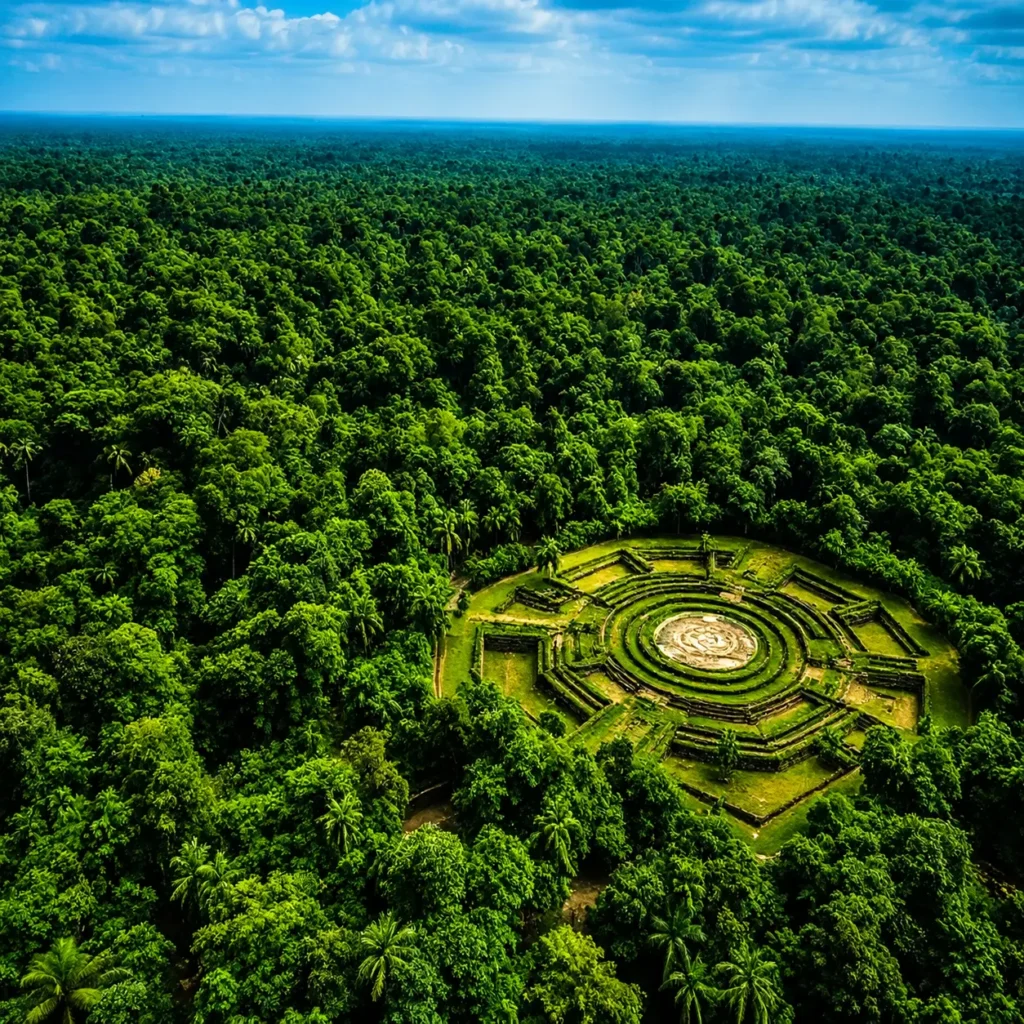
    From mysterious geometric earthworks to settlements revealed by LiDAR, the Amazon continues to challenge what we know about ancient civilization. Some archaeological landscapes suggest that people modified enormous areas of rainforest, managed forests, cultivated crops, constructed transportation routes, and organized communities on a much larger scale than previously believed.

    What Are Amazon Cities?

    The term Amazon cities can refer to modern urban centers located within or closely connected to the Amazon Basin, but it can also be used more broadly when discussing ancient urban settlements discovered in the rainforest.

    Modern Amazon cities vary enormously in size and character. Some are major metropolitan centers with populations in the millions, while others are smaller regional towns surrounded by forest, rivers, wetlands, and agricultural areas. Their common characteristic is their close relationship with the Amazon’s enormous river network.

    Ancient Amazon cities were very different from modern cities. They generally did not contain skyscrapers, paved streets, or large concentrations of industrial buildings. Instead, some ancient settlements consisted of interconnected communities organized around plazas, raised platforms, roads, canals, agricultural areas, defensive structures, and monumental earthworks.

    What Is Considered an Amazon City?

    There is no single definition of an Amazon city. In modern geography, an Amazon city is generally an urban settlement located within the Amazon Basin or strongly connected to the Amazon River system.

    The term can include:

    • Large metropolitan areas
    • Regional commercial centers
    • River ports
    • Small towns surrounded by rainforest
    • Tourism gateways
    • Indigenous and rural settlements
    • Ancient urban or semi-urban archaeological landscapes

    For archaeology, the definition becomes more complicated. Researchers may use terms such as ancient settlement, urban center, regional center, or complex society rather than simply calling every large archaeological site a city.

    This distinction is important because ancient Amazonian societies did not necessarily follow the same urban model as civilizations elsewhere in the world.

    Where Are the Amazon’s Major Cities Located?

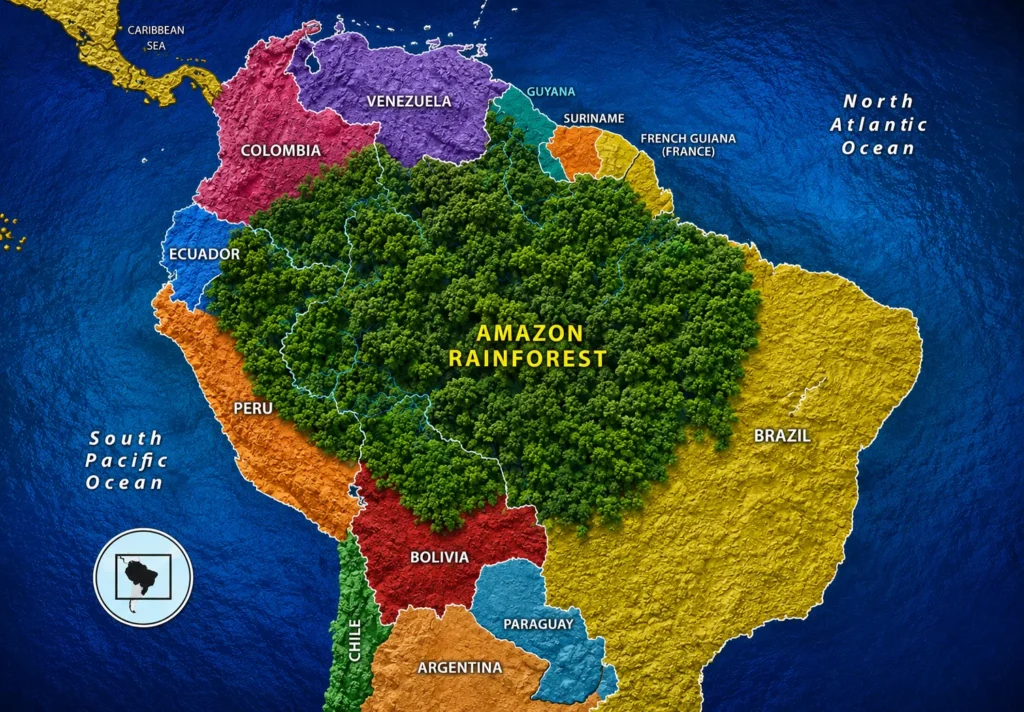
    The largest Amazon cities are distributed across several countries of South America, including Brazil, Peru, Colombia, Bolivia, and Ecuador.

    Many developed along major rivers because rivers were the Amazon’s natural highways. Long before modern roads and airports, rivers provided transportation, food, communication routes, and access to different ecological zones.

    Important modern Amazon cities include:

    • Manaus, Brazil
    • Belém, Brazil
    • Santarém, Brazil
    • Rio Branco, Brazil
    • Porto Velho, Brazil
    • Macapá, Brazil
    • Iquitos, Peru
    • Puerto Maldonado, Peru
    • Pucallpa, Peru
    • Leticia, Colombia
    • Cobija, Bolivia
    • Tena, Ecuador
    • Coca, Ecuador

    The location of these cities reveals an important fact about Amazonian geography: water determines where people live. Even today, rivers remain essential transportation corridors throughout enormous portions of the rainforest.

    Amazon Cities Map: Where Are They Located?

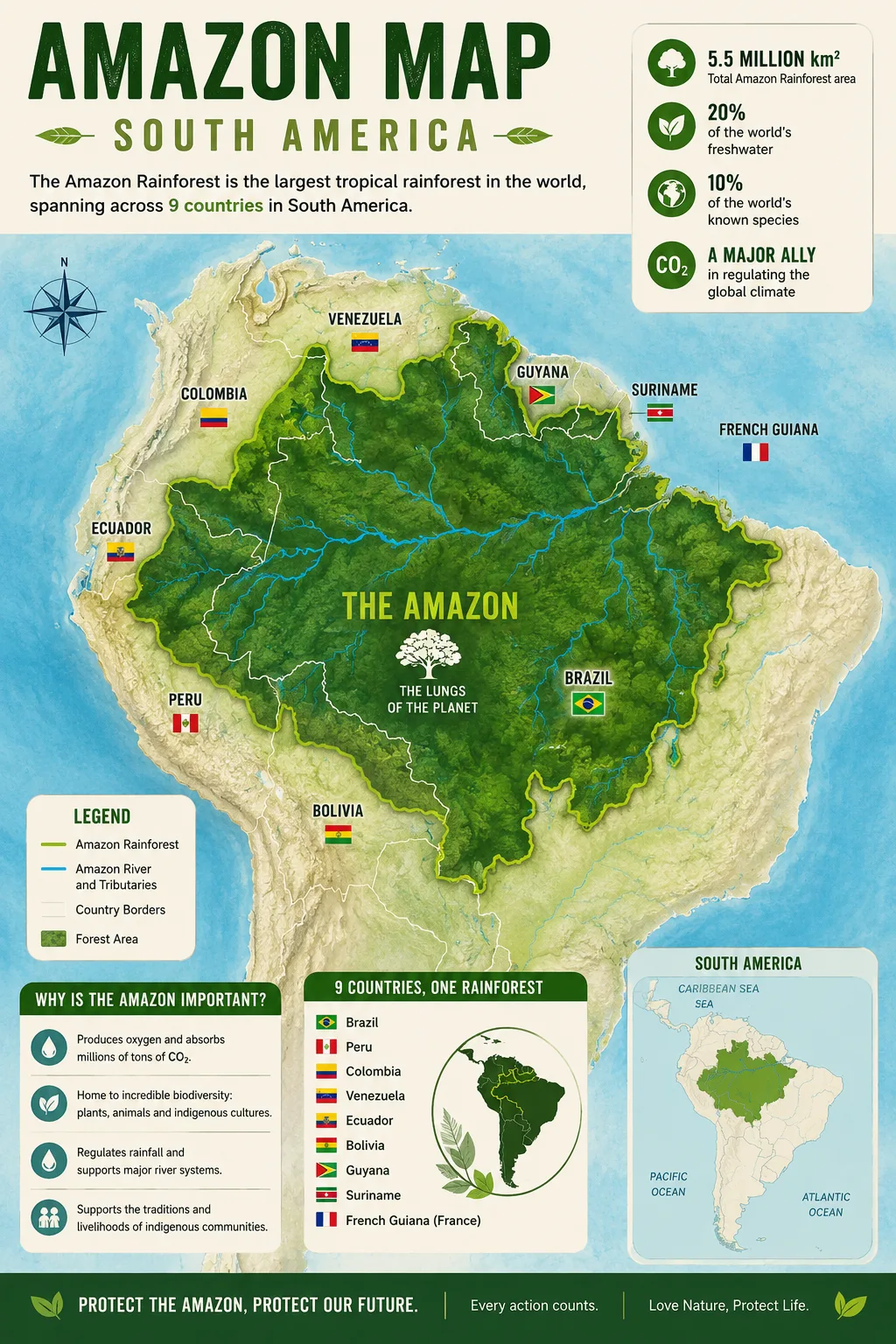
    An Amazon cities map would show an enormous urban network spread across the Amazon Basin rather than a single concentration of cities.

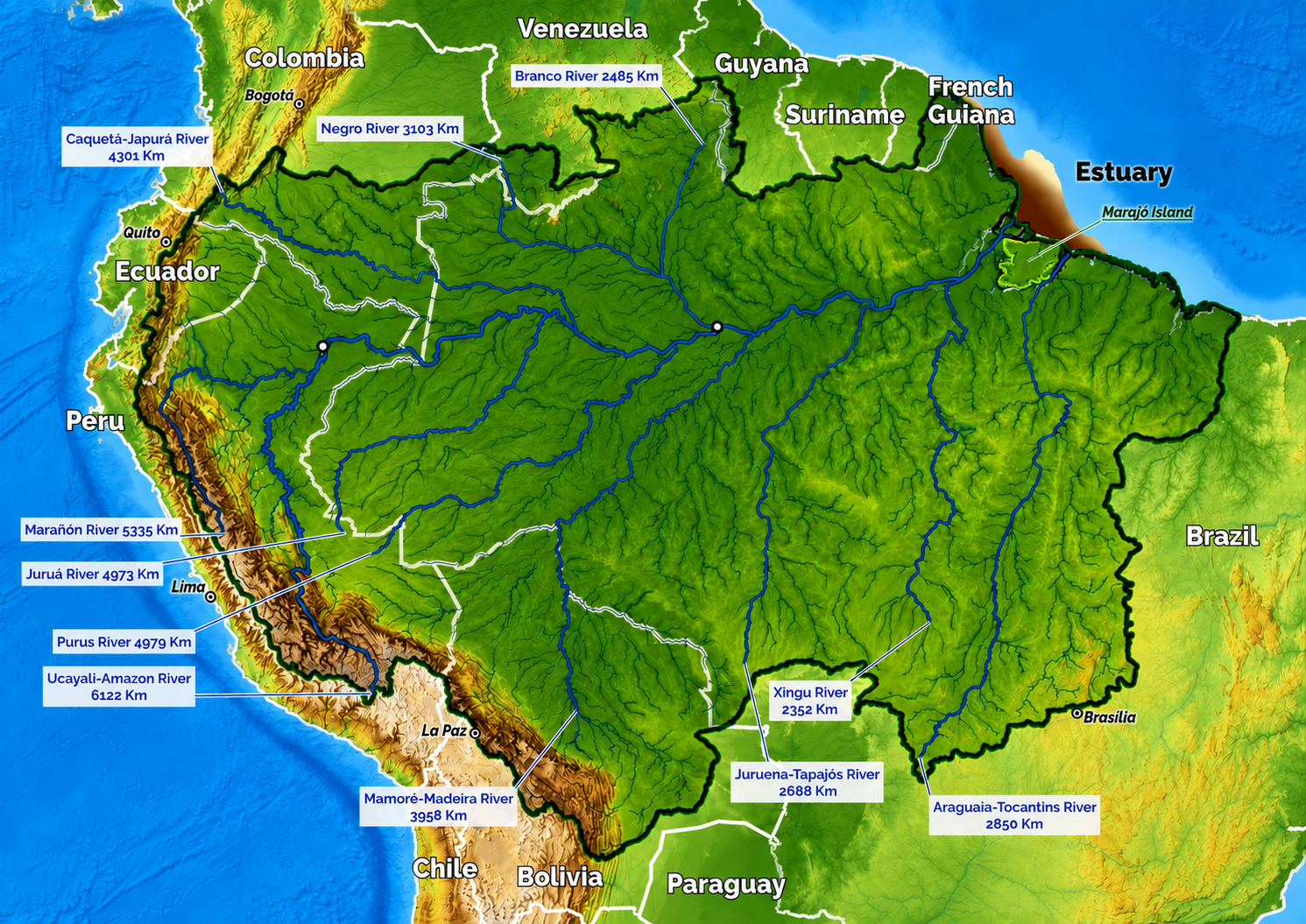
    The Amazon Basin covers approximately 7 million square kilometers when considered as a complete drainage basin, crossing national borders and containing thousands of rivers and tributaries. The Amazon River and its major tributaries form the backbone of this enormous geographic region.

    Major Amazon Cities by Country

    CountryImportant Amazon Cities
    BrazilManaus, Belém, Santarém, Rio Branco, Porto Velho, Macapá
    PeruIquitos, Puerto Maldonado, Pucallpa, Tarapoto
    ColombiaLeticia, Puerto Carreño
    BoliviaRiberalta, Cobija, Trinidad
    EcuadorCoca, Tena, Nueva Loja
    VenezuelaPuerto Ayacucho

    The map would also reveal something unusual: many important Amazonian population centers are located hundreds of kilometers from one another, separated by forest, rivers, wetlands, mountains, and enormous areas of relatively low population density.

    Amazon Cities in Peru

    Peru contains a substantial portion of the western Amazon Basin, where the Andes meet the rainforest. Several important cities serve as gateways to different Amazonian ecosystems.

    Iquitos

    Iquitos is one of the world’s most unusual major cities because it has no conventional road connection to the rest of Peru. The city is accessible primarily by air or river.

    Located in northeastern Peru, Iquitos is surrounded by rivers and tropical forest. It serves as an important commercial, cultural, and tourism center for the Peruvian Amazon.

    The city is closely connected to the Amazon River and nearby communities, reserves, forests, and wetlands.

    Puerto Maldonado

    Puerto Maldonado is one of the principal gateways to the southern Peruvian Amazon and is particularly important for access to the Tambopata region and surrounding rainforest.

    The city sits near the confluence of the Madre de Dios and Tambopata rivers, making waterways central to its history and economy.

    Puerto Maldonado is also a gateway to some of Peru’s most biologically diverse rainforest landscapes, including areas where visitors can encounter giant river otters, macaws, monkeys, caimans, capybaras, and hundreds of bird species.

    Pucallpa

    Pucallpa lies in eastern Peru on the banks of the Ucayali River. It is an important commercial and transportation center connecting the interior of Peru with the Amazon river system.

    Its location illustrates why rivers became so important to Amazonian settlements: a river can function simultaneously as a transportation route, source of food, geographic boundary, and connection between communities.

    Amazon Cities Across the Amazon Basin

    Amazon cities are not restricted to Peru or Brazil. The entire basin contains an extraordinary variety of urban centers.

    Brazil contains the largest portion of the Amazon Basin and includes major cities such as Manaus and Santarém. Colombia’s Leticia provides an important connection to the Amazon River and forms part of a unique tri-border region involving Peru and Brazil.

    Bolivia has important Amazonian settlements including Riberalta and Trinidad, while Ecuador’s Amazonian cities include Tena and Coca.

    Despite their differences, many Amazon cities share several characteristics:

    • Strong dependence on rivers
    • Tropical climates
    • Rapid urban expansion
    • Close proximity to rainforest
    • Important Indigenous cultural influences
    • Economies connected to agriculture, forestry, tourism, fishing, and trade
    • Unique transportation challenges

    Ancient Cities of the Amazon

    The idea of ancient cities of the Amazon once seemed almost impossible to many people. The rainforest was traditionally imagined as an environment incapable of supporting large populations because soils can be nutrient-poor, vegetation grows rapidly, and seasonal flooding can transform enormous areas.

    Archaeology has revealed a much more complicated reality.

    Ancient Amazonian societies learned how to work with the rainforest rather than simply attempting to replace it. They developed agricultural systems, managed useful trees and plants, constructed earthworks, created transportation networks, and organized settlements according to local environmental conditions.

    Some archaeological landscapes are so extensive that they suggest populations far larger and more organized than earlier historical accounts had recognized.

    Did Ancient Cities Really Exist in the Amazon?

    Yes, archaeological evidence demonstrates that ancient Amazonian societies created substantial settlements and highly modified landscapes.

    However, it is important to avoid imagining them as exact equivalents of modern cities.

    Some ancient settlements may have consisted of clusters of communities connected through roads and causeways. Others contained monumental structures, plazas, canals, agricultural fields, raised areas, and defensive earthworks.

    In several parts of the Amazon, the archaeological landscape indicates that humans deliberately transformed large areas over centuries.

    This means that the ancient Amazon was not simply a forest containing isolated villages. In some regions, it was a cultural landscape shaped by generations of human activity.

    What Were Ancient Amazon Cities Like?

    Ancient Amazon settlements could look completely different from cities in Europe, Asia, or the Americas.

    Instead of dense buildings made from stone, many structures were constructed from earth, wood, palm materials, and other organic resources. Wooden buildings disappeared over time, while earthworks remained buried beneath vegetation.

    Common Features of Ancient Amazonian Settlements

    Archaeologists have identified or investigated features including:

    • Large plazas
    • Raised platforms
    • Geometric earthworks
    • Ditches
    • Defensive walls
    • Causeways
    • Canals
    • Agricultural fields
    • Terraces
    • Roads
    • Reservoirs
    • Residential areas
    • Ceremonial structures
    • Modified soils

    The use of earth was especially important. Large geometric structures could survive for centuries even after wooden houses and other organic materials disappeared.

    How Did People Live in the Ancient Amazon?

    Ancient Amazonian people developed diverse ways of living according to their local environments.

    Fishing was crucial near rivers and lakes, while agriculture provided crops such as manioc, maize, sweet potatoes, fruits, and other plants. Hunting and gathering supplemented cultivated foods.

    People also modified the forest itself. Rather than treating every tree as something wild and separate from human activity, communities cultivated or encouraged useful species.

    Ancient Amazonian Food Systems

    Some communities practiced sophisticated forms of landscape management that included:

    • Cultivation of root crops
    • Tree management
    • Fishing
    • Hunting
    • Gathering wild foods
    • Soil improvement
    • Seasonal agriculture
    • Wetland resource management

    This approach created a relationship between people and forest that could last for generations.

    Lost and Hidden Cities of the Amazon

    The phrase lost cities of the Amazon has inspired legends for centuries. Stories of enormous hidden cities filled with gold captured the imagination of explorers, adventurers, and treasure hunters.

    The reality is more fascinating than many legends.

    Instead of discovering mythical cities made of gold, archaeology has revealed genuine ancient settlements hidden beneath vegetation. Some are enormous, but their remains are subtle and difficult to recognize from the ground.

    The rainforest itself is one reason these places became “lost.”

    Vegetation can cover roads, ditches, platforms, walls, and other structures. After centuries of abandonment, an ancient settlement can look like ordinary forest.

    Lost Amazon Cities and Ancient Settlements

    Some of the most remarkable discoveries are not individual cities but networks of settlements.

    In parts of the western and southern Amazon, researchers have identified extensive archaeological landscapes containing interconnected earthworks and settlements.

    These discoveries suggest that ancient populations could organize space on a regional scale.

    Instead of one isolated settlement, there may have been:

    household → village → regional center → connected settlement network

    This changes the way researchers think about Amazonian civilization.

    How Were Hidden Amazon Cities Discovered?

    Ancient settlements in the Amazon have been discovered using many different techniques.

    Some were identified through archaeological surveys and excavations. Others became visible through aerial photography, satellite imagery, local knowledge, historical records, or systematic exploration.

    More recently, LiDAR technology has transformed archaeological research in heavily forested regions.

    Dense rainforest can make traditional aerial photography difficult because the canopy hides the ground. LiDAR provides another way to see the landscape.

    What Archaeological Evidence Has Been Found?

    Evidence of ancient Amazonian occupation comes from many different sources.

    Archaeological Evidence Includes:

    • Pottery fragments
    • Stone tools
    • Human-made earthworks
    • Ancient roads
    • Canals
    • Raised fields
    • Ditches
    • Defensive structures
    • Residential platforms
    • Modified soils
    • Charcoal
    • Food remains
    • Plant remains
    • Burial areas
    • Ancient settlement patterns

    Soils can also contain evidence of human activity. In some locations, centuries of occupation changed the chemical and physical characteristics of the ground.

    One particularly interesting example is Amazonian Dark Earth, often called terra preta. These unusually dark and fertile soils are associated with ancient human activity in various parts of the Amazon.

    Amazon Cities Discovered With LiDAR

    LiDAR has become one of the most important technologies for investigating ancient settlements beneath tropical vegetation.

    The technology has revealed landscape features that can be extremely difficult to recognize while standing on the ground.

    In several Amazonian regions, LiDAR surveys have exposed:

    • Straight ancient roads
    • Geometric earthworks
    • Large platforms
    • Circular settlements
    • Defensive ditches
    • Causeways
    • Agricultural modifications
    • Settlement clusters
    • Large-scale landscape engineering

    These discoveries are especially significant because they demonstrate that some ancient societies were capable of modifying enormous areas without creating cities that looked like the monumental stone cities familiar from other parts of the ancient world.

    What Is LiDAR?

    LiDAR stands for Light Detection and Ranging.

    It is a remote-sensing technology that uses pulses of laser light to measure distances.

    A LiDAR system sends thousands or millions of laser pulses toward the ground. Some pulses interact with leaves and vegetation, while others reach the surface.

    By analyzing the returning signals, computers can construct a detailed three-dimensional representation of the landscape.

    The result can reveal subtle differences in elevation that would otherwise be hidden.

    How LiDAR Works in the Amazon Rainforest

    The rainforest canopy is extremely dense. From the ground, an ancient road may look like nothing more than a slight depression. A large earthwork may be covered by trees and vines.

    LiDAR changes the perspective.

    Step-by-Step LiDAR Process

    1. A sensor is carried by an aircraft or another platform.
    2. Laser pulses are transmitted toward the forest.
    3. Some pulses hit leaves and branches.
    4. Other pulses pass through gaps in the vegetation.
    5. Some reach the ground.
    6. The returning signals are measured.
    7. Computers calculate distances.
    8. Researchers remove vegetation data.
    9. A digital terrain model is created.
    10. Archaeological structures become easier to recognize.

    This is why LiDAR is sometimes described as allowing archaeologists to “see through” the forest, although technically it does not literally see through solid vegetation.

    Amazon Cities Found With LiDAR

    LiDAR has contributed to discoveries across several Amazonian regions, including areas of Bolivia, Brazil, Ecuador, and other parts of the basin.

    One of the most remarkable findings has been the identification of extensive settlement systems in the Bolivian Amazon. In the Llanos de Mojos region, LiDAR revealed complex networks of raised platforms, causeways, canals, and settlement structures associated with the ancient Casarabe culture.

    These landscapes indicate deliberate engineering on a scale that was difficult to appreciate from ground-level observations.

    The discoveries are particularly important because they demonstrate that some Amazonian societies constructed organized settlements in seasonally flooded environments.

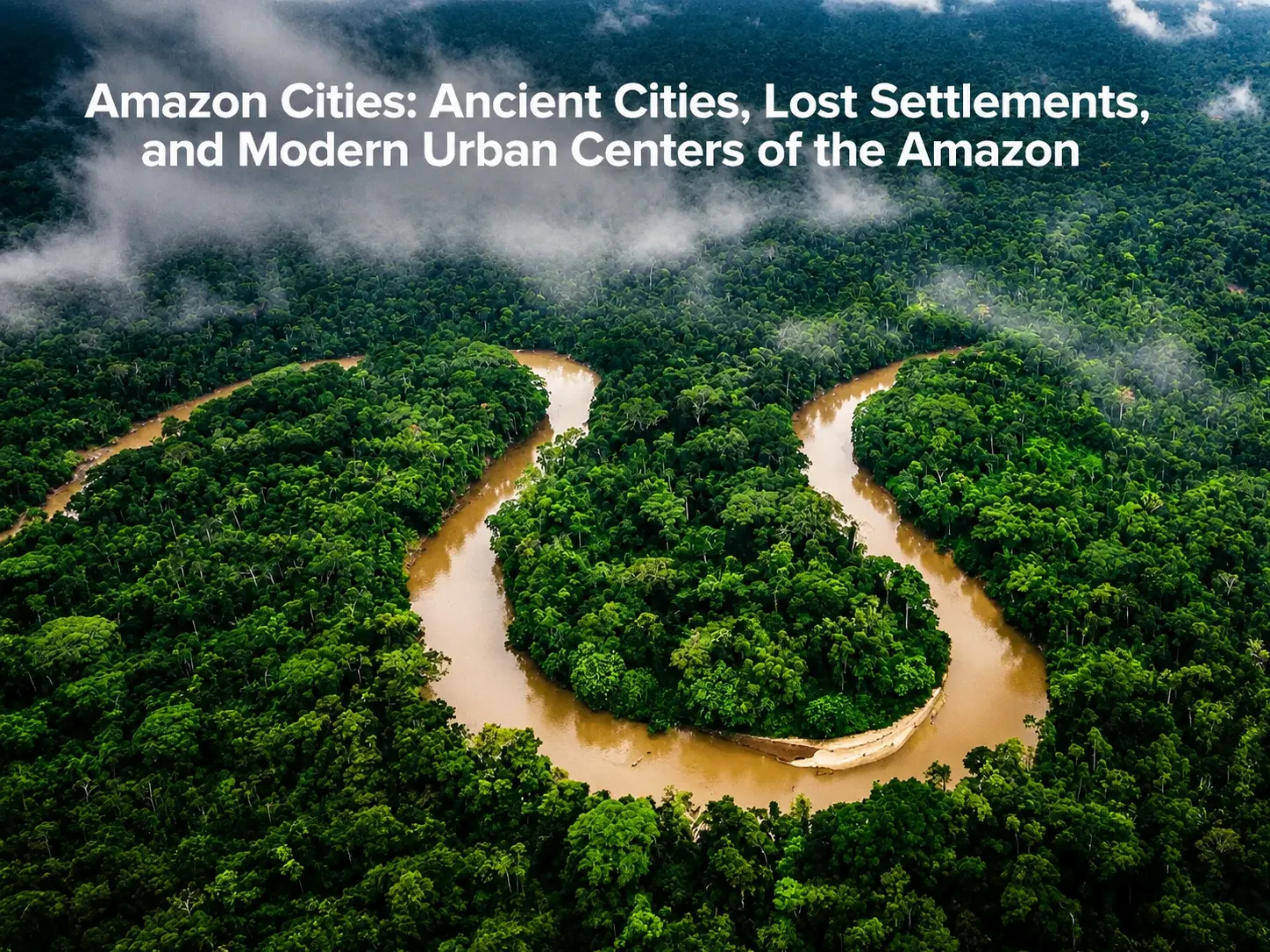
    Ancient Amazon Cities Revealed From Above

    Seeing an ancient settlement from above can completely change its appearance.

    At ground level, a geometric ditch may seem insignificant. From the air, it may form part of a massive geometric pattern.

    A road that is nearly invisible beneath vegetation may become obvious when mapped across kilometers.

    A series of platforms may reveal a planned settlement.

    A canal may connect multiple communities.

    This aerial perspective has helped archaeologists understand that some ancient Amazonian landscapes were designed environments.

    The Most Unusual Facts About Ancient Amazon Cities

    The history of Amazonian cities contains many surprising details.

    1. Some ancient settlements were hidden beneath ordinary forest

    The rainforest can completely conceal human-made structures. What appears to be untouched vegetation may cover ancient roads, ditches, platforms, and agricultural systems.

    2. Ancient people changed the forest without destroying it

    Amazonian societies often managed useful plants and trees. Their influence could persist long after settlements disappeared.

    3. Roads existed deep inside the rainforest

    Some archaeological regions contain networks of straight roads or raised causeways connecting settlements.

    4. Some settlements were built in difficult flood-prone environments

    Ancient engineers constructed raised platforms, canals, and other features that allowed communities to adapt to seasonal flooding.

    5. The rainforest can preserve landscapes while destroying buildings

    Wooden architecture decays rapidly, but earthworks can remain visible for centuries or millennia.

    6. The Amazon was never simply “empty wilderness”

    The archaeological record shows that humans have lived in and modified Amazonian environments for thousands of years.

    7. LiDAR can reveal structures invisible from the ground

    This technology has fundamentally changed how archaeologists investigate dense rainforest.

    Ancient Amazon Cities vs. Modern Amazon Cities

    Modern and ancient Amazonian cities are separated by thousands of years, yet they share one important characteristic: their relationship with the environment.

    Modern cities continue to depend heavily on rivers for transportation, commerce, food, and communication.

    Ancient settlements also depended on rivers, wetlands, forests, and seasonal cycles.

    The major difference is scale, technology, architecture, and economic organization.

    Modern cities contain roads, electricity, airports, hospitals, universities, factories, hotels, ports, and large commercial districts. Ancient settlements relied on local materials, agriculture, fishing, forest resources, and human labor.

    Nevertheless, both demonstrate a fundamental Amazonian principle: successful communities must understand water, climate, soils, forests, and seasonal change.

    Why Were Ancient Amazon Cities Abandoned?

    There was no single reason why ancient Amazonian settlements disappeared.

    Different communities experienced different environmental and social conditions.

    Possible factors include:

    • Changes in climate
    • Flooding
    • Drought
    • Changes in rivers
    • Soil degradation
    • Warfare
    • Political changes
    • Disease
    • Migration
    • Economic transformation
    • Collapse of regional networks

    In some cases, abandonment may have been gradual rather than sudden.

    A settlement could decline while people moved to nearby communities, leaving behind structures that slowly disappeared beneath vegetation.

    Could There Be More Ancient Amazon Cities Waiting to Be Discovered?

    Almost certainly.

    Large portions of the Amazon remain difficult to access archaeologically. Dense vegetation, enormous distances, difficult terrain, seasonal flooding, and limited infrastructure make systematic exploration challenging.

    The increasing use of satellite imagery, LiDAR, artificial intelligence, geographic information systems, aerial surveys, and field archaeology is likely to reveal more archaeological landscapes.

    Future discoveries may not consist of spectacular stone monuments. Instead, they may involve thousands of subtle features that together reveal how ancient people organized the rainforest.

    Why Ancient Amazon Cities Matter Today

    The discovery of ancient Amazonian settlements has changed more than archaeological history. It has also influenced how scientists understand the rainforest itself.

    The modern Amazon is not simply a natural environment unaffected by people. It is a mixture of ecosystems that have interacted with human communities for thousands of years.

    Ancient inhabitants planted, harvested, burned, managed, hunted, fished, built, traveled, and modified their surroundings.

    This does not mean that the entire rainforest was artificially created. Rather, it means that human history is deeply embedded within Amazonian landscapes.

    Understanding this history can help scientists interpret modern forests, soils, plant distributions, and archaeological sites.

    The Future of Amazon Archaeology

    The next generation of Amazon archaeology is likely to combine traditional fieldwork with increasingly advanced remote sensing.

    LiDAR is already revealing structures that were difficult or impossible to detect from the ground. Satellite imagery can identify patterns across enormous areas. Archaeologists can then visit selected locations to test what the remote data reveal.

    The result is a new research model:

    Remote sensing → archaeological mapping → field investigation → excavation → environmental analysis → historical reconstruction

    This combination allows researchers to investigate landscapes rather than individual ruins.

    What We May Learn Next

    Future discoveries could help answer questions such as:

    • How large were ancient Amazonian populations?
    • How were settlements connected?
    • How far did ancient roads extend?
    • How did communities manage seasonal flooding?
    • Which plants were deliberately cultivated?
    • How did ancient societies influence forest composition?
    • Why did certain settlement networks disappear?
    • How did different Amazonian cultures interact?

    The answers may fundamentally reshape our understanding of tropical civilization.

    Final Thoughts: The Amazon Has More Cities in Its History Than We Once Imagined

    The story of Amazon cities extends far beyond the modern urban centers visible on today’s maps. Beneath the rainforest canopy lies evidence of ancient communities, roads, agricultural landscapes, canals, plazas, earthworks, and settlement networks.

    The discovery of these places has overturned the old idea that the Amazon was an untouched wilderness populated only by small, isolated groups.

    Ancient Amazonian societies developed remarkable ways of adapting to forests, rivers, wetlands, and seasonal changes. Some created extensive settlement systems and transformed landscapes on a scale that is only now becoming fully visible.

    Modern technology, especially LiDAR, has opened a new window into this hidden past. From above, geometric patterns buried beneath vegetation reveal roads, platforms, ditches, canals, and settlements that can remain almost invisible at ground level.

    Perhaps the most fascinating fact is that the Amazon’s greatest cities may not be the ones we can see today. Some of its most extraordinary human landscapes are hidden beneath trees, waiting for archaeology and technology to reveal them.

    The Amazon rainforest is therefore not only one of Earth’s greatest natural environments. It is also an enormous archaeological landscape—and much of its human history has yet to be discovered.

  • Facts About the Amazon Rainforest

    Facts About the Amazon Rainforest

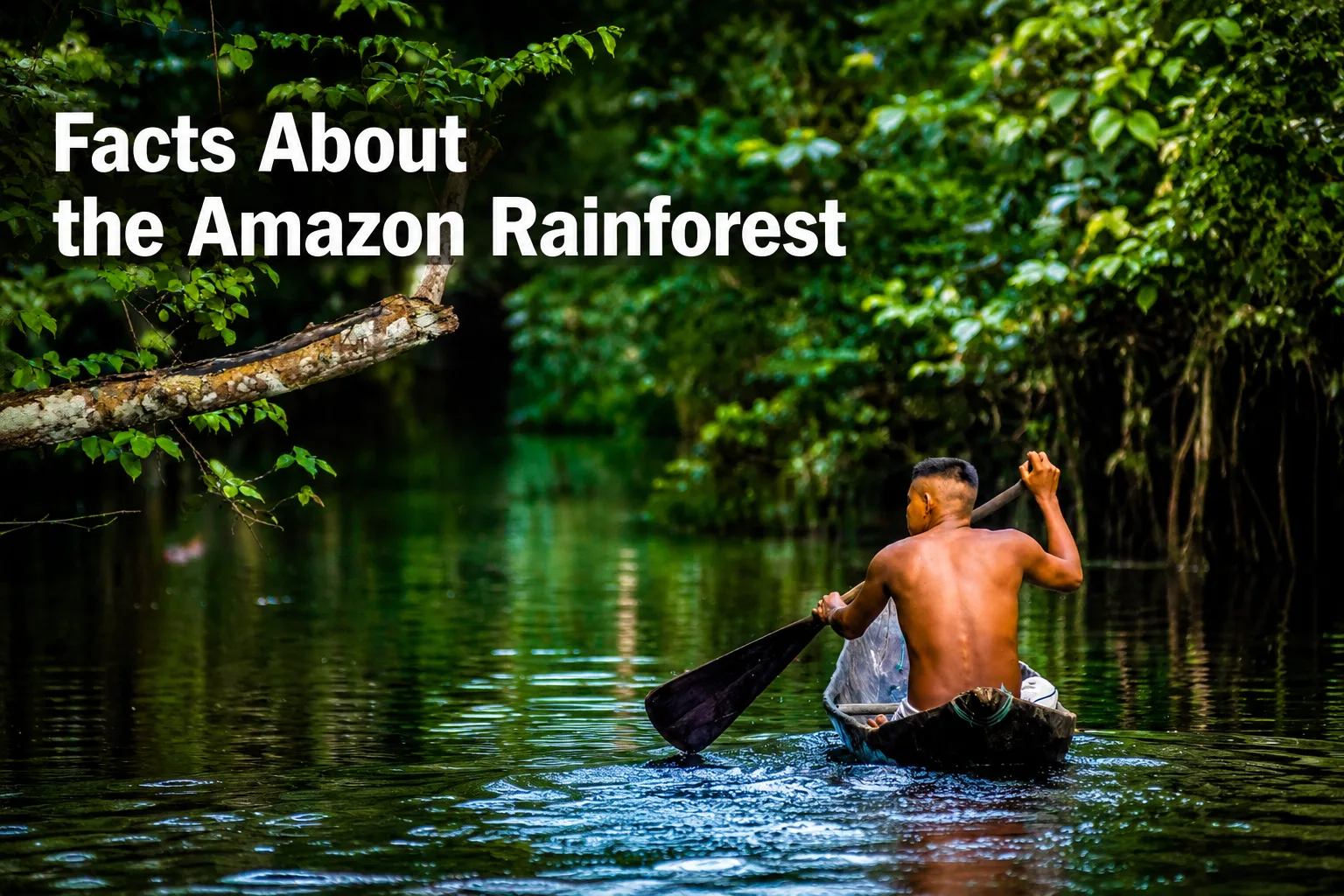
    The Amazon rainforest is one of the most extraordinary ecosystems on Earth. It stretches across a vast area of South America, contains an incredible variety of plants and animals, and is home to Indigenous peoples whose cultures and knowledge are deeply connected to the forest. From enormous trees and colorful macaws to stealthy jaguars, pink river dolphins, giant river otters, and tiny frogs, the Amazon is full of remarkable discoveries.

    In this guide, you will find 100+ facts about the Amazon rainforest, including interesting facts, fun facts, unusual discoveries, facts about Amazon rainforest animals and plants, information about the Amazon River, rainforest layers, Indigenous peoples, deforestation, and surprising facts that may sound unbelievable but are part of life in this enormous tropical ecosystem.

    100+ Facts About the Amazon Rainforest

    Rather than separating the same information into artificial lists of 10, 30, or 100 facts, the following facts are organized by topic. This makes it easier to understand how the Amazon rainforest works as a connected ecosystem.

    Amazon Rainforest Geography and Location Facts

    1. The Amazon rainforest is located in South America.
    2. The forest extends across several countries, with the largest portions found in Brazil, Peru, Colombia, Bolivia, Venezuela, Ecuador, Guyana, Suriname, and French Guiana.
    3. The Amazon Basin is much larger than the rainforest itself because it includes rivers, wetlands, forests, savannas, and other landscapes drained by the Amazon River system.
    4. Brazil contains the largest share of the Amazon rainforest.
    5. Peru contains one of the world’s largest portions of Amazonian rainforest outside Brazil.
    6. The Amazon is not a single uniform forest. Its landscapes include flooded forests, upland forests, bamboo forests, palm-dominated areas, wetlands, river islands, and seasonally flooded ecosystems.
    7. Some parts of the Amazon are so remote that reaching them can require traveling for days by boat or through difficult forest terrain.
    8. The rainforest is crossed by an enormous network of rivers, streams, channels, oxbow lakes, and seasonal wetlands.
    9. The Amazon’s landscape changes considerably between the wet and dry seasons.
    10. River levels can rise dramatically during the rainy season, flooding large areas of forest.
    11. Some trees are adapted to survive for months with their trunks or roots underwater.
    12. The Amazon is connected ecologically to the Andes, where many of its major rivers originate.
    13. Sediments carried from the Andes help replenish nutrients in some Amazonian floodplains.
    14. The rainforest contains both ancient forests and areas that have been naturally disturbed by rivers, storms, landslides, and other processes.
    15. The Amazon is not simply an endless wall of trees. From the air and on the ground, it contains an astonishing variety of habitats.

    Interesting Amazon Rainforest Climate Facts

    1. The Amazon has a predominantly tropical climate.
    2. Temperatures are generally warm throughout the year, although conditions vary considerably according to location, elevation, season, and proximity to rivers.
    3. Rainfall is one of the defining characteristics of the Amazon rainforest.
    4. Some areas receive several meters of rain in a year.
    5. The forest does not simply receive moisture from the ocean and keep it there. Trees continually recycle water through a process called transpiration.
    6. Plants release water vapor into the atmosphere through tiny openings in their leaves.
    7. This recycled moisture can contribute to rainfall farther across the Amazon Basin.
    8. Large rivers, wetlands, vegetation, clouds, and atmospheric moisture are therefore interconnected.
    9. Heavy rain can transform trails into muddy paths and cause rivers and streams to rise rapidly.
    10. During dry periods, some smaller streams can shrink considerably.
    11. The Amazon can experience intense thunderstorms.
    12. Lightning can occasionally ignite vegetation during exceptionally dry conditions.
    13. Climate conditions are not identical throughout the Amazon. Western, central, eastern, northern, and southern areas can have significantly different rainfall patterns.
    14. Some Amazonian forests experience predictable seasonal flooding.
    15. Flooding creates special habitats for fish, birds, mammals, reptiles, and plants.

    Amazing Amazon Rainforest Biodiversity Facts

    The Amazon’s most extraordinary characteristic may be its biodiversity. The forest contains an enormous number of species, including many that scientists have not yet fully studied. Biodiversity is not distributed evenly: different habitats can contain different communities of organisms, and even neighboring areas can have surprisingly different species.

    1. The Amazon rainforest is one of the most biologically diverse places on Earth.
    2. Thousands of plant species occur across the Amazon Basin.
    3. The region supports thousands of species of fish.
    4. It is home to hundreds of mammal species.
    5. The Amazon contains an extraordinary diversity of birds.
    6. Reptiles and amphibians are particularly diverse in many Amazonian habitats.
    7. Insects make up a huge proportion of Amazonian biodiversity.
    8. Scientists continue to describe new species from the Amazon region.
    9. Some Amazonian species have extremely small geographic ranges.
    10. Losing a particular forest area can therefore threaten species that may exist nowhere else.
    11. Biodiversity is supported by the enormous variety of ecological niches found in the forest.
    12. A single large tree can provide food, shelter, nesting sites, and climbing surfaces for numerous organisms.
    13. Different animals occupy different parts of the forest, from the soil and leaf litter to the understory and treetops.
    14. Some animals spend most of their lives high above the ground.
    15. Others are highly specialized for living in rivers and flooded forests.

    Facts About Amazon Rainforest Animals

    The Amazon rainforest animals are among the most fascinating creatures on the planet. Some are famous worldwide, while others are rarely seen even by people who spend their lives in the forest.

    Jaguar Facts

    1. Jaguars are among the Amazon’s most powerful predators.
    2. The jaguar is the largest cat species in the Americas.
    3. Jaguars are excellent swimmers and are strongly associated with rivers, wetlands, and other water-rich habitats.
    4. Their spotted coats provide camouflage in the complex patterns of forest vegetation.
    5. Jaguars can prey on a remarkable variety of animals.
    6. Their powerful jaws allow them to kill prey in a way that is unusual among large cats.
    7. Jaguars are generally solitary animals.
    8. They can travel considerable distances in search of territory, prey, and mates.
    9. Seeing a wild jaguar in the Amazon is relatively uncommon because these cats are secretive and often avoid people.

    Sloth Facts

    1. Sloths are among the best-known animals associated with the Amazon rainforest.
    2. Sloths spend much of their lives in trees.
    3. Their slow movements help them conserve energy.
    4. Sloths have specialized limbs and curved claws that allow them to hang from branches.
    5. Their diet is largely based on leaves, although their exact diets vary among species.
    6. Sloths have very slow metabolisms compared with many other mammals.
    7. Some sloths can swim when necessary.
    8. Algae can grow in the fur of some sloths, giving their coats a greenish appearance that helps camouflage them.
    9. Sloths can be difficult to spot because their coloration blends with the vegetation around them.

    More Amazon Animal Facts

    1. Giant river otters are highly social aquatic mammals found in parts of the Amazon Basin.
    2. Giant river otters communicate with a variety of vocalizations.
    3. Pink river dolphins live in Amazonian rivers and flooded forests.
    4. Amazon river dolphins can maneuver through flooded forests when water levels rise.
    5. Caimans are common aquatic predators in many Amazonian waterways.
    6. Anacondas are powerful aquatic snakes associated with wetlands, rivers, and flooded forests.
    7. Capybaras are the world’s largest living rodents.
    8. Harpy eagles are among the most impressive birds of prey found in Amazonian forests.
    9. Macaws use their powerful beaks to crack hard seeds and nuts.
    10. Toucans are recognizable for their large, lightweight bills.
    11. Howler monkeys are famous for their extremely loud calls.
    12. Spider monkeys use their long limbs and prehensile tails to move efficiently through the canopy.
    13. Poison dart frogs include some of the Amazon’s most colorful amphibians.
    14. Not every brightly colored Amazonian animal is dangerous.
    15. Many Amazonian animals rely on camouflage rather than bright colors to avoid predators.
    16. Some insects imitate leaves, twigs, bark, or other objects.
    17. Many Amazon animals are active primarily at night, making them difficult to observe during daytime walks.

    Facts About Plants in the Amazon Rainforest

    The Amazon is sometimes described as a “green ocean,” but this phrase hides enormous botanical diversity. Trees form the basic structure of the forest, while palms, vines, epiphytes, shrubs, fungi, mosses, and countless smaller plants occupy different levels and habitats.

    1. The Amazon contains an enormous diversity of trees.
    2. Some Amazonian trees grow to heights of more than 50 meters.
    3. Kapok trees can become enormous emergent trees.
    4. Brazil nut trees can live for many decades and produce commercially important nuts.
    5. Rubber trees are native to the Amazon region.
    6. Palm trees are important components of many Amazonian ecosystems.
    7. Lianas are woody climbing plants that use trees as support to reach sunlight.
    8. Epiphytes grow on other plants without necessarily taking nutrients directly from their host.
    9. Bromeliads can collect water between their leaves.
    10. Some plants have evolved special relationships with insects and other animals.
    11. Fruits are important food sources for monkeys, birds, bats, fish, and other animals.
    12. Seeds can be transported considerable distances by animals.
    13. Some Amazonian trees depend on specific animals for effective seed dispersal.
    14. Fungi play essential roles in decomposing dead organic material.
    15. Decomposition returns nutrients to the ecosystem.

    The Four Layers of the Amazon Rainforest

    One of the most interesting facts about the Amazon rainforest is that it is not organized simply from ground to sky. It has several vertical layers, each with different levels of sunlight, humidity, temperature, and wildlife.

    The Emergent Layer

    The emergent layer contains the tallest trees, which rise above the general canopy.

    1. Emergent trees receive intense sunlight.
    2. They can be exposed to stronger winds than vegetation lower in the forest.
    3. Large birds such as harpy eagles may use tall trees for nesting.
    4. Some monkeys and other animals travel through the highest parts of the forest.
    5. Emergent trees can have enormous crowns that extend above the surrounding canopy.

    The Canopy

    The canopy forms a vast roof of leaves and branches.

    1. The canopy receives much more sunlight than the forest floor.
    2. A huge proportion of Amazonian wildlife spends at least part of its life in the canopy.
    3. Monkeys, sloths, birds, insects, frogs, and reptiles can all live among canopy vegetation.
    4. The canopy is not a perfectly continuous surface. Gaps occur when trees fall or branches break.
    5. These gaps allow sunlight to reach lower layers and encourage new plant growth.

    The Understory

    The understory lies beneath the canopy.

    1. It generally receives much less sunlight than the canopy.
    2. Many young trees and shade-tolerant plants grow in this layer.
    3. Some animals use the understory for feeding, resting, hunting, and avoiding predators.

    The Forest Floor

    The forest floor is darker than the upper layers and can contain thick leaf litter.

    1. Dead leaves, branches, fruits, and animals eventually become part of the decomposition cycle.
    2. Fungi, insects, microorganisms, and other decomposers help break down organic matter.
    3. During heavy rains, parts of the forest floor may become flooded.

    10 Interesting Facts About the Amazon River

    The Amazon River is one of the defining features of the entire region. It is part of an enormous river system that connects mountains, forests, wetlands, communities, and the Atlantic Ocean.

    1. The Amazon River carries more water than any other river in the world.
    2. Its drainage basin covers an enormous portion of South America.
    3. The river receives water from thousands of tributaries and smaller streams.
    4. Some tributaries are themselves enormous rivers.
    5. The Amazon River system supports an extraordinary diversity of freshwater fish.
    6. Some Amazonian fish migrate hundreds or even thousands of kilometers during their life cycles.
    7. Seasonal flooding connects rivers with forests and creates feeding opportunities for fish and other wildlife.
    8. River dolphins can enter flooded forest habitats when water levels rise.
    9. Large river islands can form from sediment carried by the river system.
    10. The Amazon eventually flows into the Atlantic Ocean.

    Indigenous Peoples and the Amazon Rainforest

    The phrase “Amazon rainforest tribes” is commonly used in online searches, but Indigenous peoples of the Amazon is generally a more appropriate term because the region contains many distinct peoples, nations, languages, and communities.

    1. Indigenous peoples have lived in the Amazon for thousands of years.
    2. The Amazon is home to hundreds of Indigenous groups.
    3. Indigenous communities speak numerous languages.
    4. Different Indigenous peoples have distinct cultures, traditions, histories, and relationships with their environments.
    5. Traditional ecological knowledge can include detailed understanding of plants, animals, rivers, soils, seasons, and weather.
    6. Indigenous communities use many forest plants for food, materials, medicine, tools, and cultural purposes.
    7. Some Indigenous peoples live in regions that remain extremely remote.
    8. A number of Indigenous groups maintain limited or no regular contact with the outside world.
    9. Indigenous territories play an important role in protecting large areas of Amazonian forest.
    10. The survival of Indigenous cultures is closely connected to the protection of their lands and resources.

    Facts About Amazon Rainforest Deforestation

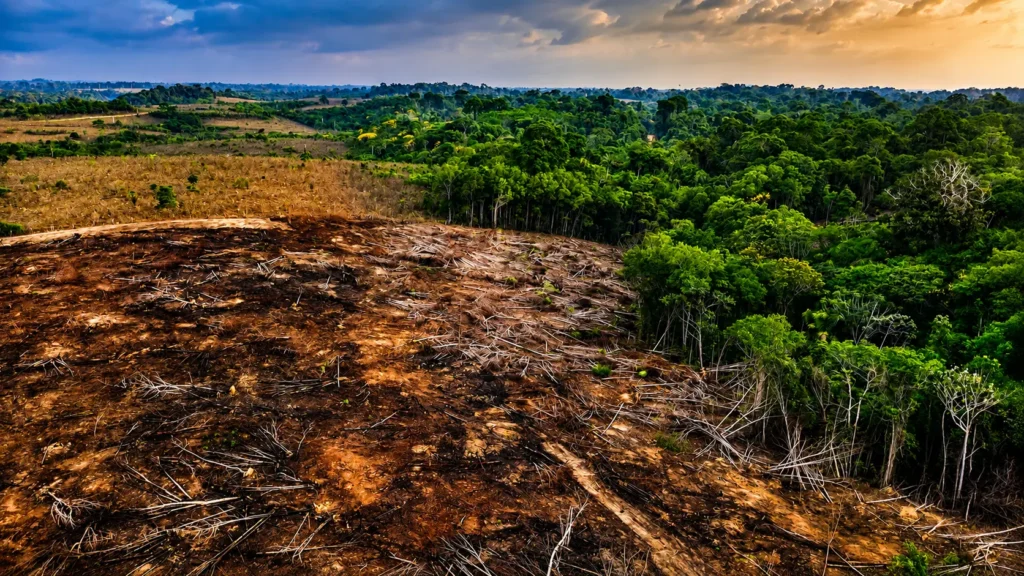
    Deforestation is one of the most important threats to the Amazon. However, it is useful to understand that the Amazon is not disappearing at one uniform rate everywhere. Forest loss varies considerably by country, region, year, land-use pressure, enforcement, and economic activity.

    1. Deforestation means the permanent or long-term conversion of forest into another land use.
    2. Cattle ranching has historically been a major driver of forest clearing in parts of the Amazon.
    3. Agricultural expansion has also contributed to forest loss.
    4. Roads can increase access to previously remote forest areas.
    5. Mining can cause direct forest clearing and can also affect rivers and surrounding ecosystems.
    6. Illegal logging can damage forests even when an area is not completely cleared.
    7. Forest fires can become especially destructive during unusually dry conditions.
    8. Deforestation fragments continuous forest into smaller patches.
    9. Fragmentation can make it harder for some animals to move between habitats.
    10. Forest edges can experience different temperatures, humidity, wind, and vegetation conditions from the interior forest.
    11. Conservation areas and Indigenous territories can help protect forests when they are effectively managed and protected.
    12. Reforestation can restore some ecological functions, but a newly planted forest does not immediately reproduce the complexity of an old-growth rainforest.

    Scary and Surprising Facts About the Amazon Rainforest

    The Amazon can be beautiful, fascinating, and sometimes intimidating. Many of its “scary facts” are not about monsters or dangerous creatures but about how difficult it can be for humans to navigate and survive in a complex tropical environment.

    1. You can walk through an Amazon forest surrounded by wildlife and still see very few animals.
    2. Many animals detect humans before humans detect them.
    3. Dense vegetation can make it difficult to see even a large animal from only a short distance away.
    4. Some snakes are extremely well camouflaged.
    5. Large spiders can occasionally be found in rainforest habitats.
    6. Stinging insects can make forest travel uncomfortable.
    7. Mosquitoes and other biting insects are part of life in many Amazonian environments.
    8. Tropical rain can arrive suddenly and heavily.
    9. Rivers can rise rapidly during periods of intense rainfall.
    10. Getting lost in dense rainforest can be extremely dangerous because landmarks can be difficult to recognize.
    11. At night, the forest can sound much more active than it appears during the day.
    12. The calls of insects, frogs, birds, monkeys, and nocturnal mammals can create an almost continuous soundscape.
    13. Some of the most dangerous situations in the Amazon involve environmental conditions rather than predators.
    14. Heat, humidity, dehydration, strong currents, slippery terrain, and isolation can all present serious challenges.

    Fun and Unusual Amazon Rainforest Facts

    Some of the most memorable Amazon facts are the ones that seem almost impossible at first.

    1. The Amazon contains fish capable of producing electric shocks.
    2. Some fish can survive in waters with extremely low oxygen concentrations.
    3. Certain Amazonian fish are adapted to living among submerged vegetation during seasonal floods.
    4. Some turtles can navigate flooded forests and river channels.
    5. Giant river otters can live in family groups.
    6. Sloths can spend most of their lives hanging upside down.
    7. Some frogs use water-filled plants as miniature habitats.
    8. Certain insects are so well camouflaged that they resemble leaves.
    9. Some Amazonian ants form enormous colonies.
    10. Army ants can move across the forest floor in coordinated groups.
    11. Leafcutter ants carry pieces of leaves many times their own body weight.
    12. Leafcutter ants do not eat the leaves directly. They use them to cultivate fungi that serve as food for the colony.
    13. The forest contains plants that produce fruits eaten by animals ranging from tiny insects to large mammals.
    14. Some Amazon trees have enormous buttress roots that help support their massive trunks.
    15. Flooded forests can remain underwater for months during seasonal high water.
    16. Fish can enter areas that look like ordinary forests but are actually underwater during flood seasons.
    17. The Amazon is still producing new scientific discoveries.

    Current Facts About the Amazon Rainforest

    The Amazon remains one of the most important ecosystems in discussions about biodiversity, climate, conservation, Indigenous rights, and sustainable development.

    Forest loss continues to be monitored closely across the region, but annual deforestation is not constant. Some areas have experienced significant improvements in forest protection while others continue to face pressure from agriculture, cattle ranching, mining, roads, fires, and illegal activities.

    Climate change is also becoming increasingly important because changes in rainfall, temperature, drought frequency, and extreme weather can affect forests and rivers. Scientists are particularly interested in how repeated drought and forest degradation may influence the resilience of Amazonian ecosystems.

    At the same time, conservation is not limited to stopping deforestation. Protecting the Amazon also involves maintaining rivers, wildlife corridors, Indigenous territories, sustainable livelihoods, biodiversity, and the ecological processes that allow forests to regenerate.

    Why Is the Amazon Rainforest So Important?

    The Amazon is important because it is a vast living system rather than simply a collection of trees.

    Its forests store enormous quantities of carbon, recycle water, support biodiversity, influence regional climate, provide food and resources, and sustain millions of people. Its rivers transport nutrients and sediments across huge distances, while seasonal flooding creates habitats that are essential for countless aquatic and terrestrial species.

    The Amazon also has global scientific importance. Researchers continue to discover species, ecological relationships, chemical compounds, behaviors, and evolutionary adaptations that increase our understanding of life on Earth.

    Perhaps most importantly, the Amazon demonstrates how interconnected ecosystems are. A tree can provide food for an animal; that animal can disperse seeds; the new plant can provide habitat for insects; insects can feed birds; decomposers return nutrients to the soil; rainfall feeds rivers; and rivers transport nutrients back through the forest.

    Amazon Rainforest Facts for Kids

    The Amazon can be difficult to understand because it is so enormous. Here are some simple facts suitable for children and students:

    • The Amazon rainforest is in South America.
    • Brazil contains the largest portion of the Amazon rainforest.
    • The Amazon River is one of the world’s greatest rivers.
    • The rainforest is home to jaguars, sloths, monkeys, macaws, frogs, snakes, river dolphins, and many other animals.
    • The Amazon contains thousands of plant species.
    • Some Amazon trees grow taller than a 15-story building.
    • Sloths spend much of their lives in trees.
    • Jaguars are powerful swimmers.
    • Giant river otters live in Amazonian waterways.
    • The rainforest has several layers, including the canopy and forest floor.
    • The canopy receives much more sunlight than the forest floor.
    • Many animals spend their entire lives high in the trees.
    • Indigenous peoples have lived in the Amazon for thousands of years.
    • Some parts of the rainforest are flooded during seasonal high water.
    • The Amazon is important for biodiversity and the global environment.
    • Scientists continue to discover new species in the Amazon region.

    Amazon Rainforest Facts for KS2 Students

    For students studying the Amazon at school, several key ideas are especially useful: the rainforest has a hot and wet tropical climate; its vegetation is organized into layers; biodiversity is extremely high; the Amazon River and its tributaries support aquatic ecosystems; Indigenous peoples have deep relationships with the forest; and deforestation can affect habitats, biodiversity, water cycles, and local communities.

    Understanding these connections is more valuable than simply memorizing isolated numbers. The Amazon is an ecosystem in which climate, vegetation, animals, rivers, people, and environmental change are all connected.

    What Is the Most Unusual Thing About the Amazon Rainforest?

    One of the most unusual things about the Amazon is how much life exists in places that appear empty. A quiet section of forest may contain hundreds of species even when almost no animals are visible. Many creatures are hidden in leaves, branches, tree hollows, underground spaces, rivers, or the canopy far above your head.

    Another remarkable feature is the seasonal transformation of flooded forests. During high-water periods, areas that normally look like ordinary forest can become underwater landscapes where fish swim between tree trunks and feed on fruits growing high above the water.

    This ability of the ecosystem to change dramatically according to water levels is one of the reasons the Amazon is so biologically fascinating.

    Frequently Asked Questions About the Amazon Rainforest

    What are 10 interesting facts about the Amazon rainforest?

    Ten particularly interesting facts are that the Amazon spans several South American countries, Brazil contains the largest portion, the region has extraordinary biodiversity, the Amazon River carries enormous volumes of water, jaguars are powerful swimmers, sloths spend much of their lives in trees, giant river otters live in family groups, some forests become flooded seasonally, Indigenous peoples have lived in the region for thousands of years, and scientists continue to discover new species.

    What are 30 facts about the Amazon rainforest?

    There are far more than 30 interesting facts about the Amazon. The most useful way to organize them is by geography, climate, biodiversity, animals, plants, rivers, rainforest layers, Indigenous peoples, and environmental threats rather than presenting a long collection of disconnected facts.

    What are 100 facts about the Amazon rainforest?

    The Amazon contains hundreds of fascinating facts relating to its geography, animals, plants, rivers, climate, people, ecology, and conservation. The comprehensive list above provides more than 100 facts while grouping them into meaningful topics.

    What animals live in the Amazon rainforest?

    The Amazon is home to jaguars, sloths, monkeys, macaws, toucans, harpy eagles, giant river otters, pink river dolphins, caimans, anacondas, capybaras, frogs, bats, insects, reptiles, fish, and many other species.

    What plants grow in the Amazon rainforest?

    Amazonian vegetation includes enormous trees, palms, lianas, epiphytes, bromeliads, shrubs, vines, fungi, and many other plant forms. Some species are adapted to permanently wet conditions, while others survive seasonal flooding or periods of drought.

    How many layers does the Amazon rainforest have?

    The rainforest is commonly described using four main vertical layers: the emergent layer, canopy, understory, and forest floor. Each layer has different environmental conditions and supports different communities of plants and animals.

    Is the Amazon rainforest dangerous?

    The Amazon can be dangerous because of heat, humidity, insects, difficult terrain, powerful rivers, poisonous or venomous animals, disease risks, and the possibility of becoming lost. However, most wildlife avoids humans, and experienced guides know how to travel safely through the forest.

    Why is the Amazon rainforest important?

    The Amazon is important because it supports extraordinary biodiversity, stores carbon, recycles water, influences regional climate, sustains rivers and wetlands, provides resources for communities, and contains ecosystems that cannot easily be replaced once destroyed.

    Final Thoughts

    The Amazon rainforest is far more than a giant collection of trees. It is an interconnected world of rivers, flooded forests, towering emergent trees, dense canopy, hidden animals, extraordinary plants, Indigenous cultures, insects, fungi, and microscopic organisms.

    From a jaguar swimming across a river to a sloth quietly moving through the canopy, from leafcutter ants cultivating fungi underground to fish swimming through seasonally flooded forests, the Amazon continually challenges our idea of what a rainforest can be.

    The most fascinating fact may be that, despite centuries of exploration and scientific research, the Amazon is still not completely understood. New species and ecological relationships continue to be discovered, while researchers, Indigenous communities, conservationists, and local people work to understand and protect this extraordinary ecosystem.

    That combination of enormous scale, extraordinary biodiversity, cultural diversity, and ecological complexity is what makes the Amazon rainforest one of the most fascinating places on Earth.

  • Amazon Rainforest Uncontacted Tribes

    Amazon Rainforest Uncontacted Tribes

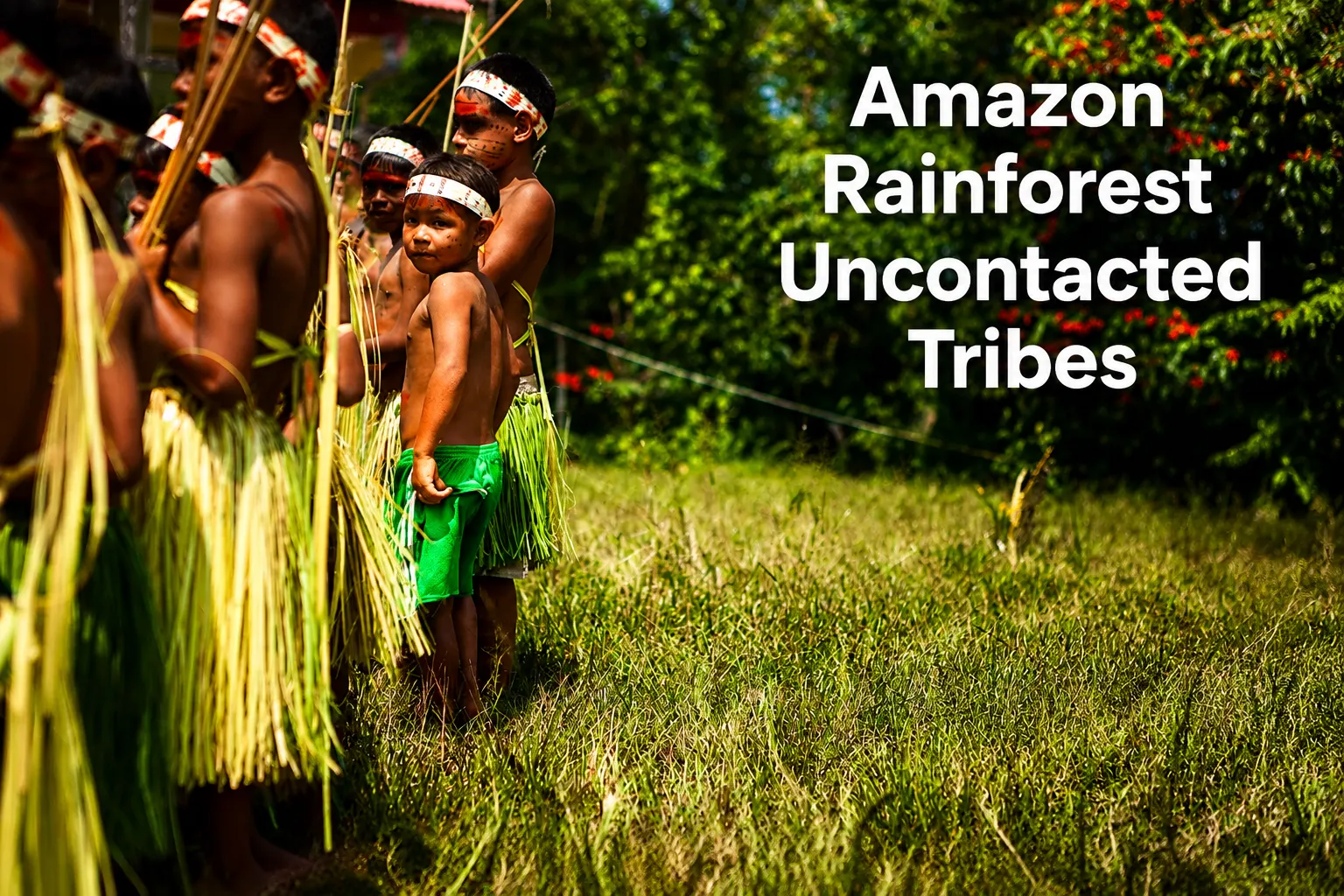
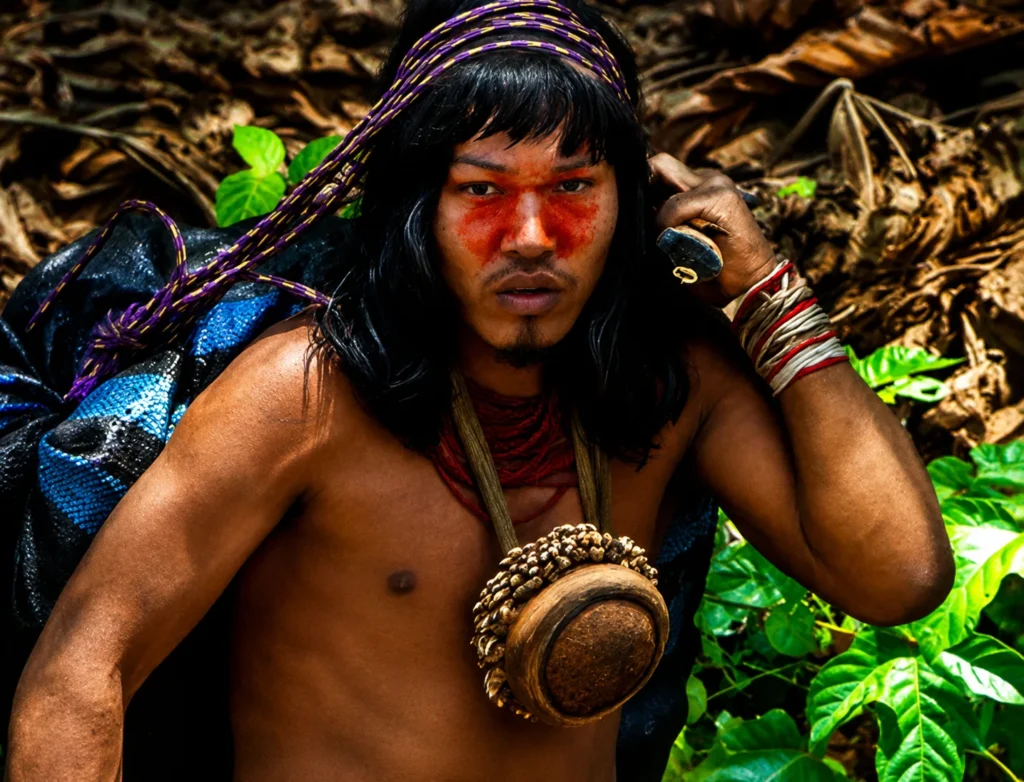
    The Amazon rainforest uncontacted tribes are among the most isolated Indigenous peoples on Earth. Living deep within vast forests and river basins across South America, these communities have little or no sustained contact with modern society. Their isolation is not simply a matter of geography: in many cases, it is a deliberate choice shaped by generations of experience with outsiders, disease, violence, exploitation, and the loss of ancestral lands.

    But how many uncontacted tribes are there? Are there still uncontacted tribes in the Amazon rainforest? What do we actually know about them, and why are photographs and direct encounters so rare? Understanding these questions requires distinguishing between uncontacted, isolated, and Indigenous communities that have regular contact with surrounding society.

    This guide explores the most important facts about Amazon tribes, uncontacted peoples, their territories, lifestyles, languages, dangers, maps, and the unusual evidence that allows researchers to understand their existence without invading their privacy.

    Are There Uncontacted Tribes in the Amazon Rainforest?

    Yes. There are still Indigenous groups in the Amazon rainforest that live in voluntary isolation and have no sustained relationship with mainstream society. Brazil and Peru contain the largest known concentrations of these isolated peoples, although isolated or minimally contacted Indigenous communities are also associated with other parts of the Amazon basin.

    The term “uncontacted tribe” can be misleading because it does not necessarily mean that these people have never seen an outsider. Some groups have probably encountered people from other Indigenous communities, hunters, workers, explorers, or aircraft. Instead, the more precise concept is Indigenous peoples in voluntary isolation: communities that maintain little or no sustained contact with the outside world.

    Are There Still Uncontacted Tribes in the Amazon Rainforest?

    Absolutely. The Amazon remains large enough to contain areas where people can live beyond regular observation. Dense vegetation, enormous distances, seasonal rivers, swamps, difficult terrain, and protected territories make some areas extremely difficult to access.

    Some isolated groups are known primarily through indirect evidence such as:

    • Abandoned or recently used gardens
    • Temporary shelters
    • Footprints
    • Canoes or boats
    • Hunting structures
    • Tools and household objects
    • Smoke from fires
    • Trails through the forest
    • Aerial observations
    • Occasional encounters reported by neighboring Indigenous communities

    Their continued existence is especially significant because it demonstrates that the Amazon is not an empty wilderness. It is a cultural landscape occupied by peoples with sophisticated relationships with forests, rivers, animals, and seasonal cycles.

    Are There Really Uncontacted Tribes in the Amazon Rainforest?

    Yes, although “uncontacted” should not be interpreted literally as people who have never encountered another human being outside their community.

    Many isolated groups have some awareness that other societies exist. Some have intentionally withdrawn from areas where contact occurred in the past. Others may have experienced occasional encounters without developing permanent relationships with outsiders.
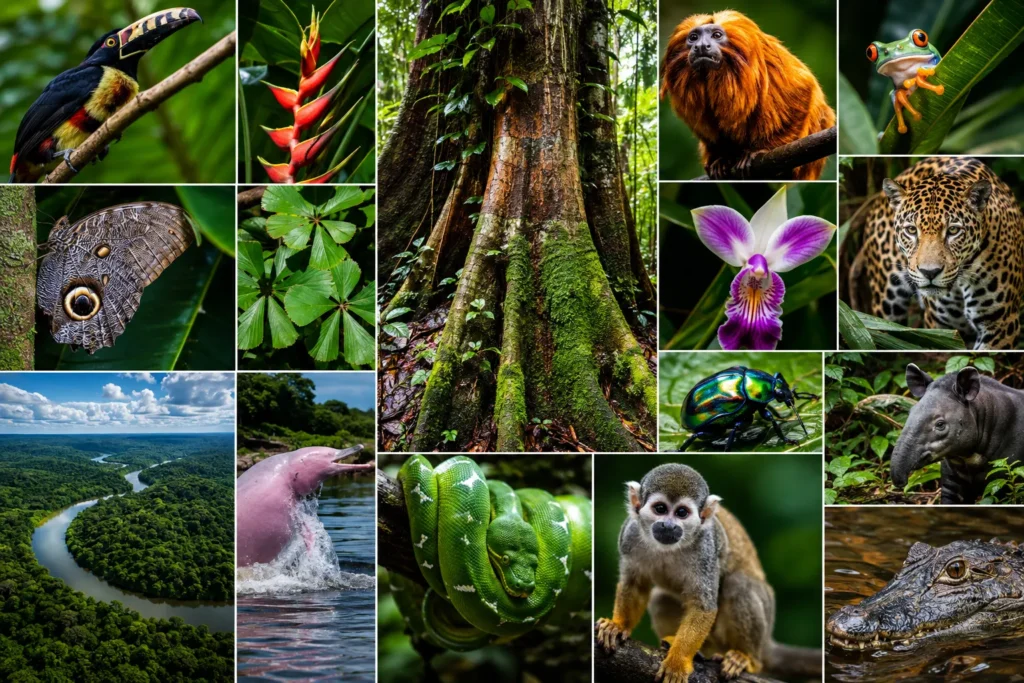
    The distinction is important because isolation can be a strategy for survival.

    A community may recognize outsiders as a potential threat and deliberately avoid them by:

    • Moving deeper into the forest
    • Abandoning settlements after encounters
    • Avoiding rivers used by outsiders
    • Traveling primarily through forest routes
    • Concealing gardens or camps
    • Maintaining distance from neighboring communities

    For these peoples, isolation is often not evidence of ignorance. It can represent an informed decision based on historical experience.


    How Many Uncontacted Tribes Are There in the Amazon Rainforest?

    There is no single precise number because isolated communities are difficult to identify, define, and monitor. Estimates vary depending on whether researchers count individual groups, possible groups, subgroups, or populations whose isolation status has not been fully confirmed.

    Across the Amazon and surrounding regions, dozens of Indigenous groups are believed to live in voluntary isolation or maintain extremely limited contact. Brazil is generally considered to contain the largest number of known isolated Indigenous peoples, while Peru also has several recognized groups and territories associated with Indigenous peoples in isolation.

    The important point is that the number should be treated as an estimate rather than a census.

    How Many Uncontacted Indigenous Tribes Are in the Amazon Rainforest?

    A precise census would actually contradict the principle of protecting these communities. Counting people directly would require entering their territories or establishing contact, which could expose them to serious risks.

    Therefore, population estimates are often based on indirect evidence.

    Researchers may consider:

    • Number and size of settlements
    • Garden areas
    • Evidence of repeated occupation
    • Observations from aircraft
    • Information from neighboring Indigenous peoples
    • Historical encounters
    • Movement patterns
    • Geographic territory

    Some isolated populations may consist of only a few dozen people, while others could be considerably larger.

    Why Is It Impossible to Know the Exact Number?

    The Amazon rainforest is enormous, and many areas remain difficult to survey. More importantly, the objective is not to locate every individual or enter every settlement.

    There is a major ethical difference between proving that a group exists and attempting to document every member.

    Aerial observations, satellite imagery, reports from nearby communities, and traces left in the forest can provide evidence without direct interaction.

    This approach protects both the physical safety and cultural autonomy of isolated peoples.


    Amazon Rainforest Uncontacted Tribes Map

    An Amazon rainforest uncontacted tribes map should be interpreted carefully. Detailed maps showing exact settlements, trails, camps, or locations of isolated communities are generally inappropriate because revealing precise locations could facilitate illegal incursions, tourism, hunting, logging, mining, or other forms of intrusion.

    Instead, responsible maps normally show generalized territories or regions rather than precise coordinates.

    Where Are Uncontacted Tribes Found?

    Known or suspected isolated Indigenous peoples are particularly associated with remote portions of:

    • Brazil
    • Peru
    • Western Amazonia
    • Southwestern Amazonia
    • Areas near the Brazil–Peru frontier
    • Remote tributaries of major Amazonian rivers
    • Forest regions far from major urban centers

    Brazil’s western and northern Amazon contains particularly important areas of Indigenous isolation. Peru’s Amazon also contains territories where Indigenous peoples in isolation or initial contact have been identified.

    Why Exact Locations Should Not Be Published

    Publishing an exact location could turn a protected territory into a target.

    Someone looking for an isolated community might attempt to:

    • Approach a settlement
    • Photograph people from close range
    • Leave objects behind
    • Follow trails
    • Hunt nearby
    • Enter restricted territory
    • Search for commercial opportunities

    Even seemingly harmless curiosity can have serious consequences.

    For this reason, an ethical Amazon tribes map should prioritize geographic education without revealing sensitive locations.


    Facts About Uncontacted Tribes in the Amazon Rainforest

    The mystery surrounding isolated peoples has generated many myths. The reality is often more fascinating than the mythology.

    1. They Are Not “Lost” Peoples

    A common misconception is that uncontacted communities are somehow lost in the jungle.

    They are not necessarily lost.

    Many know their territories extremely well and deliberately avoid outside society. Their knowledge of rivers, trails, plants, animals, weather patterns, and seasonal changes can be extraordinarily detailed.

    2. They Have Their Own Languages

    An isolated population may speak a language that is poorly documented or completely unknown to outsiders.

    Language is particularly important because communication cannot simply be assumed between neighboring Indigenous peoples. The Amazon contains remarkable linguistic diversity, with numerous language families and individual languages.

    3. They Are Not All the Same Tribe

    “Uncontacted tribes” is an umbrella expression.

    Different isolated communities may have completely different:

    • Languages
    • Origins
    • Social structures
    • Religious traditions
    • Hunting techniques
    • Agricultural practices
    • Territory
    • Historical experiences
    • Relationships with neighboring peoples

    There is no single “uncontacted tribe culture.”

    4. Some Groups Have Had Historical Contact

    Isolation exists on a spectrum.

    Some peoples have almost no contact. Others have experienced occasional encounters. Some communities may have members who interacted with outsiders in the past but later returned to isolation.

    This makes the term uncontacted more complicated than it first appears.

    5. Their Territories Can Be Enormous

    A small population may depend on a large territory because hunting, fishing, gathering, agriculture, and seasonal movement require access to many different ecological zones.

    The Amazon’s apparent abundance does not mean food is uniformly available everywhere.

    6. They Can Move Quickly

    An isolated community may abandon a settlement and establish another one.

    This can happen because of:

    • Seasonal changes
    • Hunting opportunities
    • Soil exhaustion
    • Social decisions
    • Flooding
    • Encounters with outsiders
    • Security concerns

    As a result, a map of one settlement should never be interpreted as a permanent representation of where the community lives.


    Names of Tribes in the Amazon Rainforest

    The phrase names of tribes in the Amazon rainforest requires caution because not every Indigenous people is uncontacted.

    There are hundreds of Indigenous peoples across the wider Amazon region, many of whom have long-established relationships with neighboring societies, governments, researchers, and other communities.

    Examples of Amazonian Indigenous peoples include:

    • Yanomami
    • Kayapó
    • Asháninka
    • Shipibo-Konibo
    • Matsés
    • Tikuna
    • Yagua
    • Bora
    • Awajún
    • Wampis
    • Munduruku
    • Matis
    • Marubo
    • Kichwa communities
    • Achuar communities

    These names should not automatically be classified as uncontacted tribes.

    Why “Amazon Tribes” Is Too Broad

    The keyword Amazon tribes covers an enormous range of peoples.

    Some Indigenous communities live in towns and villages and participate in national economies. Others live in remote settlements while maintaining regular relationships with surrounding society. A smaller number maintain voluntary isolation.

    Therefore, it is inaccurate to use “Amazon tribes” and “uncontacted tribes” as interchangeable terms.


    What Indigenous Tribes Live in the Amazon Rainforest?

    The Amazon rainforest is home to an extraordinary number of Indigenous peoples.

    The largest concentrations occur across Brazil, Peru, Colombia, Bolivia, Ecuador, Venezuela, and the Guianas.

    These communities have developed different ways of adapting to rainforest environments.

    Some specialize in river fishing. Others rely heavily on hunting and small-scale agriculture. Many combine farming, fishing, hunting, gathering, and trade.

    Their lifestyles can vary dramatically even between communities separated by relatively short geographic distances.


    How Many Indigenous Tribes Live in the Amazon Rainforest?

    There is no single universally accepted number because researchers use different definitions of “tribe,” “people,” “ethnic group,” and “Indigenous nation.”

    However, the Amazon basin contains hundreds of Indigenous peoples and communities, representing remarkable linguistic and cultural diversity.

    Brazil alone recognizes a large number of distinct Indigenous peoples, while Peru, Colombia, Bolivia, Ecuador, Venezuela, Guyana, Suriname, and French Guiana also contain numerous Indigenous nations.

    The diversity is particularly striking when considering that many communities have their own languages, histories, territorial identities, and traditions.

    Indigenous Diversity Across the Amazon

    The Amazon is not culturally uniform.

    Imagine traveling down a major river and encountering different communities separated by forests, tributaries, and territorial boundaries. Their languages and traditions can change substantially from one area to another.

    This diversity developed over thousands of years.


    How Do Indigenous Tribes Live in the Amazon Rainforest?

    How Indigenous peoples live in the Amazon depends heavily on geography, culture, and their level of interaction with wider society.

    There is no single Amazonian lifestyle.

    Hunting

    Hunting remains important for some Indigenous communities, particularly in remote forest environments.

    Hunters may track animals using knowledge of:

    • Footprints
    • Broken vegetation
    • Sounds
    • Droppings
    • Feeding marks
    • Animal calls
    • Seasonal behavior

    Traditional hunting knowledge can represent generations of accumulated ecological observation.

    Fishing

    Rivers, streams, lakes, and floodplain environments provide important food resources.

    Fishing techniques vary considerably and may include:

    • Spears
    • Hooks
    • Nets
    • Baskets
    • Traditional traps
    • Other locally developed techniques

    In river-oriented communities, aquatic resources can be as important as terrestrial wildlife.

    Agriculture

    Many Amazonian Indigenous peoples practice small-scale agriculture.

    Common crops may include:

    • Cassava
    • Plantains
    • Maize
    • Sweet potatoes
    • Peppers
    • Fruits
    • Medicinal plants

    Cassava is particularly important in many Amazonian cultures.

    Gathering

    The forest supplies fruits, nuts, fibers, medicinal plants, construction materials, resins, and other resources.

    Indigenous knowledge can distinguish between hundreds of useful species and identify where and when particular resources are available.


    How Do Uncontacted Tribes Get Food?

    Isolated peoples generally depend on a combination of hunting, fishing, gathering, and agriculture.

    Their survival strategy is based on diversity rather than dependence on one resource.

    If fish become less available in one season, people may rely more heavily on forest animals or cultivated plants. If a garden is abandoned, another area may be cultivated.

    This flexible approach is particularly valuable in an environment where floods, droughts, seasonal fruiting, animal movements, and river conditions constantly change.


    Are Uncontacted Tribes Dangerous?

    The question “are uncontacted tribes dangerous?” is understandable but misleading.

    An isolated community may react defensively if outsiders enter its territory. In that context, encounters can be dangerous for both sides.

    But describing an entire people as inherently dangerous is inaccurate.

    Why Might They Defend Their Territory?

    Imagine a community seeing unfamiliar people approaching its settlement after generations of avoiding outsiders.

    The newcomers could represent:

    • Disease
    • Violence
    • Kidnapping
    • Land theft
    • Illegal logging
    • Mining
    • Hunting
    • Religious pressure
    • Forced assimilation

    Defensive behavior can therefore be understood as territorial protection rather than evidence of inherent aggression.

    Are Uncontacted Tribes Dangerous to Tourists?

    People should never attempt to visit an isolated Indigenous community.

    This is not an adventure-tourism attraction.

    Apart from the possibility of confrontation, visitors could introduce respiratory infections or other diseases to populations that may have limited immunity to common illnesses.

    Even a seemingly harmless encounter could have consequences far beyond the moment.


    Footage of Uncontacted Tribesmen in the Amazon Rainforest

    The phrase footage of uncontacted tribesmen in the Amazon rainforest is frequently searched because photographs and videos of isolated Indigenous people can appear extraordinary.

    Some aerial images have shown people standing near settlements, canoes, gardens, or forest clearings. Other historical encounters have been documented from a distance.

    However, viral footage should be approached carefully.

    Why Is Authentic Footage So Rare?

    The rarity of images has several explanations.

    First, these communities deliberately avoid outsiders.

    Second, many live in extremely remote areas.

    Third, authorities and Indigenous organizations may restrict access to protect them.

    Finally, responsible observers avoid approaching isolated people merely to obtain photographs.

    The scarcity of footage is therefore not evidence that isolated peoples do not exist.

    It is partly evidence that protective policies can work.

    What Can Aerial Images Reveal?

    Aerial observations can sometimes reveal:

    • Houses
    • Gardens
    • People
    • Canoes
    • Cleared areas
    • Paths
    • Signs of recent occupation

    These observations can help establish that an isolated population exists without requiring direct contact.


    Why Do Some Amazon Tribes Remain Uncontacted?

    This is one of the most fascinating questions.

    There is no single explanation.

    Some groups may have chosen isolation because previous encounters were associated with catastrophic consequences.

    Historical experiences across Amazonia included:

    • Epidemics
    • Slave raids
    • Rubber exploitation
    • Forced labor
    • Land invasions
    • Violence
    • Religious missions
    • Resource extraction

    For some communities, avoiding outsiders may have become a powerful survival strategy.

    Isolation Can Be a Form of Resistance

    Rather than thinking of isolated peoples as simply “untouched,” it may be more accurate to understand their isolation as an active decision.

    They are not necessarily waiting for modern civilization to find them.

    They may be actively avoiding it.

    That distinction completely changes the way we should understand the term “uncontacted.”


    What Is Unusual About Amazon Rainforest Uncontacted Tribes?

    Several characteristics make isolated Amazonian peoples particularly remarkable.

    They Can Survive Without Modern Infrastructure

    No roads, supermarkets, hospitals, electricity grids, or conventional supply chains are necessary for their daily survival.

    Their infrastructure is based on local ecological knowledge.

    Their Forest Knowledge Can Be Extraordinary

    A community may recognize subtle differences between plant species, understand animal behavior, know seasonal fishing areas, and navigate through forest environments without conventional maps.

    Their Isolation Is Not Always Complete

    A group can remain isolated from national society while still having knowledge of neighboring Indigenous peoples.

    The Amazon has never been a culturally empty landscape.

    Their Population Size May Be Small

    Some isolated communities may be vulnerable to demographic problems because small populations can be particularly sensitive to disease, accidents, and disruptions to territory.

    A Single Disease Can Be Catastrophic

    A common infection for outsiders could potentially have devastating consequences for an isolated population with little previous exposure.

    This is one of the strongest reasons why forced contact is considered extremely dangerous.


    Uncontacted Tribes and Amazon Rainforest Protection

    Protecting isolated peoples requires protecting their forests.

    If an isolated community depends on hunting, fishing, agriculture, and gathering, destroying its territory can make survival impossible.

    Threats can include:

    • Illegal logging
    • Mining
    • Agricultural expansion
    • Infrastructure development
    • Illegal hunting
    • Drug-trafficking routes
    • Fires
    • Land grabbing
    • River pollution

    Consequently, protecting Indigenous territory is also a form of rainforest conservation.


    Why the Amazon Rainforest Is Perfect for Isolation

    The Amazon is one of the few places on Earth where enormous continuous forest areas can still make isolation possible.

    Its characteristics include:

    • Vast distances
    • Dense vegetation
    • Thousands of rivers
    • Seasonal flooding
    • Swamps
    • Remote headwaters
    • Difficult transportation
    • Limited roads in many areas

    The forest can therefore function as both a home and a natural barrier.

    For an outsider, navigating hundreds of kilometers through rainforest can be extremely difficult. For people who have lived there for generations, the same landscape can function as a familiar network of trails, rivers, food sources, and landmarks.


    Amazon Rainforest Tribes and Modern Technology

    One of the most interesting contradictions is that isolated communities can exist in a world filled with satellites, aircraft, smartphones, and global communication.

    Technology can detect signs of isolated populations without establishing direct contact.

    Satellite imagery can help identify:

    • Forest clearings
    • Large gardens
    • Changes in vegetation
    • Roads
    • Illegal incursions
    • Settlement patterns

    Aircraft can also provide observations from above.

    The goal is increasingly to use technology to protect distance rather than eliminate it.


    What Happens If an Uncontacted Tribe Is Contacted?

    Contact can produce consequences that go far beyond a simple conversation.

    Potential risks include:

    Disease Transmission

    A person may transmit an infection without appearing seriously ill. An isolated population may have limited immunity to pathogens that are commonplace elsewhere.

    Cultural Disruption

    Contact can rapidly change social structures, traditions, language, economic practices, and relationships with neighboring communities.

    Violence

    Misunderstandings can escalate rapidly when neither side shares a common language or expectations.

    Dependency

    Repeated contact can introduce dependence on manufactured goods, medicine, food, tools, or external trade.

    For these reasons, the safest policy in most circumstances is to respect the community’s decision to remain isolated.


    Are All Amazon Indigenous Peoples Uncontacted?

    No.

    This is perhaps the most important distinction in any article about Amazon tribes.

    The Amazon contains:

    1. Indigenous peoples with regular contact with national society.
    2. Remote Indigenous communities with limited outside interaction.
    3. Indigenous peoples who maintain voluntary isolation.
    4. Communities that have experienced recent initial contact.
    5. Indigenous populations living in cities and towns.

    Using the word “uncontacted” to describe all Amazonian Indigenous peoples creates a false picture of extraordinary cultural diversity.


    Frequently Asked Questions About Amazon Rainforest Uncontacted Tribes

    Are there still uncontacted tribes in the Amazon rainforest?

    Yes. Multiple Indigenous groups are recognized or believed to maintain voluntary isolation in parts of the Amazon, particularly in Brazil and Peru. Their exact populations and locations are often uncertain because responsible protection avoids direct contact.

    How many uncontacted tribes are there?

    There is no exact global census. Dozens of isolated Indigenous groups are known or suspected across the Amazon and surrounding regions, but numbers vary according to definitions and levels of evidence.

    What are the names of uncontacted tribes?

    Some isolated peoples have names associated with them through neighboring communities or historical records, while others remain unidentified. Publishing names alongside precise locations can sometimes create additional risks.

    How do uncontacted tribes live?

    They generally rely on combinations of hunting, fishing, gathering, and agriculture, with practices adapted to their particular environment and culture.

    Do uncontacted tribes use technology?

    Some isolated communities may use tools obtained or adapted through historical interactions, but their technological systems should not be assumed to be identical. “Uncontacted” does not mean technologically frozen in prehistoric times.

    Do uncontacted tribes know about the outside world?

    Possibly, and in some cases very likely. Isolation does not necessarily mean ignorance. Some communities appear to deliberately avoid outsiders because of knowledge or experience passed through generations.

    Can tourists visit uncontacted tribes?

    No. Attempting to locate or approach isolated peoples is dangerous and potentially harmful. Responsible Amazon travel should respect protected territories and Indigenous rights.

    Why don’t researchers simply talk to them?

    Because establishing contact can itself create serious risks, particularly disease transmission and cultural disruption. In many circumstances, protecting an isolated population means allowing it to remain isolated.


    The Amazon’s Greatest Mystery Is Not That These People Exist

    The most remarkable fact about Amazon rainforest uncontacted tribes is not simply that isolated communities still exist.

    It is that they continue to make choices about their own lives in one of the most rapidly changing regions of the planet.

    The Amazon contains modern cities, highways, aircraft, satellites, mines, farms, tourist destinations, and enormous industrial operations. Yet within this same region, some Indigenous peoples maintain ways of life centered on forests, rivers, gardens, hunting, fishing, and ancestral knowledge.

    Their existence challenges the assumption that every society must eventually follow the same path.

    Final Thoughts

    The question “are there uncontacted tribes in the Amazon rainforest?” has a clear answer: yes, isolated Indigenous peoples continue to exist, especially in remote parts of Brazil and Peru.

    But the more important lesson is that they should not be viewed simply as mysterious people hidden in a jungle waiting to be discovered. They are Indigenous peoples with their own histories, territories, languages, cultures, and decisions about contact.

    The best way to understand them is not by searching for their settlements or attempting to obtain close-up footage. It is by learning about the remarkable diversity of Amazonian cultures, understanding why voluntary isolation exists, and recognizing why protecting their territories is essential.

    In the end, the most respectful Amazon rainforest uncontacted tribes map is one that shows us the broader regions they inhabit while keeping their exact locations private. And the most meaningful fact about these communities may be surprisingly simple: they have the right to decide whether the outside world becomes part of their lives.

  • Amazon Basin Location: Map, Area, Countries, Climate, Population and Geographic Extent

    Amazon Basin Location: Map, Area, Countries, Climate, Population and Geographic Extent

    The Amazon Basin location covers one of the largest and most geographically important regions on Earth, stretching across much of northern South America and extending through several countries. Centered on the Amazon River and its enormous network of tributaries, the basin includes vast tropical forests, wetlands, floodplains, mountains, rivers, cities, farms, and Indigenous territories.

    Understanding the Amazon Basin location is about more than finding the Amazon rainforest on a map. The basin is a huge drainage system shaped by rivers and topography, while the rainforest is the vegetation that occupies much of that landscape. Together, they form one of the most extraordinary geographic regions in the world.

    This guide explains the Amazon Basin map, its area, countries, latitude, climate, population, agriculture, temperature, and geographical extent. It also explores what makes the basin unusual and why its location is so important to South America and the wider world.

    Where Is the Amazon Basin Located?

    The Amazon Basin is located primarily in South America, extending across a large portion of the continent north and east of the Andes Mountains. Its drainage area is centered on the Amazon River, which flows generally eastward across Brazil before reaching the Atlantic Ocean.

    The Amazon Basin in South America occupies a broad lowland region between the Andes to the west and the Atlantic Ocean to the east. It extends northward toward the Guiana Shield and southward toward the Brazilian Highlands, creating an enormous natural drainage system.

    Describe the Location of the Amazon Basin

    To describe the location of the Amazon Basin, the simplest explanation is that it occupies the drainage area of the Amazon River and its tributaries. The basin begins in the highlands and mountains of western South America, particularly around the eastern slopes of the Andes, and gradually descends toward the Atlantic.

    Unlike a political region with clearly visible borders, the basin is defined primarily by geography. Rainfall falling inside the basin generally drains through rivers and streams that eventually connect with the Amazon River system.

    Geographical Location of the Amazon River Basin

    The geographical location of the Amazon River Basin is determined by its watershed. Major tributaries such as the Rio Negro, Madeira, Tapajós, Xingu, Purus, Juruá, and Japurá contribute enormous quantities of water to the Amazon system.

    The Andes play a particularly important role because they form the western boundary of much of the basin. From these high elevations, rivers descend toward the immense Amazon lowlands before eventually flowing toward the Atlantic Ocean.

    Amazon Basin Location Latitude

    The Amazon Basin location latitude extends roughly from the equatorial region into the tropical latitudes of northern and central South America. The Equator crosses the northern portion of the basin, making its position especially important for understanding its warm and humid climate.

    Because the basin stretches over such a large area, its latitude varies considerably from one location to another. Western parts near the Andes differ geographically from eastern areas near the Atlantic, even though both belong to the same enormous drainage system.

    Amazon Basin Map and Geographic Extent

    An Amazon Basin map provides one of the easiest ways to understand the enormous scale of this region. On a continental map, the basin appears as a vast area occupying much of northern South America.

    The basin is often represented as a large drainage zone surrounding the Amazon River and its tributaries. Its boundaries are not identical to the boundaries of the Amazon rainforest, although the two areas overlap extensively.

    Amazon Basin Location on Map

    When viewing the Amazon Basin location on a map, look for the broad lowland area extending eastward from the Andes. The Amazon River forms the central drainage corridor, while thousands of tributaries branch throughout the surrounding landscape.

    A physical map is especially useful because it reveals the relationship between mountains, plateaus, rivers, floodplains, and lowlands. The basin becomes easier to understand when viewed as a huge bowl-like drainage system rather than simply a forested area.

    Amazon Basin Location on World Map

    The Amazon Basin location on a world map places it in the northern half of South America, close to the Equator. Its enormous size makes it one of the most recognizable geographic regions on a global map.

    The basin occupies a substantial portion of the continent, but it does not cover all of South America. The Andes, southern Brazilian highlands, Atlantic coastal regions, and other watersheds lie outside portions of its drainage area.

    Amazon River Basin Location Map

    An Amazon River Basin location map normally highlights the main river and its tributaries, along with the watershed boundary. This is useful because the basin is much larger than the visible channel of the Amazon River itself.

    The river network resembles a giant branching tree. Smaller streams join larger tributaries, which eventually connect with the main Amazon system. This interconnected network is one of the defining geographic characteristics of the basin.

    What Would an Amazon Basin Location Picture Show?

    An Amazon Basin location picture can look very different depending on the scale. A satellite-style image may show an immense green region crossed by winding rivers, while a physical map may emphasize elevation and drainage patterns.

    A useful location picture should ideally show:

    • The Andes Mountains to the west
    • The Amazon River and major tributaries
    • The Atlantic Ocean to the east
    • Major surrounding highlands
    • National boundaries
    • The approximate basin boundary
    • Major cities and settlements
    • Areas of rainforest, wetlands, and agricultural land

    How Large Is the Amazon Basin?

    The Amazon Basin area is commonly estimated at approximately 6 to 7 million square kilometers, depending on how the watershed is defined and measured. This makes it one of the largest river basins on Earth.

    The enormous size of the basin is easier to appreciate by comparing it with countries and continents. It extends across a region larger than many individual nations and contains landscapes ranging from high mountain valleys to extremely low-lying floodplains.

    Amazon Basin Area and Scale

    The exact Amazon Basin area can vary between geographic references because watershed boundaries are not always represented identically. Some measurements use a narrower hydrological definition, while others include broader areas associated with the Amazon drainage system.

    Regardless of the exact measurement, the basin is unquestionably enormous. Its scale influences rainfall, river discharge, ecosystems, transportation, agriculture, settlements, and regional climate.

    Why Is the Amazon Basin So Large?

    The basin developed around a massive drainage system that collects water from an extensive area. The Andes supply many major rivers from the west, while numerous rivers and streams from the north and south converge toward the central Amazon lowlands.

    The relatively low elevation of much of the central and eastern basin allows rivers to spread across broad floodplains. During periods of high water, these landscapes can become temporarily inundated, creating complex seasonal ecosystems.

    Which Countries Are in the Amazon Basin?

    The Amazon Basin countries include several South American nations. The basin crosses national borders because its geographical boundaries are determined by watersheds rather than political boundaries.

    The countries commonly associated with the Amazon Basin include:

    • Brazil
    • Peru
    • Colombia
    • Bolivia
    • Ecuador
    • Venezuela
    • Guyana
    • Suriname
    • French Guiana

    Brazil contains the largest portion of the basin, while Peru contains a particularly important western section where many major tributaries originate or pass through the Amazon lowlands.

    Brazil and the Amazon Basin

    Brazil contains the largest share of the Amazon Basin and much of the central and eastern drainage system. The Amazon River crosses a vast portion of northern Brazil before reaching the Atlantic.

    Major Amazonian cities and transportation routes are connected to this enormous river network, making rivers an important part of life in many communities.

    Peru and the Amazon Basin

    Peru occupies a crucial western section of the basin, where the Andes descend toward the Amazon lowlands. Rivers such as the Marañón and Ucayali form important components of the Amazon drainage network.

    The Peruvian Amazon is also geographically diverse, including mountain foothills, lowland rainforest, oxbow lakes, wetlands, and extensive river systems.

    Other Amazon Basin Countries

    Colombia, Bolivia, Ecuador, Venezuela, Guyana, Suriname, and French Guiana each contain portions of the wider Amazon drainage region. Their landscapes vary significantly, from mountainous areas to lowland forests and wetlands.

    This international character makes the Amazon Basin a geographical system shared by multiple countries rather than a single-country ecosystem.

    Amazon Basin Location and Climate

    The Amazon Basin location and climate are closely connected. Much of the basin lies in and around the Equatorial region, where intense solar energy, warm temperatures, and abundant moisture support a predominantly tropical environment.

    However, the basin does not have exactly the same climate everywhere. Elevation, latitude, distance from the Andes, seasonal rainfall, river systems, and regional atmospheric circulation all influence local conditions.

    Amazon Basin Temperature

    The Amazon Basin temperature is generally warm throughout the year, particularly in the lowlands. Many lowland areas experience average temperatures around the mid-20s Celsius, although daily and seasonal conditions vary.

    Higher elevations near the Andes can be considerably cooler than the lowlands. This means that the phrase “Amazon climate” describes a broad range of environments rather than one uniform temperature.

    Rainfall and Humidity

    Rainfall is one of the defining features of the basin. Warm air, abundant vegetation, rivers, lakes, and wetlands contribute to a humid environment where large quantities of water circulate between land, rivers, and atmosphere.

    Some parts of the western Amazon receive extremely high rainfall, while areas farther south and east can experience stronger seasonal differences.

    Wet and Dry Seasons

    Many parts of the Amazon Basin experience seasonal variations in rainfall. During wetter periods, rivers rise, floodplains expand, and aquatic habitats become much more extensive.

    During drier periods, river levels can fall significantly, exposing beaches and riverbanks. These seasonal changes strongly influence transportation, fishing, agriculture, wildlife behavior, and daily life.

    Amazon Basin Population and Human Settlement

    The Amazon Basin population is difficult to define with a single number because the basin crosses several countries and includes large cities, rural communities, Indigenous territories, and sparsely populated forest regions.

    Although the basin is often imagined as an almost completely uninhabited wilderness, millions of people live throughout the wider Amazon region.

    Life in the Amazon Basin Location

    Life in the Amazon Basin location varies enormously. People live in major cities, small river communities, agricultural settlements, Indigenous territories, and remote forest villages.

    For many river communities, waterways are central to daily life. Rivers can serve as transportation routes, fishing grounds, sources of food, and connections between communities.

    Cities and Urban Areas

    The Amazon Basin contains important urban centers, including cities such as Manaus, Iquitos, Santarém, Belém, and numerous smaller regional towns.

    Urban areas can appear surprisingly large within the surrounding rainforest. Manaus, for example, is a major city situated deep within the Amazon region and connected to a huge network of rivers.

    Indigenous Peoples

    The Amazon Basin is home to hundreds of Indigenous peoples with diverse languages, traditions, histories, and relationships with the environment.

    Many Indigenous communities have developed sophisticated knowledge of forests, rivers, plants, animals, seasonal changes, and local landscapes. Their presence is an essential part of understanding the human geography of the basin.

    Amazon Basin Agriculture

    Amazon Basin agriculture includes traditional subsistence farming, small-scale cultivation, cattle ranching, commercial agriculture, agroforestry, and other land-use systems.

    Agriculture is not distributed evenly. Some areas have long-established farming communities, while others remain dominated by forests, wetlands, or protected territories.

    Traditional Agriculture

    Traditional agricultural systems may include crops such as cassava, maize, bananas, plantains, fruits, beans, and other locally adapted plants.

    Small farms can be closely connected to seasonal rainfall and river cycles. In floodplain environments, farmers may adapt cultivation practices to changing water levels.

    Commercial Agriculture

    Commercial agriculture has become an important land-use activity in parts of the wider Amazon region. Cattle production and crops such as soybeans are particularly significant in areas where forests have been converted to agricultural landscapes.

    However, agricultural expansion can create conflicts involving biodiversity, forest conservation, Indigenous territories, water resources, and land management.

    Agroforestry and Sustainable Production

    Agroforestry combines trees with crops or other agricultural activities and can provide an alternative to clearing large areas of forest.

    Products such as açaí, Brazil nuts, cacao, coffee, fruits, and other forest-associated crops can support local economies while maintaining some tree cover when managed appropriately.

    Amazon Basin Facts You Should Know

    The Amazon Basin contains some of the most remarkable geographic features on the planet.

    Key Amazon Basin Facts

    • The basin covers roughly 6–7 million square kilometers, depending on the definition used.
    • It extends across multiple South American countries.
    • Brazil contains the largest portion of the basin.
    • The Equator crosses the northern part of the basin.
    • The Andes form an important western source region for Amazonian rivers.
    • The Amazon River system contains thousands of tributaries.
    • The basin eventually drains toward the Atlantic Ocean.
    • Much of the lowland basin has a warm and humid tropical climate.
    • Millions of people live within the wider Amazon region.
    • The basin contains enormous areas of rainforest, wetlands, rivers, and floodplains.
    • Seasonal river flooding creates temporary aquatic habitats across extensive areas.
    • The region contains extraordinary biological diversity.

    What Is Unusual About the Amazon Basin?

    One of the most unusual things about the Amazon Basin is its sheer geographical complexity. It is not simply a forest surrounding one river. It is a giant interconnected system containing mountains, lowlands, rivers, lakes, wetlands, islands, floodplains, forests, cities, farms, and communities.

    A River System Larger Than It Looks on a Map

    The main Amazon River is only one part of the system. Thousands of tributaries contribute water to the basin, creating a network that reaches deep into remote regions.

    Some tributaries are so large that they resemble independent rivers rather than branches of a larger system.

    The Meeting of Waters

    Near Manaus, two major rivers with visibly different water characteristics flow alongside each other before their waters fully mix. The phenomenon is known as the Meeting of Waters and is one of the most recognizable geographic spectacles of the Amazon region.

    Rivers Can Become Highways

    In many parts of the basin, roads are limited or difficult to construct. Rivers therefore become natural transportation corridors.

    Boats can connect communities separated by dense forest, making the river network a vital part of the regional transportation system.

    Forest and River Are Closely Connected

    The Amazon forest and its rivers cannot be considered completely separate environments. Seasonal flooding carries nutrients, creates aquatic habitats, influences fish populations, and affects vegetation.

    Some forests are adapted specifically to periodic flooding and can remain underwater for weeks or months depending on location and river conditions.

    The Amazon Basin Today

    The Amazon Basin continues to change as population growth, infrastructure development, agriculture, mining, conservation, climate variability, and urban expansion influence different parts of the region.

    Current conditions vary significantly from country to country and from one part of the basin to another. Some landscapes are highly protected, while others experience substantial land-use pressure.

    Deforestation and Land-Use Change

    Forest loss remains one of the major environmental concerns associated with the Amazon region. Roads, agricultural expansion, cattle production, fires, mining, and other activities can transform forest landscapes.

    At the same time, conservation initiatives, Indigenous land management, protected areas, restoration projects, and sustainable production programs are increasingly important components of Amazonian land management.

    Changing Climate Conditions

    Climate change adds another layer of complexity. Changes in rainfall patterns, temperature, drought frequency, river levels, and extreme weather can affect forests, wildlife, agriculture, transportation, and communities.

    The enormous size of the Amazon means that climate conditions can differ dramatically between western, central, and eastern areas.

    Why the Amazon Basin Location Matters

    The Amazon Basin location is important because its geography connects mountains, forests, rivers, wetlands, agriculture, cities, and the Atlantic Ocean into a single enormous natural system.

    Its position around the Equator contributes to high solar energy and warm temperatures, while the Andes provide water and sediments to western tributaries. The basin’s lowlands then channel enormous quantities of water eastward toward the Atlantic.

    The region also plays an important role in the movement of water through the atmosphere. Forest vegetation releases moisture into the air through evapotranspiration, contributing to atmospheric moisture transport across South America.

    Amazon Basin Geographic Extent: A Simple Summary

    To describe the location and extent of the Amazon Basin in simple terms, imagine a gigantic geographic bowl occupying much of northern South America.

    Its western edge is strongly influenced by the Andes. Its eastern drainage ultimately reaches the Atlantic Ocean. The northern and southern boundaries are shaped by surrounding highlands and watersheds.

    Inside this enormous area are the Amazon River, thousands of tributaries, tropical forests, wetlands, floodplains, agricultural areas, cities, villages, Indigenous territories, and diverse ecosystems.

    Amazon Basin Location at a Glance

    Geographic FeatureDescription
    ContinentSouth America
    Main riverAmazon River
    Approximate basin areaAbout 6–7 million km²
    General latitudeTropical and Equatorial South America
    Western boundaryAndes Mountains and associated highlands
    Eastern drainageAtlantic Ocean
    Largest country shareBrazil
    Major ecosystemTropical rainforest and associated wetlands
    ClimatePredominantly tropical, warm and humid
    PopulationMillions across the wider basin
    Major geographical featureEnormous interconnected river system

    Final Thoughts on the Amazon Basin Location

    The Amazon Basin location represents one of the world’s largest and most complex geographical systems. Its importance comes not only from the rainforest but from the enormous network of rivers, mountains, wetlands, floodplains, agricultural landscapes, cities, and communities that occupy the basin.

    Looking at an Amazon Basin map makes its size immediately impressive, but understanding its geography reveals even more. The basin stretches from the Andes across vast lowlands toward the Atlantic, crossing several countries and supporting millions of people.

    Its area, location, latitude, climate, population, agriculture, and river network are all interconnected. The Equatorial position helps create warm conditions and abundant rainfall; the Andes feed major tributaries; the lowlands allow rivers to spread across enormous floodplains; and the forest interacts continuously with the atmosphere and waterways.

    Perhaps the most fascinating fact is that the Amazon Basin is not one single landscape. It is a living geographic mosaic. Mountain forests, lowland rainforest, seasonally flooded forests, enormous rivers, wetlands, agricultural areas, urban centers, and Indigenous territories all form part of the same immense drainage system.

    For anyone studying the geography of South America, the Amazon River Basin location map provides an excellent starting point. Once the relationship between the Andes, Amazon River, tributaries, lowlands, and Atlantic Ocean becomes clear, the extraordinary scale and importance of the Amazon Basin are much easier to understand.

  • Where Is the Amazon Rainforest? Location, Map, Countries, and Geographic Region

    Where Is the Amazon Rainforest? Location, Map, Countries, and Geographic Region

    The Amazon Rainforest is located in South America, covering a vast area of the Amazon Basin across several countries. Most of the rainforest lies in Brazil, but the Amazon also extends into Peru, Colombia, Bolivia, Ecuador, Venezuela, Guyana, Suriname, and French Guiana. It is not a single forest contained within one national border. Instead, the Amazon is a massive tropical rainforest ecosystem connected by thousands of rivers, wetlands, forests, and tributaries throughout the Amazon Basin.

    The easiest way to understand where the Amazon Rainforest is located is to look at its position relative to the Amazon River and the surrounding countries. The forest stretches from the eastern slopes of the Andes in western South America toward the Atlantic Ocean in the east. Its enormous geographic range includes areas north and south of the Equator, although much of the basin lies within the tropics.

    The Amazon is remarkable not only because of its size, but also because of its geographic complexity. Different parts of the rainforest have different landscapes, climates, rivers, wildlife, and human cultures. Understanding its location therefore requires looking at the Amazon Basin, the countries it crosses, its major rivers, and its position on a map.

    Where Is the Amazon Rainforest Located?

    The Amazon Rainforest is located in northern South America, primarily within the enormous Amazon Basin. It occupies much of Brazil and extends westward toward the Andes, with additional rainforest areas in Peru, Colombia, Bolivia, Ecuador, Venezuela, Guyana, Suriname, and French Guiana.

    The forest lies roughly between the Andes Mountains in the west and the Atlantic Ocean in the east. The Amazon River and its extensive network of tributaries form the central drainage system of this geographic region. Because the basin is so large, the rainforest covers an area comparable to several large countries combined.

    The location of the Amazon is strongly influenced by its tropical position. Warm temperatures, abundant rainfall, and extensive river systems create conditions that support dense forests and exceptionally high biological diversity.

    Location in South America

    On a map of South America, the Amazon Rainforest occupies much of the northern and central portion of the continent. Its largest continuous areas are in Brazil, while substantial sections occur in western and northwestern South America.

    The rainforest extends across both sides of the Equator. However, the Equator does not divide the Amazon into two equal halves. Large portions of the forest are south of the Equator, particularly in Brazil, while major areas also occur north of it in countries such as Colombia, Venezuela, Guyana, and Suriname.

    Its position gives the Amazon a distinctive geographic relationship with several major South American features:

    • The Andes Mountains form much of its western boundary.
    • The Atlantic Ocean lies to the east.
    • The Guiana Shield occupies important areas to the north.
    • The Brazilian Highlands influence portions of the southern basin.
    • The Amazon River crosses the basin from west to east.
    • Thousands of tributaries connect different regions of the forest.

    The Amazon Basin

    The Amazon Basin is much larger than the area occupied by rainforest alone. It is the enormous drainage basin through which the Amazon River and its tributaries collect water.

    This distinction is important when asking where the Amazon Rainforest is located. The rainforest is the forest ecosystem, while the Amazon Basin is the broader geographic and hydrological region surrounding the river system.

    The basin covers millions of square kilometers and includes forests, rivers, floodplains, wetlands, savannas, mountains, and areas that have been modified by human activity.

    Water is one of the defining characteristics of the region. During the rainy season, rivers can expand dramatically and flood large areas of forest. Some trees are adapted to remain underwater for extended periods, creating specialized ecosystems known as flooded forests.

    Geographic Region of the Amazon

    Geographically, the Amazon is part of the tropical region of South America. Its climate is predominantly hot and humid, although conditions vary considerably across such a large area.

    The western Amazon is particularly influenced by the Andes. Rivers originating in the mountains carry enormous quantities of sediment into the lowlands. In contrast, parts of the eastern Amazon are closer to the Atlantic and have different geological and ecological characteristics.

    The Amazon should therefore be viewed as a continent-scale ecological region rather than a single uniform forest.

    Where Is the Amazon Rainforest on a Map?

    If you look at an Amazon Rainforest map, the forest appears as a huge green region occupying much of northern South America. The largest portion is in Brazil, but the green belt continues across national boundaries into several neighboring countries.

    A useful way to locate it on a map is to first find the Amazon River. Follow the river westward from its enormous mouth on Brazil’s Atlantic coast toward the Andes. Much of the surrounding lowland region forms part of the Amazon Basin and contains Amazon rainforest.

    The forest is not perfectly circular or rectangular. Its boundaries change depending on whether a map shows the ecological rainforest, the broader Amazon Basin, or areas classified according to vegetation and land cover.

    Main Regions and Rivers

    The Amazon’s geography is closely connected to its rivers. The Amazon River is the principal river system, but it is joined by an enormous network of tributaries.

    Some of the best-known rivers associated with the Amazon include:

    • Amazon River
    • Rio Negro
    • Madeira River
    • Tapajós River
    • Xingu River
    • Purus River
    • Juruá River
    • Japurá River
    • Marañón River
    • Ucayali River
    • Napo River

    These rivers are more than geographic features. They provide transportation routes, shape habitats, influence seasonal flooding, and support communities throughout the rainforest.

    One of the most unusual features of the Amazon is the Meeting of the Waters, where the dark waters of the Rio Negro flow alongside the muddy, sediment-rich waters of the Solimões River near Manaus before eventually mixing downstream. Differences in temperature, sediment, speed, and water chemistry can keep the two waters visibly separated for several kilometers.

    Where Is the Amazon River Compared With the Rainforest?

    The Amazon River runs through the heart of the broader Amazon region, but the rainforest extends far beyond the river itself. Millions of smaller streams and tributaries penetrate the forest.

    The river system essentially acts as the Amazon’s geographic skeleton. Major tributaries reach deep into the forest, creating corridors through otherwise difficult terrain.

    This is why an Amazon map showing only the Amazon River provides an incomplete picture of where the Amazon Rainforest is located.

    Which Countries Is the Amazon Rainforest In?

    The Amazon Rainforest extends across eight countries and one overseas territory. Brazil contains by far the largest portion, followed by Peru and Colombia in terms of the extent of Amazonian territory.

    The countries and territory associated with the Amazon are:

    1. Brazil
    2. Peru
    3. Colombia
    4. Bolivia
    5. Ecuador
    6. Venezuela
    7. Guyana
    8. Suriname
    9. French Guiana

    French Guiana is not an independent country; it is an overseas department and region of France. Together, these territories form the broader geographic range commonly associated with the Amazon.

    Amazon Rainforest in Brazil

    Brazil contains the largest share of the Amazon Rainforest, making Brazil the country most strongly associated with the Amazon.

    The Brazilian Amazon occupies a huge portion of northern Brazil. Important Amazonian states include Amazonas, Pará, Acre, Rondônia, Roraima, Amapá, and parts of Maranhão and Mato Grosso.

    The city of Manaus is one of the most important urban centers within the Brazilian Amazon. Located near the meeting of the Rio Negro and Solimões River, Manaus serves as a major gateway to the surrounding rainforest.

    The Brazilian portion contains some of the Amazon’s most famous landscapes, rivers, protected areas, and wildlife habitats. It also includes extensive areas affected by agriculture, roads, mining, logging, and other forms of development.

    When people search “where is the Amazon rainforest in Brazil?”, the simplest answer is: primarily across northern Brazil, especially throughout the vast Amazon Basin.

    Amazon Rainforest in Peru

    The Peruvian Amazon occupies the eastern lowlands of Peru, extending from the foothills of the Andes into the Amazon Basin.

    This region is especially interesting because Peru contains areas where the Andes and Amazon meet. Rivers descend from the mountains into the lowland rainforest, creating highly diverse landscapes.

    Important Amazonian areas of Peru include the regions around Loreto, Ucayali, Madre de Dios, San Martín, Amazonas, and parts of Huánuco, Pasco, Junín, and Cusco.

    Cities such as Iquitos and Puerto Maldonado are closely associated with the Peruvian rainforest. Iquitos is particularly unusual because it is a major city that has no direct road connection to the rest of Peru and is instead connected by air and river transportation.

    Peru’s Amazon is also known for extensive protected forests and extraordinary wildlife diversity.

    Amazon Rainforest in Colombia

    The Colombian Amazon lies primarily in the southeastern part of the country. It includes departments such as Amazonas, Caquetá, Guaviare, Guainía, Putumayo, and Vaupés.

    The Colombian Amazon occupies an important transition between the Andes, lowland rainforest, and other ecosystems. The region contains enormous stretches of relatively remote forest.

    The city of Leticia, located near the borders of Colombia, Peru, and Brazil, is one of the best-known gateways to the Colombian Amazon.

    The Colombian portion is particularly important for Indigenous cultures and river-based communities. The region also contains extensive protected areas and habitats for species such as pink river dolphins, monkeys, macaws, jaguars, giant river otters, and countless insects.

    Amazon Rainforest in Ecuador

    The Ecuadorian Amazon, often called the Ecuadorian Oriente, occupies the eastern portion of Ecuador beyond the Andes.

    Although Ecuador is much smaller than Brazil, its Amazonian region contains remarkably diverse rainforest habitats. The transition from the Andes to the Amazon creates substantial changes in elevation, climate, vegetation, and wildlife over relatively short distances.

    Important Amazonian provinces include Sucumbíos, Orellana, Napo, Pastaza, Morona Santiago, and Zamora-Chinchipe.

    Ecuador’s Amazon is home to famous protected areas and exceptionally biodiverse landscapes. Yasuni National Park, for example, is internationally recognized for its extraordinary biological richness.

    The Ecuadorian Amazon demonstrates why the Amazon cannot be understood simply as one enormous lowland forest. Its western margins interact directly with the Andes, producing some of the most complex ecological gradients in South America.

    Amazon Rainforest in Bolivia

    The Bolivian Amazon covers much of northern Bolivia, particularly areas within the departments of Pando, Beni, and parts of La Paz, Cochabamba, and Santa Cruz.

    Bolivia’s Amazon includes extensive lowland forests, rivers, wetlands, and seasonally flooded landscapes. It is particularly important for wildlife such as jaguars, river dolphins, giant otters, monkeys, macaws, and numerous fish species.

    The northern lowlands are less densely populated than many other parts of Bolivia, allowing large areas of forest to remain relatively remote.

    Amazon Rainforest in Venezuela

    The Venezuelan Amazon is concentrated primarily in the southern part of Venezuela, particularly in the state of Amazonas and adjacent areas.

    This region contains extensive rainforest and dramatic geological formations associated with the Guiana Shield. It is also home to large rivers and isolated landscapes.

    Venezuela’s Amazon is particularly notable for its tepuis—ancient, flat-topped mountains that rise dramatically above the surrounding landscape. These formations support unusual ecosystems and species found nowhere else.

    Amazon Rainforest in Guyana and Suriname

    The forests of Guyana and Suriname form part of the northeastern Amazon region. Both countries retain extensive forest cover, particularly in their interiors.

    These areas are important examples of relatively intact tropical forest landscapes. Low population density across large interior areas has helped maintain substantial forest ecosystems.

    Guyana’s interior includes major rivers and large protected landscapes, while Suriname has one of the world’s highest proportions of forest cover.

    Amazon Rainforest in French Guiana

    French Guiana contains extensive tropical rainforest and forms the northeastern edge of the Amazonian region.

    Because French Guiana is part of France, the Amazon here is technically within French territory. The landscape includes dense forests, rivers, protected areas, and relatively low population density away from the coastal zone.

    This makes French Guiana an interesting geographical exception when answering the question “What country is the Amazon Forest in?” The Amazon is not confined to independent South American nations.

    What Country Is the Amazon Forest In?

    There is no single answer to “Amazon forest in which country?” because the Amazon Rainforest crosses international borders.

    Brazil contains the largest portion, but the rainforest also extends through Peru, Colombia, Bolivia, Ecuador, Venezuela, Guyana, Suriname, and French Guiana.

    A simplified ranking by the approximate share of the Amazon ecosystem within each territory places Brazil clearly first, followed by Peru and Colombia. However, the exact percentages depend on how the Amazon is defined. A map of the Amazon Basin, for example, does not show exactly the same boundaries as a map of Amazon rainforest vegetation.

    This is an important distinction when comparing maps and statistics about the region.

    Why Is the Amazon Rainforest Located There?

    The Amazon exists where it does because of a combination of latitude, climate, mountains, atmospheric circulation, and river geography.

    The region receives enormous quantities of moisture. Water evaporates from vegetation, rivers, soil, and the Atlantic Ocean, while rainfall returns much of that moisture to the forest.

    The Andes and the Amazon

    The Andes Mountains play a critical role in the Amazon’s geography. Moisture-laden air moves westward from the Atlantic and across the Amazon Basin. When it encounters the Andes, the mountains influence rainfall and atmospheric circulation.

    The Andes also supply enormous quantities of water and sediment to Amazonian rivers.

    Tropical Climate

    Much of the Amazon lies within the tropics, where temperatures remain relatively high throughout the year.

    Rainfall patterns vary from place to place, but the combination of heat and abundant precipitation supports dense forests.

    The rainforest itself also influences the climate. Trees release water vapor through transpiration, contributing to atmospheric moisture and helping sustain rainfall across the region.

    Is the Entire Amazon Rainforest the Same?

    No. The Amazon contains numerous distinct ecosystems.

    Terra Firme Forest

    Terra firme forests grow on land that generally does not experience regular seasonal flooding. These forests contain some of the most recognizable characteristics of the Amazon, including extremely tall trees and multiple layers of vegetation.

    Flooded Forests

    Some Amazon forests are periodically flooded by rivers. These environments are commonly divided into different types depending on the source and characteristics of the water.

    Flood-adapted trees can survive conditions that would kill many plants elsewhere.

    Várzea and Igapó

    Várzea forests are generally associated with nutrient-rich floodwaters carrying sediment, while igapó forests are associated with blackwater or other relatively nutrient-poor waters.

    These differences in water chemistry create different plant communities and ecological conditions.

    River Islands and Wetlands

    The Amazon also contains countless river islands, lakes, channels, marshes, and seasonally inundated areas.

    As rivers shift their channels over time, they continuously reshape the landscape.

    Interesting Facts About the Location of the Amazon Rainforest

    1. The Amazon Crosses the Equator

    The Equator passes through the Amazon region, but the rainforest is not located entirely on one side of it.

    This means that parts of the Amazon experience seasonal patterns influenced by both northern and southern hemisphere climate cycles.

    2. Brazil Does Not Contain the Entire Amazon

    Because Brazil has the largest share, it is easy to assume that the Amazon is exclusively Brazilian. It is not.

    The rainforest is a multinational ecosystem spanning much of northern South America.

    3. The Amazon River Flows Toward the Atlantic

    The Amazon River ultimately drains into the Atlantic Ocean.

    Its enormous discharge makes it one of the most significant river systems on Earth.

    4. The Amazon Has No Simple Border

    Unlike a national park, the rainforest does not have a single universally agreed boundary.

    Scientists and organizations may use different definitions based on vegetation, climate, drainage basins, ecological characteristics, or political geography.

    5. The Amazon Contains Both Mountains and Lowlands

    The phrase “Amazon Rainforest” often evokes flat jungle, but the wider Amazon region includes dramatic elevation changes.

    The western edge rises toward the Andes, while much of the central basin consists of lowland terrain.

    6. Some Amazon Trees Spend Months Underwater

    In floodplain forests, seasonal flooding can leave trees partially or almost completely submerged.

    Some species have evolved remarkable adaptations that allow them to survive these conditions.

    7. The Forest Creates Part of Its Own Rainfall

    Amazon vegetation continuously releases water vapor into the atmosphere.

    This creates a powerful feedback system in which forests contribute to atmospheric moisture that can later return as rainfall.

    8. Rivers Are Natural Highways

    In many remote Amazonian areas, rivers remain among the most practical transportation routes.

    Communities can be separated by enormous distances and dense vegetation, making river travel essential.

    9. The Amazon Is Larger Than a Single Ecosystem

    The word “Amazon” can refer to several different geographic concepts:

    • Amazon Rainforest
    • Amazon Basin
    • Amazon River
    • Amazon biome
    • Amazon region
    • Pan-Amazonian region

    These terms overlap, but they are not interchangeable.

    What Is Unusual About the Amazon’s Geography?

    One of the most unusual characteristics of the Amazon is the way forest, water, and atmosphere interact on an enormous scale.

    In some areas, the boundary between land and river changes dramatically during the year. Forests that appear to be located on dry land during one season may become flooded during another.

    Another unusual feature is the enormous number of rivers and streams. Rather than being a forest with a few major waterways, the Amazon is a landscape deeply penetrated by water.

    The western Amazon is also geographically extraordinary because the lowland rainforest begins relatively close to the towering Andes. This creates an ecological gradient from high-elevation mountain environments through foothill forests and eventually into lowland rainforest.

    The Amazon Rainforest Today

    The Amazon remains one of the world’s most important tropical ecosystems, but its geography is changing because of deforestation, forest degradation, fires, infrastructure development, mining, agriculture, and climate-related pressures.

    The situation is not identical in every country or region. Some areas have extensive protected forests and relatively intact ecosystems, while other areas have experienced substantial forest loss.

    A particularly important distinction is between deforestation and degradation. Deforestation involves the conversion of forest to another land use, while degradation can damage forests without completely removing the tree cover. Logging, repeated fires, drought, and fragmentation can all degrade forests.

    Climate change also creates additional pressure through changes in temperature, rainfall patterns, drought frequency, and fire conditions.

    Why the Amazon’s Location Matters

    The Amazon’s enormous geographic scale means that changes in one part of the system can have consequences beyond local boundaries.

    The forest influences:

    • Regional rainfall
    • River systems
    • Carbon storage
    • Biodiversity
    • Local and regional climate
    • Soil and nutrient cycles
    • Indigenous livelihoods
    • Agriculture and water resources

    Its location also makes it an important link between the Andes, the interior of South America, and the Atlantic Ocean.

    A Simple Way to Find the Amazon on a Map

    If you want to identify where the Amazon Rainforest is located on a map, follow these steps:

    1. Find South America.
    2. Locate Brazil in the eastern and central part of the continent.
    3. Find the Amazon River, which crosses northern Brazil toward the Atlantic.
    4. Look west toward Peru, Colombia, and the Andes Mountains.
    5. Extend the rainforest region north toward Venezuela, Guyana, and Suriname.
    6. Include Bolivia and Ecuador to the south and west.
    7. Remember that French Guiana forms part of the Amazon region in the northeast.

    This provides a simple geographic overview, although the precise boundaries depend on which definition of the Amazon is being used.

    Where Is the Amazon Rainforest? Quick Answer

    The Amazon Rainforest is in South America, primarily within Brazil and the Amazon Basin. It stretches from the eastern slopes of the Andes to the Atlantic Ocean and crosses Brazil, Peru, Colombia, Bolivia, Ecuador, Venezuela, Guyana, Suriname, and French Guiana.

    Brazil contains the largest share of the rainforest, while Peru and Colombia also contain enormous Amazonian regions.

    The Amazon is therefore best understood not as a forest belonging to one country, but as a vast transnational tropical ecosystem centered on the Amazon Basin.

    Frequently Asked Questions About the Amazon Rainforest

    Where is the Amazon Rainforest located?

    The Amazon Rainforest is located in northern South America, mainly within the Amazon Basin. It extends from the Andes in the west toward the Atlantic Ocean in the east and crosses several South American countries.

    Where is the Amazon Rainforest on a map?

    On a map, the Amazon appears as a large tropical forest region covering much of northern and central South America. Its largest portion is in Brazil, with major extensions into Peru, Colombia, Bolivia, Ecuador, Venezuela, Guyana, Suriname, and French Guiana.

    What country is the Amazon Rainforest in?

    The Amazon Rainforest is not in only one country. Brazil contains the largest portion, but the rainforest extends into eight independent countries and French Guiana.

    Where is the Amazon Rainforest in Brazil?

    The Brazilian Amazon is primarily in northern Brazil. It includes extensive areas of Amazonas, Pará, Acre, Rondônia, Roraima, Amapá, and parts of other states.

    Where is the Amazon Rainforest in Peru?

    The Peruvian Amazon lies east of the Andes and covers much of eastern Peru. Major Amazonian regions include Loreto, Ucayali, and Madre de Dios, among others.

    Where is the Amazon Rainforest in Colombia?

    The Colombian Amazon is located mainly in southeastern Colombia. Major Amazonian departments include Amazonas, Caquetá, Guaviare, Guainía, Putumayo, and Vaupés.

    Where is the Amazon Rainforest in Ecuador?

    The Ecuadorian Amazon is in eastern Ecuador on the eastern side of the Andes. It includes provinces such as Napo, Orellana, Pastaza, and Sucumbíos.

    Is the Amazon Rainforest near the Equator?

    Yes. The Equator crosses the Amazon region. However, the rainforest extends both north and south of the Equator.

    Is the Amazon Rainforest the same as the Amazon Basin?

    No. The Amazon Basin is the enormous drainage basin associated with the Amazon River and its tributaries. The Amazon Rainforest is the tropical forest ecosystem occupying much of that basin, although the two areas do not have identical boundaries.

    Is the Amazon Rainforest only jungle?

    No. The Amazon contains many different environments, including terra firme forests, flooded forests, wetlands, rivers, lakes, savannas, river islands, and areas influenced by the Andes.

    Why is the Amazon Rainforest so wet?

    Its tropical location, proximity to the Atlantic, enormous river system, and constant recycling of water through vegetation all contribute to its humid climate and abundant rainfall.

    Final Answer: Where Is the Amazon Rainforest?

    The Amazon Rainforest is located in South America, primarily across the enormous Amazon Basin. Most of it is in Brazil, but it also extends through Peru, Colombia, Bolivia, Ecuador, Venezuela, Guyana, Suriname, and French Guiana.

    Geographically, the Amazon stretches from the Andes Mountains in the west to the Atlantic Ocean in the east and occupies a vast area around the Amazon River and its tributaries. The Equator crosses the region, while thousands of rivers, floodplains, wetlands, and different forest types make the Amazon far more geographically diverse than a simple map of “the jungle” suggests.

    Its unusual scale, interconnected river systems, extraordinary biodiversity, and influence on rainfall make the Amazon one of the most important geographic and ecological regions on Earth. Understanding where the Amazon Rainforest is located therefore means looking beyond Brazil alone and recognizing the Amazon as a vast, interconnected landscape shared across much of northern South America.

  • Animals of the Amazon: Rainforest Species, Pictures, Habitats, Facts & Dangerous Animals

    Animals of the Amazon: Rainforest Species, Pictures, Habitats, Facts & Dangerous Animals

    The Amazon is one of the richest wildlife regions on Earth, home to an extraordinary variety of mammals, birds, reptiles, amphibians, fish, insects, and other creatures. The phrase animals of the Amazon includes species that live deep inside the forest, along rivers and wetlands, high in the canopy, and even in the treetops of the emergent layer. Some are familiar, such as jaguars, giant river otters, anacondas, toucans, and sloths, while others are rare, tiny, nocturnal, or remarkably specialized. This guide brings together the main animals of the Amazon rainforest, explains where they live, highlights some of the most interesting species, and explores dangerous, endangered, rare, and unusual Amazon wildlife.

    Animals of the Amazon Rainforest

    The animals of the Amazon rainforest occupy several different environments rather than living in one uniform jungle habitat. The enormous forest contains rivers, oxbow lakes, flooded forests, swamps, tree trunks, leaf litter, underground spaces, and multiple vertical layers of vegetation. Each environment supports different wildlife. Jaguars may hunt along riverbanks and through dense forest, sloths spend much of their lives in trees, macaws travel through the upper canopy, and caimans patrol waterways. Thousands of insect species occupy almost every available ecological niche, while frogs, snakes, turtles, monkeys, and birds exploit habitats from the forest floor to the highest branches. Because the Amazon covers a vast area across several South American countries, its wildlife varies considerably from one region to another.

    Jungle Animals of the Amazon

    The expression jungle animals Amazon commonly refers to the spectacular wildlife associated with tropical rainforest environments. These include predators, herbivores, tree-dwelling mammals, colorful birds, reptiles, amphibians, and countless insects.

    Some of the best-known animals of the Amazon jungle include:

    • Jaguar
    • Giant river otter
    • Giant anteater
    • Three-toed sloth
    • Brown-throated sloth
    • Capybara
    • Giant armadillo
    • Tapir
    • Spider monkey
    • Howler monkey
    • Squirrel monkey
    • Golden lion tamarin
    • Harpy eagle
    • Scarlet macaw
    • Toucan
    • Anaconda
    • Green iguana
    • Caiman
    • Poison dart frog
    • Piranha

    Animals of the Amazon Forest

    The animals of the Amazon forest have evolved extraordinary adaptations to heat, humidity, seasonal flooding, dense vegetation, and intense competition for food. Some species specialize in eating fruit, nectar, leaves, insects, fish, or other animals, while others are opportunistic feeders. The forest is also strongly interconnected: birds disperse seeds, predators regulate prey populations, insects pollinate flowers, and mammals transport seeds over considerable distances. Even animals that appear insignificant can have important ecological roles.

    Top 10 Animals of the Amazon

    A top 10 animals of the Amazon list can be based on fame, ecological importance, unusual adaptations, or simply how fascinating the species are. The following selection combines some of the Amazon’s most recognizable and remarkable wildlife.

    1. Jaguar

    The jaguar is the largest cat in the Americas and one of the Amazon’s most powerful predators. Its muscular body and exceptionally strong jaws allow it to tackle prey that many other cats would avoid. Jaguars are excellent swimmers and may hunt near rivers, wetlands, and flooded forests. Their spotted coats provide camouflage in dappled forest light. Unlike many big cats, jaguars frequently enter water and can prey on fish, turtles, caimans, capybaras, and other animals.

    2. Giant River Otter

    The giant river otter is a highly social mammal that lives in family groups around Amazonian rivers, lakes, and wetlands. It is an excellent swimmer and communicates with a surprisingly large repertoire of vocalizations. Its long body, webbed feet, and powerful tail make it exceptionally adapted to aquatic life. Fish form an important part of its diet, although it may also capture crustaceans and other aquatic prey.

    3. Giant Anteater

    The giant anteater is instantly recognizable because of its extremely long snout and enormous bushy tail. It has no teeth and instead uses a long, sticky tongue to collect ants and termites. Its powerful foreclaws can tear open insect nests and also provide protection against predators. Despite its unusual appearance, it is highly specialized for its ecological role.

    4. Sloth

    Sloths are famous for their slow movements, but their lifestyle is remarkably efficient. Their long limbs and curved claws allow them to remain suspended from branches for long periods. Their slow metabolism helps them survive on relatively low-energy leaves. Sloths also provide habitat for small organisms living in their fur, creating a miniature ecosystem on their bodies.

    5. Capybara

    The capybara is the world’s largest living rodent. It is strongly associated with water and often lives near rivers, marshes, and flooded habitats. Capybaras are social animals and can gather in groups, especially where food and water are plentiful. Their partially webbed feet make them capable swimmers, and water provides an important refuge from predators.

    6. Harpy Eagle

    The harpy eagle is one of the most powerful eagles in the world. It hunts in the upper levels of the rainforest and has exceptionally strong feet and talons. Its prey can include tree-dwelling mammals such as sloths and monkeys. The species requires large areas of mature forest, making the protection of extensive rainforest particularly important for its survival.

    7. Anaconda

    The green anaconda is among the heaviest snakes in the world. It spends considerable time in or around water, where its muscular body is well suited to ambushing prey. It is a constrictor rather than a venomous snake. Capybaras, fish, birds, turtles, and other animals may become prey, depending on the snake’s size and habitat.

    8. Pink River Dolphin

    The Amazon river dolphin, often called the pink river dolphin, is one of the world’s most unusual freshwater dolphins. Adults can develop a pinkish coloration, although color varies considerably between individuals. Its flexible neck and broad flippers help it maneuver through flooded forests and complicated river habitats where ordinary marine-style swimming would be difficult.

    9. Poison Dart Frog

    Poison dart frogs are small but visually spectacular amphibians. Some species display brilliant colors that warn predators of chemical defenses. Their toxins are associated with their diet and ecological environment rather than being produced in the same way by every species. Their tiny size contrasts dramatically with the extraordinary biological defenses some species possess.

    10. Scarlet Macaw

    The scarlet macaw is one of the Amazon’s most recognizable birds. Its brilliant red, yellow, and blue feathers make it especially striking against green vegetation. Strong curved bills allow macaws to crack hard fruits and seeds. They also contribute to seed movement as they travel through the forest.

    Rainforest Animals List A–Z

    An A–Z rainforest animals list provides a convenient way to explore Amazon wildlife without limiting the subject to only the most famous species. The Amazon contains far more animals than can be included in a single list, but the following selection demonstrates its extraordinary diversity.

    • A — Anaconda: A huge aquatic constrictor.
    • A — Armadillo: Mammals protected by tough body armor.
    • B — Black Caiman: A major aquatic predator.
    • B — Boa Constrictor: A powerful nonvenomous snake.
    • C — Capybara: The world’s largest rodent.
    • C — Caiman: Common freshwater crocodilian relatives.
    • D — Dolphin: Several freshwater dolphin populations inhabit Amazonian waterways.
    • E — Electric Eel: A freshwater fish capable of producing powerful electric discharges.
    • F — Fishing Bat: A bat capable of detecting prey close to water.
    • G — Giant Otter: A social aquatic predator.
    • G — Giant Anteater: A specialist ant and termite eater.
    • H — Harpy Eagle: A powerful canopy predator.
    • H — Howler Monkey: Famous for its exceptionally loud calls.
    • I — Iguana: A primarily herbivorous tree-dwelling reptile.
    • J — Jaguar: The Amazon’s iconic large cat.
    • K — Kinkajou: A nocturnal mammal adapted to life in trees.
    • L — Leafcutter Ant: A fungus-growing social insect.
    • M — Macaw: Large, colorful parrots of the rainforest.
    • M — Manatee: A slow-moving aquatic herbivore.
    • O — Ocelot: A spotted nocturnal cat.
    • P — Piranha: Predatory and omnivorous freshwater fish.
    • P — Poison Dart Frog: Small amphibians known for striking colors.
    • S — Sloth: Slow-moving mammals specialized for life in trees.
    • T — Tapir: A large forest mammal and important seed disperser.
    • T — Toucan: Famous for its oversized bill.
    • V — Vampire Bat: A specialized bat that feeds on blood.
    • W — Woolly Monkey: A large New World monkey found in rainforest habitats.

    Rainforest Animals List With Pictures

    A rainforest animals list with pictures is especially useful because Amazon wildlife has an enormous variety of shapes, colors, and body structures. Photographs can reveal differences that are difficult to describe with words alone, such as the facial markings of an ocelot, the enormous bill of a toucan, the camouflage of a jaguar, or the unusual body shape of a leaf insect. When creating a visual wildlife guide, it is useful to organize pictures of animals of the Amazon rainforest by animal group and habitat rather than presenting a random collection of photographs.

    Rainforest Animals Photos: What to Look For

    Good rainforest animals photos can show more than appearance. Images can reveal behavior and habitat, including:

    • Jaguars swimming or walking along riverbanks.
    • Sloths hanging beneath branches.
    • Macaws feeding in the canopy.
    • Giant otters hunting in rivers.
    • Capybaras resting beside water.
    • Harpy eagles perched high above the forest floor.
    • Poison dart frogs among leaves and moss.
    • Anacondas partly submerged in shallow water.
    • Monkeys moving between branches.
    • Toucans feeding on fruit.

    100 Jungle Animals

    A literal list of 100 jungle animals from the Amazon can become extremely broad because the rainforest contains enormous numbers of insects, fish, birds, amphibians, reptiles, and mammals. A representative list can nevertheless illustrate the range of life found in the region.

    1. Jaguar
    2. Ocelot
    3. Margay
    4. Puma
    5. Giant otter
    6. Neotropical otter
    7. Giant anteater
    8. Southern tamandua
    9. Brown-throated sloth
    10. Three-toed sloth
    11. Capybara
    12. Lowland tapir
    13. Giant armadillo
    14. Nine-banded armadillo
    15. Collared peccary
    16. White-lipped peccary
    17. Red brocket deer
    18. Spider monkey
    19. Howler monkey
    20. Squirrel monkey
    21. Woolly monkey
    22. Capuchin monkey
    23. Tamarin
    24. Titi monkey
    25. Saki monkey
    26. Uakari
    27. Kinkajou
    28. Coati
    29. Agouti
    30. Paca
    31. Porcupine
    32. Harpy eagle
    33. Crested eagle
    34. Black-and-white hawk-eagle
    35. Scarlet macaw
    36. Blue-and-yellow macaw
    37. Red-and-green macaw
    38. Mealy parrot
    39. Toucan
    40. Aracari
    41. Hoatzin
    42. King vulture
    43. Great potoo
    44. Sunbittern
    45. Horned screamer
    46. Amazon kingfisher
    47. Green iguana
    48. Caiman lizard
    49. Green anaconda
    50. Boa constrictor
    51. Bushmaster
    52. Fer-de-lance
    53. Coral snake
    54. Emerald tree boa
    55. Mata mata turtle
    56. Yellow-footed tortoise
    57. Arrau turtle
    58. Black caiman
    59. Spectacled caiman
    60. Pink river dolphin
    61. Amazonian manatee
    62. Piranha
    63. Arapaima
    64. Electric eel
    65. Peacock bass
    66. Catfish
    67. Freshwater stingray
    68. Candiru
    69. Poison dart frog
    70. Glass frog
    71. Red-eyed tree frog
    72. Amazon horned frog
    73. Giant river frog
    74. Leafcutter ant
    75. Bullet ant
    76. Army ant
    77. Hercules beetle
    78. Rhinoceros beetle
    79. Atlas moth
    80. Blue morpho butterfly
    81. Owl butterfly
    82. Birdwing butterfly
    83. Walking stick insect
    84. Leaf insect
    85. Praying mantis
    86. Tarantula
    87. Golden orb-weaver spider
    88. Brazilian wandering spider
    89. Scorpion
    90. Mosquito
    91. Rhinoceros beetle
    92. Cicada
    93. Katydid
    94. Orchid mantis
    95. Hercules moth
    96. Giant water bug
    97. Dragonfly
    98. Treehopper
    99. Stingless bee
    100. Amazonian freshwater crab

    This list is illustrative rather than a complete inventory. The true number of Amazon animal species is vastly greater.

    Animals of the Amazon River

    The animals of the Amazon River include some of the rainforest’s most specialized aquatic species. The river system is not simply a channel of flowing water; it includes tributaries, floodplain lakes, seasonally flooded forests, muddy banks, sandy beaches, and vegetation-filled backwaters. Pink river dolphins navigate among submerged roots, giant otters hunt fish, caimans wait near shorelines, and fish species such as arapaima and piranhas occupy different ecological niches. Freshwater turtles and manatees also depend on these waterways. Seasonal changes in water levels can dramatically transform the available habitat, allowing aquatic animals to enter areas of forest that are dry during other parts of the year.

    Unusual Amazon River Animals

    Some particularly unusual river animals include:

    • Arapaima: A huge freshwater fish capable of breathing atmospheric air.
    • Electric eel: Produces electrical discharges for hunting, defense, and sensing.
    • Freshwater stingrays: Relatives of marine rays that evolved for freshwater environments.
    • Pink river dolphin: Highly maneuverable in complex flooded habitats.
    • Giant river otter: A fast aquatic hunter that lives socially.
    • Mata mata turtle: A bizarre-looking turtle that resembles floating vegetation.

    Animals in the Emergent Layer of the Amazon Rainforest

    The emergent layer of the Amazon rainforest consists of the tallest trees rising above the main canopy. Conditions here can be very different from those near the ground: sunlight is intense, winds are stronger, temperatures can fluctuate more, and animals may have to move across exposed branches. Large birds are particularly important inhabitants of this zone. Harpy eagles, macaws, parrots, toucans, and other birds use the upper forest for feeding, nesting, and movement.

    Animals That Live in the Emergent Layer of the Amazon Rainforest

    Typical examples include:

    • Harpy eagle
    • Scarlet macaw
    • Blue-and-yellow macaw
    • Red-and-green macaw
    • Large parrots
    • Toucans
    • Some bats
    • Tree-dwelling monkeys
    • Large butterflies
    • Specialized insects

    The emergent layer is also important because flowering and fruiting trees provide food resources at different times of year. An animal that can fly or climb efficiently can move between isolated food sources in the upper forest.

    Animals in the Canopy Layer of the Amazon Rainforest

    The canopy layer forms a vast green roof below the tallest emergent trees. It contains enormous numbers of leaves, flowers, fruits, insects, birds, and tree-dwelling mammals. Many Amazon species spend most of their lives above the ground. Monkeys travel through branches, sloths remain attached to trees, macaws search for fruit, and tree frogs reproduce in elevated habitats. The canopy is effectively an ecosystem suspended above the forest floor.

    Canopy Specialists

    Important canopy animals include:

    • Sloths
    • Spider monkeys
    • Howler monkeys
    • Woolly monkeys
    • Squirrel monkeys
    • Kinkajous
    • Toucans
    • Macaws
    • Parrots
    • Tree frogs
    • Iguanas
    • Tree boas
    • Bats
    • Butterflies
    • Beetles
    • Leaf insects

    One fascinating feature of canopy life is that animals often use different levels of the same tree. A fruit-eating bird may feed near the outer branches, while a monkey moves through stronger interior branches and an insect hides beneath leaves.

    Animals That Live in the Understory Layer of the Amazon Rainforest

    The understory of the Amazon rainforest lies below the canopy and above the forest floor. It is darker and more enclosed than the upper layers, with dense vegetation creating a maze of stems, leaves, vines, and branches. Animals living here often rely on camouflage, stealth, hearing, smell, and careful movement rather than simply flying over obstacles.

    Examples include:

    • Ocelots
    • Margays
    • Jaguars
    • Tamarin monkeys
    • Titi monkeys
    • Iguanas
    • Tree snakes
    • Tree frogs
    • Coatis
    • Kinkajous
    • Insects and spiders

    Why the Understory Is Important

    The understory provides shelter and feeding opportunities for animals that do not specialize in the tallest trees. Predators can move quietly through dense vegetation, while smaller animals can hide among leaves and vines. Many species move between the understory and canopy depending on food availability and the time of day.

    Animals on the Forest Floor of the Amazon Rainforest

    The forest floor of the Amazon rainforest receives much less sunlight than the upper layers. Despite this, it is extremely active. Fallen leaves, fruit, branches, animal remains, fungi, microorganisms, and soil organisms create a constantly changing environment. Large mammals such as jaguars, tapirs, peccaries, and giant anteaters move through this layer, while countless insects and other small creatures live among the leaf litter.

    Forest Floor Animals

    Notable examples include:

    • Jaguar
    • Giant anteater
    • Tapir
    • Peccary
    • Armadillo
    • Agouti
    • Paca
    • Coati
    • Poison dart frogs
    • Snakes
    • Tortoises
    • Leafcutter ants
    • Beetles
    • Spiders
    • Earthworms
    • Numerous decomposer organisms

    An unusual fact about the forest floor is that many nutrients are rapidly recycled. Dead leaves and organic matter do not simply accumulate indefinitely; fungi, bacteria, insects, and other organisms break material down and return nutrients to the ecosystem.

    Dangerous Animals of the Amazon

    The dangerous animals of the Amazon include predators, venomous snakes, electrically defensive fish, biting insects, and animals capable of causing injury when threatened. However, the idea of a “dangerous” rainforest animal can be misleading. Most wild animals generally avoid humans rather than actively seeking them out. Risk depends heavily on habitat, behavior, proximity, and whether an animal feels threatened.

    Most Dangerous Animals of the Amazon Rainforest

    Among the animals commonly considered potentially dangerous are:

    Jaguar

    Jaguars possess enormous physical strength and powerful jaws. They are capable predators, but encounters with people are uncommon. Their ecological role is much more important than their reputation as a threat.

    Green Anaconda

    The green anaconda is enormous and powerful, but it is not normally an animal that hunts people. Its preferred prey consists of animals that it can overpower and swallow. Most people are much more likely to see evidence of an anaconda than encounter one directly.

    Black Caiman

    Large black caimans are capable aquatic predators with powerful jaws. Their size and strength make them potentially dangerous, especially in waterways where people and animals overlap.

    Venomous Snakes

    The Amazon contains several medically significant venomous snakes, including lanceheads, coral snakes, and bushmasters. Their venom has evolved for subduing prey and defense. Most snakes prefer to escape rather than confront something as large as a human.

    Electric Eel

    Despite its name, the electric eel is a fish rather than a true eel. It can generate strong electrical discharges and uses electricity to locate prey, communicate, defend itself, and incapacitate smaller animals.

    Piranha

    Piranhas have a fearsome reputation, but their behavior is more complicated than popular stories suggest. Many species are omnivorous or opportunistic and may feed on fish, insects, fruits, seeds, carrion, and other food.

    Brazilian Wandering Spider

    Some large wandering spiders possess medically significant venom. They are nocturnal hunters and generally avoid humans.

    Deadliest Animals of the Amazon

    The term deadliest animals of the Amazon should be treated carefully because danger is not determined only by physical strength or venom. An animal can be highly dangerous in theory but rarely encounter humans, while a much smaller organism may have a greater effect on human health because of frequent contact. Mosquitoes are a useful example of this difference: they are tiny compared with jaguars or anacondas, but mosquito-borne diseases can make them much more significant to human health.

    Endangered Animals of the Amazon Rainforest

    The endangered animals of the Amazon rainforest face pressures including habitat loss, fragmentation, illegal hunting, pollution, overfishing, fires, climate-related changes, and disruption of river ecosystems. Species that require large territories or specialized habitats can be especially vulnerable when forests become fragmented.

    Animals of conservation concern include certain populations of:

    • Giant otters
    • Giant armadillos
    • Amazonian manatees
    • River turtles
    • Harpy eagles
    • Jaguars
    • Several monkey species
    • Some macaws and parrots
    • Numerous amphibians
    • Specialized freshwater fish

    Why Habitat Protection Matters

    Protecting Amazon wildlife means protecting more than individual animals. A jaguar requires prey and territory, a river dolphin requires functioning waterways, a macaw needs mature trees for nesting, and many amphibians depend on particular moisture and temperature conditions. Conserving connected ecosystems therefore helps entire communities of species rather than only one animal at a time.

    Rare Animals of the Amazon Rainforest

    The rare animals of the Amazon rainforest can be difficult to observe because rarity is sometimes combined with nocturnal behavior, camouflage, remote habitats, or naturally low population densities. Some species may be present in a forest but remain almost invisible to visitors.

    Examples of elusive or less frequently observed Amazon wildlife include:

    • Harpy eagle
    • Giant armadillo
    • Bushmaster
    • Margay
    • Amazonian manatee
    • Giant river otter
    • Certain river turtles
    • Potoos
    • Nocturnal frogs
    • Many specialized insects

    What Makes an Amazon Animal Rare?

    Rarity can mean several different things. A species may have a small population, occupy a restricted geographic range, or occur naturally at low densities. Another species may be relatively widespread but extremely difficult to see because it is nocturnal or spends its life high in the canopy. Consequently, “rare to see” does not always mean “globally rare.”

    Plants and Animals of the Amazon Rainforest

    The relationship between plants and animals of the Amazon rainforest is fundamental to the ecosystem. Plants provide food, shelter, nesting locations, and structural habitat, while animals pollinate flowers, disperse seeds, consume vegetation, and influence which plants successfully reproduce.

    Animals and Plants of the Amazon Rainforest

    Important interactions include:

    • Birds eating fruits and spreading seeds.
    • Monkeys transporting seeds between trees.
    • Bats pollinating flowers and dispersing fruit seeds.
    • Insects pollinating plants.
    • Leafcutter ants collecting leaves to cultivate fungus.
    • Herbivores controlling vegetation through feeding.
    • Predators regulating populations of herbivorous animals.

    One of the most fascinating examples is the relationship between leafcutter ants and fungi. The ants collect plant material not primarily to eat the leaves themselves, but to use the material in cultivating fungal gardens that provide their colony with food.

    Animals of the Amazon Rainforest for Kids

    Learning about animals of the Amazon for kids is an excellent way to introduce concepts such as food chains, habitats, adaptations, biodiversity, and conservation. The Amazon is particularly engaging for children because its wildlife includes animals with unusual abilities and appearances.

    Amazing Amazon Facts for Kids

    • The jaguar is the largest cat in the Americas.
    • The capybara is the largest living rodent.
    • Sloths can spend much of their lives in trees.
    • Giant river otters live in family groups.
    • Anacondas are enormous constrictor snakes.
    • Electric eels produce powerful electrical discharges.
    • Some poison dart frogs have striking warning colors.
    • Harpy eagles have enormous talons.
    • Pink river dolphins live in freshwater.
    • Leafcutter ants grow fungus for food.
    • Macaws have strong bills capable of cracking hard foods.
    • Some Amazon fish can breathe atmospheric air.

    Animals of the Amazon Rainforest KS2

    For animals of the Amazon rainforest KS2, the most useful approach is to connect individual species to simple ecological concepts. Children can compare how a sloth is adapted to trees, how a capybara is adapted to life near water, and how a jaguar is adapted for hunting. The rainforest can also demonstrate the idea of food chains: plants provide energy, herbivores consume plants, predators consume other animals, and decomposers recycle nutrients. Students can investigate rainforest layers and identify which animals live in the emergent layer, canopy, understory, and forest floor.

    Simple Amazon Food Chain

    Plants → insects and herbivores → smaller predators → larger predators

    For example:

    Leaves → caterpillar → bird → larger predator

    Or:

    Forest plants → capybara → jaguar

    These examples show that animals are connected rather than existing independently.

    What Is Unusual About Amazon Animals?

    Perhaps the most unusual thing about Amazon wildlife is not one particular animal but the enormous range of adaptations found within a single ecosystem. Some animals live almost permanently in trees, others spend most of their lives underwater, and others survive in the darkness of the forest floor. The Amazon also contains animals that use electricity, echolocation, venom, camouflage, chemical defenses, specialized tongues, powerful jaws, gripping claws, or extraordinary sensory abilities.

    Particularly Fascinating Facts

    Jaguars can swim well. Unlike the stereotype of big cats avoiding water, jaguars are comfortable in aquatic environments and may hunt around rivers and wetlands.

    Sloths host miniature ecosystems. Their fur can support algae and small organisms, creating a microscopic community on the animal itself.

    Harpy eagles have extraordinary gripping power. Their powerful talons allow them to capture substantial prey in the forest canopy.

    Arapaima can breathe air. This adaptation allows the giant fish to survive in waters where dissolved oxygen may become limited.

    Electric eels communicate and hunt electrically. Their electrical abilities are not simply a defensive weapon; they are part of a sophisticated sensory and hunting system.

    Leafcutter ants farm fungus. Their colonies demonstrate a remarkable form of agriculture that evolved long before human farming.

    River dolphins can navigate flooded forests. During high-water periods, some Amazon waterways extend into areas filled with tree trunks and vegetation, creating a three-dimensional underwater forest.

    How Many Animals Live in the Amazon?

    There is no single simple number for all animals of the Amazon rainforest because the ecosystem contains an enormous and continually studied diversity of species. New species and previously poorly understood populations continue to be documented, while scientific knowledge varies between animal groups. Mammals, birds, reptiles, amphibians, fish, insects, spiders, and countless smaller organisms all contribute to Amazonian biodiversity.

    The important point is that an Amazon wildlife list containing dozens or even 100 animals represents only a small fraction of the ecosystem’s total biological diversity.

    Why Amazon Animals Matter

    Every species occupies a place within the rainforest ecosystem. Predators influence prey populations, herbivores affect vegetation, birds and mammals disperse seeds, insects pollinate plants, and decomposers return nutrients to the soil. Even species that appear frightening or insignificant can perform functions that help maintain ecological balance.

    The Amazon is therefore much more than a collection of famous animals such as jaguars, anacondas, macaws, and sloths. It is a complex living system in which thousands upon thousands of organisms interact. Understanding animals of the Amazon, their habitats, adaptations, and relationships with plants and waterways helps explain why the rainforest is one of the world’s most biologically important ecosystems.

  • Blue Morpho Butterfly: Facts, Life Cycle, Habitat, Diet, Meaning, Size, and More

    Blue Morpho Butterfly: Facts, Life Cycle, Habitat, Diet, Meaning, Size, and More

    The blue morpho butterfly is one of the most recognizable butterflies in the world, famous for its brilliant blue wings, impressive size, and almost magical appearance in flight. Native to tropical regions of Central and South America, blue morphos belong to the genus Morpho, a group of large forest butterflies known for their striking colors and distinctive wing patterns. Although people often picture one particular butterfly when they hear “blue morpho,” several closely related Morpho species can appear blue, and the exact scientific identification depends on the species being discussed. The blue morpho is interesting not only because of its appearance but also because of its unusual optical coloration, forest lifestyle, caterpillar stage, life cycle, feeding behavior, and cultural symbolism. This comprehensive guide covers blue morpho butterfly facts, habitat, diet, size, scientific name, life cycle, female blue morphos, drawing ideas, tattoos, meaning, prices, children’s-media references, and some unusual facts that make this butterfly particularly fascinating.

    What Is a Blue Morpho Butterfly?

    A blue morpho butterfly is a large tropical butterfly belonging to the genus Morpho. Its most famous feature is the intense blue coloration visible on the upper surfaces of its wings. The color is especially spectacular when a morpho flies through a shaft of sunlight in the rainforest, causing the wings to appear almost metallic or electric blue. Despite this brilliant appearance, the blue color is not produced in the same way as the colors of many blue flowers or blue pigments.

    Microscopic structures on the wing scales interact with light to create structural coloration, producing the remarkable blue appearance for which morphos are famous.

    Blue morphos spend much of their lives in tropical forests, where their large wings allow them to glide and maneuver through vegetation. Their flight can seem erratic when they are avoiding predators, yet they can also move quickly through forest openings. The contrast between the brilliant upper wing surfaces and the darker, patterned underside is important because the butterfly can effectively change its visual appearance when it closes its wings. This combination of beauty, behavior, camouflage, and optical physics makes the blue morpho an especially interesting subject for nature study, artwork, educational projects, and photography.

    Blue Morpho Butterfly Scientific Name

    The phrase blue morpho butterfly scientific name does not refer to only one species because “blue morpho” is a common name used for multiple species and forms within the genus Morpho. One of the best-known species associated with the name is Morpho menelaus, commonly called the Menelaus blue morpho. Other blue-colored morphos are also found within the genus, so identifying a particular butterfly accurately may require examining its wing pattern, geographic distribution, size, and other characteristics.

    Why the Scientific Name Matters

    Scientific names are useful because common names can vary between countries and regions. Two butterflies may both be called blue morphos while belonging to different species. The genus Morpho itself is strongly associated with large Neotropical butterflies, many of which have spectacular blue or blue-green coloration. When discussing a particular blue morpho, therefore, it is better to identify the species when possible rather than assuming every blue morpho belongs to Morpho menelaus.

    Blue Morpho Butterfly Size

    The blue morpho butterfly size is one reason the insect is so visually impressive. Depending on the species and individual, blue morphos can have a wingspan of roughly 3 to 8 inches (about 7.5 to 20 centimeters), although exact measurements vary. Some individuals can therefore look enormous compared with familiar garden butterflies. Their broad wings and strong flight muscles make them well adapted to moving through tropical forest environments.

    Why Blue Morphos Look So Large

    Wing shape contributes significantly to their impressive appearance. A blue morpho has broad wings that can flash bright blue when opened and then seemingly disappear into darker forest colors when closed. The large surface area also makes their optical coloration particularly noticeable. When sunlight strikes the wing scales at the right angle, the blue can appear extraordinarily vivid, sometimes seeming brighter than many artificial blue colors.

    Blue Morpho Butterfly Habitat

    The blue morpho butterfly habitat is primarily associated with tropical forests of Central and South America. Different species occur in different parts of the Neotropical region, including areas of the Amazon Basin and other humid forest ecosystems. Blue morphos are particularly associated with forest environments where suitable food plants, shelter, moisture, and opportunities for reproduction are available.

    Life in the Rainforest

    A blue morpho may spend its time flying through different levels of forest vegetation rather than remaining constantly in one location. Adults can be seen in forest clearings, along paths, near streams, and around areas where sunlight penetrates the canopy. The forest provides both resources and protection. The butterfly’s large blue wings are conspicuous when viewed from above or from certain angles, but the darker underside of the wings can provide a very different visual impression when the butterfly rests.

    Blue Morpho Butterfly and Tropical Ecosystems

    Blue morphos are part of complex rainforest food webs. Their caterpillars consume plant material, while adults participate in nutrient cycling and serve as prey for other animals. Their presence can also contribute to the ecological richness of tropical forests. Protecting rainforest habitat is therefore important not only for blue morphos but also for countless other insects, birds, mammals, reptiles, plants, fungi, and microorganisms living in the same ecosystem.

    Blue Morpho Butterfly Coral Island

    The search phrase blue morpho butterfly coral island is commonly connected with children’s educational entertainment and fictional adventure settings rather than a recognized biological habitat called “Coral Island.” A particularly notable connection comes from the children’s animated series Go, Diego, Go!, where blue morphos appear in an adventure context. It is important to distinguish fictional locations or story settings from the real-world habitat of blue morpho butterflies. In nature, blue morphos are associated with tropical forests of the Americas rather than being naturally restricted to a specific fictional Coral Island.

    Blue Morpho Butterfly Life Cycle

    The blue morpho butterfly life cycle follows the familiar stages of complete metamorphosis: egg, caterpillar, pupa, and adult butterfly. Each stage looks remarkably different from the others, meaning that a blue morpho is almost unrecognizable as the same animal while it is a caterpillar or chrysalis. This transformation is one of the most fascinating aspects of the species.

    1. Egg

    The life cycle begins when a female blue morpho lays eggs on or near suitable host plants. The tiny eggs provide the developing embryo with the resources needed to begin life. After development is complete, a caterpillar emerges and begins the next stage of the cycle.

    2. Blue Morpho Butterfly Caterpillar

    The blue morpho butterfly caterpillar looks completely different from the brilliant adult. Instead of having large blue wings, the caterpillar has a soft-bodied, segmented form adapted for feeding and growth. Blue morpho caterpillars generally feed on leaves of suitable host plants. Like other butterfly larvae, they must grow substantially before they can transform into the pupal stage.

    3. Pupa or Chrysalis

    After reaching the appropriate stage of development, the caterpillar stops feeding and undergoes metamorphosis inside a chrysalis. During this period, its body is reorganized into the adult butterfly form. Wings, antennae, adult legs, reproductive structures, and other features develop during this extraordinary transformation.

    4. Adult Butterfly

    The adult eventually emerges from the chrysalis. At first, its wings are soft and folded. The newly emerged butterfly must allow its wings to expand and harden before it can fly normally. Once the wings are ready, the adult begins feeding, searching for mates, avoiding predators, and eventually reproducing to begin the cycle again.

    A Blue Morpho Butterfly Is Born

    The phrase “a blue morpho butterfly is born” is often used to describe the moment a newly developed adult emerges from its chrysalis. Strictly speaking, the butterfly’s life began earlier as an egg and then a caterpillar, but the emergence from the chrysalis is the dramatic moment people commonly imagine as the butterfly being “born.” A newly emerged blue morpho is especially striking because the bright blue wing surfaces gradually become visible as the wings unfold and dry. This transformation is a powerful example of complete metamorphosis and is often used in educational material to explain how insects can undergo dramatic changes during development.

    Blue Morpho Butterfly Diet

    The blue morpho butterfly diet changes dramatically between the larval and adult stages. The caterpillar is primarily a plant eater, consuming leaves from appropriate host plants, while the adult generally obtains liquid nutrients rather than chewing leaves. Understanding this difference is essential when asking what does a blue morpho butterfly eat?

    What Does a Blue Morpho Butterfly Eat?

    Adult blue morphos commonly feed on liquids such as fruit juices, particularly from overripe or fermenting fruit. They can also obtain nutrients from other organic sources and mineral-rich materials. Unlike caterpillars, adult butterflies do not have chewing mouthparts designed for eating leaves. Instead, they use a long, straw-like proboscis to take in liquids.

    What Does the Blue Morpho Caterpillar Eat?

    The caterpillar feeds on leaves from suitable host plants. Its main objective during this stage is growth. Caterpillars can consume significant quantities of plant material because they need to accumulate the energy and nutrients required for metamorphosis and adult development. The precise host plants can differ among Morpho species and populations, so it is not accurate to assume that every blue morpho caterpillar eats exactly the same plants.

    Do Blue Morphos Drink Nectar?

    Blue morphos are not best known as specialized nectar-feeders. Compared with many brightly colored garden butterflies that regularly visit flowers, adult morphos are strongly associated with feeding on juices from ripe or decaying fruit and other liquid sources. This feeding behavior helps explain why a blue morpho may be encountered in tropical forest environments even when it is not visiting flowers.

    Female Blue Morpho Butterfly

    The female blue morpho butterfly can differ from the male in coloration, wing pattern, size, and overall appearance depending on the species. In many blue morpho species, males are famous for their intensely bright blue upper wings, while females may have broader, more complex patterns and less extensive blue coloration. However, sexual dimorphism varies, so photographs or illustrations should be interpreted in the context of the particular species.

    Male and Female Differences

    The bright blue coloration of males is one of the most recognizable features associated with blue morphos. Females may have more muted or contrasting coloration, sometimes including brown, yellow, cream, or other markings. These differences are not simply decorative; coloration can be associated with courtship, species recognition, camouflage, and other biological functions.

    Blue Morpho Butterfly Facts

    There are many blue morpho butterfly facts that make this insect stand out among butterflies. Its extraordinary blue color, large wings, tropical lifestyle, unusual feeding habits, and dramatic metamorphosis all contribute to its popularity.

    • Blue morphos belong to the genus Morpho.
    • Several different Morpho species can have brilliant blue coloration.
    • Their blue appearance is largely produced by microscopic wing structures rather than ordinary blue pigment.
    • They are native to tropical regions of the Americas.
    • They can have very large wingspans compared with many familiar butterflies.
    • Caterpillars and adults have very different diets.
    • Adult morphos can feed on juices from ripe or fermenting fruit.
    • Their wing undersides can be much darker and more cryptically patterned than their blue upper surfaces.
    • The blue flash of a flying morpho can make the butterfly difficult for predators to track.
    • Their life cycle includes egg, caterpillar, chrysalis, and adult stages.
    • The caterpillar may have defensive structures and chemical defenses that discourage predators.
    • Different species and populations can vary considerably in appearance.

    Blue Morpho Butterfly Fun Facts

    The most memorable blue morpho butterfly fun facts involve its optical coloration and unusual behavior. The brilliant blue is not simply a layer of blue paint on the wings. Instead, microscopic structures on the scales reflect and interact with light in a way that produces the blue appearance. This is called structural coloration. As the viewing angle changes, the intensity and appearance of the blue can change dramatically, creating the famous flashing effect seen when a morpho flies through the forest.

    Another fun fact is that the butterfly can look almost like a completely different insect when it closes its wings. The bright blue upper surfaces are hidden, exposing the comparatively dark underside. This contrast can help the butterfly avoid detection while resting. The wings are therefore not merely beautiful; their different surfaces form part of a sophisticated survival strategy.

    Why Is the Blue Morpho Butterfly Blue?

    The blue morpho’s color is one of the most unusual features of the insect. Microscopic structures within its wing scales interact with incoming light. These structures are arranged in ways that strongly reflect particular wavelengths associated with blue while reducing the visibility of many other wavelengths. The result is an intense blue appearance that can look metallic or almost luminous.

    Structural Coloration Explained

    Structural coloration differs from ordinary pigment-based coloration. A pigment absorbs some wavelengths and reflects others because of its chemical properties. Structural color, by contrast, depends heavily on the physical arrangement of microscopic structures. Blue morpho wings demonstrate how extremely small structures can produce an effect visible from many meters away.

    Blue Morpho Butterfly Meaning

    The blue morpho butterfly meaning varies depending on culture and personal interpretation. Because butterflies generally symbolize transformation, rebirth, freedom, change, and beauty, the blue morpho is often given additional associations with peace, imagination, spirituality, confidence, mystery, and personal transformation. These meanings are symbolic rather than biological facts, and interpretations can differ widely.

    The blue morpho’s transformation from caterpillar to butterfly makes it particularly suitable as a symbol of growth and change. Its blue wings can also inspire associations with the sky, water, calmness, openness, and freedom. For this reason, blue morpho imagery is popular in artwork, jewelry, decorative designs, tattoos, educational illustrations, and personal symbols.

    Blue Morpho Butterfly Tattoo

    blue morpho butterfly tattoo is often chosen because the insect combines dramatic visual beauty with strong symbolic associations. The bright blue wings can create a highly recognizable tattoo design, while the butterfly’s metamorphosis can represent personal change, resilience, freedom, or a new stage of life.

    Blue Morpho Tattoo Design Ideas

    A realistic blue morpho can emphasize the intricate wing scales and natural shape. A more artistic design can combine the butterfly with flowers, rainforest leaves, stars, geometric patterns, watercolor effects, or other symbols. Some designs show the butterfly with its wings open to emphasize the brilliant blue, while others depict the underside to create a more unusual natural-history style.

    Because the real butterfly’s blue coloration comes from structural effects, reproducing it accurately in tattoo ink is an artistic interpretation rather than an exact duplication of the living insect. A skilled artist can nevertheless create a convincing impression through different shades of blue, highlights, gradients, black detailing, and carefully arranged wing patterns.

    Blue Morpho Butterfly Drawing

    blue morpho butterfly drawing can be created as either a realistic scientific illustration or a simplified artistic picture. The key identifying characteristics to capture are the large wings, broad wing shape, strong blue upper surfaces, darker wing edges or markings, delicate body, and characteristic antennae.

    How to Draw a Blue Morpho Butterfly

    If you are wondering how to draw a blue morpho butterfly, begin with the body and use it as the central axis for the composition. Lightly sketch two large symmetrical upper wings, followed by the lower wing sections. Refine the wing edges and add the distinctive blue surface. For a realistic drawing, use several shades of blue rather than a single flat color. Add darker edges and subtle gradients to create depth.

    Step-by-Step Drawing Guide

    1. Draw a narrow central body with a slightly rounded head.
    2. Add two thin antennae extending from the head.
    3. Sketch the large upper wings symmetrically.
    4. Add the lower wings and refine their curved edges.
    5. Establish the darker wing borders and natural markings.
    6. Fill the main wing areas with rich blue tones.
    7. Add lighter blue highlights where light would strike the wing scales.
    8. Add fine lines and texture to suggest microscopic wing scales.
    9. Shade the body and legs with darker natural colors.
    10. Add a rainforest, flower, branch, or plain background depending on the desired artistic style.

    A children’s drawing can simplify these steps into large blue wings, a small body, antennae, and a few decorative markings. A scientific illustration should instead focus on proportions, wing venation, scale patterns, and accurate species identification.

    Blue Morpho Butterfly Price

    The phrase blue morpho butterfly price can refer to several completely different things, so there is no single universal price. A live butterfly, legally preserved specimen, framed educational display, handmade artwork, print, jewelry item, or decorative object can each have a very different value. Prices also depend on condition, rarity, species, provenance, craftsmanship, legality, and whether the item is a genuine specimen or merely an artistic representation.

    A real butterfly specimen may also be subject to wildlife and conservation regulations depending on where it was collected, sold, transported, or imported. Therefore, a high price does not necessarily indicate a rare species, and a low price does not necessarily mean an item is authentic. Anyone considering purchasing a physical blue morpho specimen should verify that it was obtained and sold legally and ethically. For ordinary consumers, artwork and educational reproductions are often much simpler alternatives to owning an actual specimen.

    Go Diego Go Blue Morpho Butterfly

    The Go Diego Go blue morpho butterfly connection comes from the animated children’s adventure series Go, Diego, Go!, which introduced young audiences to rainforest animals through fictionalized conservation adventures. The program uses animal characters and dramatic story situations to teach children about wildlife, habitats, observation, and helping animals.

    Go Diego Go: A Blue Morpho Butterfly Is Born

    The phrase “Go Diego Go, A Blue Morpho Butterfly Is Born” is associated with the show’s educational entertainment approach to butterfly metamorphosis. In a children’s story, the emergence of a blue morpho can be presented as an exciting transformation that helps explain the difference between a caterpillar, chrysalis, and adult butterfly. While the animated story is designed for young viewers and may simplify biological details, the central idea reflects real biology: a morpho develops through complete metamorphosis.

    The episode-style concept is especially useful for children because a butterfly’s life cycle is easier to understand when the stages are connected to a character and an adventure. A caterpillar that later becomes a large blue butterfly gives children a memorable way to visualize one of nature’s most dramatic transformations.

    Unusual Blue Morpho Butterfly Facts

    The blue morpho becomes even more interesting when its less obvious characteristics are considered. Its wings are not simply colorful surfaces; they are highly specialized optical structures. A morpho can also appear to vanish visually when it closes its wings because the brilliant blue upper surface is replaced by a darker underside. This rapid change can make the butterfly difficult to follow in the complex visual environment of a rainforest.

    Another unusual fact is that the famous blue color is not necessarily visible from every angle. Structural coloration depends on how light interacts with microscopic structures, so the butterfly can appear dramatically brighter or darker depending on illumination and viewing position. This is why a blue morpho flying through sunlight can produce a sudden blue flash that seems to appear and disappear almost instantly.

    The caterpillar is another source of surprises. It does not resemble the adult butterfly at all, and its defensive appearance and behavior contrast strongly with the delicate image associated with the adult. The transformation demonstrates how radically insect bodies can change during metamorphosis.

    Blue Morpho Butterfly Predators and Defense

    Like most butterflies, blue morphos face predators at multiple stages of their lives. Eggs, caterpillars, pupae, and adults can all be vulnerable to different predators. Birds and other insect-eating animals may attack adults, while caterpillars can be eaten by insects, reptiles, birds, and other forest animals.

    The butterfly’s contrasting wing surfaces may help with predator avoidance. When flying, the blue upper wings can create a rapidly moving flash that makes the butterfly difficult to track. When resting with its wings closed, the darker underside can make it less conspicuous against vegetation and the complex shadows of the forest.

    Blue Morpho Butterfly and Conservation

    Blue morphos depend on healthy tropical ecosystems, making habitat protection an important part of their long-term survival. Tropical forests face pressures from deforestation, land conversion, fragmentation, fires, and other environmental changes. Because morphos require suitable plants during their larval stages and appropriate forest conditions as adults, major changes to their habitat can affect their populations.

    Conservation is therefore about much more than protecting a beautiful butterfly. Preserving rainforest habitat protects entire ecological communities. Blue morphos are one visible example of the enormous biological diversity supported by tropical forests.

    Blue Morpho Butterfly vs. Other Blue Butterflies

    The blue morpho is sometimes confused with other blue butterflies because many unrelated butterflies have blue wings. What distinguishes morphos is the combination of large size, characteristic wing shape, Neotropical distribution, and the extraordinary structural blue coloration associated with the genus Morpho.

    Not every blue butterfly is a morpho, and not every morpho has the same shade or extent of blue. Species identification should therefore rely on multiple characteristics rather than color alone. This distinction is particularly important in scientific illustrations, museum displays, educational materials, and wildlife photography.

    Why Is the Blue Morpho Butterfly So Popular?

    The blue morpho has become famous because it combines several qualities that naturally attract human attention: enormous wings, vivid blue coloration, an unusual optical mechanism, dramatic metamorphosis, tropical habitat, and cultural symbolism. It looks almost unreal, yet its appearance is produced by precise biological structures that evolved naturally.

    For children, the butterfly provides an accessible introduction to metamorphosis and rainforest ecology. For artists, it offers an extraordinary subject because the wings contain strong colors and symmetrical forms. For scientists, it demonstrates structural coloration and adaptation. For conservationists, it represents the ecological richness of tropical forests.

    Frequently Asked Questions About the Blue Morpho Butterfly

    Is a blue morpho butterfly actually blue?

    Yes, its wings can appear intensely blue, but the famous color is primarily structural rather than simply pigment-based. Microscopic structures in the wing scales interact with light to produce the brilliant appearance.

    Where do blue morpho butterflies live?

    Blue morphos are native to tropical regions of Central and South America. Different species have different geographic ranges, with many associated with tropical rainforest environments.

    What does a blue morpho butterfly eat?

    Adults commonly obtain liquid nutrients from ripe or fermenting fruit and other sources. Caterpillars primarily consume leaves from appropriate host plants.

    How big is a blue morpho butterfly?

    Depending on the species and individual, a blue morpho can have a wingspan of approximately 3 to 8 inches, making it considerably larger than many familiar butterflies.

    Are female blue morpho butterflies blue?

    Females can have blue coloration, but they are often less uniformly brilliant blue than males and may have more extensive contrasting markings. The exact appearance depends on the species.

    What does the blue morpho butterfly symbolize?

    It is commonly associated symbolically with transformation, freedom, beauty, change, imagination, and personal growth. These meanings are cultural or personal interpretations rather than scientific characteristics.

    Is the blue morpho butterfly rare?

    The answer depends on the species and location. “Blue morpho” covers several species, and conservation status, population size, and local abundance can differ. The name alone is not enough to determine whether a particular morpho is rare.

    Can a blue morpho butterfly be kept as a pet?

    Butterflies have specialized biological requirements and short adult lives, so they are not comparable to conventional household pets. Any captive rearing or possession of specimens should also comply with applicable wildlife regulations and ethical standards.

    Final Thoughts

    The blue morpho butterfly is much more than a beautiful blue insect. It represents an extraordinary combination of biology, optical physics, rainforest ecology, metamorphosis, and cultural imagination. From the tiny egg and plant-eating caterpillar to the chrysalis and spectacular adult, every stage of its life demonstrates a different aspect of adaptation. Its brilliant blue wings are created by microscopic structures that manipulate light, while its darker wing undersides can help it blend into the forest when resting. Its large size, unusual feeding habits, sexual differences, and dramatic transformation explain why it has become such a popular subject for books, children’s programs, drawings, tattoos, educational projects, and wildlife enthusiasts.

    Whether you encounter the blue morpho through a rainforest experience, a scientific illustration, an animated story such as Go, Diego, Go!, or a piece of artwork, the butterfly offers a memorable lesson about transformation and biodiversity. Its most remarkable quality may be that its extraordinary appearance is not an illusion created by human technology: it is the result of natural structures, evolution, and the complex ecological world of tropical forests. The blue morpho therefore remains one of the most captivating examples of how nature can combine beauty, survival, and scientific complexity in a single living creature.