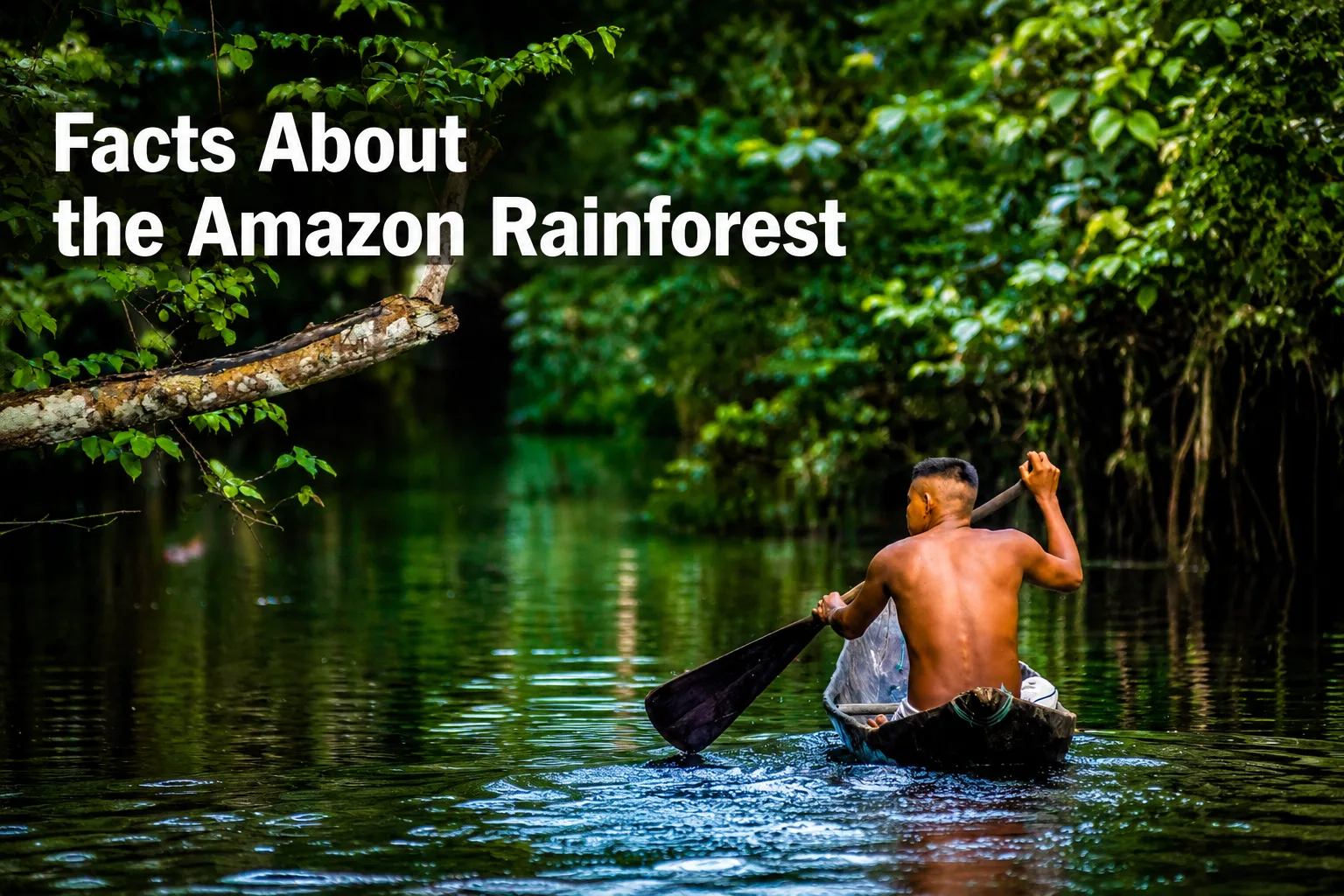
The Amazon rainforest is one of the most extraordinary ecosystems on Earth. It stretches across a vast area of South America, contains an incredible variety of plants and animals, and is home to Indigenous peoples whose cultures and knowledge are deeply connected to the forest. From enormous trees and colorful macaws to stealthy jaguars, pink river dolphins, giant river otters, and tiny frogs, the Amazon is full of remarkable discoveries.
In this guide, you will find 100+ facts about the Amazon rainforest, including interesting facts, fun facts, unusual discoveries, facts about Amazon rainforest animals and plants, information about the Amazon River, rainforest layers, Indigenous peoples, deforestation, and surprising facts that may sound unbelievable but are part of life in this enormous tropical ecosystem.
100+ Facts About the Amazon Rainforest
Rather than separating the same information into artificial lists of 10, 30, or 100 facts, the following facts are organized by topic. This makes it easier to understand how the Amazon rainforest works as a connected ecosystem.
Amazon Rainforest Geography and Location Facts
- The Amazon rainforest is located in South America.
- The forest extends across several countries, with the largest portions found in Brazil, Peru, Colombia, Bolivia, Venezuela, Ecuador, Guyana, Suriname, and French Guiana.
- The Amazon Basin is much larger than the rainforest itself because it includes rivers, wetlands, forests, savannas, and other landscapes drained by the Amazon River system.
- Brazil contains the largest share of the Amazon rainforest.
- Peru contains one of the world’s largest portions of Amazonian rainforest outside Brazil.
- The Amazon is not a single uniform forest. Its landscapes include flooded forests, upland forests, bamboo forests, palm-dominated areas, wetlands, river islands, and seasonally flooded ecosystems.
- Some parts of the Amazon are so remote that reaching them can require traveling for days by boat or through difficult forest terrain.
- The rainforest is crossed by an enormous network of rivers, streams, channels, oxbow lakes, and seasonal wetlands.
- The Amazon’s landscape changes considerably between the wet and dry seasons.
- River levels can rise dramatically during the rainy season, flooding large areas of forest.
- Some trees are adapted to survive for months with their trunks or roots underwater.
- The Amazon is connected ecologically to the Andes, where many of its major rivers originate.
- Sediments carried from the Andes help replenish nutrients in some Amazonian floodplains.
- The rainforest contains both ancient forests and areas that have been naturally disturbed by rivers, storms, landslides, and other processes.
- The Amazon is not simply an endless wall of trees. From the air and on the ground, it contains an astonishing variety of habitats.
Interesting Amazon Rainforest Climate Facts
- The Amazon has a predominantly tropical climate.
- Temperatures are generally warm throughout the year, although conditions vary considerably according to location, elevation, season, and proximity to rivers.
- Rainfall is one of the defining characteristics of the Amazon rainforest.
- Some areas receive several meters of rain in a year.
- The forest does not simply receive moisture from the ocean and keep it there. Trees continually recycle water through a process called transpiration.
- Plants release water vapor into the atmosphere through tiny openings in their leaves.
- This recycled moisture can contribute to rainfall farther across the Amazon Basin.
- Large rivers, wetlands, vegetation, clouds, and atmospheric moisture are therefore interconnected.
- Heavy rain can transform trails into muddy paths and cause rivers and streams to rise rapidly.
- During dry periods, some smaller streams can shrink considerably.
- The Amazon can experience intense thunderstorms.
- Lightning can occasionally ignite vegetation during exceptionally dry conditions.
- Climate conditions are not identical throughout the Amazon. Western, central, eastern, northern, and southern areas can have significantly different rainfall patterns.
- Some Amazonian forests experience predictable seasonal flooding.
- Flooding creates special habitats for fish, birds, mammals, reptiles, and plants.
Amazing Amazon Rainforest Biodiversity Facts
The Amazon’s most extraordinary characteristic may be its biodiversity. The forest contains an enormous number of species, including many that scientists have not yet fully studied. Biodiversity is not distributed evenly: different habitats can contain different communities of organisms, and even neighboring areas can have surprisingly different species.
- The Amazon rainforest is one of the most biologically diverse places on Earth.
- Thousands of plant species occur across the Amazon Basin.
- The region supports thousands of species of fish.
- It is home to hundreds of mammal species.
- The Amazon contains an extraordinary diversity of birds.
- Reptiles and amphibians are particularly diverse in many Amazonian habitats.
- Insects make up a huge proportion of Amazonian biodiversity.
- Scientists continue to describe new species from the Amazon region.
- Some Amazonian species have extremely small geographic ranges.
- Losing a particular forest area can therefore threaten species that may exist nowhere else.
- Biodiversity is supported by the enormous variety of ecological niches found in the forest.
- A single large tree can provide food, shelter, nesting sites, and climbing surfaces for numerous organisms.
- Different animals occupy different parts of the forest, from the soil and leaf litter to the understory and treetops.
- Some animals spend most of their lives high above the ground.
- Others are highly specialized for living in rivers and flooded forests.
Facts About Amazon Rainforest Animals
The Amazon rainforest animals are among the most fascinating creatures on the planet. Some are famous worldwide, while others are rarely seen even by people who spend their lives in the forest.
Jaguar Facts
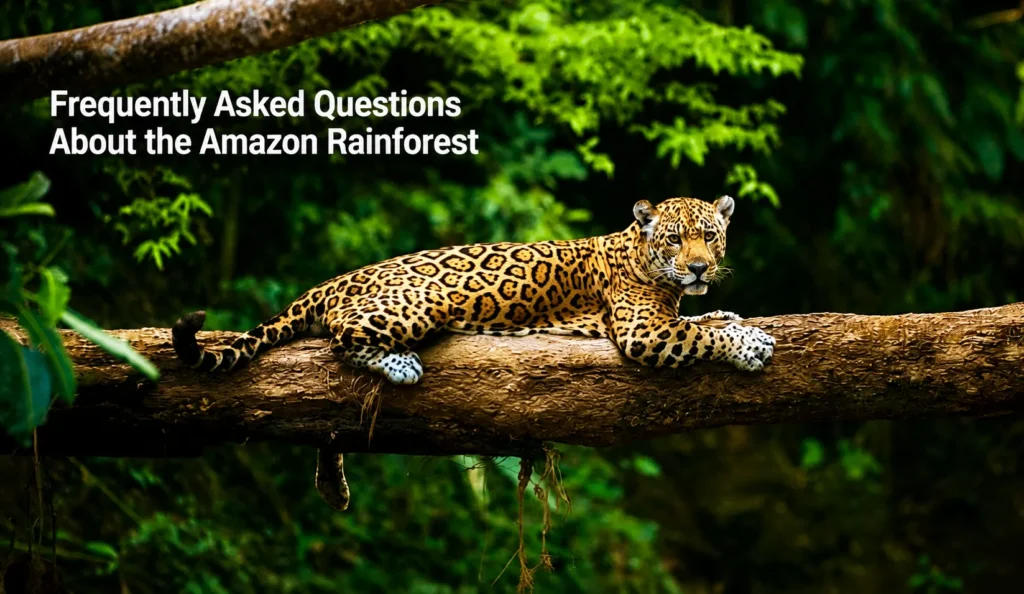
- Jaguars are among the Amazon’s most powerful predators.
- The jaguar is the largest cat species in the Americas.
- Jaguars are excellent swimmers and are strongly associated with rivers, wetlands, and other water-rich habitats.
- Their spotted coats provide camouflage in the complex patterns of forest vegetation.
- Jaguars can prey on a remarkable variety of animals.
- Their powerful jaws allow them to kill prey in a way that is unusual among large cats.
- Jaguars are generally solitary animals.
- They can travel considerable distances in search of territory, prey, and mates.
- Seeing a wild jaguar in the Amazon is relatively uncommon because these cats are secretive and often avoid people.
Sloth Facts
- Sloths are among the best-known animals associated with the Amazon rainforest.
- Sloths spend much of their lives in trees.
- Their slow movements help them conserve energy.
- Sloths have specialized limbs and curved claws that allow them to hang from branches.
- Their diet is largely based on leaves, although their exact diets vary among species.
- Sloths have very slow metabolisms compared with many other mammals.
- Some sloths can swim when necessary.
- Algae can grow in the fur of some sloths, giving their coats a greenish appearance that helps camouflage them.
- Sloths can be difficult to spot because their coloration blends with the vegetation around them.
More Amazon Animal Facts
- Giant river otters are highly social aquatic mammals found in parts of the Amazon Basin.
- Giant river otters communicate with a variety of vocalizations.
- Pink river dolphins live in Amazonian rivers and flooded forests.
- Amazon river dolphins can maneuver through flooded forests when water levels rise.
- Caimans are common aquatic predators in many Amazonian waterways.
- Anacondas are powerful aquatic snakes associated with wetlands, rivers, and flooded forests.
- Capybaras are the world’s largest living rodents.
- Harpy eagles are among the most impressive birds of prey found in Amazonian forests.
- Macaws use their powerful beaks to crack hard seeds and nuts.
- Toucans are recognizable for their large, lightweight bills.
- Howler monkeys are famous for their extremely loud calls.
- Spider monkeys use their long limbs and prehensile tails to move efficiently through the canopy.
- Poison dart frogs include some of the Amazon’s most colorful amphibians.
- Not every brightly colored Amazonian animal is dangerous.
- Many Amazonian animals rely on camouflage rather than bright colors to avoid predators.
- Some insects imitate leaves, twigs, bark, or other objects.
- Many Amazon animals are active primarily at night, making them difficult to observe during daytime walks.
Facts About Plants in the Amazon Rainforest
The Amazon is sometimes described as a “green ocean,” but this phrase hides enormous botanical diversity. Trees form the basic structure of the forest, while palms, vines, epiphytes, shrubs, fungi, mosses, and countless smaller plants occupy different levels and habitats.
- The Amazon contains an enormous diversity of trees.
- Some Amazonian trees grow to heights of more than 50 meters.
- Kapok trees can become enormous emergent trees.
- Brazil nut trees can live for many decades and produce commercially important nuts.
- Rubber trees are native to the Amazon region.
- Palm trees are important components of many Amazonian ecosystems.
- Lianas are woody climbing plants that use trees as support to reach sunlight.
- Epiphytes grow on other plants without necessarily taking nutrients directly from their host.
- Bromeliads can collect water between their leaves.
- Some plants have evolved special relationships with insects and other animals.
- Fruits are important food sources for monkeys, birds, bats, fish, and other animals.
- Seeds can be transported considerable distances by animals.
- Some Amazonian trees depend on specific animals for effective seed dispersal.
- Fungi play essential roles in decomposing dead organic material.
- Decomposition returns nutrients to the ecosystem.
The Four Layers of the Amazon Rainforest
One of the most interesting facts about the Amazon rainforest is that it is not organized simply from ground to sky. It has several vertical layers, each with different levels of sunlight, humidity, temperature, and wildlife.
The Emergent Layer
The emergent layer contains the tallest trees, which rise above the general canopy.
- Emergent trees receive intense sunlight.
- They can be exposed to stronger winds than vegetation lower in the forest.
- Large birds such as harpy eagles may use tall trees for nesting.
- Some monkeys and other animals travel through the highest parts of the forest.
- Emergent trees can have enormous crowns that extend above the surrounding canopy.
The Canopy
The canopy forms a vast roof of leaves and branches.
- The canopy receives much more sunlight than the forest floor.
- A huge proportion of Amazonian wildlife spends at least part of its life in the canopy.
- Monkeys, sloths, birds, insects, frogs, and reptiles can all live among canopy vegetation.
- The canopy is not a perfectly continuous surface. Gaps occur when trees fall or branches break.
- These gaps allow sunlight to reach lower layers and encourage new plant growth.
The Understory
The understory lies beneath the canopy.
- It generally receives much less sunlight than the canopy.
- Many young trees and shade-tolerant plants grow in this layer.
- Some animals use the understory for feeding, resting, hunting, and avoiding predators.
The Forest Floor
The forest floor is darker than the upper layers and can contain thick leaf litter.
- Dead leaves, branches, fruits, and animals eventually become part of the decomposition cycle.
- Fungi, insects, microorganisms, and other decomposers help break down organic matter.
- During heavy rains, parts of the forest floor may become flooded.
10 Interesting Facts About the Amazon River
The Amazon River is one of the defining features of the entire region. It is part of an enormous river system that connects mountains, forests, wetlands, communities, and the Atlantic Ocean.
- The Amazon River carries more water than any other river in the world.
- Its drainage basin covers an enormous portion of South America.
- The river receives water from thousands of tributaries and smaller streams.
- Some tributaries are themselves enormous rivers.
- The Amazon River system supports an extraordinary diversity of freshwater fish.
- Some Amazonian fish migrate hundreds or even thousands of kilometers during their life cycles.
- Seasonal flooding connects rivers with forests and creates feeding opportunities for fish and other wildlife.
- River dolphins can enter flooded forest habitats when water levels rise.
- Large river islands can form from sediment carried by the river system.
- The Amazon eventually flows into the Atlantic Ocean.
Indigenous Peoples and the Amazon Rainforest
The phrase “Amazon rainforest tribes” is commonly used in online searches, but Indigenous peoples of the Amazon is generally a more appropriate term because the region contains many distinct peoples, nations, languages, and communities.
- Indigenous peoples have lived in the Amazon for thousands of years.
- The Amazon is home to hundreds of Indigenous groups.
- Indigenous communities speak numerous languages.
- Different Indigenous peoples have distinct cultures, traditions, histories, and relationships with their environments.
- Traditional ecological knowledge can include detailed understanding of plants, animals, rivers, soils, seasons, and weather.
- Indigenous communities use many forest plants for food, materials, medicine, tools, and cultural purposes.
- Some Indigenous peoples live in regions that remain extremely remote.
- A number of Indigenous groups maintain limited or no regular contact with the outside world.
- Indigenous territories play an important role in protecting large areas of Amazonian forest.
- The survival of Indigenous cultures is closely connected to the protection of their lands and resources.
Facts About Amazon Rainforest Deforestation
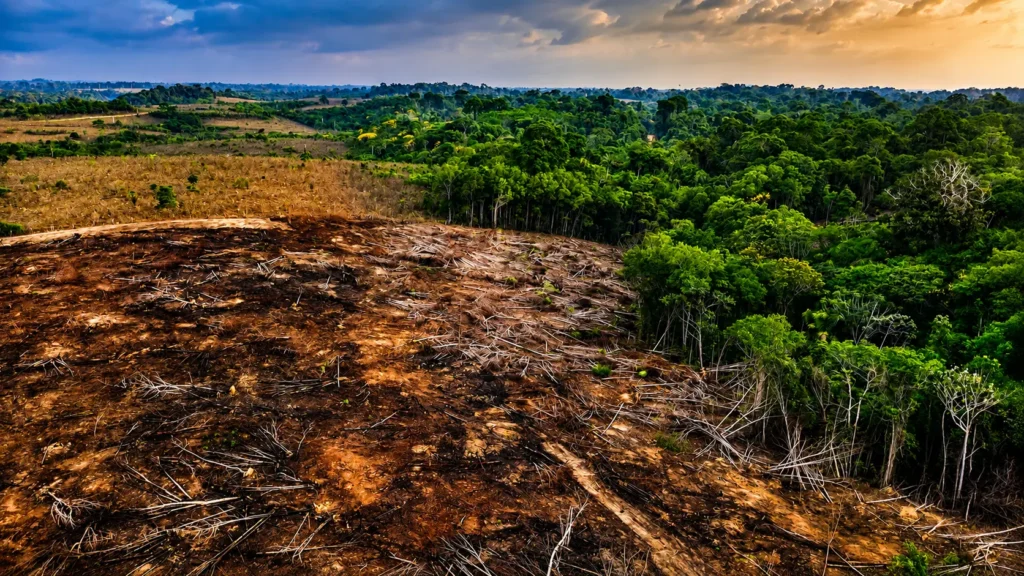
Deforestation is one of the most important threats to the Amazon. However, it is useful to understand that the Amazon is not disappearing at one uniform rate everywhere. Forest loss varies considerably by country, region, year, land-use pressure, enforcement, and economic activity.
- Deforestation means the permanent or long-term conversion of forest into another land use.
- Cattle ranching has historically been a major driver of forest clearing in parts of the Amazon.
- Agricultural expansion has also contributed to forest loss.
- Roads can increase access to previously remote forest areas.
- Mining can cause direct forest clearing and can also affect rivers and surrounding ecosystems.
- Illegal logging can damage forests even when an area is not completely cleared.
- Forest fires can become especially destructive during unusually dry conditions.
- Deforestation fragments continuous forest into smaller patches.
- Fragmentation can make it harder for some animals to move between habitats.
- Forest edges can experience different temperatures, humidity, wind, and vegetation conditions from the interior forest.
- Conservation areas and Indigenous territories can help protect forests when they are effectively managed and protected.
- Reforestation can restore some ecological functions, but a newly planted forest does not immediately reproduce the complexity of an old-growth rainforest.
Scary and Surprising Facts About the Amazon Rainforest
The Amazon can be beautiful, fascinating, and sometimes intimidating. Many of its “scary facts” are not about monsters or dangerous creatures but about how difficult it can be for humans to navigate and survive in a complex tropical environment.
- You can walk through an Amazon forest surrounded by wildlife and still see very few animals.
- Many animals detect humans before humans detect them.
- Dense vegetation can make it difficult to see even a large animal from only a short distance away.
- Some snakes are extremely well camouflaged.
- Large spiders can occasionally be found in rainforest habitats.
- Stinging insects can make forest travel uncomfortable.
- Mosquitoes and other biting insects are part of life in many Amazonian environments.
- Tropical rain can arrive suddenly and heavily.
- Rivers can rise rapidly during periods of intense rainfall.
- Getting lost in dense rainforest can be extremely dangerous because landmarks can be difficult to recognize.
- At night, the forest can sound much more active than it appears during the day.
- The calls of insects, frogs, birds, monkeys, and nocturnal mammals can create an almost continuous soundscape.
- Some of the most dangerous situations in the Amazon involve environmental conditions rather than predators.
- Heat, humidity, dehydration, strong currents, slippery terrain, and isolation can all present serious challenges.
Fun and Unusual Amazon Rainforest Facts
Some of the most memorable Amazon facts are the ones that seem almost impossible at first.
- The Amazon contains fish capable of producing electric shocks.
- Some fish can survive in waters with extremely low oxygen concentrations.
- Certain Amazonian fish are adapted to living among submerged vegetation during seasonal floods.
- Some turtles can navigate flooded forests and river channels.
- Giant river otters can live in family groups.
- Sloths can spend most of their lives hanging upside down.
- Some frogs use water-filled plants as miniature habitats.
- Certain insects are so well camouflaged that they resemble leaves.
- Some Amazonian ants form enormous colonies.
- Army ants can move across the forest floor in coordinated groups.
- Leafcutter ants carry pieces of leaves many times their own body weight.
- Leafcutter ants do not eat the leaves directly. They use them to cultivate fungi that serve as food for the colony.
- The forest contains plants that produce fruits eaten by animals ranging from tiny insects to large mammals.
- Some Amazon trees have enormous buttress roots that help support their massive trunks.
- Flooded forests can remain underwater for months during seasonal high water.
- Fish can enter areas that look like ordinary forests but are actually underwater during flood seasons.
- The Amazon is still producing new scientific discoveries.
Current Facts About the Amazon Rainforest
The Amazon remains one of the most important ecosystems in discussions about biodiversity, climate, conservation, Indigenous rights, and sustainable development.
Forest loss continues to be monitored closely across the region, but annual deforestation is not constant. Some areas have experienced significant improvements in forest protection while others continue to face pressure from agriculture, cattle ranching, mining, roads, fires, and illegal activities.
Climate change is also becoming increasingly important because changes in rainfall, temperature, drought frequency, and extreme weather can affect forests and rivers. Scientists are particularly interested in how repeated drought and forest degradation may influence the resilience of Amazonian ecosystems.
At the same time, conservation is not limited to stopping deforestation. Protecting the Amazon also involves maintaining rivers, wildlife corridors, Indigenous territories, sustainable livelihoods, biodiversity, and the ecological processes that allow forests to regenerate.
Why Is the Amazon Rainforest So Important?
The Amazon is important because it is a vast living system rather than simply a collection of trees.
Its forests store enormous quantities of carbon, recycle water, support biodiversity, influence regional climate, provide food and resources, and sustain millions of people. Its rivers transport nutrients and sediments across huge distances, while seasonal flooding creates habitats that are essential for countless aquatic and terrestrial species.
The Amazon also has global scientific importance. Researchers continue to discover species, ecological relationships, chemical compounds, behaviors, and evolutionary adaptations that increase our understanding of life on Earth.
Perhaps most importantly, the Amazon demonstrates how interconnected ecosystems are. A tree can provide food for an animal; that animal can disperse seeds; the new plant can provide habitat for insects; insects can feed birds; decomposers return nutrients to the soil; rainfall feeds rivers; and rivers transport nutrients back through the forest.
Amazon Rainforest Facts for Kids
The Amazon can be difficult to understand because it is so enormous. Here are some simple facts suitable for children and students:
- The Amazon rainforest is in South America.
- Brazil contains the largest portion of the Amazon rainforest.
- The Amazon River is one of the world’s greatest rivers.
- The rainforest is home to jaguars, sloths, monkeys, macaws, frogs, snakes, river dolphins, and many other animals.
- The Amazon contains thousands of plant species.
- Some Amazon trees grow taller than a 15-story building.
- Sloths spend much of their lives in trees.
- Jaguars are powerful swimmers.
- Giant river otters live in Amazonian waterways.
- The rainforest has several layers, including the canopy and forest floor.
- The canopy receives much more sunlight than the forest floor.
- Many animals spend their entire lives high in the trees.
- Indigenous peoples have lived in the Amazon for thousands of years.
- Some parts of the rainforest are flooded during seasonal high water.
- The Amazon is important for biodiversity and the global environment.
- Scientists continue to discover new species in the Amazon region.
Amazon Rainforest Facts for KS2 Students
For students studying the Amazon at school, several key ideas are especially useful: the rainforest has a hot and wet tropical climate; its vegetation is organized into layers; biodiversity is extremely high; the Amazon River and its tributaries support aquatic ecosystems; Indigenous peoples have deep relationships with the forest; and deforestation can affect habitats, biodiversity, water cycles, and local communities.
Understanding these connections is more valuable than simply memorizing isolated numbers. The Amazon is an ecosystem in which climate, vegetation, animals, rivers, people, and environmental change are all connected.
What Is the Most Unusual Thing About the Amazon Rainforest?
One of the most unusual things about the Amazon is how much life exists in places that appear empty. A quiet section of forest may contain hundreds of species even when almost no animals are visible. Many creatures are hidden in leaves, branches, tree hollows, underground spaces, rivers, or the canopy far above your head.
Another remarkable feature is the seasonal transformation of flooded forests. During high-water periods, areas that normally look like ordinary forest can become underwater landscapes where fish swim between tree trunks and feed on fruits growing high above the water.
This ability of the ecosystem to change dramatically according to water levels is one of the reasons the Amazon is so biologically fascinating.
Frequently Asked Questions About the Amazon Rainforest
What are 10 interesting facts about the Amazon rainforest?
Ten particularly interesting facts are that the Amazon spans several South American countries, Brazil contains the largest portion, the region has extraordinary biodiversity, the Amazon River carries enormous volumes of water, jaguars are powerful swimmers, sloths spend much of their lives in trees, giant river otters live in family groups, some forests become flooded seasonally, Indigenous peoples have lived in the region for thousands of years, and scientists continue to discover new species.
What are 30 facts about the Amazon rainforest?
There are far more than 30 interesting facts about the Amazon. The most useful way to organize them is by geography, climate, biodiversity, animals, plants, rivers, rainforest layers, Indigenous peoples, and environmental threats rather than presenting a long collection of disconnected facts.
What are 100 facts about the Amazon rainforest?
The Amazon contains hundreds of fascinating facts relating to its geography, animals, plants, rivers, climate, people, ecology, and conservation. The comprehensive list above provides more than 100 facts while grouping them into meaningful topics.
What animals live in the Amazon rainforest?
The Amazon is home to jaguars, sloths, monkeys, macaws, toucans, harpy eagles, giant river otters, pink river dolphins, caimans, anacondas, capybaras, frogs, bats, insects, reptiles, fish, and many other species.
What plants grow in the Amazon rainforest?
Amazonian vegetation includes enormous trees, palms, lianas, epiphytes, bromeliads, shrubs, vines, fungi, and many other plant forms. Some species are adapted to permanently wet conditions, while others survive seasonal flooding or periods of drought.
How many layers does the Amazon rainforest have?
The rainforest is commonly described using four main vertical layers: the emergent layer, canopy, understory, and forest floor. Each layer has different environmental conditions and supports different communities of plants and animals.
Is the Amazon rainforest dangerous?
The Amazon can be dangerous because of heat, humidity, insects, difficult terrain, powerful rivers, poisonous or venomous animals, disease risks, and the possibility of becoming lost. However, most wildlife avoids humans, and experienced guides know how to travel safely through the forest.
Why is the Amazon rainforest important?
The Amazon is important because it supports extraordinary biodiversity, stores carbon, recycles water, influences regional climate, sustains rivers and wetlands, provides resources for communities, and contains ecosystems that cannot easily be replaced once destroyed.
Final Thoughts
The Amazon rainforest is far more than a giant collection of trees. It is an interconnected world of rivers, flooded forests, towering emergent trees, dense canopy, hidden animals, extraordinary plants, Indigenous cultures, insects, fungi, and microscopic organisms.
From a jaguar swimming across a river to a sloth quietly moving through the canopy, from leafcutter ants cultivating fungi underground to fish swimming through seasonally flooded forests, the Amazon continually challenges our idea of what a rainforest can be.
The most fascinating fact may be that, despite centuries of exploration and scientific research, the Amazon is still not completely understood. New species and ecological relationships continue to be discovered, while researchers, Indigenous communities, conservationists, and local people work to understand and protect this extraordinary ecosystem.
That combination of enormous scale, extraordinary biodiversity, cultural diversity, and ecological complexity is what makes the Amazon rainforest one of the most fascinating places on Earth.