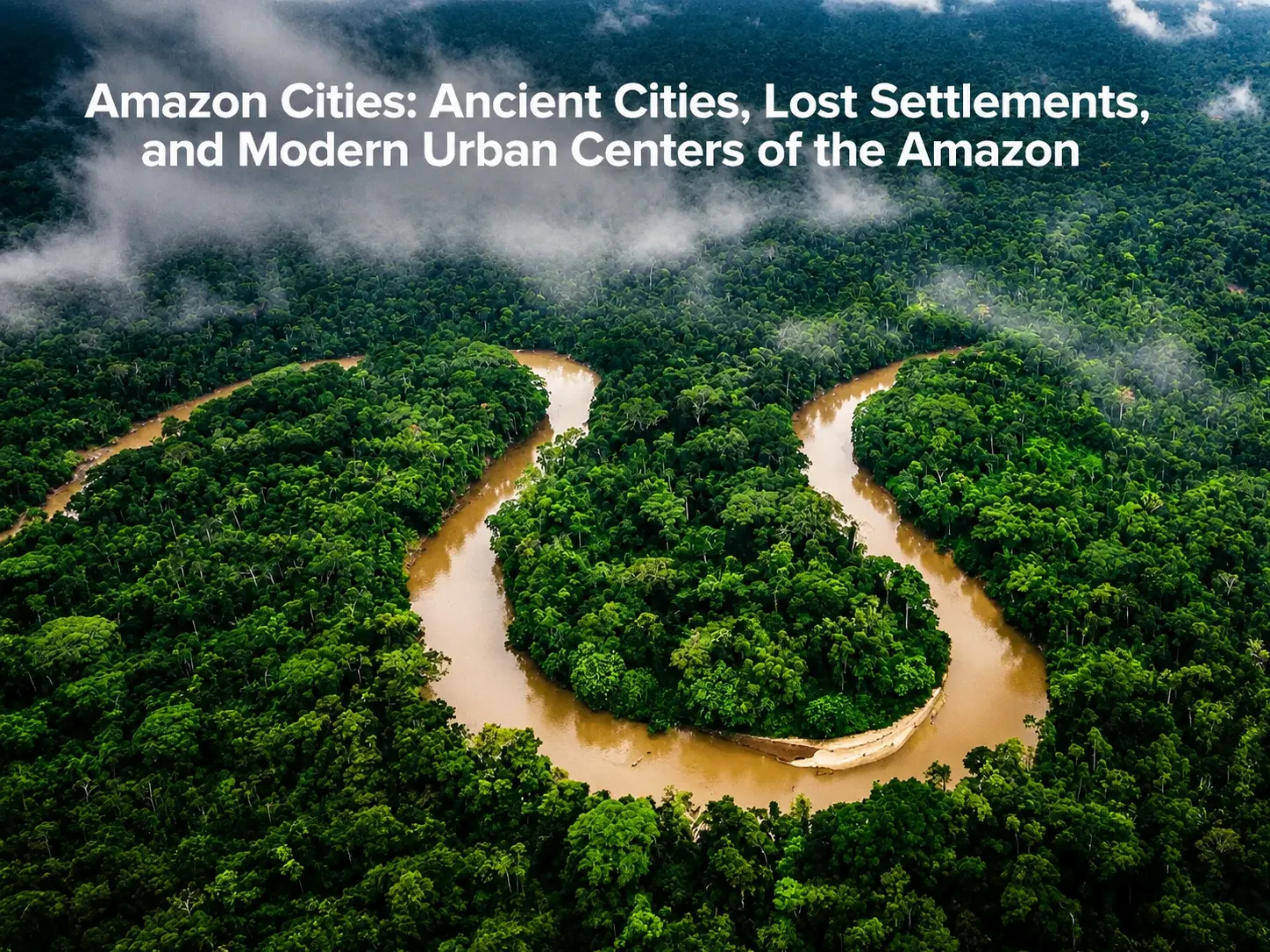
he Amazon cities of today are only one part of a much older human story. For centuries, the Amazon rainforest was often portrayed as an untouched wilderness where people lived only in small, scattered communities. Archaeological discoveries have dramatically changed that picture. Beneath the dense vegetation, researchers have found evidence of roads, canals, agricultural systems, earthworks, plazas, settlements, and enormous networks of human occupation that existed long before European arrival.
Today, cities such as Manaus, Iquitos, Belém, Santarém, and Puerto Maldonado connect millions of people with the Amazon Basin. But beneath and around these modern cities lies another history: the story of ancient Amazon cities, large settlements, and sophisticated societies that adapted to one of the most challenging environments on Earth.
From mysterious geometric earthworks to settlements revealed by LiDAR, the Amazon continues to challenge what we know about ancient civilization. Some archaeological landscapes suggest that people modified enormous areas of rainforest, managed forests, cultivated crops, constructed transportation routes, and organized communities on a much larger scale than previously believed.
What Are Amazon Cities?
The term Amazon cities can refer to modern urban centers located within or closely connected to the Amazon Basin, but it can also be used more broadly when discussing ancient urban settlements discovered in the rainforest.
Modern Amazon cities vary enormously in size and character. Some are major metropolitan centers with populations in the millions, while others are smaller regional towns surrounded by forest, rivers, wetlands, and agricultural areas. Their common characteristic is their close relationship with the Amazon’s enormous river network.
Ancient Amazon cities were very different from modern cities. They generally did not contain skyscrapers, paved streets, or large concentrations of industrial buildings. Instead, some ancient settlements consisted of interconnected communities organized around plazas, raised platforms, roads, canals, agricultural areas, defensive structures, and monumental earthworks.
What Is Considered an Amazon City?
There is no single definition of an Amazon city. In modern geography, an Amazon city is generally an urban settlement located within the Amazon Basin or strongly connected to the Amazon River system.
The term can include:
- Large metropolitan areas
- Regional commercial centers
- River ports
- Small towns surrounded by rainforest
- Tourism gateways
- Indigenous and rural settlements
- Ancient urban or semi-urban archaeological landscapes
For archaeology, the definition becomes more complicated. Researchers may use terms such as ancient settlement, urban center, regional center, or complex society rather than simply calling every large archaeological site a city.
This distinction is important because ancient Amazonian societies did not necessarily follow the same urban model as civilizations elsewhere in the world.
Where Are the Amazon’s Major Cities Located?
The largest Amazon cities are distributed across several countries of South America, including Brazil, Peru, Colombia, Bolivia, and Ecuador.
Many developed along major rivers because rivers were the Amazon’s natural highways. Long before modern roads and airports, rivers provided transportation, food, communication routes, and access to different ecological zones.
Important modern Amazon cities include:
- Manaus, Brazil
- Belém, Brazil
- Santarém, Brazil
- Rio Branco, Brazil
- Porto Velho, Brazil
- Macapá, Brazil
- Iquitos, Peru
- Puerto Maldonado, Peru
- Pucallpa, Peru
- Leticia, Colombia
- Cobija, Bolivia
- Tena, Ecuador
- Coca, Ecuador
The location of these cities reveals an important fact about Amazonian geography: water determines where people live. Even today, rivers remain essential transportation corridors throughout enormous portions of the rainforest.
Amazon Cities Map: Where Are They Located?
An Amazon cities map would show an enormous urban network spread across the Amazon Basin rather than a single concentration of cities.
The Amazon Basin covers approximately 7 million square kilometers when considered as a complete drainage basin, crossing national borders and containing thousands of rivers and tributaries. The Amazon River and its major tributaries form the backbone of this enormous geographic region.
Major Amazon Cities by Country
| Country | Important Amazon Cities |
|---|---|
| Brazil | Manaus, Belém, Santarém, Rio Branco, Porto Velho, Macapá |
| Peru | Iquitos, Puerto Maldonado, Pucallpa, Tarapoto |
| Colombia | Leticia, Puerto Carreño |
| Bolivia | Riberalta, Cobija, Trinidad |
| Ecuador | Coca, Tena, Nueva Loja |
| Venezuela | Puerto Ayacucho |
The map would also reveal something unusual: many important Amazonian population centers are located hundreds of kilometers from one another, separated by forest, rivers, wetlands, mountains, and enormous areas of relatively low population density.
Amazon Cities in Peru
Peru contains a substantial portion of the western Amazon Basin, where the Andes meet the rainforest. Several important cities serve as gateways to different Amazonian ecosystems.
Iquitos
Iquitos is one of the world’s most unusual major cities because it has no conventional road connection to the rest of Peru. The city is accessible primarily by air or river.
Located in northeastern Peru, Iquitos is surrounded by rivers and tropical forest. It serves as an important commercial, cultural, and tourism center for the Peruvian Amazon.
The city is closely connected to the Amazon River and nearby communities, reserves, forests, and wetlands.
Puerto Maldonado
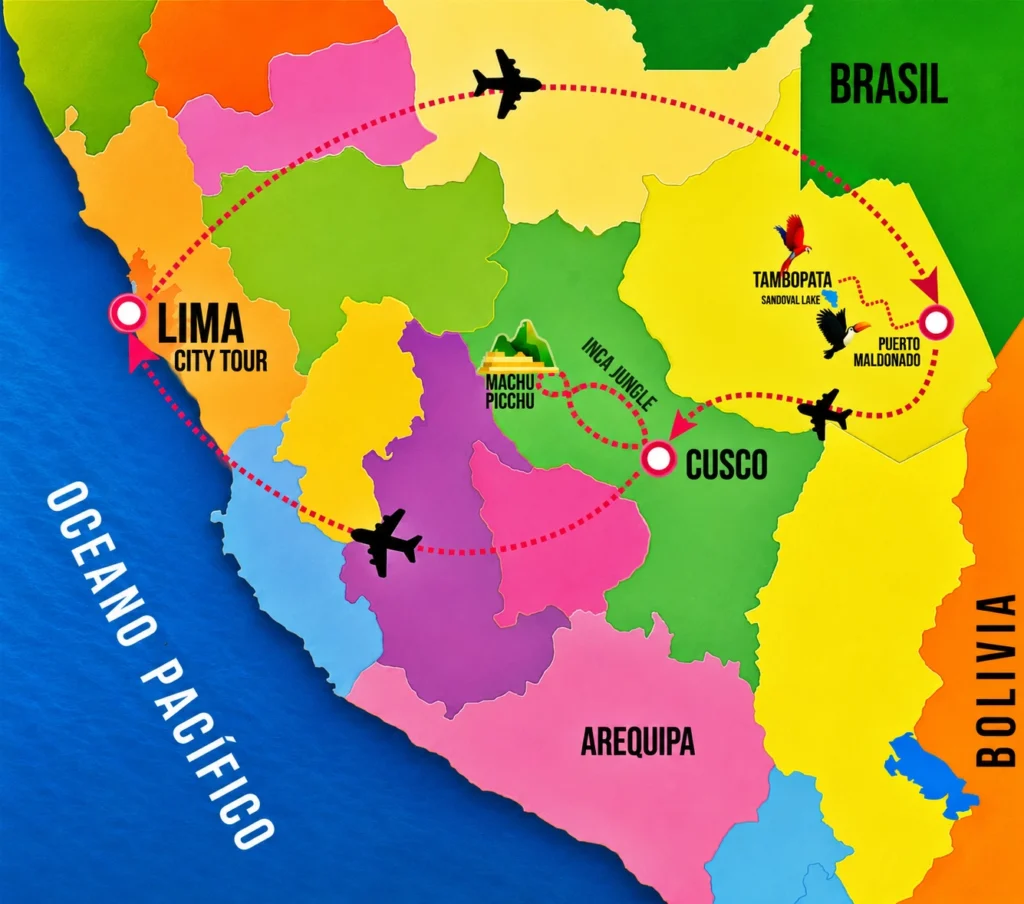
Puerto Maldonado is one of the principal gateways to the southern Peruvian Amazon and is particularly important for access to the Tambopata region and surrounding rainforest.
The city sits near the confluence of the Madre de Dios and Tambopata rivers, making waterways central to its history and economy.
Puerto Maldonado is also a gateway to some of Peru’s most biologically diverse rainforest landscapes, including areas where visitors can encounter giant river otters, macaws, monkeys, caimans, capybaras, and hundreds of bird species.
Pucallpa
Pucallpa lies in eastern Peru on the banks of the Ucayali River. It is an important commercial and transportation center connecting the interior of Peru with the Amazon river system.
Its location illustrates why rivers became so important to Amazonian settlements: a river can function simultaneously as a transportation route, source of food, geographic boundary, and connection between communities.
Amazon Cities Across the Amazon Basin
Amazon cities are not restricted to Peru or Brazil. The entire basin contains an extraordinary variety of urban centers.
Brazil contains the largest portion of the Amazon Basin and includes major cities such as Manaus and Santarém. Colombia’s Leticia provides an important connection to the Amazon River and forms part of a unique tri-border region involving Peru and Brazil.
Bolivia has important Amazonian settlements including Riberalta and Trinidad, while Ecuador’s Amazonian cities include Tena and Coca.
Despite their differences, many Amazon cities share several characteristics:
- Strong dependence on rivers
- Tropical climates
- Rapid urban expansion
- Close proximity to rainforest
- Important Indigenous cultural influences
- Economies connected to agriculture, forestry, tourism, fishing, and trade
- Unique transportation challenges
Ancient Cities of the Amazon
The idea of ancient cities of the Amazon once seemed almost impossible to many people. The rainforest was traditionally imagined as an environment incapable of supporting large populations because soils can be nutrient-poor, vegetation grows rapidly, and seasonal flooding can transform enormous areas.
Archaeology has revealed a much more complicated reality.
Ancient Amazonian societies learned how to work with the rainforest rather than simply attempting to replace it. They developed agricultural systems, managed useful trees and plants, constructed earthworks, created transportation networks, and organized settlements according to local environmental conditions.
Some archaeological landscapes are so extensive that they suggest populations far larger and more organized than earlier historical accounts had recognized.
Did Ancient Cities Really Exist in the Amazon?
Yes, archaeological evidence demonstrates that ancient Amazonian societies created substantial settlements and highly modified landscapes.
However, it is important to avoid imagining them as exact equivalents of modern cities.
Some ancient settlements may have consisted of clusters of communities connected through roads and causeways. Others contained monumental structures, plazas, canals, agricultural fields, raised areas, and defensive earthworks.
In several parts of the Amazon, the archaeological landscape indicates that humans deliberately transformed large areas over centuries.
This means that the ancient Amazon was not simply a forest containing isolated villages. In some regions, it was a cultural landscape shaped by generations of human activity.
What Were Ancient Amazon Cities Like?
Ancient Amazon settlements could look completely different from cities in Europe, Asia, or the Americas.
Instead of dense buildings made from stone, many structures were constructed from earth, wood, palm materials, and other organic resources. Wooden buildings disappeared over time, while earthworks remained buried beneath vegetation.
Common Features of Ancient Amazonian Settlements
Archaeologists have identified or investigated features including:
- Large plazas
- Raised platforms
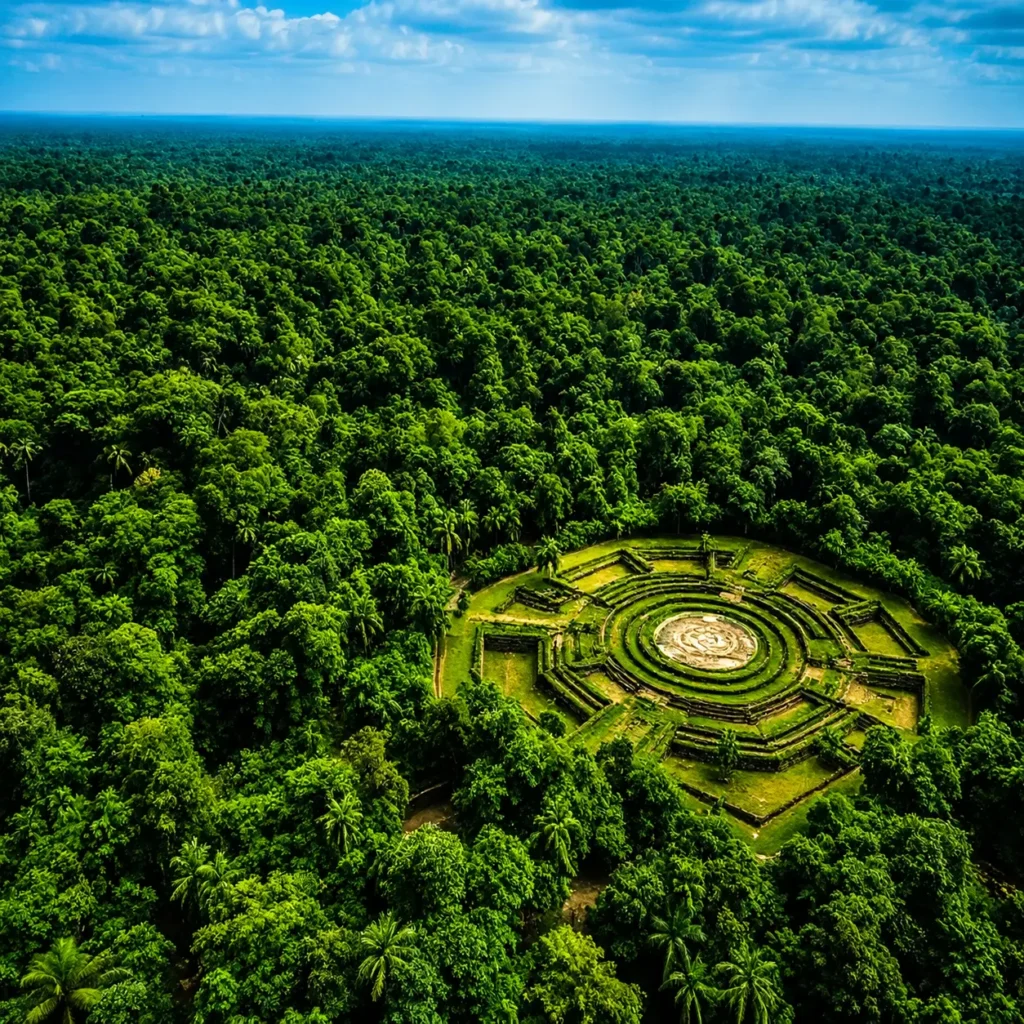
- Geometric earthworks
- Ditches
- Defensive walls
- Causeways
- Canals
- Agricultural fields
- Terraces
- Roads
- Reservoirs
- Residential areas
- Ceremonial structures
- Modified soils
The use of earth was especially important. Large geometric structures could survive for centuries even after wooden houses and other organic materials disappeared.
How Did People Live in the Ancient Amazon?
Ancient Amazonian people developed diverse ways of living according to their local environments.
Fishing was crucial near rivers and lakes, while agriculture provided crops such as manioc, maize, sweet potatoes, fruits, and other plants. Hunting and gathering supplemented cultivated foods.
People also modified the forest itself. Rather than treating every tree as something wild and separate from human activity, communities cultivated or encouraged useful species.
Ancient Amazonian Food Systems
Some communities practiced sophisticated forms of landscape management that included:
- Cultivation of root crops
- Tree management
- Fishing
- Hunting
- Gathering wild foods
- Soil improvement
- Seasonal agriculture
- Wetland resource management
This approach created a relationship between people and forest that could last for generations.
Lost and Hidden Cities of the Amazon
The phrase lost cities of the Amazon has inspired legends for centuries. Stories of enormous hidden cities filled with gold captured the imagination of explorers, adventurers, and treasure hunters.
The reality is more fascinating than many legends.
Instead of discovering mythical cities made of gold, archaeology has revealed genuine ancient settlements hidden beneath vegetation. Some are enormous, but their remains are subtle and difficult to recognize from the ground.
The rainforest itself is one reason these places became “lost.”
Vegetation can cover roads, ditches, platforms, walls, and other structures. After centuries of abandonment, an ancient settlement can look like ordinary forest.
Lost Amazon Cities and Ancient Settlements
Some of the most remarkable discoveries are not individual cities but networks of settlements.
In parts of the western and southern Amazon, researchers have identified extensive archaeological landscapes containing interconnected earthworks and settlements.
These discoveries suggest that ancient populations could organize space on a regional scale.
Instead of one isolated settlement, there may have been:
household → village → regional center → connected settlement network
This changes the way researchers think about Amazonian civilization.
How Were Hidden Amazon Cities Discovered?
Ancient settlements in the Amazon have been discovered using many different techniques.
Some were identified through archaeological surveys and excavations. Others became visible through aerial photography, satellite imagery, local knowledge, historical records, or systematic exploration.
More recently, LiDAR technology has transformed archaeological research in heavily forested regions.
Dense rainforest can make traditional aerial photography difficult because the canopy hides the ground. LiDAR provides another way to see the landscape.
What Archaeological Evidence Has Been Found?
Evidence of ancient Amazonian occupation comes from many different sources.
Archaeological Evidence Includes:
- Pottery fragments
- Stone tools
- Human-made earthworks
- Ancient roads
- Canals
- Raised fields
- Ditches
- Defensive structures
- Residential platforms
- Modified soils
- Charcoal
- Food remains
- Plant remains
- Burial areas
- Ancient settlement patterns
Soils can also contain evidence of human activity. In some locations, centuries of occupation changed the chemical and physical characteristics of the ground.
One particularly interesting example is Amazonian Dark Earth, often called terra preta. These unusually dark and fertile soils are associated with ancient human activity in various parts of the Amazon.
Amazon Cities Discovered With LiDAR
LiDAR has become one of the most important technologies for investigating ancient settlements beneath tropical vegetation.
The technology has revealed landscape features that can be extremely difficult to recognize while standing on the ground.
In several Amazonian regions, LiDAR surveys have exposed:
- Straight ancient roads
- Geometric earthworks
- Large platforms
- Circular settlements
- Defensive ditches
- Causeways
- Agricultural modifications
- Settlement clusters
- Large-scale landscape engineering
These discoveries are especially significant because they demonstrate that some ancient societies were capable of modifying enormous areas without creating cities that looked like the monumental stone cities familiar from other parts of the ancient world.
What Is LiDAR?
LiDAR stands for Light Detection and Ranging.
It is a remote-sensing technology that uses pulses of laser light to measure distances.
A LiDAR system sends thousands or millions of laser pulses toward the ground. Some pulses interact with leaves and vegetation, while others reach the surface.
By analyzing the returning signals, computers can construct a detailed three-dimensional representation of the landscape.
The result can reveal subtle differences in elevation that would otherwise be hidden.
How LiDAR Works in the Amazon Rainforest
The rainforest canopy is extremely dense. From the ground, an ancient road may look like nothing more than a slight depression. A large earthwork may be covered by trees and vines.
LiDAR changes the perspective.
Step-by-Step LiDAR Process
- A sensor is carried by an aircraft or another platform.
- Laser pulses are transmitted toward the forest.
- Some pulses hit leaves and branches.
- Other pulses pass through gaps in the vegetation.
- Some reach the ground.
- The returning signals are measured.
- Computers calculate distances.
- Researchers remove vegetation data.
- A digital terrain model is created.
- Archaeological structures become easier to recognize.
This is why LiDAR is sometimes described as allowing archaeologists to “see through” the forest, although technically it does not literally see through solid vegetation.
Amazon Cities Found With LiDAR
LiDAR has contributed to discoveries across several Amazonian regions, including areas of Bolivia, Brazil, Ecuador, and other parts of the basin.
One of the most remarkable findings has been the identification of extensive settlement systems in the Bolivian Amazon. In the Llanos de Mojos region, LiDAR revealed complex networks of raised platforms, causeways, canals, and settlement structures associated with the ancient Casarabe culture.
These landscapes indicate deliberate engineering on a scale that was difficult to appreciate from ground-level observations.
The discoveries are particularly important because they demonstrate that some Amazonian societies constructed organized settlements in seasonally flooded environments.
Ancient Amazon Cities Revealed From Above
Seeing an ancient settlement from above can completely change its appearance.
At ground level, a geometric ditch may seem insignificant. From the air, it may form part of a massive geometric pattern.
A road that is nearly invisible beneath vegetation may become obvious when mapped across kilometers.
A series of platforms may reveal a planned settlement.
A canal may connect multiple communities.
This aerial perspective has helped archaeologists understand that some ancient Amazonian landscapes were designed environments.
The Most Unusual Facts About Ancient Amazon Cities
The history of Amazonian cities contains many surprising details.
1. Some ancient settlements were hidden beneath ordinary forest
The rainforest can completely conceal human-made structures. What appears to be untouched vegetation may cover ancient roads, ditches, platforms, and agricultural systems.
2. Ancient people changed the forest without destroying it
Amazonian societies often managed useful plants and trees. Their influence could persist long after settlements disappeared.
3. Roads existed deep inside the rainforest
Some archaeological regions contain networks of straight roads or raised causeways connecting settlements.
4. Some settlements were built in difficult flood-prone environments
Ancient engineers constructed raised platforms, canals, and other features that allowed communities to adapt to seasonal flooding.
5. The rainforest can preserve landscapes while destroying buildings
Wooden architecture decays rapidly, but earthworks can remain visible for centuries or millennia.
6. The Amazon was never simply “empty wilderness”
The archaeological record shows that humans have lived in and modified Amazonian environments for thousands of years.
7. LiDAR can reveal structures invisible from the ground
This technology has fundamentally changed how archaeologists investigate dense rainforest.
Ancient Amazon Cities vs. Modern Amazon Cities
Modern and ancient Amazonian cities are separated by thousands of years, yet they share one important characteristic: their relationship with the environment.
Modern cities continue to depend heavily on rivers for transportation, commerce, food, and communication.
Ancient settlements also depended on rivers, wetlands, forests, and seasonal cycles.
The major difference is scale, technology, architecture, and economic organization.
Modern cities contain roads, electricity, airports, hospitals, universities, factories, hotels, ports, and large commercial districts. Ancient settlements relied on local materials, agriculture, fishing, forest resources, and human labor.
Nevertheless, both demonstrate a fundamental Amazonian principle: successful communities must understand water, climate, soils, forests, and seasonal change.
Why Were Ancient Amazon Cities Abandoned?
There was no single reason why ancient Amazonian settlements disappeared.
Different communities experienced different environmental and social conditions.
Possible factors include:
- Changes in climate
- Flooding
- Drought
- Changes in rivers
- Soil degradation
- Warfare
- Political changes
- Disease
- Migration
- Economic transformation
- Collapse of regional networks
In some cases, abandonment may have been gradual rather than sudden.
A settlement could decline while people moved to nearby communities, leaving behind structures that slowly disappeared beneath vegetation.
Could There Be More Ancient Amazon Cities Waiting to Be Discovered?
Almost certainly.
Large portions of the Amazon remain difficult to access archaeologically. Dense vegetation, enormous distances, difficult terrain, seasonal flooding, and limited infrastructure make systematic exploration challenging.
The increasing use of satellite imagery, LiDAR, artificial intelligence, geographic information systems, aerial surveys, and field archaeology is likely to reveal more archaeological landscapes.
Future discoveries may not consist of spectacular stone monuments. Instead, they may involve thousands of subtle features that together reveal how ancient people organized the rainforest.
Why Ancient Amazon Cities Matter Today
The discovery of ancient Amazonian settlements has changed more than archaeological history. It has also influenced how scientists understand the rainforest itself.
The modern Amazon is not simply a natural environment unaffected by people. It is a mixture of ecosystems that have interacted with human communities for thousands of years.
Ancient inhabitants planted, harvested, burned, managed, hunted, fished, built, traveled, and modified their surroundings.
This does not mean that the entire rainforest was artificially created. Rather, it means that human history is deeply embedded within Amazonian landscapes.
Understanding this history can help scientists interpret modern forests, soils, plant distributions, and archaeological sites.
The Future of Amazon Archaeology
The next generation of Amazon archaeology is likely to combine traditional fieldwork with increasingly advanced remote sensing.
LiDAR is already revealing structures that were difficult or impossible to detect from the ground. Satellite imagery can identify patterns across enormous areas. Archaeologists can then visit selected locations to test what the remote data reveal.
The result is a new research model:
Remote sensing → archaeological mapping → field investigation → excavation → environmental analysis → historical reconstruction
This combination allows researchers to investigate landscapes rather than individual ruins.
What We May Learn Next
Future discoveries could help answer questions such as:
- How large were ancient Amazonian populations?
- How were settlements connected?
- How far did ancient roads extend?
- How did communities manage seasonal flooding?
- Which plants were deliberately cultivated?
- How did ancient societies influence forest composition?
- Why did certain settlement networks disappear?
- How did different Amazonian cultures interact?
The answers may fundamentally reshape our understanding of tropical civilization.
Final Thoughts: The Amazon Has More Cities in Its History Than We Once Imagined
The story of Amazon cities extends far beyond the modern urban centers visible on today’s maps. Beneath the rainforest canopy lies evidence of ancient communities, roads, agricultural landscapes, canals, plazas, earthworks, and settlement networks.
The discovery of these places has overturned the old idea that the Amazon was an untouched wilderness populated only by small, isolated groups.
Ancient Amazonian societies developed remarkable ways of adapting to forests, rivers, wetlands, and seasonal changes. Some created extensive settlement systems and transformed landscapes on a scale that is only now becoming fully visible.
Modern technology, especially LiDAR, has opened a new window into this hidden past. From above, geometric patterns buried beneath vegetation reveal roads, platforms, ditches, canals, and settlements that can remain almost invisible at ground level.
Perhaps the most fascinating fact is that the Amazon’s greatest cities may not be the ones we can see today. Some of its most extraordinary human landscapes are hidden beneath trees, waiting for archaeology and technology to reveal them.
The Amazon rainforest is therefore not only one of Earth’s greatest natural environments. It is also an enormous archaeological landscape—and much of its human history has yet to be discovered.