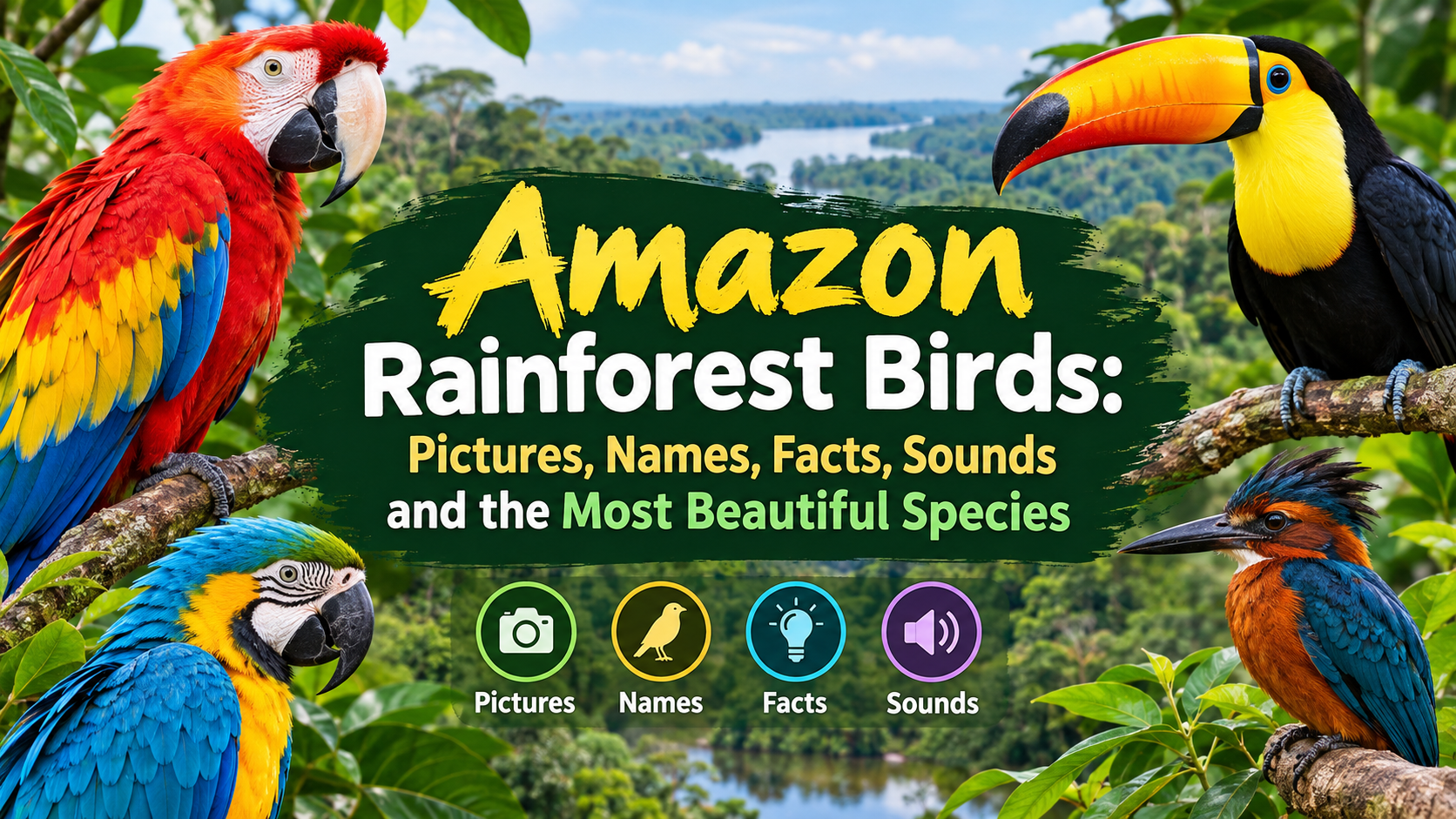
The Amazon rainforest birds are among the most spectacular animals found anywhere on Earth. From brilliantly colored macaws and toucans to powerful birds of prey, tiny hummingbirds, parrots, tanagers, and secretive forest species, the Amazon is home to an astonishing diversity of birds.
For travelers and wildlife enthusiasts, discovering Amazon rainforest birds pictures with names is an exciting way to learn about the species they may encounter in the jungle. Some birds are easy to recognize because of their vivid colors or enormous bills, while others are masters of camouflage and require patience and a trained eye to find.
Birdwatching in the Amazon is also about more than simply looking for colorful species. The sounds of birds calling through the forest, the sudden flight of a flock of parrots, or the sight of a macaw crossing the canopy can become some of the most memorable moments of an Amazon adventure.
This guide explores Amazon rainforest birds names, pictures, facts, sounds, birds of prey, rare species, toucans, macaws, and some of the most beautiful birds found throughout the Amazon rainforest.
Amazon Rainforest Birds at a Glance
The Amazon rainforest supports an extraordinary variety of bird species across an enormous range of habitats.
You can find birds living in:
- The upper rainforest canopy
- Forest understory
- Riverbanks
- Flooded forests
- Wetlands
- Amazonian lakes
- Clay licks
- Forest clearings
- Palm swamps
- Bamboo forests
- Open river islands
Some species spend most of their lives high above the forest floor, while others rarely leave the dense vegetation below.
Popular Amazon rainforest birds include:
- Scarlet Macaw
- Blue-and-yellow Macaw
- Harpy Eagle
- Toucan
- Channel-billed Toucan
- Hoatzin
- Hummingbirds
- Great Potoo
- Amazon Kingfisher
- Capped Heron
- Sunbittern
- Blue-gray Tanager
- Paradise Tanager
- Oropendolas
- Parrots
- Parakeets
- Motmots
- Jacamars
- Antbirds
- Curassows
These represent only a small selection of the remarkable birds that inhabit the Amazon.
Amazon Rainforest Birds Pictures With Names
For beginners, seeing Amazon rainforest birds pictures with names is one of the easiest ways to begin learning the differences between species.
Color, body shape, beak size, tail length, habitat, and behavior can all help with identification.
Here are some of the most recognizable species.
1. Scarlet Macaw
The Scarlet Macaw is one of the most iconic Amazon rainforest birds.
Its brilliant red plumage is combined with yellow and blue feathers on the wings, creating one of the most spectacular color patterns in the rainforest.
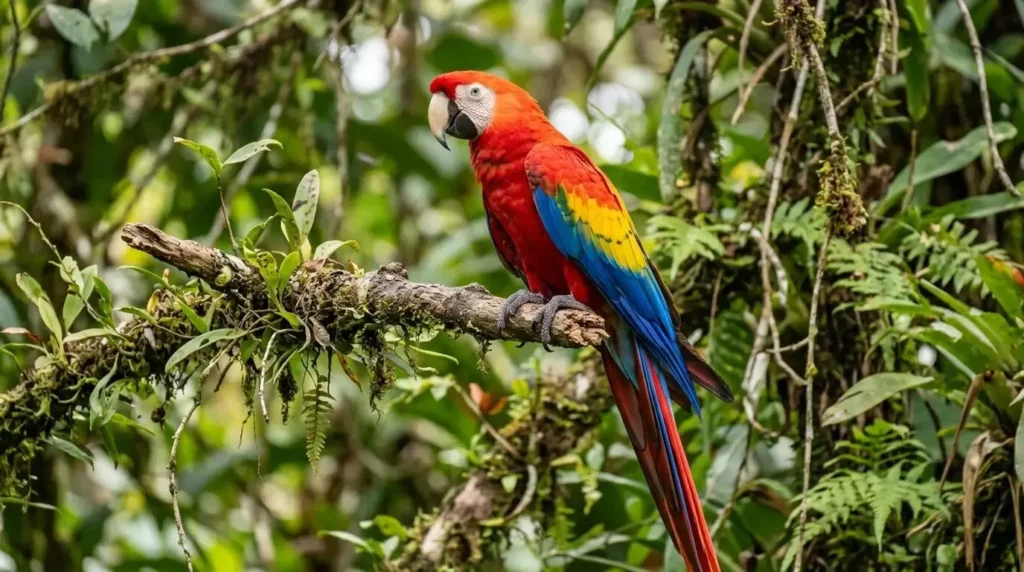
Scarlet Macaws are highly social and are often seen flying in pairs or small groups.
Their loud calls can carry through the forest, making them easier to detect before they appear overhead.
2. Blue-and-Yellow Macaw
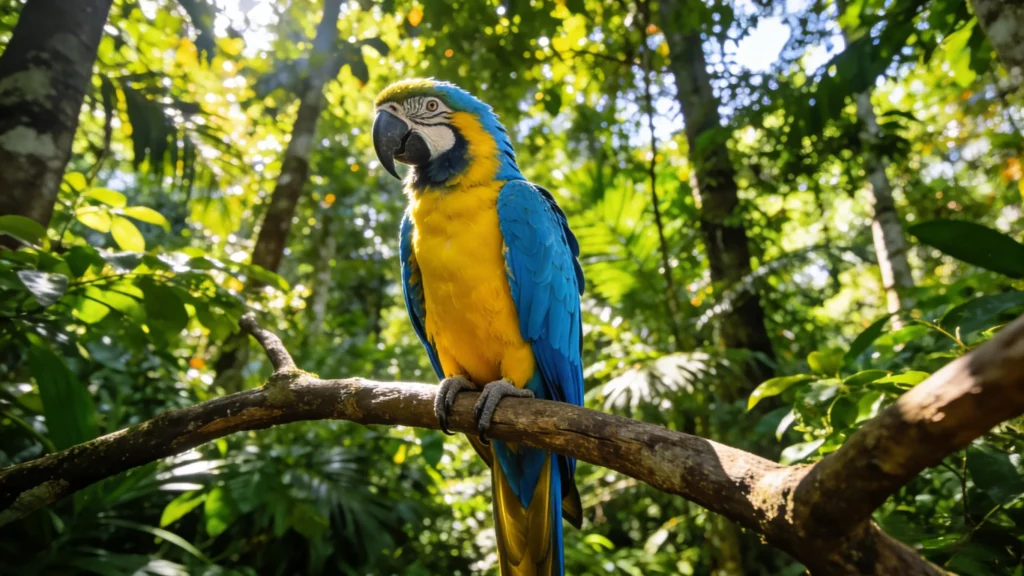
The Blue-and-Yellow Macaw is another unforgettable rainforest bird.
Its bright blue wings and back contrast dramatically with its yellow chest.
These large parrots have strong, curved bills that allow them to crack hard nuts and seeds.
They are often seen flying above rivers or forest clearings.
3. Toucan
Few birds are as immediately recognizable as a toucan.
Their enormous colorful bills are their most distinctive feature.
Despite their large appearance, a toucan’s bill is relatively lightweight because it contains a honeycomb-like internal structure.
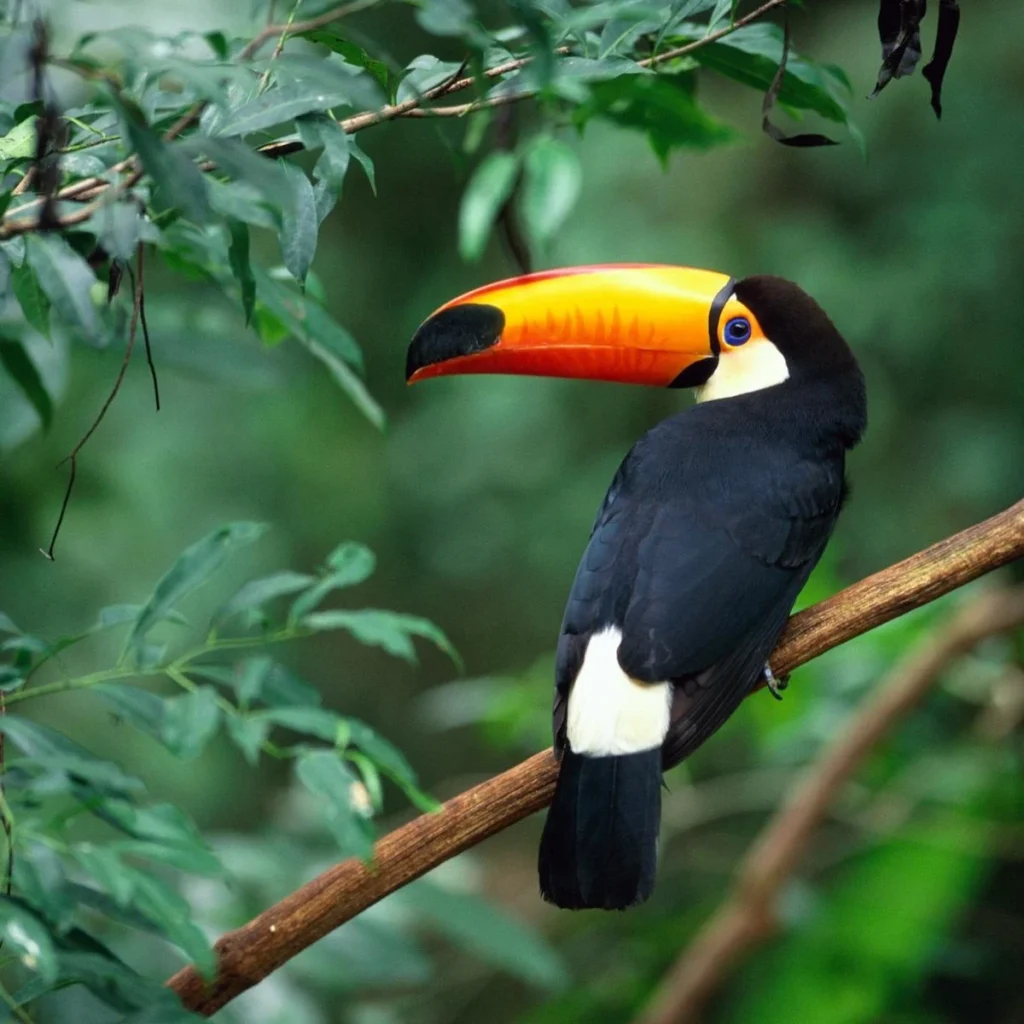
Toucans spend much of their time in trees, feeding on fruit, insects, eggs, and small animals.
Toucan Amazon Rainforest Birds
The phrase toucan Amazon rainforest birds refers to several species of toucans and related birds found throughout the region.
Toucans belong to the family Ramphastidae.
Among the better-known Amazonian species are:
- Keel-billed Toucan
- Channel-billed Toucan
- White-throated Toucan
- Yellow-ridged Toucan
- Chestnut-eared Aracari
- Many-banded Aracari
Aracaris are smaller relatives of the larger toucans.
Their bills can also be remarkably colorful.
Why Do Toucans Have Such Large Bills?
A toucan’s bill serves several purposes.
It helps the bird:
- Reach fruit on thin branches
- Manipulate food
- Defend itself
- Display to other birds
- Regulate heat
The bill is also an important part of the toucan’s visual identity.
When searching for Amazon rainforest birds pictures, toucans frequently appear because their dramatic appearance makes them particularly photogenic.
Macaw Amazon Rainforest Birds
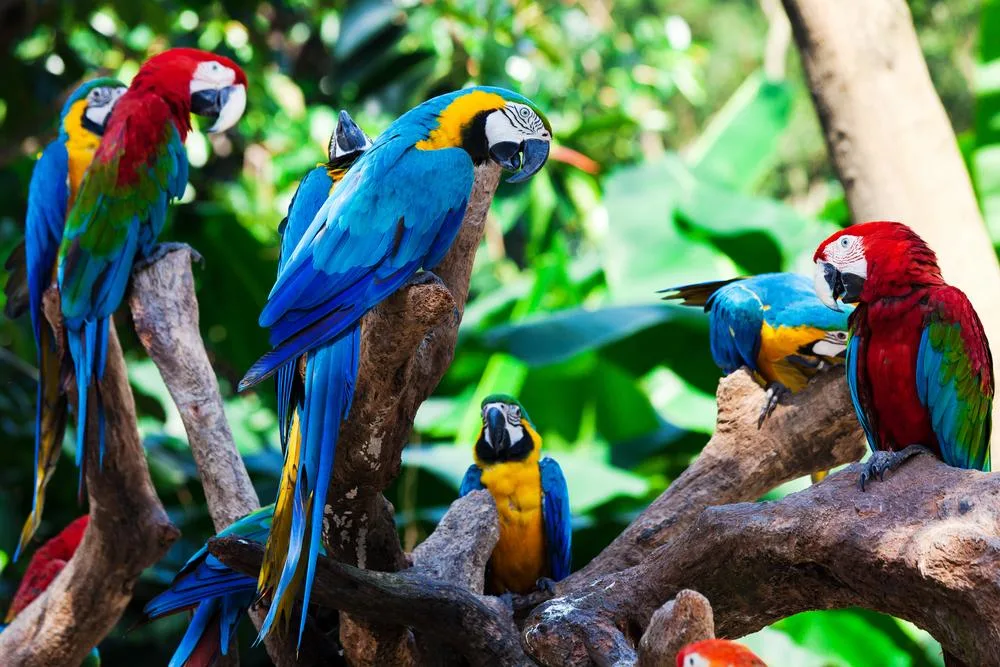
Macaws are among the most beautiful and recognizable Amazon rainforest birds.
These large parrots are famous for:
- Brilliant colors
- Strong curved bills
- Long tails
- Loud calls
- Intelligence
- Social behavior
Several macaw species can be found in the Amazon.
Important Amazonian macaws include:
- Scarlet Macaw
- Blue-and-Yellow Macaw
- Red-and-Green Macaw
- Blue-winged Macaw
- Chestnut-fronted Macaw
- Military Macaw
One of the most spectacular places to observe macaws is an Amazonian clay lick.
Why Do Macaws Visit Clay Licks?
Clay licks are exposed areas of mineral-rich soil where parrots and macaws gather to eat clay.
These locations can become important social gathering places.
At certain sites, dozens or even hundreds of colorful parrots may arrive, creating one of the most impressive wildlife spectacles in the rainforest.
Clay lick visits are particularly famous in parts of the Peruvian Amazon.
The sight of red, blue, yellow, and green birds gathering against a backdrop of dense rainforest is one of the reasons birdwatchers travel to the region.
Amazon Rainforest Birds List
If you are building an Amazon rainforest birds list, it is useful to organize species according to their appearance, behavior, and ecological role.
Parrots and Macaws
- Scarlet Macaw
- Blue-and-Yellow Macaw
- Red-and-Green Macaw
- Blue-winged Macaw
- Mealy Amazon
- Orange-winged Amazon
- White-eyed Parakeet
Toucans and Aracaris
- Keel-billed Toucan
- Channel-billed Toucan
- White-throated Toucan
- Chestnut-eared Aracari
- Many-banded Aracari
Birds of Prey
- Harpy Eagle
- Crested Eagle
- Ornate Hawk-Eagle
- Black-and-white Hawk-Eagle
- Roadside Hawks
- Black Vulture
- King Vulture
Forest Birds
- Hoatzin
- Great Potoo
- Motmots
- Jacamars
- Antbirds
- Manakins
- Oropendolas
- Curassows
Water and Wetland Birds
- Amazon Kingfisher
- Green Kingfisher
- Cocoi Heron
- Capped Heron
- Sunbittern
- Anhinga
This list represents only a fraction of the Amazon’s bird diversity.
Amazon Rainforest Birds Facts
The Amazon rainforest birds facts that surprise many visitors are not always related to colors.
Birds have evolved extraordinary adaptations to survive in one of the world’s most complex ecosystems.
Fact 1: Many Birds Spend Their Lives in the Canopy
The rainforest canopy creates an enormous three-dimensional habitat.
Many species rarely descend to the forest floor.
Instead, they feed, nest, and interact high above the ground.
Fact 2: Bird Calls Are Essential for Communication
Dense vegetation makes visual communication difficult.
Bird calls therefore become extremely important.
Birds use sounds to:
- Find mates
- Defend territories
- Warn of predators
- Communicate with partners
- Keep contact with groups
- Announce food sources
This is why Amazon birdwatching often begins with listening rather than looking.
Fact 3: Bright Colors Have Many Functions
The spectacular colors of macaws and other birds can help individuals recognize members of their species.
Colors may also play a role in courtship and social communication.
However, not every Amazon bird is brightly colored.
Many species are brown, gray, green, or olive-colored, allowing them to disappear into the forest.
Amazon Rainforest Birds Sounds
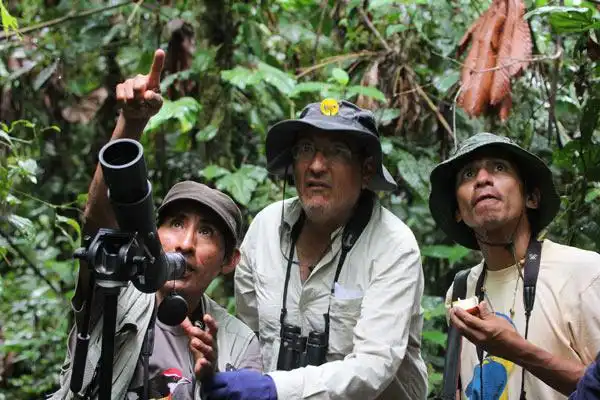
Amazon rainforest birds sounds are one of the defining characteristics of the jungle.
The rainforest can seem visually quiet from a distance, but once you stop and listen, it becomes a constantly changing soundscape.
You may hear:
- Macaw calls
- Parrot chatter
- Toucan calls
- Hummingbird wing sounds
- Pigeon calls
- Hawk cries
- Woodpecker tapping
- Oropendola songs
- Antbird calls
- Insect sounds
- Frog calls
Some bird calls are loud and unmistakable, while others are soft and difficult to locate.
For birdwatchers, identifying a bird by sound can be just as rewarding as seeing it.
Amazon Rainforest Birds of Prey
The Amazon rainforest birds of prey occupy important positions within the ecosystem.
These predators hunt other animals and help regulate populations.
Among the most impressive is the Harpy Eagle.
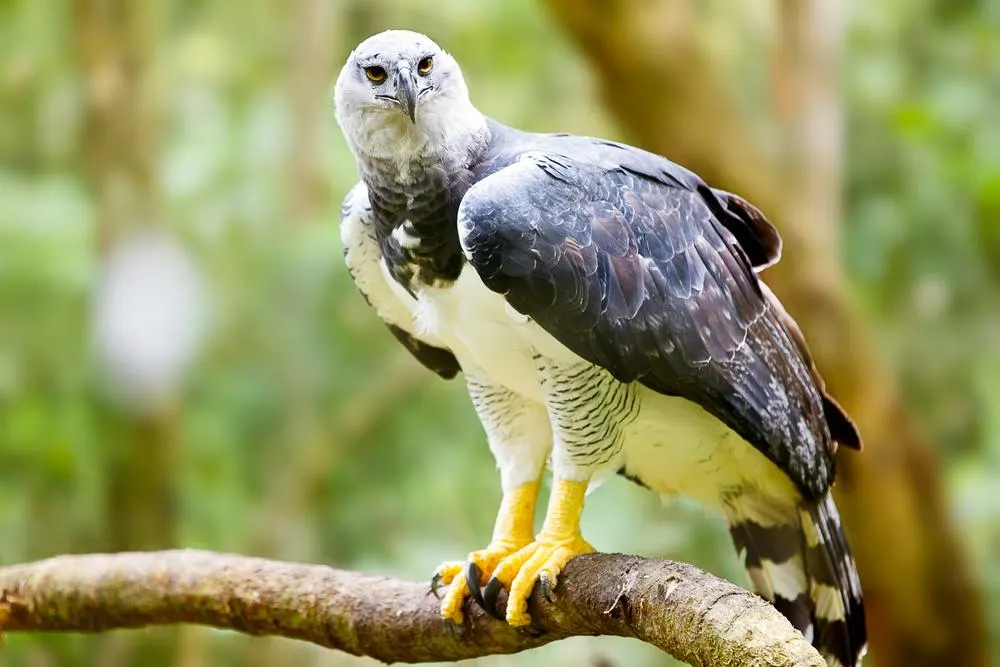
Harpy Eagle
The Harpy Eagle is one of the most powerful eagles associated with tropical American forests.
It has:
- Massive talons
- Broad wings
- A powerful hooked bill
- A prominent crest
- Exceptional hunting ability
Harpy Eagles are specialized forest predators.
Their prey can include arboreal mammals and birds.
Seeing one in the wild is considered a remarkable experience because these eagles require large areas of suitable forest.
Other Amazon Birds of Prey
The Amazon supports numerous raptors beyond the Harpy Eagle.
These include:
Crested Eagle
A forest predator capable of hunting birds and other animals.
Ornate Hawk-Eagle
A beautifully patterned raptor associated with forest habitats.
Black-and-White Hawk-Eagle
A striking species with contrasting plumage.
King Vulture
A large scavenging bird with a distinctive appearance.
Black Vulture
Often seen soaring above open areas and settlements.
Birds of prey demonstrate that the Amazon ecosystem contains predators at many levels, from tiny insect hunters to powerful canopy eagles.
Rare Amazon Rainforest Birds
The term rare Amazon rainforest birds can refer to species that are genuinely uncommon, difficult to observe, restricted to specific habitats, or simply difficult to locate.
Some birds may be relatively widespread but rarely seen because they live deep inside dense forest.
Others have specialized habitat requirements.
Examples of birds that can be challenging for birdwatchers include:
- Harpy Eagle
- Crested Eagle
- Great Potoo
- Rufous Potoo
- Various antbirds
- Forest-falcons
- Specialized cotingas
- Certain manakins
- Some ground-dwelling species
Birding in the Amazon often requires patience.
A rare bird may be heard several times before it is finally visible.
Beautiful Amazon Rainforest Birds
The Amazon contains some of the world’s most beautiful birds.
Beauty is subjective, but several species are especially famous for spectacular coloration.
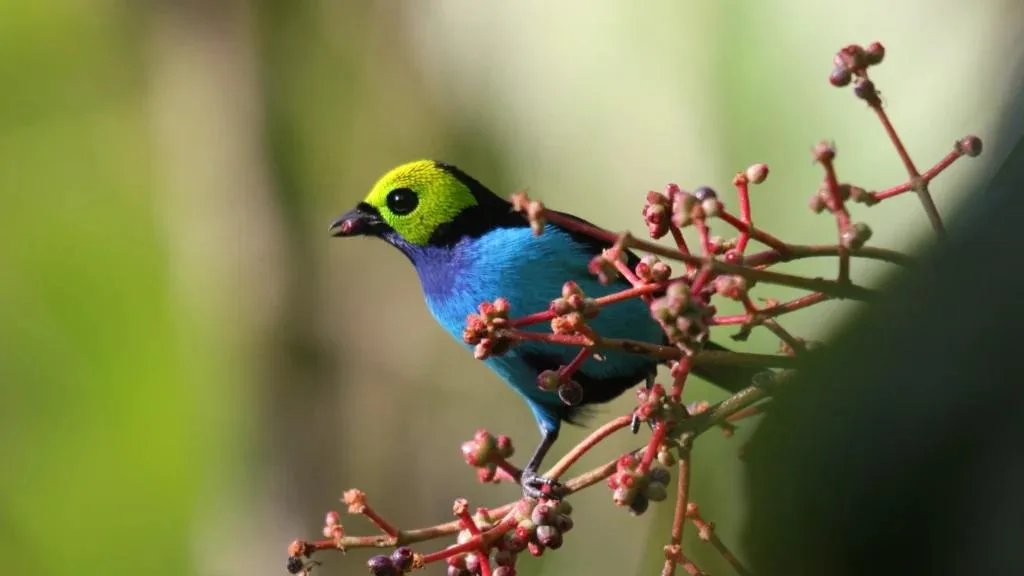
Paradise Tanager
The Paradise Tanager is one of the most colorful birds in the Amazon.
Its contrasting blue, green, red, and yellow coloration makes it a favorite among photographers and birdwatchers.
Scarlet Macaw
Its intense red, yellow, and blue feathers make it one of the rainforest’s most recognizable birds.
Blue-and-Yellow Macaw
The dramatic contrast between blue and yellow creates a striking appearance.
Toucans
Their oversized bills and contrasting plumage make them exceptionally photogenic.
Hummingbirds
Small but brilliantly colored, hummingbirds can display metallic greens, blues, purples, and reds depending on the species and lighting.
Amazon Rainforest Animals: Birds Are Only Part of the Story
The phrase Amazon rainforest animals encompasses much more than birds.
Birds form one of the most visible groups, but the rainforest is also home to:
- Jaguars
- Giant river otters
- Sloths
- Monkeys
- Tapirs
- Capybaras
- Anacondas
- Caimans
- Tree frogs
- Turtles
- Bats
- Thousands of insects
Birds interact with many of these animals.
For example, some birds eat insects disturbed by mammals, while others feed on fruits that help disperse seeds.
This makes birds an important component of the Amazon’s ecological network.
How Birds Help the Amazon Rainforest
Birds perform several essential ecological functions.
Seed Dispersal
Fruit-eating birds consume fruits and transport seeds to new locations.
Toucans, macaws, cotingas, and many other birds contribute to this process.
Pollination
Some birds, especially hummingbirds, visit flowers and can contribute to pollination.
Pest Control
Insect-eating birds consume enormous numbers of insects.
Scavenging
Certain birds help recycle nutrients by consuming carrion.
Food Webs
Birds are both predators and prey.
Their presence connects insects, plants, reptiles, mammals, and larger predators.
Birds From the Amazon Canopy to the Forest Floor
One of the most fascinating things about Amazonian birdlife is vertical diversity.
Imagine the rainforest as a multi-story building.
Upper Canopy
The highest layers receive intense sunlight and contain:
- Macaws
- Toucans
- Parrots
- Eagles
- Large fruit-eating birds
Middle Canopy
This zone contains:
- Tanagers
- Woodpeckers
- Cotingas
- Hummingbirds
- Smaller parrots
Understory
Here you may encounter:
- Antbirds
- Manakins
- Small insectivores
- Forest-falcons
Forest Floor
Some birds forage near the ground, including certain:
- Curassows
- Tinamous
- Antbirds
- Pigeons
This vertical structure explains why a single forest trail can contain many different bird communities.
Amazon Birdwatching: How to Find Birds
Birdwatching in the Amazon requires a different strategy from birdwatching in an open landscape.
Instead of simply scanning a distant horizon, listen carefully and search systematically.
Start Early
The early morning is often one of the best periods for bird activity.
Birds are calling, feeding, and moving through the forest.
Listen Before Looking
A bird call can reveal where a bird is located.
Once you hear it, follow the sound and search the vegetation carefully.
Look for Movement
Instead of searching for an entire bird, watch for:
- Moving leaves
- Flying silhouettes
- Branch movement
- Flashing colors
- Birds crossing gaps between trees
Bring Binoculars
Many Amazonian birds remain high in the canopy.
Binoculars can turn an indistinct shape into a clearly identifiable species.
Why Amazon Bird Photography Is Challenging
Taking Amazon rainforest birds pictures can be surprisingly difficult.
Dense vegetation, low light, high humidity, and fast-moving birds create significant challenges.
A bird may appear for only a few seconds before disappearing behind leaves.
Photographers often need:
- Patience
- Long lenses
- Fast shutter speeds
- Good fieldcraft
- Knowledge of bird behavior
- Early starts
Some of the best photographs are captured at forest edges, riverbanks, clay licks, and clearings because these areas provide better visibility.
Amazon Birds and Seasonal Changes
Bird activity can change throughout the year.
Rainfall influences:
- Fruit availability
- Flowering
- Insect abundance
- River levels
- Flooding
- Bird movement
During certain periods, flooded forests create temporary feeding habitats.
When rivers rise, some forest areas become submerged.
When water levels fall, beaches, mudflats, and exposed riverbanks may appear, creating new feeding opportunities for other species.
This dynamic environment contributes to the extraordinary diversity of Amazonian birdlife.
Amazon Rainforest Birds Eye View
The phrase Amazon rainforest birds eye view can describe two different ideas.
First, it can mean viewing the rainforest from above, such as from a canopy tower or elevated observation point.
Second, it can refer to birds themselves flying above the rainforest canopy.
From an elevated viewpoint, visitors can see how enormous and continuous the forest really is.
Instead of seeing individual trees, you may see a seemingly endless sea of green extending toward the horizon.
Macaws and other large birds sometimes cross this landscape at eye level or below elevated observation points, creating spectacular photographic opportunities.
Amazon Rainforest Birds Eye: Seeing the Jungle Differently
An elevated perspective also reveals the structure of the forest.
From ground level, vegetation can seem dense and almost impenetrable.
From above, you can see:
- Canopy layers
- River channels
- Forest clearings
- Palm crowns
- Wetlands
- Distant hills
- Forest edges
This perspective is especially valuable in regions where canopy towers or elevated platforms are available.
Best Places to See Amazon Rainforest Birds
Different Amazon destinations provide different birdwatching opportunities.
Peruvian Amazon
Peru is an excellent destination for birdwatching because its Amazonian forests contain tremendous habitat diversity.
Southern Peru, including areas around Puerto Maldonado and Tambopata, is particularly attractive to wildlife enthusiasts.
Possible sightings include:
- Macaws
- Toucans
- Parrots
- Tanagers
- Hummingbirds
- Raptors
- Hoatzins
- Kingfishers
Why the Peruvian Amazon Is Special for Birdwatching
A Peruvian Amazon map with cities shows how southern and northeastern Peru provide different entry points into the rainforest.
The region around Puerto Maldonado is particularly well known for wildlife tourism.
The combination of rivers, oxbow lakes, clay licks, wetlands, and primary rainforest creates numerous bird habitats.
For visitors, this means a relatively short trip can potentially produce a surprisingly long Amazon rainforest birds list.
The experience is not simply about counting species.
It is about being surrounded by the sounds, movement, colors, and rhythms of a living rainforest.
Frequently Asked Questions About Amazon Rainforest Birds
How many bird species live in the Amazon rainforest?
The Amazon supports an extraordinary number of bird species, with estimates varying depending on the geographic definition of the Amazon region and the taxonomic treatment used. It is considered one of the richest bird regions on Earth.
What is the most famous Amazon rainforest bird?
Macaws and toucans are among the most famous because of their spectacular colors and distinctive shapes. The Harpy Eagle is another iconic Amazonian bird.
What are the most colorful Amazon rainforest birds?
Paradise Tanagers, macaws, toucans, parrots, cotingas, and hummingbirds are among the most colorful groups.
What Amazon bird has the biggest beak?
Toucans are famous for their enormous bills relative to their body size.
What is the largest bird of prey in the Amazon?
The Harpy Eagle is one of the largest and most powerful forest eagles in the Americas.
Are Amazon rainforest birds dangerous?
Most Amazonian birds pose little threat to humans. Even large birds generally avoid people. The primary challenge for birdwatchers is finding and identifying them.
When is the best time to see Amazon rainforest birds?
Early morning is generally excellent for birdwatching because many species are active and vocal. Local conditions, season, habitat, and weather also influence sightings.
Why are Amazon birds so colorful?
Color can help birds recognize members of their species, attract mates, communicate, and blend into particular environments. The exact function varies among species.
Can you hear Amazon rainforest birds before seeing them?
Absolutely. Many species are easier to detect by sound first. Experienced birdwatchers often identify a bird from its call before locating it visually.
Final Thoughts on Amazon Rainforest Birds
The Amazon rainforest birds represent one of the most extraordinary parts of the Amazon ecosystem.
From the brilliant feathers of macaws and tanagers to the enormous bills of toucans and the powerful talons of the Harpy Eagle, Amazonian birds demonstrate an incredible range of adaptations.
For anyone searching for Amazon rainforest birds pictures with names, studying photographs is a great first step, but seeing these animals in their natural habitat offers something much more powerful.
A macaw flying above the canopy is not simply a colorful photograph.
A toucan calling from a distant branch is not simply a bird identification.
A Harpy Eagle hidden somewhere in the forest is not simply another item on a checklist.
Together, these encounters reveal how interconnected the Amazon ecosystem really is.
The best way to experience Amazon rainforest birds is to slow down and listen. The jungle constantly communicates through calls, wingbeats, movement, and color. Sometimes you will see a brilliant macaw immediately. Other times, you may hear a mysterious call for several minutes before finally finding the bird hidden among the leaves.
Whether you are interested in rare Amazon rainforest birds, Amazon birds of prey, toucan Amazon rainforest birds, macaw Amazon rainforest birds, or simply the most beautiful Amazon rainforest birds, the region offers an extraordinary world waiting to be discovered.
And perhaps the most remarkable lesson is that every bird is part of something much larger: the Amazon rainforest itself—a vast living ecosystem where rivers, trees, insects, mammals, birds, and people are connected by an intricate web of life.