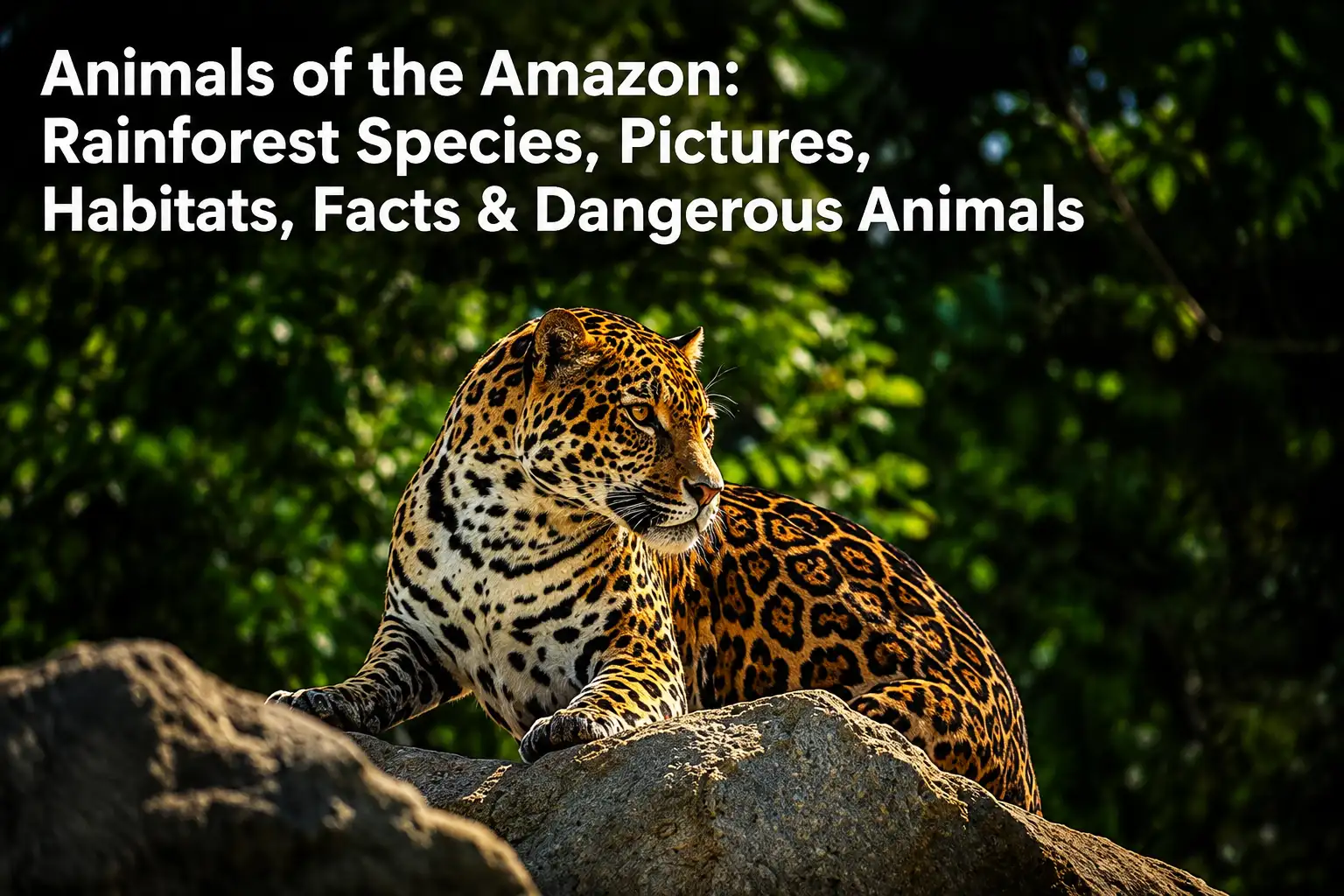
The Amazon is one of the richest wildlife regions on Earth, home to an extraordinary variety of mammals, birds, reptiles, amphibians, fish, insects, and other creatures. The phrase animals of the Amazon includes species that live deep inside the forest, along rivers and wetlands, high in the canopy, and even in the treetops of the emergent layer. Some are familiar, such as jaguars, giant river otters, anacondas, toucans, and sloths, while others are rare, tiny, nocturnal, or remarkably specialized. This guide brings together the main animals of the Amazon rainforest, explains where they live, highlights some of the most interesting species, and explores dangerous, endangered, rare, and unusual Amazon wildlife.
Animals of the Amazon Rainforest
The animals of the Amazon rainforest occupy several different environments rather than living in one uniform jungle habitat. The enormous forest contains rivers, oxbow lakes, flooded forests, swamps, tree trunks, leaf litter, underground spaces, and multiple vertical layers of vegetation. Each environment supports different wildlife. Jaguars may hunt along riverbanks and through dense forest, sloths spend much of their lives in trees, macaws travel through the upper canopy, and caimans patrol waterways. Thousands of insect species occupy almost every available ecological niche, while frogs, snakes, turtles, monkeys, and birds exploit habitats from the forest floor to the highest branches. Because the Amazon covers a vast area across several South American countries, its wildlife varies considerably from one region to another.
Jungle Animals of the Amazon
The expression jungle animals Amazon commonly refers to the spectacular wildlife associated with tropical rainforest environments. These include predators, herbivores, tree-dwelling mammals, colorful birds, reptiles, amphibians, and countless insects.
Some of the best-known animals of the Amazon jungle include:
- Jaguar
- Giant river otter
- Giant anteater
- Three-toed sloth
- Brown-throated sloth
- Capybara
- Giant armadillo
- Tapir
- Spider monkey
- Howler monkey
- Squirrel monkey
- Golden lion tamarin
- Harpy eagle
- Scarlet macaw
- Toucan
- Anaconda
- Green iguana
- Caiman
- Poison dart frog
- Piranha
Animals of the Amazon Forest
The animals of the Amazon forest have evolved extraordinary adaptations to heat, humidity, seasonal flooding, dense vegetation, and intense competition for food. Some species specialize in eating fruit, nectar, leaves, insects, fish, or other animals, while others are opportunistic feeders. The forest is also strongly interconnected: birds disperse seeds, predators regulate prey populations, insects pollinate flowers, and mammals transport seeds over considerable distances. Even animals that appear insignificant can have important ecological roles.
Top 10 Animals of the Amazon
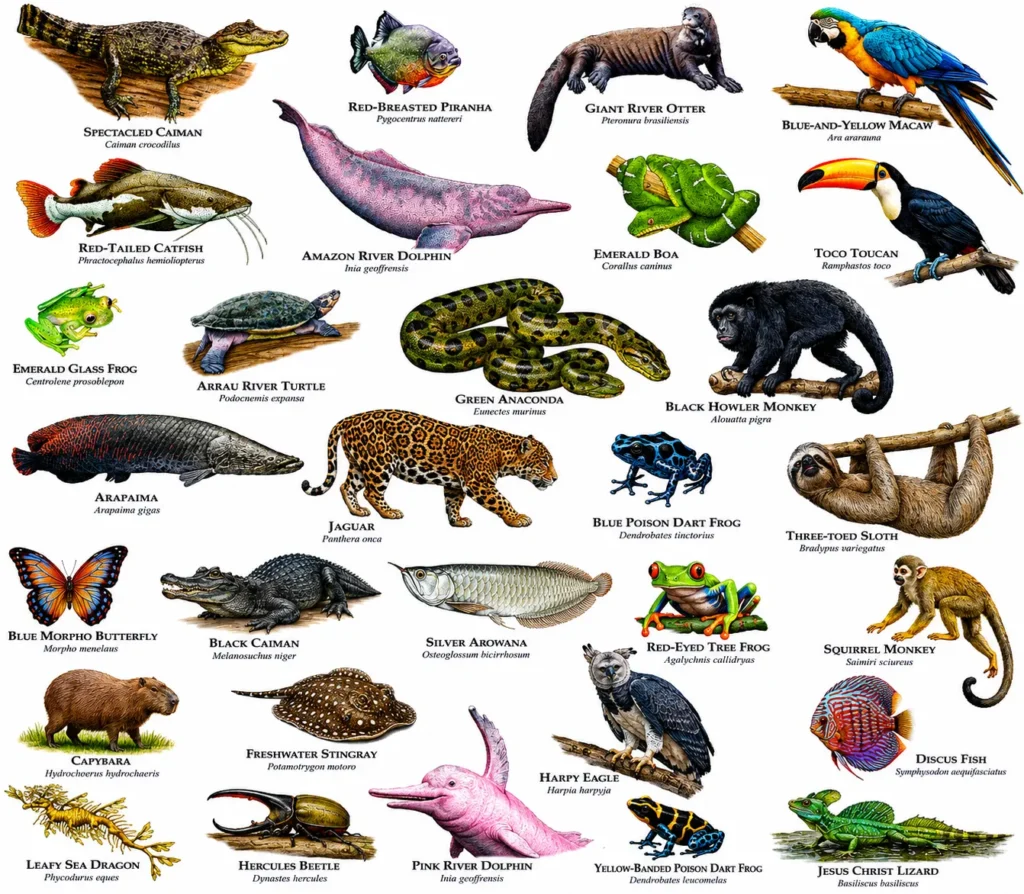
A top 10 animals of the Amazon list can be based on fame, ecological importance, unusual adaptations, or simply how fascinating the species are. The following selection combines some of the Amazon’s most recognizable and remarkable wildlife.
1. Jaguar
The jaguar is the largest cat in the Americas and one of the Amazon’s most powerful predators. Its muscular body and exceptionally strong jaws allow it to tackle prey that many other cats would avoid. Jaguars are excellent swimmers and may hunt near rivers, wetlands, and flooded forests. Their spotted coats provide camouflage in dappled forest light. Unlike many big cats, jaguars frequently enter water and can prey on fish, turtles, caimans, capybaras, and other animals.
2. Giant River Otter
The giant river otter is a highly social mammal that lives in family groups around Amazonian rivers, lakes, and wetlands. It is an excellent swimmer and communicates with a surprisingly large repertoire of vocalizations. Its long body, webbed feet, and powerful tail make it exceptionally adapted to aquatic life. Fish form an important part of its diet, although it may also capture crustaceans and other aquatic prey.
3. Giant Anteater
The giant anteater is instantly recognizable because of its extremely long snout and enormous bushy tail. It has no teeth and instead uses a long, sticky tongue to collect ants and termites. Its powerful foreclaws can tear open insect nests and also provide protection against predators. Despite its unusual appearance, it is highly specialized for its ecological role.
4. Sloth
Sloths are famous for their slow movements, but their lifestyle is remarkably efficient. Their long limbs and curved claws allow them to remain suspended from branches for long periods. Their slow metabolism helps them survive on relatively low-energy leaves. Sloths also provide habitat for small organisms living in their fur, creating a miniature ecosystem on their bodies.
5. Capybara
The capybara is the world’s largest living rodent. It is strongly associated with water and often lives near rivers, marshes, and flooded habitats. Capybaras are social animals and can gather in groups, especially where food and water are plentiful. Their partially webbed feet make them capable swimmers, and water provides an important refuge from predators.
6. Harpy Eagle
The harpy eagle is one of the most powerful eagles in the world. It hunts in the upper levels of the rainforest and has exceptionally strong feet and talons. Its prey can include tree-dwelling mammals such as sloths and monkeys. The species requires large areas of mature forest, making the protection of extensive rainforest particularly important for its survival.
7. Anaconda
The green anaconda is among the heaviest snakes in the world. It spends considerable time in or around water, where its muscular body is well suited to ambushing prey. It is a constrictor rather than a venomous snake. Capybaras, fish, birds, turtles, and other animals may become prey, depending on the snake’s size and habitat.
8. Pink River Dolphin
The Amazon river dolphin, often called the pink river dolphin, is one of the world’s most unusual freshwater dolphins. Adults can develop a pinkish coloration, although color varies considerably between individuals. Its flexible neck and broad flippers help it maneuver through flooded forests and complicated river habitats where ordinary marine-style swimming would be difficult.
9. Poison Dart Frog
Poison dart frogs are small but visually spectacular amphibians. Some species display brilliant colors that warn predators of chemical defenses. Their toxins are associated with their diet and ecological environment rather than being produced in the same way by every species. Their tiny size contrasts dramatically with the extraordinary biological defenses some species possess.
10. Scarlet Macaw
The scarlet macaw is one of the Amazon’s most recognizable birds. Its brilliant red, yellow, and blue feathers make it especially striking against green vegetation. Strong curved bills allow macaws to crack hard fruits and seeds. They also contribute to seed movement as they travel through the forest.
Rainforest Animals List A–Z
An A–Z rainforest animals list provides a convenient way to explore Amazon wildlife without limiting the subject to only the most famous species. The Amazon contains far more animals than can be included in a single list, but the following selection demonstrates its extraordinary diversity.
- A — Anaconda: A huge aquatic constrictor.
- A — Armadillo: Mammals protected by tough body armor.
- B — Black Caiman: A major aquatic predator.
- B — Boa Constrictor: A powerful nonvenomous snake.
- C — Capybara: The world’s largest rodent.
- C — Caiman: Common freshwater crocodilian relatives.
- D — Dolphin: Several freshwater dolphin populations inhabit Amazonian waterways.
- E — Electric Eel: A freshwater fish capable of producing powerful electric discharges.
- F — Fishing Bat: A bat capable of detecting prey close to water.
- G — Giant Otter: A social aquatic predator.
- G — Giant Anteater: A specialist ant and termite eater.
- H — Harpy Eagle: A powerful canopy predator.
- H — Howler Monkey: Famous for its exceptionally loud calls.
- I — Iguana: A primarily herbivorous tree-dwelling reptile.
- J — Jaguar: The Amazon’s iconic large cat.
- K — Kinkajou: A nocturnal mammal adapted to life in trees.
- L — Leafcutter Ant: A fungus-growing social insect.
- M — Macaw: Large, colorful parrots of the rainforest.
- M — Manatee: A slow-moving aquatic herbivore.
- O — Ocelot: A spotted nocturnal cat.
- P — Piranha: Predatory and omnivorous freshwater fish.
- P — Poison Dart Frog: Small amphibians known for striking colors.
- S — Sloth: Slow-moving mammals specialized for life in trees.
- T — Tapir: A large forest mammal and important seed disperser.
- T — Toucan: Famous for its oversized bill.
- V — Vampire Bat: A specialized bat that feeds on blood.
- W — Woolly Monkey: A large New World monkey found in rainforest habitats.
Rainforest Animals List With Pictures
A rainforest animals list with pictures is especially useful because Amazon wildlife has an enormous variety of shapes, colors, and body structures. Photographs can reveal differences that are difficult to describe with words alone, such as the facial markings of an ocelot, the enormous bill of a toucan, the camouflage of a jaguar, or the unusual body shape of a leaf insect. When creating a visual wildlife guide, it is useful to organize pictures of animals of the Amazon rainforest by animal group and habitat rather than presenting a random collection of photographs.
Rainforest Animals Photos: What to Look For
Good rainforest animals photos can show more than appearance. Images can reveal behavior and habitat, including:
- Jaguars swimming or walking along riverbanks.
- Sloths hanging beneath branches.
- Macaws feeding in the canopy.
- Giant otters hunting in rivers.
- Capybaras resting beside water.
- Harpy eagles perched high above the forest floor.
- Poison dart frogs among leaves and moss.
- Anacondas partly submerged in shallow water.
- Monkeys moving between branches.
- Toucans feeding on fruit.
100 Jungle Animals
A literal list of 100 jungle animals from the Amazon can become extremely broad because the rainforest contains enormous numbers of insects, fish, birds, amphibians, reptiles, and mammals. A representative list can nevertheless illustrate the range of life found in the region.
- Jaguar
- Ocelot
- Margay
- Puma
- Giant otter
- Neotropical otter
- Giant anteater
- Southern tamandua
- Brown-throated sloth
- Three-toed sloth
- Capybara
- Lowland tapir
- Giant armadillo
- Nine-banded armadillo
- Collared peccary
- White-lipped peccary
- Red brocket deer
- Spider monkey
- Howler monkey
- Squirrel monkey
- Woolly monkey
- Capuchin monkey
- Tamarin
- Titi monkey
- Saki monkey
- Uakari
- Kinkajou
- Coati
- Agouti
- Paca
- Porcupine
- Harpy eagle
- Crested eagle
- Black-and-white hawk-eagle
- Scarlet macaw
- Blue-and-yellow macaw
- Red-and-green macaw
- Mealy parrot
- Toucan
- Aracari
- Hoatzin
- King vulture
- Great potoo
- Sunbittern
- Horned screamer
- Amazon kingfisher
- Green iguana
- Caiman lizard
- Green anaconda
- Boa constrictor
- Bushmaster
- Fer-de-lance
- Coral snake
- Emerald tree boa
- Mata mata turtle
- Yellow-footed tortoise
- Arrau turtle
- Black caiman
- Spectacled caiman
- Pink river dolphin
- Amazonian manatee
- Piranha
- Arapaima
- Electric eel
- Peacock bass
- Catfish
- Freshwater stingray
- Candiru
- Poison dart frog
- Glass frog
- Red-eyed tree frog
- Amazon horned frog
- Giant river frog
- Leafcutter ant
- Bullet ant
- Army ant
- Hercules beetle
- Rhinoceros beetle
- Atlas moth
- Blue morpho butterfly
- Owl butterfly
- Birdwing butterfly
- Walking stick insect
- Leaf insect
- Praying mantis
- Tarantula
- Golden orb-weaver spider
- Brazilian wandering spider
- Scorpion
- Mosquito
- Rhinoceros beetle
- Cicada
- Katydid
- Orchid mantis
- Hercules moth
- Giant water bug
- Dragonfly
- Treehopper
- Stingless bee
- Amazonian freshwater crab
This list is illustrative rather than a complete inventory. The true number of Amazon animal species is vastly greater.
Animals of the Amazon River
The animals of the Amazon River include some of the rainforest’s most specialized aquatic species. The river system is not simply a channel of flowing water; it includes tributaries, floodplain lakes, seasonally flooded forests, muddy banks, sandy beaches, and vegetation-filled backwaters. Pink river dolphins navigate among submerged roots, giant otters hunt fish, caimans wait near shorelines, and fish species such as arapaima and piranhas occupy different ecological niches. Freshwater turtles and manatees also depend on these waterways. Seasonal changes in water levels can dramatically transform the available habitat, allowing aquatic animals to enter areas of forest that are dry during other parts of the year.
Unusual Amazon River Animals
Some particularly unusual river animals include:
- Arapaima: A huge freshwater fish capable of breathing atmospheric air.
- Electric eel: Produces electrical discharges for hunting, defense, and sensing.
- Freshwater stingrays: Relatives of marine rays that evolved for freshwater environments.
- Pink river dolphin: Highly maneuverable in complex flooded habitats.
- Giant river otter: A fast aquatic hunter that lives socially.
- Mata mata turtle: A bizarre-looking turtle that resembles floating vegetation.
Animals in the Emergent Layer of the Amazon Rainforest
The emergent layer of the Amazon rainforest consists of the tallest trees rising above the main canopy. Conditions here can be very different from those near the ground: sunlight is intense, winds are stronger, temperatures can fluctuate more, and animals may have to move across exposed branches. Large birds are particularly important inhabitants of this zone. Harpy eagles, macaws, parrots, toucans, and other birds use the upper forest for feeding, nesting, and movement.
Animals That Live in the Emergent Layer of the Amazon Rainforest
Typical examples include:
- Harpy eagle
- Scarlet macaw
- Blue-and-yellow macaw
- Red-and-green macaw
- Large parrots
- Toucans
- Some bats
- Tree-dwelling monkeys
- Large butterflies
- Specialized insects
The emergent layer is also important because flowering and fruiting trees provide food resources at different times of year. An animal that can fly or climb efficiently can move between isolated food sources in the upper forest.
Animals in the Canopy Layer of the Amazon Rainforest
The canopy layer forms a vast green roof below the tallest emergent trees. It contains enormous numbers of leaves, flowers, fruits, insects, birds, and tree-dwelling mammals. Many Amazon species spend most of their lives above the ground. Monkeys travel through branches, sloths remain attached to trees, macaws search for fruit, and tree frogs reproduce in elevated habitats. The canopy is effectively an ecosystem suspended above the forest floor.
Canopy Specialists
Important canopy animals include:
- Sloths
- Spider monkeys
- Howler monkeys
- Woolly monkeys
- Squirrel monkeys
- Kinkajous
- Toucans
- Macaws
- Parrots
- Tree frogs
- Iguanas
- Tree boas
- Bats
- Butterflies
- Beetles
- Leaf insects
One fascinating feature of canopy life is that animals often use different levels of the same tree. A fruit-eating bird may feed near the outer branches, while a monkey moves through stronger interior branches and an insect hides beneath leaves.
Animals That Live in the Understory Layer of the Amazon Rainforest
The understory of the Amazon rainforest lies below the canopy and above the forest floor. It is darker and more enclosed than the upper layers, with dense vegetation creating a maze of stems, leaves, vines, and branches. Animals living here often rely on camouflage, stealth, hearing, smell, and careful movement rather than simply flying over obstacles.
Examples include:
- Ocelots
- Margays
- Jaguars
- Tamarin monkeys
- Titi monkeys
- Iguanas
- Tree snakes
- Tree frogs
- Coatis
- Kinkajous
- Insects and spiders
Why the Understory Is Important
The understory provides shelter and feeding opportunities for animals that do not specialize in the tallest trees. Predators can move quietly through dense vegetation, while smaller animals can hide among leaves and vines. Many species move between the understory and canopy depending on food availability and the time of day.
Animals on the Forest Floor of the Amazon Rainforest
The forest floor of the Amazon rainforest receives much less sunlight than the upper layers. Despite this, it is extremely active. Fallen leaves, fruit, branches, animal remains, fungi, microorganisms, and soil organisms create a constantly changing environment. Large mammals such as jaguars, tapirs, peccaries, and giant anteaters move through this layer, while countless insects and other small creatures live among the leaf litter.
Forest Floor Animals
Notable examples include:
- Jaguar
- Giant anteater
- Tapir
- Peccary
- Armadillo
- Agouti
- Paca
- Coati
- Poison dart frogs
- Snakes
- Tortoises
- Leafcutter ants
- Beetles
- Spiders
- Earthworms
- Numerous decomposer organisms
An unusual fact about the forest floor is that many nutrients are rapidly recycled. Dead leaves and organic matter do not simply accumulate indefinitely; fungi, bacteria, insects, and other organisms break material down and return nutrients to the ecosystem.
Dangerous Animals of the Amazon
The dangerous animals of the Amazon include predators, venomous snakes, electrically defensive fish, biting insects, and animals capable of causing injury when threatened. However, the idea of a “dangerous” rainforest animal can be misleading. Most wild animals generally avoid humans rather than actively seeking them out. Risk depends heavily on habitat, behavior, proximity, and whether an animal feels threatened.
Most Dangerous Animals of the Amazon Rainforest
Among the animals commonly considered potentially dangerous are:
Jaguar
Jaguars possess enormous physical strength and powerful jaws. They are capable predators, but encounters with people are uncommon. Their ecological role is much more important than their reputation as a threat.
Green Anaconda
The green anaconda is enormous and powerful, but it is not normally an animal that hunts people. Its preferred prey consists of animals that it can overpower and swallow. Most people are much more likely to see evidence of an anaconda than encounter one directly.
Black Caiman
Large black caimans are capable aquatic predators with powerful jaws. Their size and strength make them potentially dangerous, especially in waterways where people and animals overlap.
Venomous Snakes
The Amazon contains several medically significant venomous snakes, including lanceheads, coral snakes, and bushmasters. Their venom has evolved for subduing prey and defense. Most snakes prefer to escape rather than confront something as large as a human.
Electric Eel
Despite its name, the electric eel is a fish rather than a true eel. It can generate strong electrical discharges and uses electricity to locate prey, communicate, defend itself, and incapacitate smaller animals.
Piranha
Piranhas have a fearsome reputation, but their behavior is more complicated than popular stories suggest. Many species are omnivorous or opportunistic and may feed on fish, insects, fruits, seeds, carrion, and other food.
Brazilian Wandering Spider
Some large wandering spiders possess medically significant venom. They are nocturnal hunters and generally avoid humans.
Deadliest Animals of the Amazon
The term deadliest animals of the Amazon should be treated carefully because danger is not determined only by physical strength or venom. An animal can be highly dangerous in theory but rarely encounter humans, while a much smaller organism may have a greater effect on human health because of frequent contact. Mosquitoes are a useful example of this difference: they are tiny compared with jaguars or anacondas, but mosquito-borne diseases can make them much more significant to human health.
Endangered Animals of the Amazon Rainforest
The endangered animals of the Amazon rainforest face pressures including habitat loss, fragmentation, illegal hunting, pollution, overfishing, fires, climate-related changes, and disruption of river ecosystems. Species that require large territories or specialized habitats can be especially vulnerable when forests become fragmented.
Animals of conservation concern include certain populations of:
- Giant otters
- Giant armadillos
- Amazonian manatees
- River turtles
- Harpy eagles
- Jaguars
- Several monkey species
- Some macaws and parrots
- Numerous amphibians
- Specialized freshwater fish
Why Habitat Protection Matters
Protecting Amazon wildlife means protecting more than individual animals. A jaguar requires prey and territory, a river dolphin requires functioning waterways, a macaw needs mature trees for nesting, and many amphibians depend on particular moisture and temperature conditions. Conserving connected ecosystems therefore helps entire communities of species rather than only one animal at a time.
Rare Animals of the Amazon Rainforest
The rare animals of the Amazon rainforest can be difficult to observe because rarity is sometimes combined with nocturnal behavior, camouflage, remote habitats, or naturally low population densities. Some species may be present in a forest but remain almost invisible to visitors.
Examples of elusive or less frequently observed Amazon wildlife include:
- Harpy eagle
- Giant armadillo
- Bushmaster
- Margay
- Amazonian manatee
- Giant river otter
- Certain river turtles
- Potoos
- Nocturnal frogs
- Many specialized insects
What Makes an Amazon Animal Rare?
Rarity can mean several different things. A species may have a small population, occupy a restricted geographic range, or occur naturally at low densities. Another species may be relatively widespread but extremely difficult to see because it is nocturnal or spends its life high in the canopy. Consequently, “rare to see” does not always mean “globally rare.”
Plants and Animals of the Amazon Rainforest
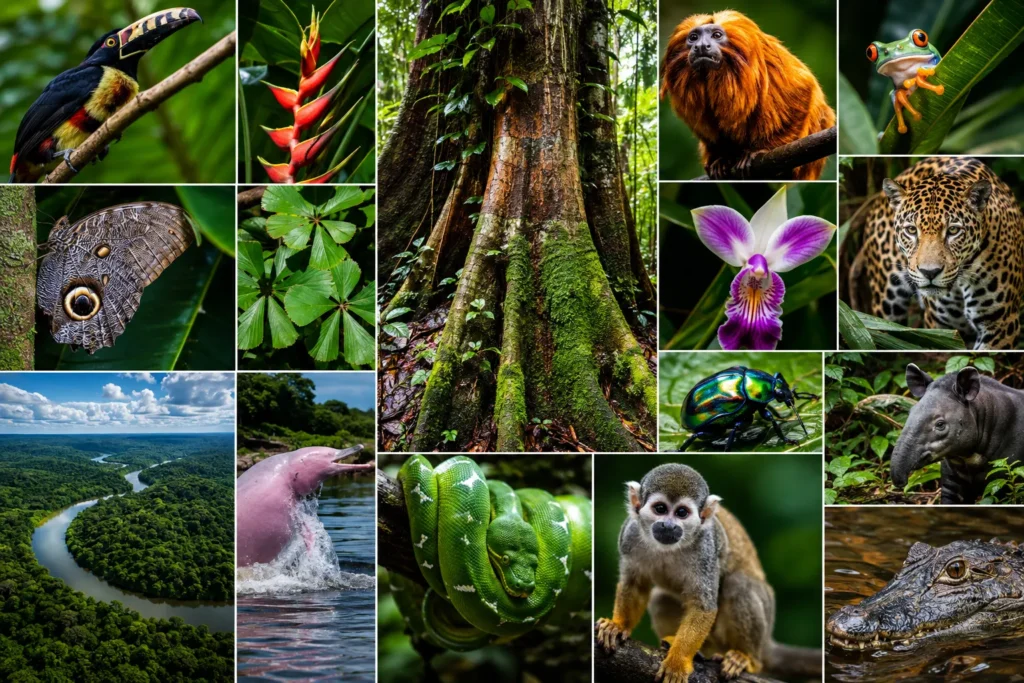
The relationship between plants and animals of the Amazon rainforest is fundamental to the ecosystem. Plants provide food, shelter, nesting locations, and structural habitat, while animals pollinate flowers, disperse seeds, consume vegetation, and influence which plants successfully reproduce.
Animals and Plants of the Amazon Rainforest
Important interactions include:
- Birds eating fruits and spreading seeds.
- Monkeys transporting seeds between trees.
- Bats pollinating flowers and dispersing fruit seeds.
- Insects pollinating plants.
- Leafcutter ants collecting leaves to cultivate fungus.
- Herbivores controlling vegetation through feeding.
- Predators regulating populations of herbivorous animals.
One of the most fascinating examples is the relationship between leafcutter ants and fungi. The ants collect plant material not primarily to eat the leaves themselves, but to use the material in cultivating fungal gardens that provide their colony with food.
Animals of the Amazon Rainforest for Kids
Learning about animals of the Amazon for kids is an excellent way to introduce concepts such as food chains, habitats, adaptations, biodiversity, and conservation. The Amazon is particularly engaging for children because its wildlife includes animals with unusual abilities and appearances.
Amazing Amazon Facts for Kids
- The jaguar is the largest cat in the Americas.
- The capybara is the largest living rodent.
- Sloths can spend much of their lives in trees.
- Giant river otters live in family groups.
- Anacondas are enormous constrictor snakes.
- Electric eels produce powerful electrical discharges.
- Some poison dart frogs have striking warning colors.
- Harpy eagles have enormous talons.
- Pink river dolphins live in freshwater.
- Leafcutter ants grow fungus for food.
- Macaws have strong bills capable of cracking hard foods.
- Some Amazon fish can breathe atmospheric air.
Animals of the Amazon Rainforest KS2
For animals of the Amazon rainforest KS2, the most useful approach is to connect individual species to simple ecological concepts. Children can compare how a sloth is adapted to trees, how a capybara is adapted to life near water, and how a jaguar is adapted for hunting. The rainforest can also demonstrate the idea of food chains: plants provide energy, herbivores consume plants, predators consume other animals, and decomposers recycle nutrients. Students can investigate rainforest layers and identify which animals live in the emergent layer, canopy, understory, and forest floor.
Simple Amazon Food Chain
Plants → insects and herbivores → smaller predators → larger predators
For example:
Leaves → caterpillar → bird → larger predator
Or:
Forest plants → capybara → jaguar
These examples show that animals are connected rather than existing independently.
What Is Unusual About Amazon Animals?
Perhaps the most unusual thing about Amazon wildlife is not one particular animal but the enormous range of adaptations found within a single ecosystem. Some animals live almost permanently in trees, others spend most of their lives underwater, and others survive in the darkness of the forest floor. The Amazon also contains animals that use electricity, echolocation, venom, camouflage, chemical defenses, specialized tongues, powerful jaws, gripping claws, or extraordinary sensory abilities.
Particularly Fascinating Facts
Jaguars can swim well. Unlike the stereotype of big cats avoiding water, jaguars are comfortable in aquatic environments and may hunt around rivers and wetlands.
Sloths host miniature ecosystems. Their fur can support algae and small organisms, creating a microscopic community on the animal itself.
Harpy eagles have extraordinary gripping power. Their powerful talons allow them to capture substantial prey in the forest canopy.
Arapaima can breathe air. This adaptation allows the giant fish to survive in waters where dissolved oxygen may become limited.
Electric eels communicate and hunt electrically. Their electrical abilities are not simply a defensive weapon; they are part of a sophisticated sensory and hunting system.
Leafcutter ants farm fungus. Their colonies demonstrate a remarkable form of agriculture that evolved long before human farming.
River dolphins can navigate flooded forests. During high-water periods, some Amazon waterways extend into areas filled with tree trunks and vegetation, creating a three-dimensional underwater forest.
How Many Animals Live in the Amazon?
There is no single simple number for all animals of the Amazon rainforest because the ecosystem contains an enormous and continually studied diversity of species. New species and previously poorly understood populations continue to be documented, while scientific knowledge varies between animal groups. Mammals, birds, reptiles, amphibians, fish, insects, spiders, and countless smaller organisms all contribute to Amazonian biodiversity.
The important point is that an Amazon wildlife list containing dozens or even 100 animals represents only a small fraction of the ecosystem’s total biological diversity.
Why Amazon Animals Matter
Every species occupies a place within the rainforest ecosystem. Predators influence prey populations, herbivores affect vegetation, birds and mammals disperse seeds, insects pollinate plants, and decomposers return nutrients to the soil. Even species that appear frightening or insignificant can perform functions that help maintain ecological balance.
The Amazon is therefore much more than a collection of famous animals such as jaguars, anacondas, macaws, and sloths. It is a complex living system in which thousands upon thousands of organisms interact. Understanding animals of the Amazon, their habitats, adaptations, and relationships with plants and waterways helps explain why the rainforest is one of the world’s most biologically important ecosystems.