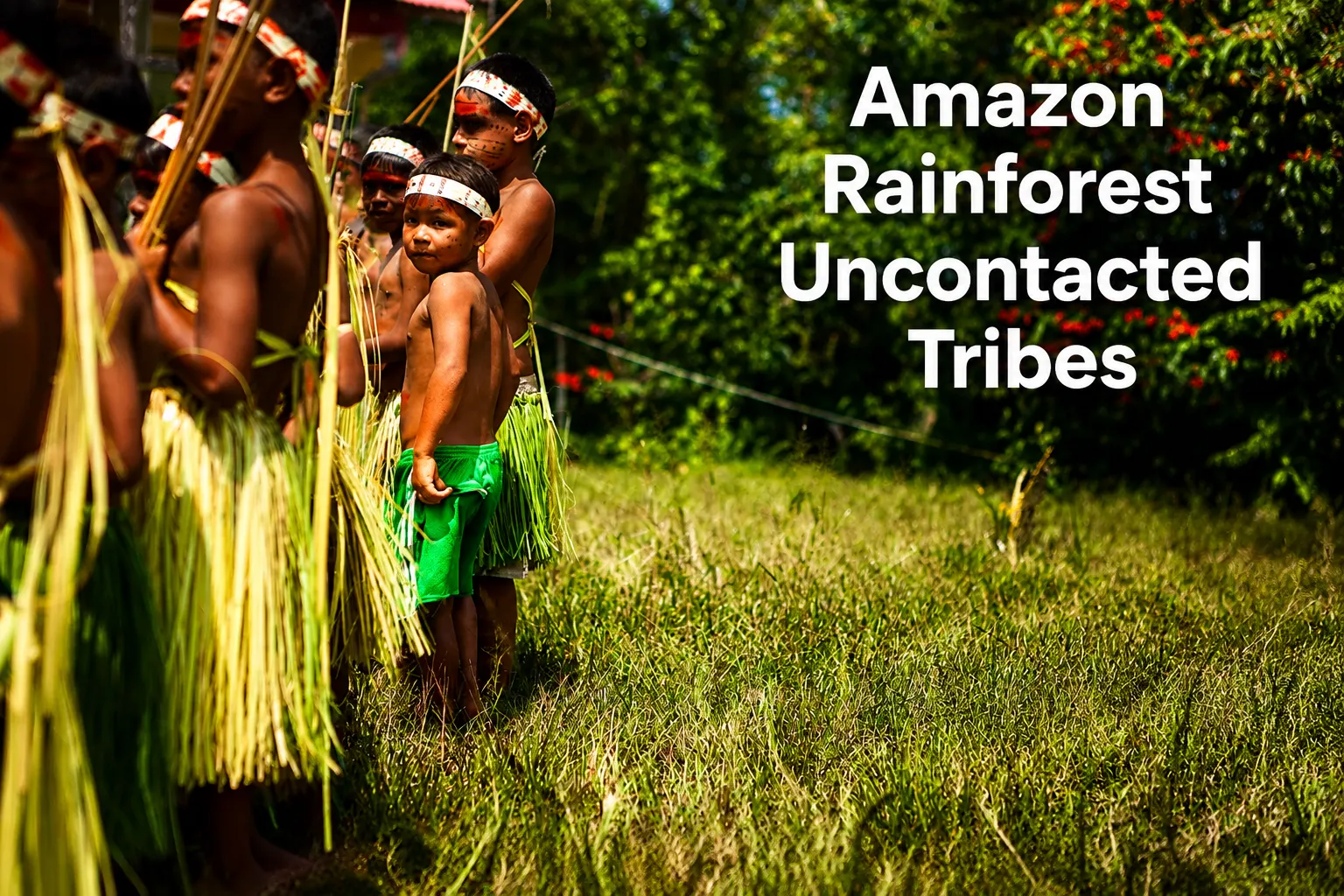
The Amazon rainforest uncontacted tribes are among the most isolated Indigenous peoples on Earth. Living deep within vast forests and river basins across South America, these communities have little or no sustained contact with modern society. Their isolation is not simply a matter of geography: in many cases, it is a deliberate choice shaped by generations of experience with outsiders, disease, violence, exploitation, and the loss of ancestral lands.
But how many uncontacted tribes are there? Are there still uncontacted tribes in the Amazon rainforest? What do we actually know about them, and why are photographs and direct encounters so rare? Understanding these questions requires distinguishing between uncontacted, isolated, and Indigenous communities that have regular contact with surrounding society.
This guide explores the most important facts about Amazon tribes, uncontacted peoples, their territories, lifestyles, languages, dangers, maps, and the unusual evidence that allows researchers to understand their existence without invading their privacy.
Are There Uncontacted Tribes in the Amazon Rainforest?
Yes. There are still Indigenous groups in the Amazon rainforest that live in voluntary isolation and have no sustained relationship with mainstream society. Brazil and Peru contain the largest known concentrations of these isolated peoples, although isolated or minimally contacted Indigenous communities are also associated with other parts of the Amazon basin.
The term “uncontacted tribe” can be misleading because it does not necessarily mean that these people have never seen an outsider. Some groups have probably encountered people from other Indigenous communities, hunters, workers, explorers, or aircraft. Instead, the more precise concept is Indigenous peoples in voluntary isolation: communities that maintain little or no sustained contact with the outside world.
Are There Still Uncontacted Tribes in the Amazon Rainforest?
Absolutely. The Amazon remains large enough to contain areas where people can live beyond regular observation. Dense vegetation, enormous distances, seasonal rivers, swamps, difficult terrain, and protected territories make some areas extremely difficult to access.
Some isolated groups are known primarily through indirect evidence such as:
- Abandoned or recently used gardens
- Temporary shelters
- Footprints
- Canoes or boats
- Hunting structures
- Tools and household objects
- Smoke from fires
- Trails through the forest
- Aerial observations
- Occasional encounters reported by neighboring Indigenous communities
Their continued existence is especially significant because it demonstrates that the Amazon is not an empty wilderness. It is a cultural landscape occupied by peoples with sophisticated relationships with forests, rivers, animals, and seasonal cycles.
Are There Really Uncontacted Tribes in the Amazon Rainforest?
Yes, although “uncontacted” should not be interpreted literally as people who have never encountered another human being outside their community.
Many isolated groups have some awareness that other societies exist. Some have intentionally withdrawn from areas where contact occurred in the past. Others may have experienced occasional encounters without developing permanent relationships with outsiders.
The distinction is important because isolation can be a strategy for survival.
A community may recognize outsiders as a potential threat and deliberately avoid them by:
- Moving deeper into the forest
- Abandoning settlements after encounters
- Avoiding rivers used by outsiders
- Traveling primarily through forest routes
- Concealing gardens or camps
- Maintaining distance from neighboring communities
For these peoples, isolation is often not evidence of ignorance. It can represent an informed decision based on historical experience.
How Many Uncontacted Tribes Are There in the Amazon Rainforest?
There is no single precise number because isolated communities are difficult to identify, define, and monitor. Estimates vary depending on whether researchers count individual groups, possible groups, subgroups, or populations whose isolation status has not been fully confirmed.
Across the Amazon and surrounding regions, dozens of Indigenous groups are believed to live in voluntary isolation or maintain extremely limited contact. Brazil is generally considered to contain the largest number of known isolated Indigenous peoples, while Peru also has several recognized groups and territories associated with Indigenous peoples in isolation.
The important point is that the number should be treated as an estimate rather than a census.
How Many Uncontacted Indigenous Tribes Are in the Amazon Rainforest?
A precise census would actually contradict the principle of protecting these communities. Counting people directly would require entering their territories or establishing contact, which could expose them to serious risks.
Therefore, population estimates are often based on indirect evidence.
Researchers may consider:
- Number and size of settlements
- Garden areas
- Evidence of repeated occupation
- Observations from aircraft
- Information from neighboring Indigenous peoples
- Historical encounters
- Movement patterns
- Geographic territory
Some isolated populations may consist of only a few dozen people, while others could be considerably larger.
Why Is It Impossible to Know the Exact Number?
The Amazon rainforest is enormous, and many areas remain difficult to survey. More importantly, the objective is not to locate every individual or enter every settlement.
There is a major ethical difference between proving that a group exists and attempting to document every member.
Aerial observations, satellite imagery, reports from nearby communities, and traces left in the forest can provide evidence without direct interaction.
This approach protects both the physical safety and cultural autonomy of isolated peoples.
Amazon Rainforest Uncontacted Tribes Map
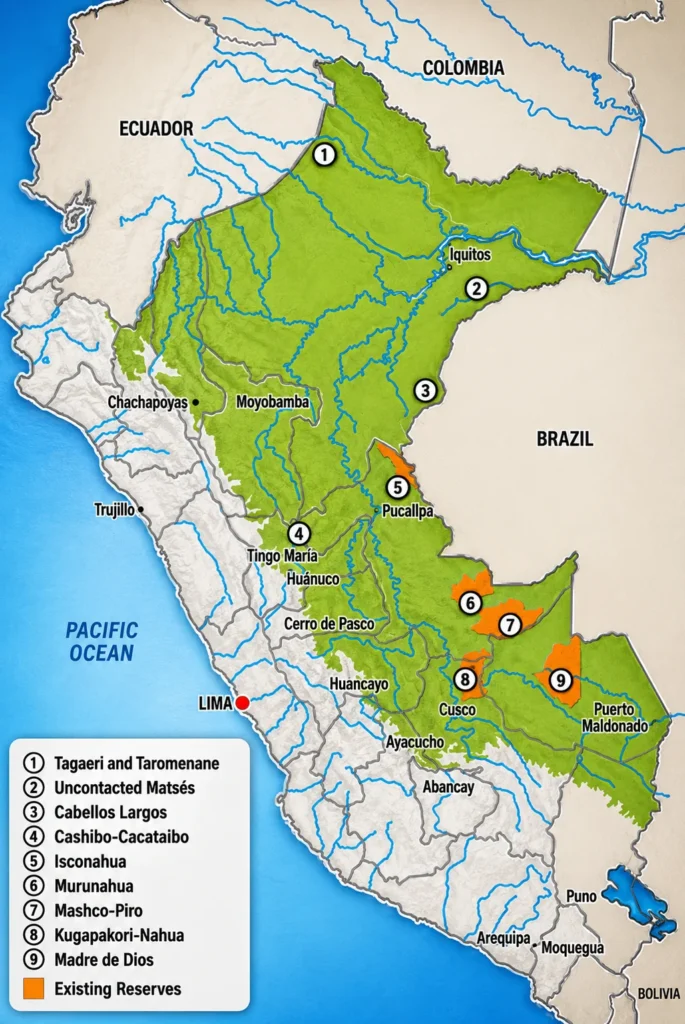
An Amazon rainforest uncontacted tribes map should be interpreted carefully. Detailed maps showing exact settlements, trails, camps, or locations of isolated communities are generally inappropriate because revealing precise locations could facilitate illegal incursions, tourism, hunting, logging, mining, or other forms of intrusion.
Instead, responsible maps normally show generalized territories or regions rather than precise coordinates.
Where Are Uncontacted Tribes Found?
Known or suspected isolated Indigenous peoples are particularly associated with remote portions of:
- Brazil
- Peru
- Western Amazonia
- Southwestern Amazonia
- Areas near the Brazil–Peru frontier
- Remote tributaries of major Amazonian rivers
- Forest regions far from major urban centers
Brazil’s western and northern Amazon contains particularly important areas of Indigenous isolation. Peru’s Amazon also contains territories where Indigenous peoples in isolation or initial contact have been identified.
Why Exact Locations Should Not Be Published
Publishing an exact location could turn a protected territory into a target.
Someone looking for an isolated community might attempt to:
- Approach a settlement
- Photograph people from close range
- Leave objects behind
- Follow trails
- Hunt nearby
- Enter restricted territory
- Search for commercial opportunities
Even seemingly harmless curiosity can have serious consequences.
For this reason, an ethical Amazon tribes map should prioritize geographic education without revealing sensitive locations.
Facts About Uncontacted Tribes in the Amazon Rainforest
The mystery surrounding isolated peoples has generated many myths. The reality is often more fascinating than the mythology.
1. They Are Not “Lost” Peoples
A common misconception is that uncontacted communities are somehow lost in the jungle.
They are not necessarily lost.
Many know their territories extremely well and deliberately avoid outside society. Their knowledge of rivers, trails, plants, animals, weather patterns, and seasonal changes can be extraordinarily detailed.
2. They Have Their Own Languages
An isolated population may speak a language that is poorly documented or completely unknown to outsiders.
Language is particularly important because communication cannot simply be assumed between neighboring Indigenous peoples. The Amazon contains remarkable linguistic diversity, with numerous language families and individual languages.
3. They Are Not All the Same Tribe
“Uncontacted tribes” is an umbrella expression.
Different isolated communities may have completely different:
- Languages
- Origins
- Social structures
- Religious traditions
- Hunting techniques
- Agricultural practices
- Territory
- Historical experiences
- Relationships with neighboring peoples
There is no single “uncontacted tribe culture.”
4. Some Groups Have Had Historical Contact
Isolation exists on a spectrum.
Some peoples have almost no contact. Others have experienced occasional encounters. Some communities may have members who interacted with outsiders in the past but later returned to isolation.
This makes the term uncontacted more complicated than it first appears.
5. Their Territories Can Be Enormous
A small population may depend on a large territory because hunting, fishing, gathering, agriculture, and seasonal movement require access to many different ecological zones.
The Amazon’s apparent abundance does not mean food is uniformly available everywhere.
6. They Can Move Quickly
An isolated community may abandon a settlement and establish another one.
This can happen because of:
- Seasonal changes
- Hunting opportunities
- Soil exhaustion
- Social decisions
- Flooding
- Encounters with outsiders
- Security concerns
As a result, a map of one settlement should never be interpreted as a permanent representation of where the community lives.
Names of Tribes in the Amazon Rainforest
The phrase names of tribes in the Amazon rainforest requires caution because not every Indigenous people is uncontacted.
There are hundreds of Indigenous peoples across the wider Amazon region, many of whom have long-established relationships with neighboring societies, governments, researchers, and other communities.
Examples of Amazonian Indigenous peoples include:
- Yanomami
- Kayapó
- Asháninka
- Shipibo-Konibo
- Matsés
- Tikuna
- Yagua
- Bora
- Awajún
- Wampis
- Munduruku
- Matis
- Marubo
- Kichwa communities
- Achuar communities
These names should not automatically be classified as uncontacted tribes.
Why “Amazon Tribes” Is Too Broad
The keyword Amazon tribes covers an enormous range of peoples.
Some Indigenous communities live in towns and villages and participate in national economies. Others live in remote settlements while maintaining regular relationships with surrounding society. A smaller number maintain voluntary isolation.
Therefore, it is inaccurate to use “Amazon tribes” and “uncontacted tribes” as interchangeable terms.
What Indigenous Tribes Live in the Amazon Rainforest?
The Amazon rainforest is home to an extraordinary number of Indigenous peoples.
The largest concentrations occur across Brazil, Peru, Colombia, Bolivia, Ecuador, Venezuela, and the Guianas.
These communities have developed different ways of adapting to rainforest environments.
Some specialize in river fishing. Others rely heavily on hunting and small-scale agriculture. Many combine farming, fishing, hunting, gathering, and trade.
Their lifestyles can vary dramatically even between communities separated by relatively short geographic distances.
How Many Indigenous Tribes Live in the Amazon Rainforest?
There is no single universally accepted number because researchers use different definitions of “tribe,” “people,” “ethnic group,” and “Indigenous nation.”
However, the Amazon basin contains hundreds of Indigenous peoples and communities, representing remarkable linguistic and cultural diversity.
Brazil alone recognizes a large number of distinct Indigenous peoples, while Peru, Colombia, Bolivia, Ecuador, Venezuela, Guyana, Suriname, and French Guiana also contain numerous Indigenous nations.
The diversity is particularly striking when considering that many communities have their own languages, histories, territorial identities, and traditions.
Indigenous Diversity Across the Amazon
The Amazon is not culturally uniform.
Imagine traveling down a major river and encountering different communities separated by forests, tributaries, and territorial boundaries. Their languages and traditions can change substantially from one area to another.
This diversity developed over thousands of years.
How Do Indigenous Tribes Live in the Amazon Rainforest?
How Indigenous peoples live in the Amazon depends heavily on geography, culture, and their level of interaction with wider society.
There is no single Amazonian lifestyle.
Hunting
Hunting remains important for some Indigenous communities, particularly in remote forest environments.
Hunters may track animals using knowledge of:
- Footprints
- Broken vegetation
- Sounds
- Droppings
- Feeding marks
- Animal calls
- Seasonal behavior
Traditional hunting knowledge can represent generations of accumulated ecological observation.
Fishing
Rivers, streams, lakes, and floodplain environments provide important food resources.
Fishing techniques vary considerably and may include:
- Spears
- Hooks
- Nets
- Baskets
- Traditional traps
- Other locally developed techniques
In river-oriented communities, aquatic resources can be as important as terrestrial wildlife.
Agriculture
Many Amazonian Indigenous peoples practice small-scale agriculture.
Common crops may include:
- Cassava
- Plantains
- Maize
- Sweet potatoes
- Peppers
- Fruits
- Medicinal plants
Cassava is particularly important in many Amazonian cultures.
Gathering
The forest supplies fruits, nuts, fibers, medicinal plants, construction materials, resins, and other resources.
Indigenous knowledge can distinguish between hundreds of useful species and identify where and when particular resources are available.
How Do Uncontacted Tribes Get Food?
Isolated peoples generally depend on a combination of hunting, fishing, gathering, and agriculture.
Their survival strategy is based on diversity rather than dependence on one resource.
If fish become less available in one season, people may rely more heavily on forest animals or cultivated plants. If a garden is abandoned, another area may be cultivated.
This flexible approach is particularly valuable in an environment where floods, droughts, seasonal fruiting, animal movements, and river conditions constantly change.
Are Uncontacted Tribes Dangerous?
The question “are uncontacted tribes dangerous?” is understandable but misleading.
An isolated community may react defensively if outsiders enter its territory. In that context, encounters can be dangerous for both sides.
But describing an entire people as inherently dangerous is inaccurate.
Why Might They Defend Their Territory?
Imagine a community seeing unfamiliar people approaching its settlement after generations of avoiding outsiders.
The newcomers could represent:
- Disease
- Violence
- Kidnapping
- Land theft
- Illegal logging
- Mining
- Hunting
- Religious pressure
- Forced assimilation
Defensive behavior can therefore be understood as territorial protection rather than evidence of inherent aggression.
Are Uncontacted Tribes Dangerous to Tourists?
People should never attempt to visit an isolated Indigenous community.
This is not an adventure-tourism attraction.
Apart from the possibility of confrontation, visitors could introduce respiratory infections or other diseases to populations that may have limited immunity to common illnesses.
Even a seemingly harmless encounter could have consequences far beyond the moment.
Footage of Uncontacted Tribesmen in the Amazon Rainforest
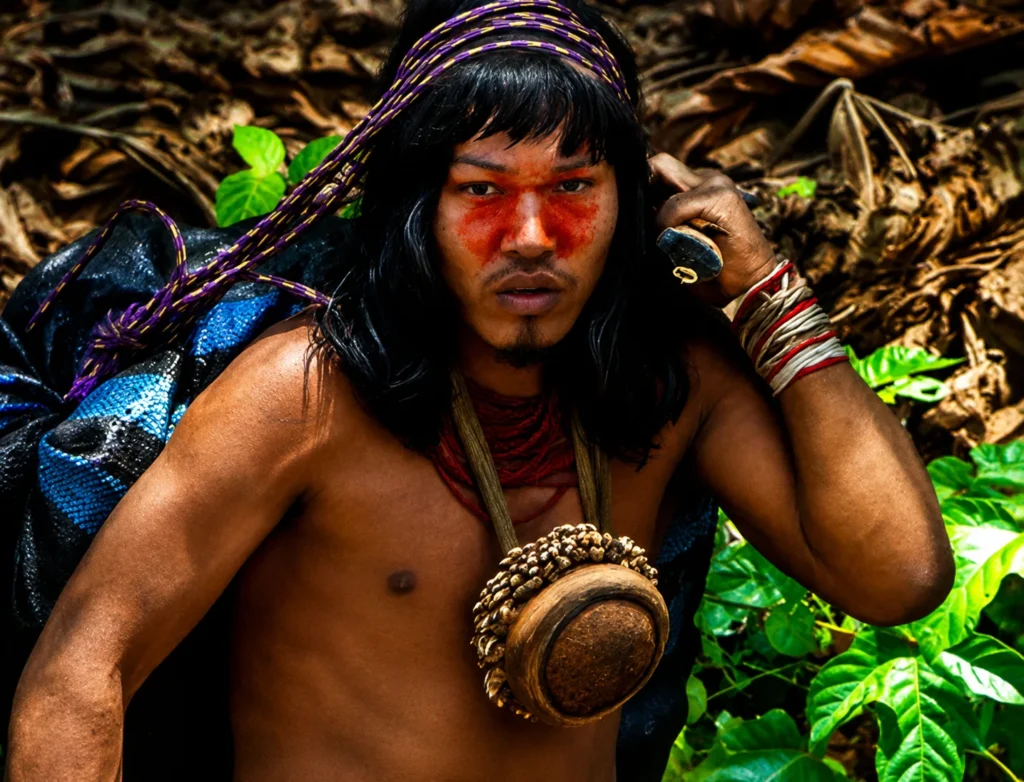
The phrase footage of uncontacted tribesmen in the Amazon rainforest is frequently searched because photographs and videos of isolated Indigenous people can appear extraordinary.
Some aerial images have shown people standing near settlements, canoes, gardens, or forest clearings. Other historical encounters have been documented from a distance.
However, viral footage should be approached carefully.
Why Is Authentic Footage So Rare?
The rarity of images has several explanations.
First, these communities deliberately avoid outsiders.
Second, many live in extremely remote areas.
Third, authorities and Indigenous organizations may restrict access to protect them.
Finally, responsible observers avoid approaching isolated people merely to obtain photographs.
The scarcity of footage is therefore not evidence that isolated peoples do not exist.
It is partly evidence that protective policies can work.
What Can Aerial Images Reveal?
Aerial observations can sometimes reveal:
- Houses
- Gardens
- People
- Canoes
- Cleared areas
- Paths
- Signs of recent occupation
These observations can help establish that an isolated population exists without requiring direct contact.
Why Do Some Amazon Tribes Remain Uncontacted?
This is one of the most fascinating questions.
There is no single explanation.
Some groups may have chosen isolation because previous encounters were associated with catastrophic consequences.
Historical experiences across Amazonia included:
- Epidemics
- Slave raids
- Rubber exploitation
- Forced labor
- Land invasions
- Violence
- Religious missions
- Resource extraction
For some communities, avoiding outsiders may have become a powerful survival strategy.
Isolation Can Be a Form of Resistance
Rather than thinking of isolated peoples as simply “untouched,” it may be more accurate to understand their isolation as an active decision.
They are not necessarily waiting for modern civilization to find them.
They may be actively avoiding it.
That distinction completely changes the way we should understand the term “uncontacted.”
What Is Unusual About Amazon Rainforest Uncontacted Tribes?
Several characteristics make isolated Amazonian peoples particularly remarkable.
They Can Survive Without Modern Infrastructure
No roads, supermarkets, hospitals, electricity grids, or conventional supply chains are necessary for their daily survival.
Their infrastructure is based on local ecological knowledge.
Their Forest Knowledge Can Be Extraordinary
A community may recognize subtle differences between plant species, understand animal behavior, know seasonal fishing areas, and navigate through forest environments without conventional maps.
Their Isolation Is Not Always Complete
A group can remain isolated from national society while still having knowledge of neighboring Indigenous peoples.
The Amazon has never been a culturally empty landscape.
Their Population Size May Be Small
Some isolated communities may be vulnerable to demographic problems because small populations can be particularly sensitive to disease, accidents, and disruptions to territory.
A Single Disease Can Be Catastrophic
A common infection for outsiders could potentially have devastating consequences for an isolated population with little previous exposure.
This is one of the strongest reasons why forced contact is considered extremely dangerous.
Uncontacted Tribes and Amazon Rainforest Protection
Protecting isolated peoples requires protecting their forests.
If an isolated community depends on hunting, fishing, agriculture, and gathering, destroying its territory can make survival impossible.
Threats can include:
- Illegal logging
- Mining
- Agricultural expansion
- Infrastructure development
- Illegal hunting
- Drug-trafficking routes
- Fires
- Land grabbing
- River pollution
Consequently, protecting Indigenous territory is also a form of rainforest conservation.
Why the Amazon Rainforest Is Perfect for Isolation
The Amazon is one of the few places on Earth where enormous continuous forest areas can still make isolation possible.
Its characteristics include:
- Vast distances
- Dense vegetation
- Thousands of rivers
- Seasonal flooding
- Swamps
- Remote headwaters
- Difficult transportation
- Limited roads in many areas
The forest can therefore function as both a home and a natural barrier.
For an outsider, navigating hundreds of kilometers through rainforest can be extremely difficult. For people who have lived there for generations, the same landscape can function as a familiar network of trails, rivers, food sources, and landmarks.
Amazon Rainforest Tribes and Modern Technology
One of the most interesting contradictions is that isolated communities can exist in a world filled with satellites, aircraft, smartphones, and global communication.
Technology can detect signs of isolated populations without establishing direct contact.
Satellite imagery can help identify:
- Forest clearings
- Large gardens
- Changes in vegetation
- Roads
- Illegal incursions
- Settlement patterns
Aircraft can also provide observations from above.
The goal is increasingly to use technology to protect distance rather than eliminate it.
What Happens If an Uncontacted Tribe Is Contacted?
Contact can produce consequences that go far beyond a simple conversation.
Potential risks include:
Disease Transmission
A person may transmit an infection without appearing seriously ill. An isolated population may have limited immunity to pathogens that are commonplace elsewhere.
Cultural Disruption
Contact can rapidly change social structures, traditions, language, economic practices, and relationships with neighboring communities.
Violence
Misunderstandings can escalate rapidly when neither side shares a common language or expectations.
Dependency
Repeated contact can introduce dependence on manufactured goods, medicine, food, tools, or external trade.
For these reasons, the safest policy in most circumstances is to respect the community’s decision to remain isolated.
Are All Amazon Indigenous Peoples Uncontacted?
No.
This is perhaps the most important distinction in any article about Amazon tribes.
The Amazon contains:
- Indigenous peoples with regular contact with national society.
- Remote Indigenous communities with limited outside interaction.
- Indigenous peoples who maintain voluntary isolation.
- Communities that have experienced recent initial contact.
- Indigenous populations living in cities and towns.
Using the word “uncontacted” to describe all Amazonian Indigenous peoples creates a false picture of extraordinary cultural diversity.
Frequently Asked Questions About Amazon Rainforest Uncontacted Tribes
Are there still uncontacted tribes in the Amazon rainforest?
Yes. Multiple Indigenous groups are recognized or believed to maintain voluntary isolation in parts of the Amazon, particularly in Brazil and Peru. Their exact populations and locations are often uncertain because responsible protection avoids direct contact.
How many uncontacted tribes are there?
There is no exact global census. Dozens of isolated Indigenous groups are known or suspected across the Amazon and surrounding regions, but numbers vary according to definitions and levels of evidence.
What are the names of uncontacted tribes?
Some isolated peoples have names associated with them through neighboring communities or historical records, while others remain unidentified. Publishing names alongside precise locations can sometimes create additional risks.
How do uncontacted tribes live?
They generally rely on combinations of hunting, fishing, gathering, and agriculture, with practices adapted to their particular environment and culture.
Do uncontacted tribes use technology?
Some isolated communities may use tools obtained or adapted through historical interactions, but their technological systems should not be assumed to be identical. “Uncontacted” does not mean technologically frozen in prehistoric times.
Do uncontacted tribes know about the outside world?
Possibly, and in some cases very likely. Isolation does not necessarily mean ignorance. Some communities appear to deliberately avoid outsiders because of knowledge or experience passed through generations.
Can tourists visit uncontacted tribes?
No. Attempting to locate or approach isolated peoples is dangerous and potentially harmful. Responsible Amazon travel should respect protected territories and Indigenous rights.
Why don’t researchers simply talk to them?
Because establishing contact can itself create serious risks, particularly disease transmission and cultural disruption. In many circumstances, protecting an isolated population means allowing it to remain isolated.
The Amazon’s Greatest Mystery Is Not That These People Exist
The most remarkable fact about Amazon rainforest uncontacted tribes is not simply that isolated communities still exist.
It is that they continue to make choices about their own lives in one of the most rapidly changing regions of the planet.
The Amazon contains modern cities, highways, aircraft, satellites, mines, farms, tourist destinations, and enormous industrial operations. Yet within this same region, some Indigenous peoples maintain ways of life centered on forests, rivers, gardens, hunting, fishing, and ancestral knowledge.
Their existence challenges the assumption that every society must eventually follow the same path.
Final Thoughts
The question “are there uncontacted tribes in the Amazon rainforest?” has a clear answer: yes, isolated Indigenous peoples continue to exist, especially in remote parts of Brazil and Peru.
But the more important lesson is that they should not be viewed simply as mysterious people hidden in a jungle waiting to be discovered. They are Indigenous peoples with their own histories, territories, languages, cultures, and decisions about contact.
The best way to understand them is not by searching for their settlements or attempting to obtain close-up footage. It is by learning about the remarkable diversity of Amazonian cultures, understanding why voluntary isolation exists, and recognizing why protecting their territories is essential.
In the end, the most respectful Amazon rainforest uncontacted tribes map is one that shows us the broader regions they inhabit while keeping their exact locations private. And the most meaningful fact about these communities may be surprisingly simple: they have the right to decide whether the outside world becomes part of their lives.