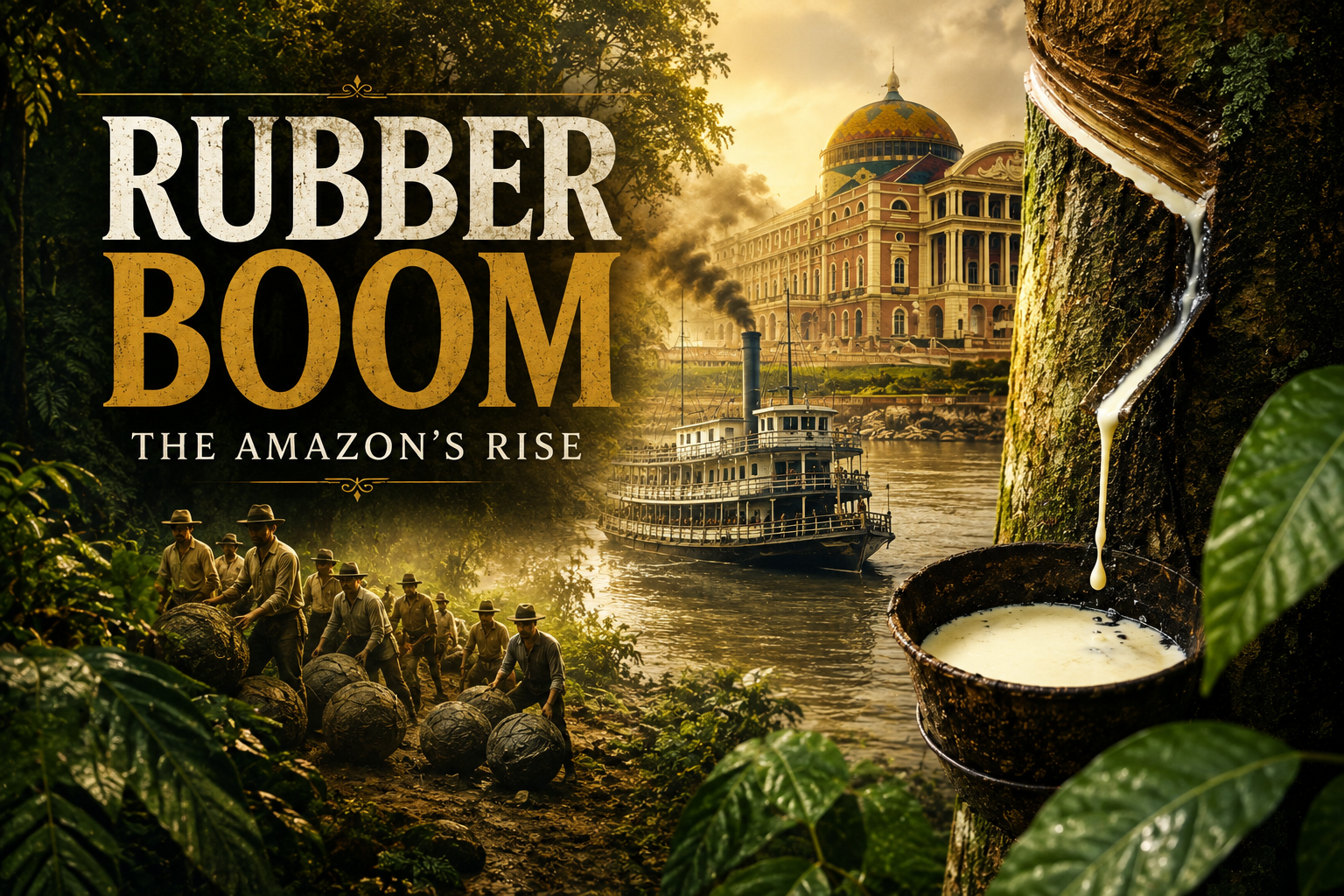
The rubber boom was one of the most extraordinary economic transformations in the history of the Amazon. Beginning in the late 19th century, enormous international demand for natural rubber turned the Amazon rainforest into the center of a global industry. Rubber trees, especially the Hevea brasiliensis, supplied latex that was transformed into tires, belts, waterproof goods, industrial products and countless other items.
The rubber boom period radically changed cities such as Manaus and Belém, created immense fortunes for rubber merchants, expanded transportation networks deep into the rainforest and brought thousands of workers into the Amazon. At the same time, the boom was associated with debt bondage, violence, exploitation of Indigenous peoples and severe social inequality.
Today, the rubber boom days survive in Amazonian architecture, museums, historical sites, forest communities and the continuing tradition of wild rubber tapping. Understanding the rubber boom therefore means looking at two very different sides of the Amazon: extraordinary economic ambition and extraordinary human cost.
What Is the Rubber Boom?
Rubber boom meaning
The rubber boom meaning refers to the period when natural rubber became an extremely valuable international commodity and generated rapid economic growth in parts of the Amazon. The term usually refers to the major Amazonian rubber industry that developed during the late 19th and early 20th centuries, particularly between roughly the 1880s and the early 1910s.
The boom was driven by a simple but powerful combination: the Amazon contained enormous populations of rubber trees, while industrialization created an unprecedented demand for natural rubber. As bicycles, automobiles, electrical equipment and industrial machinery expanded, rubber became increasingly important. The Amazon suddenly possessed a resource that factories around the world desperately wanted.
The rubber boom of the 19th century
The rubber boom of the 19th century was not simply a local Amazonian event. It was part of the worldwide industrial revolution. European and North American manufacturers needed rubber for waterproof clothing, industrial belts, hoses, insulation and eventually bicycle and automobile tires.
The Amazon had a major natural advantage because Hevea brasiliensis, one of the world’s most productive natural rubber trees, originated in the region. Latex could be collected from trees growing naturally throughout the forest rather than from plantations.
As demand increased, traders, entrepreneurs, workers and transport companies moved deeper into the Amazon. Rivers became the industry’s highways, connecting remote forests with commercial centers such as Manaus and Belém.
When Did the Rubber Boom Start?
When did the rubber boom start?
The Amazonian rubber boom began developing during the second half of the 19th century, but it accelerated dramatically during the 1870s and 1880s. By the final decades of the 19th century, natural rubber had become one of the Amazon’s most important exports.
There was no single date on which the boom suddenly began. Instead, it developed gradually as international demand increased and Amazonian merchants expanded extraction into increasingly remote areas.
The period reached its greatest importance around the turn of the 20th century. During this era, enormous quantities of rubber left Amazonian ports and entered international markets.
The rubber boom period
The rubber boom period is generally associated with approximately 1879–1912, although economic activity continued before and after these dates. The early 20th century represented the peak of Amazonian rubber wealth.
The industry was especially important in Brazil, Bolivia, Peru and Colombia, although the Brazilian Amazon became the most famous center of the boom. The regions surrounding the Amazon, Negro, Madeira, Purus, Juruá, Acre and other rivers became closely connected to the international rubber trade.
The exact beginning and end of the period therefore depends on how historians define the boom, but the period from the late 19th century to the early 1910s is the most commonly recognized framework.
The Rubber Tree: The Source of Amazonian Wealth
What is a rubber tree?
The principal Amazonian rubber tree is Hevea brasiliensis. It is a tropical tree belonging to the Euphorbiaceae family and can grow naturally in the humid forests of South America.
Its economic importance comes from latex, a milky fluid found inside specialized vessels beneath the bark. When the bark is carefully cut, latex flows from the wound and can be collected.
How natural rubber was collected
Rubber extraction required workers to walk through the forest and locate individual rubber trees. Rather than planting trees in neat rows, Amazonian rubber tappers often worked with naturally dispersed trees.
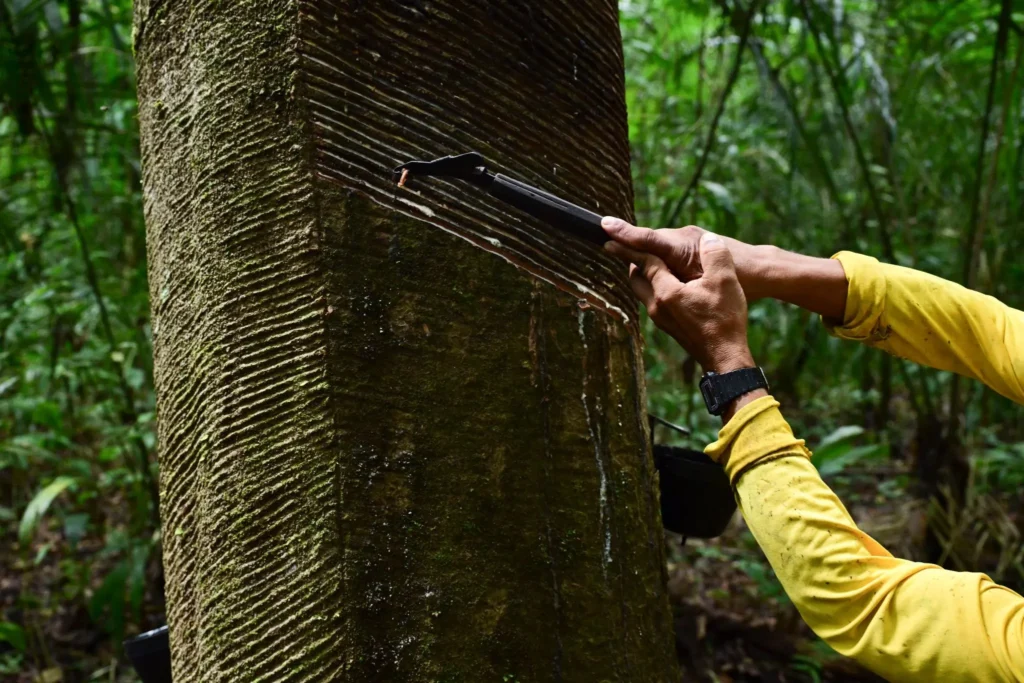
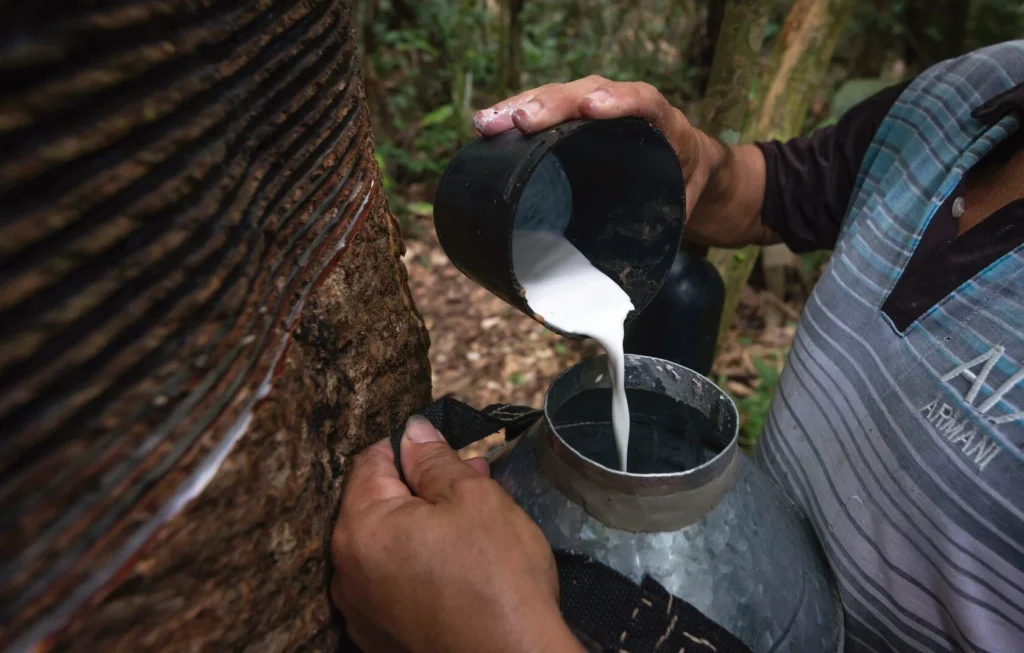
A typical extraction route could involve dozens or even hundreds of trees spread over a large area. The worker made controlled cuts in the bark and attached a small container to collect the latex.
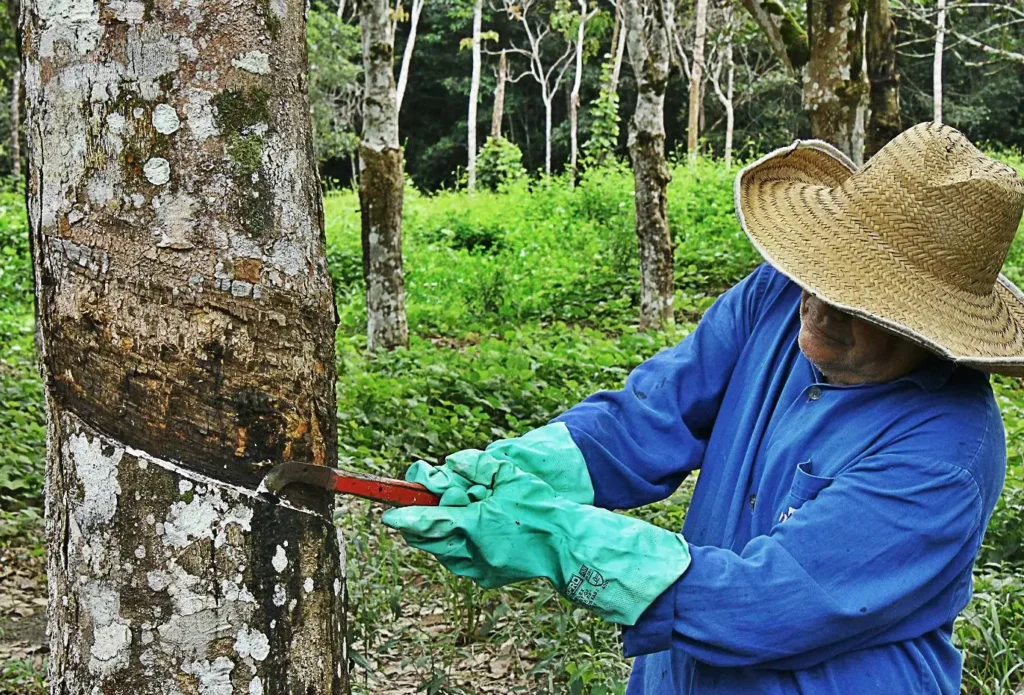
The latex was then processed, traditionally by smoking and coagulating it into large rubber balls or dense masses. These products could then be transported by canoe or boat toward commercial centers.
Why the rubber tree was so valuable
The rubber tree was valuable because its latex possessed an unusual combination of elasticity, durability and waterproofing properties. As industrial technology advanced, these characteristics made natural rubber increasingly useful.
Rubber could be used for:
- Tires
- Bicycle components
- Industrial belts
- Hoses
- Waterproof clothing
- Electrical insulation
- Medical equipment
- Mechanical components
- Footwear
- Various industrial goods
The automobile transformed the situation even further. As cars became more common, the demand for rubber tires increased enormously.
Rubber Tappers: The People Behind the Boom
Who were the rubber tappers?
Rubber tappers, traditionally called seringueiros in Portuguese, were the workers who extracted latex from wild rubber trees. They were among the most important people in the entire rubber economy, yet they generally received only a small fraction of the wealth generated by the international trade.
Rubber tapping was physically demanding and often extremely isolated. Workers could spend long periods living deep inside the forest, far from towns and commercial centers.
Their work required detailed knowledge of the rainforest, including trails, tree locations, river routes, seasonal conditions and forest resources.
The rubber tapper’s forest route
A rubber tapper often followed a network of trails known as a rubber trail. These routes connected individual rubber trees and allowed the worker to move efficiently through the forest.
A typical day could begin before sunrise. The tapper moved through the forest making cuts in trees and collecting latex. Later, the latex was processed, often through smoking, producing the characteristic rubber material that could be stored and transported.
This was an unusual industrial system because the “factory” was the rainforest itself.
The darker side of rubber tapping
The romantic image of the independent forest worker does not tell the whole story. Many workers became trapped in systems of debt and dependency.
Merchants supplied food, tools, clothing, weapons and other necessities on credit. Rubber tappers were then expected to repay these costs with rubber. Because prices and accounting were controlled by merchants, workers could become permanently indebted.
In several Amazonian regions, Indigenous peoples suffered particularly severe violence and exploitation. Communities were displaced, forced into labor or attacked when they resisted rubber extraction.
This human cost is essential to understanding the great rubber boom.
The Great Rubber Boom
What was the Great Rubber Boom?
The Great Rubber Boom was the extraordinary expansion of Amazonian natural rubber production and trade during the late 19th and early 20th centuries. It created fortunes for merchants and transformed previously small settlements into major commercial centers.
Rubber became so valuable that rivers, forests and entire territories were reorganized around its extraction.
The boom also contributed to territorial disputes and political changes across the western Amazon.
Why was rubber suddenly so important?
The industrial revolution created new uses for rubber at exactly the time when Amazonian extraction was expanding.
One important technological development was vulcanization, which made rubber considerably more practical for industrial applications. Later, bicycles and automobiles generated enormous demand for rubber tires.
This created a feedback loop:
Industrialization → greater rubber demand → higher prices → more Amazonian extraction → expansion deeper into the forest → greater international trade.
The Amazon became one of the world’s most important sources of a strategic industrial raw material.
Manaus and the Rubber Boom
Manaus rubber boom
The Manaus rubber boom is perhaps the most visible symbol of Amazonian wealth during this period. Manaus, located far inland in the Brazilian Amazon, grew rapidly as rubber money flowed through the city.
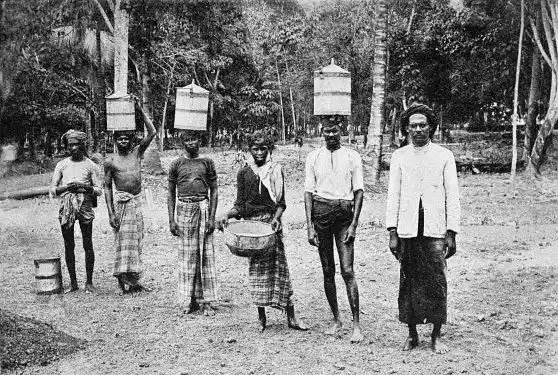
Manaus became a center for merchants, exporters, shipping companies, banks, hotels and wealthy families. Imported goods arrived by river and were distributed into the interior, while rubber traveled in the opposite direction toward international markets.
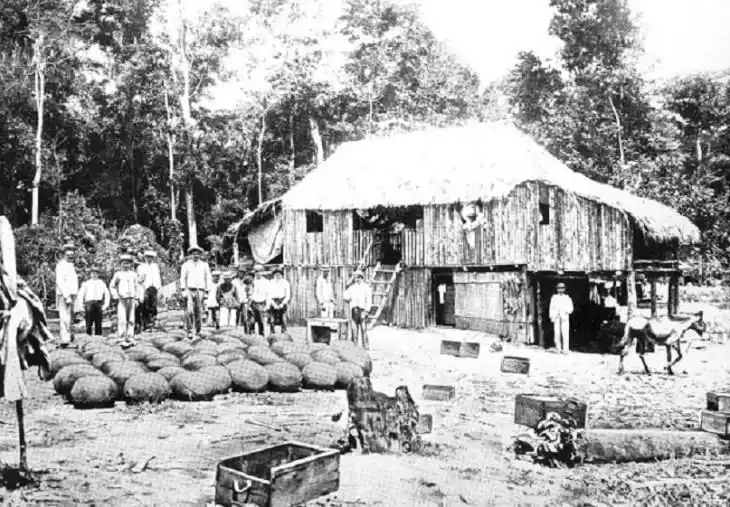
Manaus during the rubber boom
During the height of the boom, Manaus developed a reputation for extraordinary luxury. Wealthy residents and business owners invested in elaborate buildings, European-style architecture, public improvements and entertainment.
The city became an astonishing contrast to the surrounding rainforest.
Imported products that would have been extremely difficult to obtain in the Amazon became symbols of elite wealth. European fashions, sophisticated furniture, fine foods and technological innovations could be found among the city’s wealthy population.
The Amazon Theatre
One of the most famous physical reminders of the boom is the Teatro Amazonas, completed in Manaus in 1896.
Its construction demonstrated the confidence of the city’s rubber-era elite. A grand opera house in the middle of the Amazon may seem surprising today, but during the rubber boom, Manaus had enough wealth and international connections to support such an ambitious project.
The building became one of the defining symbols of the era.
Manaus: from rainforest outpost to boom city
The transformation of Manaus illustrates how quickly commodity wealth can change a city.
Before the rubber boom, Manaus was comparatively small and geographically isolated. During the boom, it became an internationally connected commercial center.
But the city’s prosperity depended heavily on one commodity. When Amazonian rubber lost its competitive advantage, the consequences were dramatic.
Rubber Boom Towns
What is a rubber boom town?
A rubber boom town was a settlement that experienced rapid economic and population growth because of the natural rubber trade.
Some were located along major rivers and became collection, transportation or trading centers. Others developed around commercial routes connecting forest extraction zones with larger cities.
A rubber boom town could include warehouses, merchant houses, docks, shops, restaurants and administrative buildings. In some cases, its prosperity lasted only as long as rubber prices remained high.
The city that was once a rubber boom town is…
When people ask, “the city that was once a rubber boom town is…”, Manaus is one of the strongest answers, although it was more than simply a boom town. During the height of the Amazon rubber industry, Manaus became a major commercial city and one of the most famous urban symbols of rubber wealth.
Other Amazonian settlements also experienced rubber-related growth, particularly towns situated along important rivers and extraction routes.
The important distinction is that Manaus became the most internationally recognizable example of a city transformed by rubber wealth.
Why Did the Amazon Rubber Boom End?
The decline of Amazonian rubber
The first great Amazonian rubber boom began collapsing in the early 20th century because rubber plantations in Southeast Asia became extraordinarily productive.
The crucial turning point was the transfer of Amazonian rubber seeds to Britain in the late 19th century. These plants were cultivated successfully in Asian colonies, where rubber could be grown in organized plantations.
This fundamentally changed the economics of natural rubber.
Wild rubber versus plantations
Amazonian rubber came primarily from naturally distributed trees growing throughout a vast rainforest. Workers had to travel considerable distances to reach individual trees.
Plantations offered a major economic advantage. Rubber trees could be planted in organized rows, making harvesting more efficient and predictable.
As Asian plantations expanded, they began producing rubber at increasingly competitive prices.
The end of the rubber boom days
By the early 1910s, Amazonian rubber had lost much of its dominance in the international market.
The rubber boom days ended with extraordinary speed compared with the enormous wealth they had generated.
Manaus experienced a severe economic decline. Businesses closed, investment disappeared and many people who had arrived during the boom left.
Some buildings remained as reminders of a period when Amazonian cities had seemed destined to become permanent global centers of wealth.
What Happened to Manaus After the Rubber Boom?
The collapse did not erase Manaus, but it changed the city’s economic trajectory.
The city remained an important Amazonian center, eventually developing new industries and commercial activities. Today, Manaus is one of the largest cities in the Brazilian Amazon and remains an important gateway to the rainforest.
The contrast between modern Manaus and its rubber-era architecture makes the history especially fascinating. A visitor can see modern urban life alongside buildings created during one of the world’s most dramatic commodity booms.
Amazonian Rubber Today
Is Amazonian rubber still produced?
Yes. Natural rubber continues to be harvested in parts of the Amazon, although on a much smaller scale than during the great boom.
Modern interest in Amazonian rubber is connected not only to manufacturing but also to forest conservation, sustainable livelihoods and the preservation of traditional knowledge.
Wild rubber extraction can allow forest communities to generate income without completely replacing the forest with agricultural land.
Amazonian rubber and conservation
One of the most interesting modern developments is the idea that the forest itself can have economic value while remaining standing.
Rubber tapping is a classic example of a non-timber forest activity. Instead of cutting down the entire tree, the tapper repeatedly collects latex from living trees.
When managed sustainably, this can connect economic activity with forest conservation.
Amazonian Rubber and Veja
What does “Amazonian rubber Veja” mean?
The keyword “amazonian rubber veja” generally connects Amazonian wild rubber with modern sustainable footwear discussions. In this context, Amazonian rubber is interesting because natural latex harvested from rainforest trees can be incorporated into products while supporting forest-based economies.
The important distinction is that modern Amazonian rubber initiatives should not be confused with the historical rubber boom. The old boom was dominated by rapid extraction and international commodity demand, while modern projects may emphasize traceability, sustainable harvesting and benefits for forest communities.
This represents an intriguing historical reversal: a resource that once contributed to exploitation can now be part of conversations about conservation and sustainable economic development.
Unusual Facts About the Rubber Boom
1. Manaus had an opera house during the rainforest boom
Perhaps the most surprising fact is that an elaborate European-style opera house was built in the Amazon during the height of the rubber boom.
The Teatro Amazonas symbolizes the enormous purchasing power of the rubber elite.
2. Rubber could be worth more than almost anything else in the forest
To merchants, rubber was not simply another forest product. It was the foundation of an international business capable of generating enormous fortunes.
3. The rainforest was the industry’s production system
Unlike a modern factory, the rubber industry depended on thousands of scattered trees growing naturally across enormous territories.
The workers had to know where the trees were and how to reach them.
4. Rivers were the Amazon’s industrial highways
Before extensive roads existed, rivers provided the main transportation network.
Rubber traveled from remote forest areas toward commercial centers by canoe, riverboat and larger vessels.
5. The rubber boom helped reshape political borders
The economic importance of rubber contributed to territorial conflicts, especially in the western Amazon. The history of Acre, for example, became closely connected with the rubber economy and regional territorial disputes.
6. The boom connected remote forests to the global economy
A rubber tree deep in the rainforest could ultimately contribute to products manufactured thousands of kilometers away.
This was one of the earliest examples of a truly global commodity chain involving the Amazon.
The Rubber Boom and Indigenous Peoples
Any serious history of the rubber boom must include Indigenous communities.
The expansion of rubber extraction brought outsiders into territories occupied by Indigenous peoples. In some areas, rubber interests used armed violence to force Indigenous communities away from their lands or into labor.
The consequences included deaths, displacement, destruction of communities and long-lasting social trauma.
This is one reason the rubber boom should not be remembered exclusively as an age of luxury and urban development. The wealth visible in Manaus and other commercial centers was connected to an extraction system that imposed enormous costs on people living in the forest.
Rubber Boom vs. Modern Rubber Industry
The historical rubber boom and modern rubber production are very different.
| Historical rubber boom | Modern rubber industry |
|---|---|
| Primarily wild forest extraction in the Amazon | Large plantation production dominates global supply |
| Limited transportation infrastructure | Highly developed global logistics |
| Extensive debt-based labor systems | Modern labor and commercial regulations |
| Extreme concentration of wealth | More diversified industry |
| Rapid expansion | More controlled production |
| Strong dependence on river transportation | Global road, port and shipping networks |
| Major territorial conflicts | Greater emphasis on legal land rights and sustainability |
The most important continuity is that natural rubber remains valuable because of its unique physical properties.
What Is the “Rubber Boom Rest”?
The phrase “rubber boom rest” does not normally refer to the historical Amazonian rubber boom. It is likely to appear in searches for modern mechanical, industrial or product terminology.
For historical research, the relevant concepts are rubber boom, rubber boom period, rubber boom days, Great Rubber Boom, Manaus rubber boom and Amazonian rubber.
Likewise, “rubber boom rest pad” appears to belong to a completely different product or mechanical context rather than Amazonian history.
These terms should not be treated as historical synonyms.
Other “Rubber Boom” Searches That Mean Something Different
Because the words “rubber” and “boom” are used in many industries, some searches can look related to the Amazon rubber boom even though they are not.
Inflatable rubber boom
An inflatable rubber boom is generally an industrial or environmental device designed to float on water. Depending on the design, such booms can be used for containment, barriers or water-management applications.
It has nothing inherently to do with the historical rubber boom.
Rubber track boom lift
A rubber track boom lift is a type of mobile elevated work platform using rubber tracks instead of conventional wheels. It is designed for accessing elevated areas, often where maneuverability and reduced ground pressure are important.
Again, this is a modern mechanical meaning of “boom,” not the Amazonian economic meaning.
Rubber oil boom
A rubber oil boom generally refers to a containment barrier used to control or surround oil and other floating substances on water. The term “boom” here means a physical barrier rather than an economic period.
Rubber band boom song
The phrase “rubber band boom song” appears to be a music-related search rather than a reference to Amazonian history. It should therefore be separated from the historical keyword cluster.
Rubber duck boom
Rubber duck boom can refer to entertainment, toys, trends or other modern uses of the words “rubber duck” and “boom.” It has no direct historical connection to the Amazon rubber industry.
Rubber boomerang
A rubber boomerang is a recreational object made from flexible rubber or similar material. Its design is intended for throwing and returning, depending on its shape.
It is completely unrelated to Amazonian rubber extraction.
Rubber boomerang dog toy
A rubber boomerang dog toy is a modern pet product designed for interactive games such as fetching. Its name combines the material and shape of the toy with the word “boomerang.”
It should not be confused with the historical use of the term “rubber boom.”
Why the Rubber Boom Still Matters
The historical rubber boom offers a remarkable lesson about the relationship between natural resources, globalization and economic development.
A single biological product—latex from a rainforest tree—helped transform cities, create fortunes, alter migration patterns, influence territorial politics and connect remote Amazonian forests to factories on the other side of the world.
It also demonstrates the danger of depending too heavily on a single commodity. Manaus became enormously wealthy while rubber prices were high, but the city suffered when plantation production in Asia changed the international market.
The boom also shows that economic success does not necessarily mean prosperity for everyone. Wealth concentrated among merchants and elites while many rubber tappers lived under difficult and exploitative conditions.
The Most Important Rubber Boom Facts
Rubber boom facts at a glance
- The Amazonian rubber boom was concentrated mainly in the late 19th and early 20th centuries.
- The principal rubber tree was Hevea brasiliensis.
- Natural rubber comes from latex.
- Rubber tappers extracted latex from living trees.
- Rivers were essential transportation routes.
- Manaus became one of the great commercial centers of the boom.
- The Teatro Amazonas was completed in Manaus in 1896.
- The boom created enormous fortunes for some merchants.
- Many rubber workers experienced debt and exploitation.
- Indigenous peoples suffered severe violence and displacement in some extraction regions.
- Asian rubber plantations eventually outcompeted much Amazonian wild rubber.
- The first great boom declined dramatically around the early 1910s.
- A second, shorter Amazonian rubber boom occurred during World War II.
- Natural rubber is still produced in parts of the Amazon today.
- Modern Amazonian rubber can play a role in forest-based livelihoods and conservation.
Frequently Asked Questions About the Rubber Boom
What was the rubber boom?
The rubber boom was the period when natural rubber became an extremely valuable international commodity and generated rapid economic growth in the Amazon, especially from the late 19th century into the early 20th century.
When did the rubber boom start?
The Amazonian rubber boom developed gradually during the 19th century and accelerated strongly during the 1870s and 1880s. Its greatest period of prosperity occurred around the turn of the 20th century.
How long did the rubber boom last?
The first great Amazonian rubber boom is generally associated with approximately 1879–1912, although rubber extraction continued afterward and experienced a temporary revival during World War II.
Why was the rubber boom important?
It transformed the Amazon economically and socially, created major fortunes, expanded river commerce, stimulated urban development and connected remote rainforest regions to the global industrial economy.
What tree produced the rubber?
The most important species was Hevea brasiliensis, commonly known as the rubber tree.
Who were the rubber tappers?
Rubber tappers, or seringueiros, were workers who entered the rainforest to collect latex from wild rubber trees.
Why did the rubber boom end?
The major reason was competition from highly productive rubber plantations in Southeast Asia, where rubber trees descended from Amazonian plants were cultivated in organized plantations.
Why is Manaus associated with the rubber boom?
Manaus became one of the principal commercial centers of the Amazon rubber trade and accumulated enormous wealth during the boom. Its historic architecture, especially the Teatro Amazonas, remains a visible reminder of that period.
Was the rubber boom good for the Amazon?
It brought investment, transportation, urban development and international connections, but it also produced severe exploitation, environmental pressures, debt bondage, territorial conflicts and violence against Indigenous peoples. Its legacy is therefore both economically fascinating and deeply troubling.
The Legacy of the Rubber Boom
The rubber boom remains one of the most fascinating chapters in Amazonian history because it combines nature, technology, globalization, wealth and human struggle in a single story.
The humble rubber tree helped make Manaus famous, turned rainforest merchants into millionaires and supplied a rapidly industrializing world with a material it desperately needed. Rubber tappers walked through immense forests collecting latex, while riverboats transported the finished product toward commercial centers and international markets.
Yet the magnificent buildings created during the Manaus rubber boom tell only one side of the story. Behind the wealth were isolated workers, Indigenous communities, dangerous journeys, debt and violence. The collapse of the first boom also demonstrated how quickly an economy based on one natural resource can rise—and fall.
Today, Amazonian rubber has a different significance. Wild rubber tapping can be part of a forest economy that keeps trees standing, supports traditional communities and demonstrates that the rainforest can generate value without being completely cleared.
That makes the history of the Great Rubber Boom more than an account of a vanished economic era. It is also a lesson about the Amazon’s continuing relationship with the global economy. The same forest that once supplied the world with rubber is still producing natural resources, knowledge and livelihoods—and the challenge today is finding ways to value those resources without repeating the destructive patterns of the past.