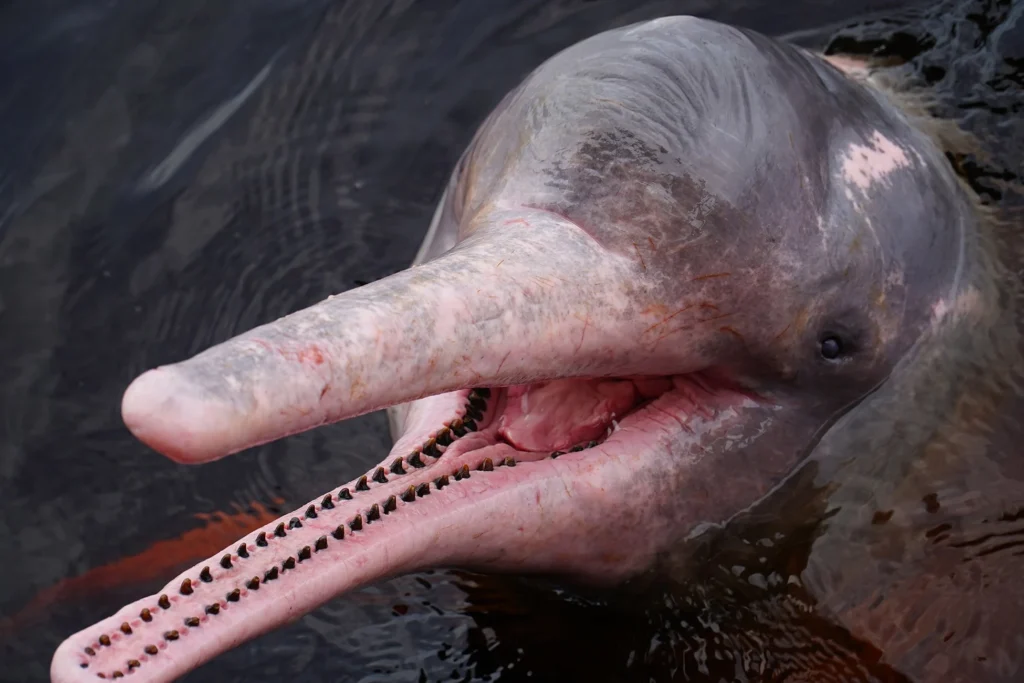
The Amazon River dolphin, commonly called the pink river dolphin or pink dolphin, is one of the most unusual mammals in South America. Unlike marine dolphins that spend their lives in saltwater, this remarkable animal lives in freshwater rivers, flooded forests, channels, lagoons, and lakes throughout the Amazon and neighboring river systems. Its flexible body, long beak, rounded forehead, broad flippers, and sometimes striking pink coloration make it instantly recognizable, but its biology is even more fascinating than its appearance.
Known scientifically as Inia geoffrensis and closely related species or populations occurring in different South American river systems, the Amazon river dolphin is specially adapted to an environment that changes dramatically between high-water and low-water seasons. When rivers rise, these dolphins can move through flooded forests and between trees, following fish into areas that would be inaccessible to most aquatic predators. When water levels fall, they return to deeper channels and permanent lakes.
This guide explores Amazon River dolphin facts, habitat, diet, behavior, physical characteristics, unusual adaptations, pink coloration, myths, and conservation, while answering the most common questions about one of the Amazon’s most fascinating aquatic animals.
Amazon River Dolphin Facts
The Amazon River dolphin is a freshwater cetacean belonging to the dolphin family. Unlike oceanic dolphins, it has evolved to live in complex river environments where visibility can be extremely poor, water levels fluctuate seasonally, and submerged vegetation can create a maze of channels. Its long, narrow snout, flexible neck, broad flippers, and relatively small dorsal fin are particularly useful in these conditions.
The species is often called boto in parts of the Amazon. Adult individuals can show a remarkable range of coloration, from gray and brownish-gray to pale pink and vivid pink. Color can vary according to age, sex, individual genetics, physical condition, water temperature, and even how much blood is circulating close to the skin.
What Is the Amazon River Dolphin?
The Amazon River dolphin is a freshwater dolphin adapted to life in the rivers and wetlands of tropical South America. It is considerably different from familiar bottlenose dolphins because its body evolved for maneuvering through narrow channels, submerged forests, shallow areas, and winding tributaries rather than traveling rapidly through open ocean.
One of its most unusual characteristics is its flexible neck. The vertebrae are not as tightly connected as those of many marine dolphins, allowing the head to move more independently. This flexibility is particularly useful when the dolphin is searching for fish between branches, roots, submerged trunks, and other obstacles.
The animal also has broad flippers and a relatively low dorsal fin. These characteristics help it maneuver in complicated freshwater environments. Instead of depending exclusively on speed, the Amazon River dolphin relies heavily on agility, echolocation, hearing, and its ability to investigate different parts of the underwater environment.
Scientific Name and Classification
The Amazon River dolphin is generally known as Inia geoffrensis. Scientific classification of South American river dolphins has been debated, particularly concerning how different river populations should be categorized. Some classifications recognize additional species or subspecies associated with separate river systems.
For travelers and wildlife enthusiasts, however, the important point is that these dolphins represent a distinctive group of freshwater cetaceans specialized for South America’s enormous river networks.
10 Interesting Amazon River Dolphin Facts
The pink river dolphin has many characteristics that distinguish it from both ocean dolphins and other Amazonian wildlife.
- It is a freshwater dolphin. It spends its life in rivers, lakes, channels, and flooded forests rather than the ocean.
- Its neck is unusually flexible. This allows the dolphin to turn its head while navigating complicated underwater environments.
- Its coloration can change. Young animals are generally darker, while some adults become noticeably pinker.
- It uses echolocation. Sound helps it locate prey and navigate when water visibility is extremely limited.
- It can enter flooded forests. During high-water periods, dolphins may travel among submerged trees and vegetation.
- Its teeth are useful for catching many types of prey. Its diet can include numerous fish species and other aquatic animals.
- It has relatively large flippers. These provide excellent maneuverability in slow-moving and confined water.
- Its dorsal fin is low and elongated. This shape is advantageous in shallow or vegetation-filled environments.
- It can live in extremely muddy water. Vision alone would be inadequate in many Amazonian rivers, making echolocation especially important.
- Its pink coloration is not simply a permanent species-wide color. Individuals can differ considerably, and coloration changes as animals mature.
An Especially Unusual Fact
One of the most remarkable behaviors associated with the Amazon River dolphin is its ability to move through seasonally flooded forests. When rivers rise, water can spread across enormous areas of forest. Fish follow this new habitat because it provides food and shelter, and dolphins can follow them.
This means that part of the dolphin’s habitat can effectively disappear and reappear with the annual flood cycle.
How Big Are Amazon River Dolphins?
Amazon River dolphins are relatively large freshwater mammals. Adult males are generally larger and heavier than females, an unusual degree of sexual size difference compared with many other dolphin species.
Large adult males can reach approximately 2.5 to 2.7 meters in length, while some females may approach 2 meters or somewhat more, depending on the individual and population. Large males can weigh well over 100 kilograms, although body mass varies considerably.
Their body shape is designed more for maneuverability than speed. The flexible neck, large flippers, and low dorsal fin help them turn through narrow channels and around submerged obstacles.
Physical Characteristics of the Pink River Dolphin
Several features immediately distinguish the Amazon River dolphin from marine dolphins.
Long Beak
The snout is elongated and contains numerous teeth. This shape helps the dolphin capture fish and other aquatic prey in complex underwater environments.
Flexible Neck
The ability to move the head relatively independently is particularly useful in flooded forests. A dolphin can investigate around branches and submerged vegetation without having to turn its entire body.
Broad Flippers
The flippers are comparatively large, giving the animal precise control when maneuvering.
Small Dorsal Fin
Rather than having a tall triangular dorsal fin, the Amazon River dolphin has a low, elongated dorsal structure. This reduces interference when swimming through shallow or vegetation-filled environments.
How Long Do Amazon River Dolphins Live?
The exact lifespan of wild Amazon River dolphins is difficult to establish because observing the same individual throughout its entire life is extremely challenging. Unlike some marine dolphin populations, freshwater dolphins are difficult to monitor consistently across enormous river systems.
Researchers therefore have less complete information about maximum natural lifespan than they do for some better-studied cetaceans. Individual survival is influenced by habitat quality, food availability, human activities, disease, pollution, fishing interactions, and other environmental factors.
Why Is Their Lifespan Difficult to Measure?
The Amazon Basin is enormous, and many dolphins live in remote areas where long-term identification and monitoring are difficult. Seasonal flooding also changes where animals can be found.
Scientists can use scars, coloration, body characteristics, photographs, and other methods to identify individuals, but establishing a complete lifespan for wild dolphins remains challenging.
Pink River Dolphin Habitat
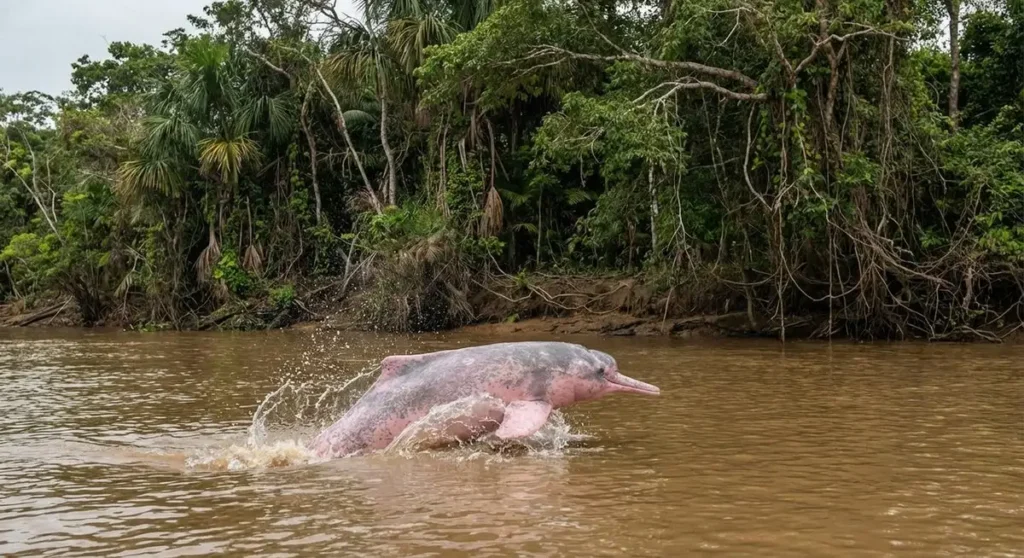
The pink river dolphin habitat is one of the most dynamic freshwater environments on Earth. Rather than living in one specific type of river, Amazon River dolphins occupy a network of habitats connected by seasonal changes in water level.
They can occur in:
- Main rivers
- Tributaries
- Flooded forests
- Oxbow lakes
- Permanent lakes
- Channels
- Confluences
- Seasonal waterways
- Areas around sandbanks and islands
- Deep pools
Their distribution is closely connected to water availability and the movement of fish.
Where Do Pink River Dolphins Live?
Where do pink river dolphins live? They are found primarily in freshwater systems across the Amazon and neighboring South American river basins. Their range includes parts of countries such as Peru, Brazil, Colombia, Bolivia, Ecuador, and Venezuela, depending on the river system and classification being considered.
In Peru, they are associated with major Amazonian watersheds and can be encountered in rivers and lakes around areas such as Loreto and Madre de Dios. In Brazil, their distribution extends across enormous portions of the Amazon Basin.
The animals are not restricted to the main Amazon River itself. They can travel through tributaries and connected waterways, allowing them to occupy an enormous and changing freshwater landscape.
Amazon River Dolphin Habitat in the Amazon Basin
The Amazon Basin provides an extraordinary combination of rivers, tributaries, lakes, wetlands, and seasonally flooded forests. For the Amazon River dolphin, this interconnected environment functions almost like a giant network of aquatic highways.
During the rainy season and annual flood cycle, rivers rise and water enters forests and low-lying areas. Fish move into these newly flooded habitats to feed on fruits, seeds, insects, and other organisms. Dolphins may follow them into these temporary underwater forests.
When the water level falls, the available aquatic environment contracts. Fish become concentrated in channels, lakes, and deeper areas, and dolphins adjust their movements accordingly.
Flooded Forests: A Special Dolphin Habitat
Flooded forests are among the most unusual habitats used by Amazon River dolphins. From the surface, a flooded forest may look like ordinary woodland. Underwater, however, it becomes an intricate three-dimensional environment.
Dolphins can navigate between tree trunks and submerged branches while searching for prey.
This helps explain why their anatomy differs from that of fast-swimming ocean dolphins.
Where Are Amazon River Dolphins Found?
Amazon River dolphins occur throughout extensive portions of South America’s freshwater network. Their distribution is associated with major Amazonian rivers and tributaries, including systems connected to the Amazon, Solimões, Rio Negro, Madeira, Purus, Juruá, Ucayali, Marañón, and other waterways.
Their presence in different habitats is influenced by:
- Water depth
- Seasonal flooding
- Fish availability
- River connectivity
- Water temperature
- Human disturbance
- Availability of permanent lakes and channels
Amazon River Dolphin Distribution in Peru
Peru is particularly important for observing Amazonian freshwater wildlife because large areas of rainforest remain connected to extensive river systems.
The regions surrounding Puerto Maldonado and the Tambopata–Madre de Dios landscape provide opportunities to encounter freshwater dolphins, although sightings are naturally dependent on water conditions, animal movements, weather, and location.
What Do Pink River Dolphins Eat?
The question “What do pink river dolphins eat?” has a surprisingly broad answer. These dolphins are opportunistic predators and consume a wide variety of aquatic prey.
Fish make up a major part of the diet, but Amazon River dolphins are not restricted to one or two species. Their long snout and teeth allow them to capture prey of different shapes and sizes.
Depending on the habitat and season, their food can include:
- Fish
- Catfish
- Characins
- Cichlids
- Piranhas
- Crustaceans
- Small aquatic animals
- Occasionally other available aquatic prey
Their diet can change according to what is abundant in a particular river, lake, channel, or flooded forest.
Amazon River Dolphin Diet
The Amazon River dolphin diet is strongly connected to the extraordinary diversity of Amazonian freshwater fish. Thousands of aquatic species inhabit the basin, and dolphins take advantage of this diversity.
Unlike a predator that specializes in one particular prey, the pink river dolphin can adjust its feeding strategy to local conditions.
During high water, fish disperse into flooded forests. During lower water, fish can become concentrated in channels and lakes. Dolphins adjust their hunting locations accordingly.
What Fish Do Amazon River Dolphins Eat?
What fish do Amazon River dolphins eat? There is no single fish species that defines their diet. They consume a broad assortment of freshwater fish.
Potential prey includes:
- Catfish
- Piranhas
- Cichlids
- Characins
- Small schooling fish
- Bottom-associated fish
- Fish inhabiting flooded vegetation
The diversity of their prey is one reason the dolphin can survive across such a large geographic area.
How Do Amazon River Dolphins Find Their Food?
Amazon River dolphins use echolocation to locate prey and understand their underwater surroundings. This ability is especially important because Amazonian rivers can become extremely cloudy with suspended sediment.
A dolphin produces high-frequency sounds that travel through the water. Echoes returning from objects can provide information about their position, distance, shape, and movement.
This gives the dolphin an acoustic picture of its environment.
Hunting in Murky Water
In some Amazonian rivers, visibility may be only a small fraction of what a human swimmer might expect in clear water. A predator that depended primarily on eyesight would face major limitations.
Echolocation allows dolphins to continue hunting in these conditions.
Hunting Among Trees
Flooded forests create another challenge. Branches, roots, trunks, leaves, and other structures can make open-water swimming impossible.
The Amazon River dolphin’s flexible neck and maneuverable body help it search around these obstacles.
This combination of echolocation + flexible neck + broad flippers represents one of the most impressive adaptations among freshwater mammals.
Why Are Pink Dolphins Pink?
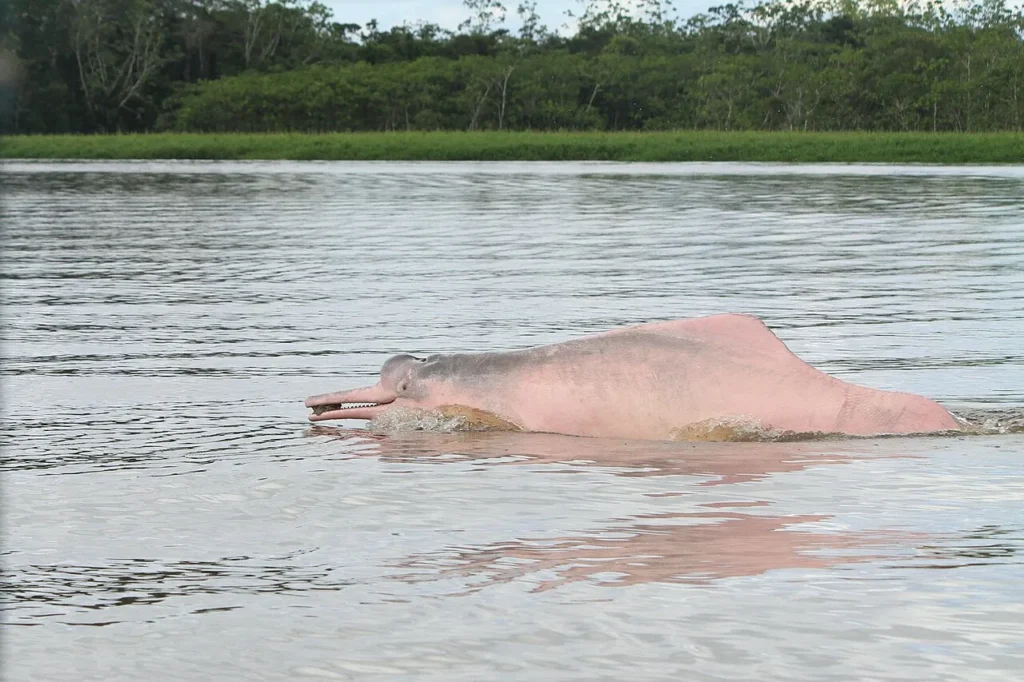
One of the most famous questions about the species is:
Why are pink dolphins pink?
The answer is more complicated than simply saying that the species is naturally pink.
Amazon River dolphins can have gray, brownish, reddish, or pinkish coloration. Young individuals are often darker, while adults can become increasingly pink.
Blood circulation close to the skin is believed to contribute strongly to the visible pink coloration. Because the skin can be relatively light in some adults, blood vessels beneath the surface can influence how the animal appears.
Coloration can also vary depending on:
- Age
- Sex
- Individual genetics
- Physical condition
- Water temperature
- Activity level
- Excitement or stress
- Light conditions
Why Is the Pink River Dolphin Pink?
The pink river dolphin does not necessarily look bright pink throughout its entire body or at every stage of life. Some individuals are predominantly gray, while older animals can develop much stronger pink coloration.
Adult males are often particularly pink.
One explanation is that males can accumulate scars through interactions with other dolphins. Older animals may therefore show a mixture of natural pigmentation, scar tissue, and visible blood circulation.
Do All Amazon River Dolphins Have Pink Skin?
No. Not all Amazon River dolphins are bright pink.
This is an important distinction. The popular name “pink river dolphin” can create the impression that every individual looks like a bright pink marine mammal. In reality, coloration varies considerably.
Young dolphins can appear gray or dark gray. Adults can range from grayish to pinkish, and some individuals can be remarkably pink.
Therefore, seeing a gray Amazon River dolphin does not mean it is a different animal.
Amazon River Dolphin Behavior
Amazon River dolphin behavior is adapted to a complex freshwater environment. They can be seen alone, in pairs, or in small groups, although social organization can change depending on food availability and habitat.
They communicate using sounds and rely heavily on hearing and echolocation.
They can also interact with other dolphins around productive feeding areas, confluences, and lakes.
Do Pink River Dolphins Swim Alone?
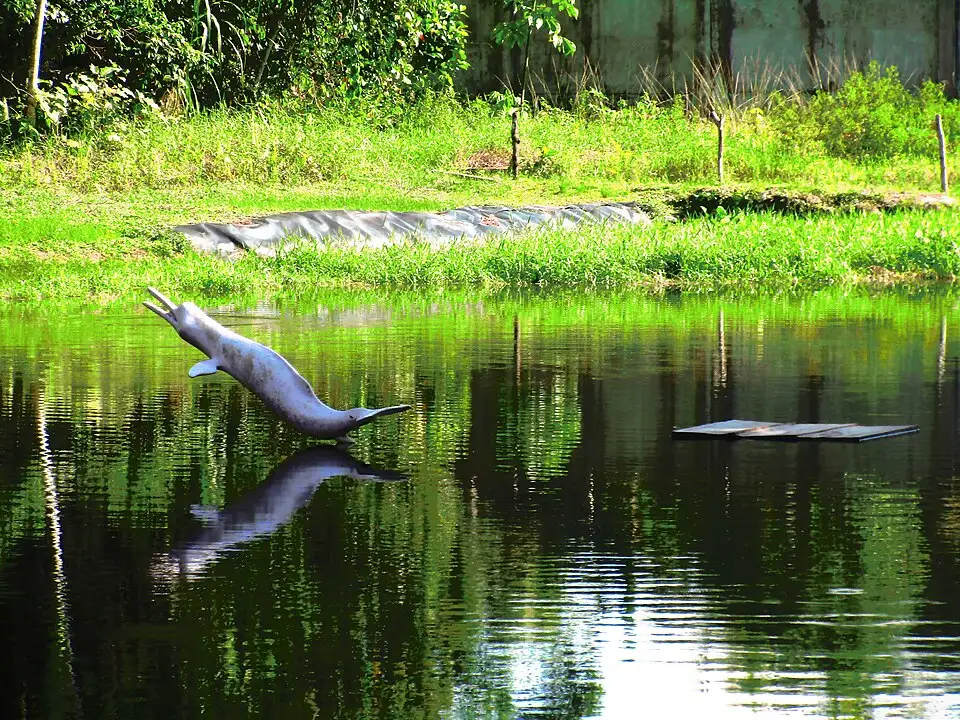
They can be solitary, but this does not mean they are completely antisocial. Groups can form temporarily around abundant food or favorable habitat.
Their social behavior is flexible and can change with environmental conditions.
How Do Amazon River Dolphins Communicate?
Communication involves a variety of sounds. Echolocation clicks are primarily associated with navigation and finding objects, while other sounds can be involved in social interactions.
Because rivers are acoustically complex environments, sound is particularly important for a species living in muddy water and flooded forests.
Amazon River Dolphin Myths and Legends
Few Amazonian animals have generated as many stories as the pink river dolphin.
Across parts of the Amazon, traditional stories describe the boto as a supernatural being capable of transforming into a human. In some traditions, the boto is associated with nighttime encounters, riverside communities, romance, mystery, and unexplained events.
These stories belong to the cultural traditions of Amazonian communities and should not be presented as biological evidence about dolphin behavior.
The persistence of these legends reflects how closely the animal has been connected with human life along Amazonian rivers for generations.
Why Did the Pink Dolphin Become So Legendary?
The animal’s unusual appearance naturally contributes to its mystique. A freshwater dolphin that can appear pink, navigate flooded forests, and surface unexpectedly in remote rivers is very different from the wildlife familiar to people in most other parts of the world.
The fact that Amazonian rivers are often difficult to see through adds another layer of mystery.
Are Amazon River Dolphins Dangerous?
Amazon River dolphins are wild animals and should always be observed respectfully, but they are not generally regarded as predators that intentionally hunt humans.
Their diet consists primarily of aquatic prey, particularly fish.
However, people should not attempt to touch, chase, feed, corner, or capture wild dolphins. Like any strong wild mammal, a dolphin could react defensively if it feels threatened.
Responsible wildlife tourism means allowing the animal to decide how close it wants to approach.
What Is Unusual About Amazon River Dolphins?
The Amazon River dolphin combines several unusual characteristics rarely found together in one mammal.
1. A Freshwater Dolphin
It is a true dolphin adapted to freshwater rather than an ocean environment.
2. It Can Enter Flooded Forests
During high water, its habitat expands dramatically.
3. Its Neck Is Highly Flexible
This helps it maneuver around submerged trees.
4. Its Color Changes With Age
Individuals can become much pinker as they mature.
5. It Hunts in Extremely Turbid Water
Echolocation becomes essential when visibility is poor.
6. It Lives in a Seasonally Changing World
The boundaries of its habitat can move dramatically between high-water and low-water seasons.
Amazon River Dolphin Conservation
Conservation of the Amazon River dolphin is closely connected to the health of the rivers themselves. A dolphin cannot be protected effectively if its food supply, breeding areas, migration routes, and freshwater habitat are degraded.
The major conservation challenges can include:
- Water pollution
- Habitat degradation
- Accidental capture in fishing equipment
- Reduction of fish populations
- River modification
- Human disturbance
- Contamination from mining activities
- Loss of connected aquatic habitat
- Deliberate killing in some fisheries-related situations
Why Are Amazon River Dolphins Vulnerable?
The enormous size of the Amazon Basin can create the impression that freshwater dolphins have unlimited space and resources. In reality, aquatic ecosystems are interconnected.
Pollution introduced in one part of a river system can travel downstream. Changes in fish populations can affect predators. Alteration of river connectivity can change access to feeding and breeding habitats.
Protecting the dolphin therefore requires protecting the wider freshwater ecosystem.
How Many Pink Dolphins Are Left in the World?
There is no simple, universally accepted global number representing every pink river dolphin in South America.
Estimating populations is particularly difficult because these animals occupy enormous river systems, move seasonally, and can become difficult to detect in muddy water or flooded forests.
Population estimates also depend on:
- Survey methods
- Geographic area
- Season
- Water level
- Species classification
- Survey duration
- Visibility
- Dolphin behavior
For this reason, a responsible article should avoid presenting an unsupported single worldwide population number.
The Future of the Amazon River Dolphin
The future of the Amazon River dolphin depends largely on the future of Amazonian freshwater ecosystems.
Conservation efforts can focus on protecting river habitats, reducing pollution, improving fisheries management, monitoring populations, maintaining aquatic connectivity, and increasing awareness among communities and visitors.
Tourism can also contribute when it is carefully managed. Wildlife observation should prioritize distance, avoid feeding or touching animals, and support local conservation and community-based initiatives.
Amazon River Dolphins and Responsible Wildlife Tourism
For travelers visiting the Amazon, seeing a pink river dolphin can be one of the most memorable wildlife experiences. However, the best encounter is one in which the animal remains completely wild.
Responsible observation means:
- Keep a respectful distance.
- Never chase dolphins with a boat.
- Do not feed wild dolphins.
- Avoid swimming toward animals.
- Do not attempt to touch them.
- Keep boat engines controlled near wildlife.
- Follow local guide instructions.
- Avoid producing unnecessary noise.
- Never remove wildlife or aquatic organisms from their habitat.
The goal should not be to force a close encounter. The goal is to observe natural behavior.
Amazon River Dolphin: Quick Facts
| Feature | Amazon River Dolphin |
|---|---|
| Common names | Amazon River dolphin, pink river dolphin, boto |
| Scientific name | Inia geoffrensis |
| Habitat | Freshwater rivers, lakes, channels and flooded forests |
| Main region | Amazon and neighboring South American river systems |
| Main food | Fish and other aquatic prey |
| Hunting method | Echolocation and active searching |
| Color | Gray, brownish, pinkish or pink |
| Neck | Highly flexible |
| Main adaptation | Maneuverability in complex freshwater habitats |
| Famous behavior | Entering flooded forests during high water |
| Conservation concerns | Pollution, fishing interactions, habitat degradation and other human pressures |
Final Thoughts: Why the Amazon River Dolphin Is So Special
The Amazon River dolphin is much more than a famous pink animal. It is a highly specialized freshwater mammal whose entire biology is connected to the extraordinary seasonal rhythm of the Amazon Basin.
Its flexible neck allows it to navigate submerged forests. Its broad flippers help it maneuver around underwater obstacles. Its echolocation allows it to hunt in muddy water. Its diet changes according to the fish available in different habitats and seasons. And its famous pink coloration can develop gradually as individuals mature.
Perhaps the most fascinating aspect of the species is that its world changes throughout the year. During high-water periods, the Amazon rainforest itself can become part of the dolphin’s habitat. Trees, roots, channels, lakes, and rivers become interconnected, creating an underwater landscape where a terrestrial forest once stood.
For visitors exploring the Amazon, encountering a pink river dolphin offers a glimpse into this hidden aquatic world. Protecting these dolphins ultimately means protecting the rivers, forests, fish, wetlands, and communities that make the Amazon one of the most extraordinary ecosystems on Earth.