The Amazon aquatic plants of South America form one of the most fascinating plant communities on Earth. From tiny floating plants covering quiet backwaters to enormous water lilies with leaves several feet across, aquatic vegetation is an essential part of Amazonian rivers, lakes, wetlands and seasonally flooded forests. These plants provide food, shelter and breeding habitat for fish, insects, amphibians, birds and other wildlife while also influencing water chemistry, sediment and the amount of sunlight reaching underwater environments.
The Amazon Basin is not a single uniform aquatic environment. Water levels can rise and fall dramatically during the year, transforming river margins, beaches, floodplain forests, lagoons and wetlands. A plant that is completely submerged during one season may grow above the water during another. This seasonal change is one of the most unusual characteristics of aquatic plants in the Amazon River and rainforest.
This guide brings together the major types of Amazonian aquatic plants, their habitats, examples of floating, submerged and emergent species, Amazon sword plants, Amazon frogbit and other floating vegetation, plus unusual facts about how these plants survive in one of the world’s most dynamic freshwater ecosystems.
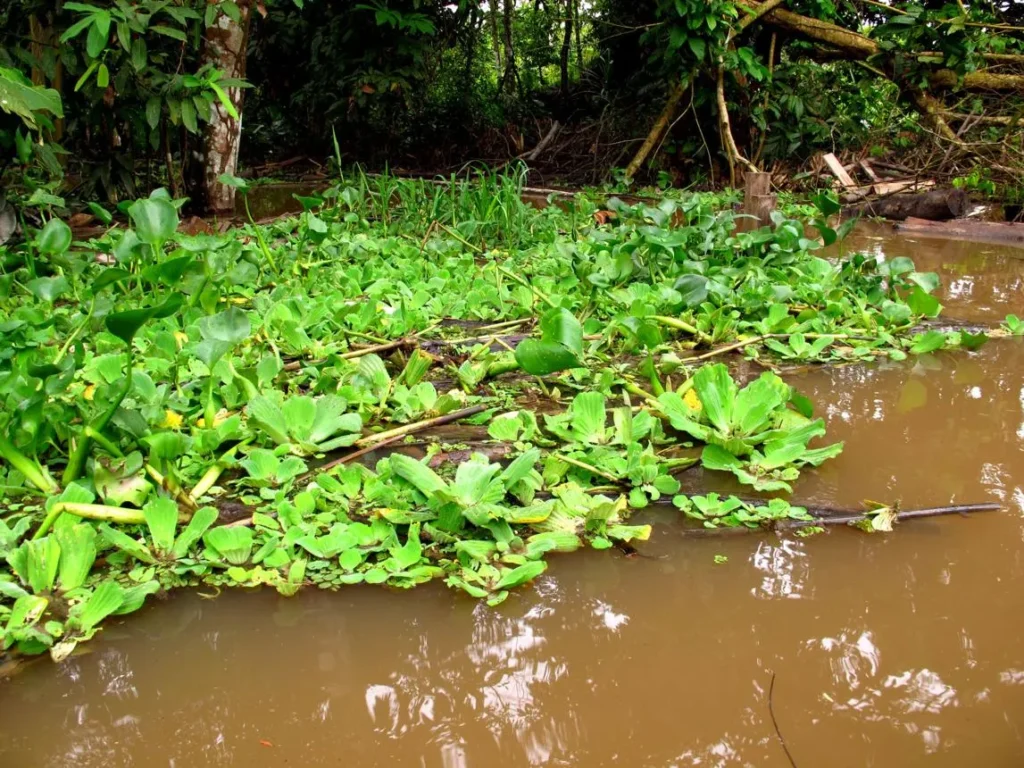
What Are Amazon Aquatic Plants?
Amazon aquatic plants are plants adapted to living in or around freshwater environments throughout the Amazon Basin. They occur in rivers, streams, oxbow lakes, floodplain lakes, marshes, swamps, ponds and forests that become flooded during periods of high water.
Some species spend their entire lives floating or submerged, while others are amphibious and can tolerate both underwater and terrestrial conditions. This distinction is particularly important in the Amazon because water levels change dramatically throughout the year.
Amazonian aquatic plants can therefore be divided into several broad ecological categories:
- Floating plants
- Submerged plants
- Emergent plants
- Floating-leaved plants
- Amphibious and seasonally aquatic plants
- Plants of flooded forests
- Wetland and marsh plants
The boundaries between these categories are not always rigid. A plant can change its growth form according to water depth, flooding duration and seasonal conditions.
Aquatic Plants in the Amazon River and Rainforest
Aquatic vegetation is closely connected to the annual flood cycle of the Amazon. During high-water periods, rivers expand into surrounding floodplains and forests. Areas that may appear to be terrestrial forest during the dry season can become aquatic habitats during the rainy or flood season.
This creates an enormous temporary landscape where aquatic plants can grow.
In white-water floodplains, herbaceous vegetation can become particularly abundant. Plants belonging to groups such as Eichhornia, Ludwigia, Neptunia, Salvinia and Pistia, together with aquatic grasses, can occur along rivers and floodplain environments. The vegetation changes as water levels rise and fall.
Why Aquatic Vegetation Is Important
Amazon aquatic plants perform several ecological functions:
- Provide shelter for small fish
- Offer surfaces for aquatic insects
- Create spawning and nursery habitats
- Provide food for herbivorous animals
- Reduce wave action in quiet waters
- Influence oxygen and carbon cycling
- Stabilize sediments in some shallow habitats
- Provide cover for amphibians
- Create resting places for birds
- Shade portions of the water surface
The vegetation can also influence the entire food web. A dense mat of floating plants may provide hiding places for juvenile fish, which in turn become food for larger fish, birds, caimans and other predators.
Aquatic Plants of the Amazon Basin
The Amazon Basin contains an extraordinary variety of aquatic environments. Instead of imagining one enormous river surrounded by forest, it is more useful to think of the basin as a huge interconnected network of rivers, tributaries, floodplain lakes, channels, wetlands and seasonally flooded forests.
Each habitat favors different plant strategies.
Rivers and Moving Water
Fast-moving river channels can be challenging environments for plants because strong currents can uproot vegetation or prevent floating mats from becoming established.
Plants are therefore often more abundant in:
- Slow-moving margins
- Shallow bays
- Protected channels
- Backwaters
- River islands
- Sheltered coves
Plants growing along river edges may experience substantial changes in water depth during the year.
Floodplain Lakes
Floodplain lakes, including many oxbow lakes, can support extensive aquatic vegetation.
These environments are often calmer than the main river channel and may contain:
- Floating plants
- Floating-leaved plants
- Emergent grasses
- Submerged vegetation
- Water lilies
- Marsh plants
Because sunlight can reach shallow water, plant productivity can be particularly high.
Swamps and Wetlands
Amazonian wetlands contain some of the most diverse aquatic plant communities.
Wetlands may remain permanently wet or experience seasonal drying. Plants living here must often tolerate changing water levels, soft sediment and periods of low oxygen around their roots.
Seasonally Flooded Forests
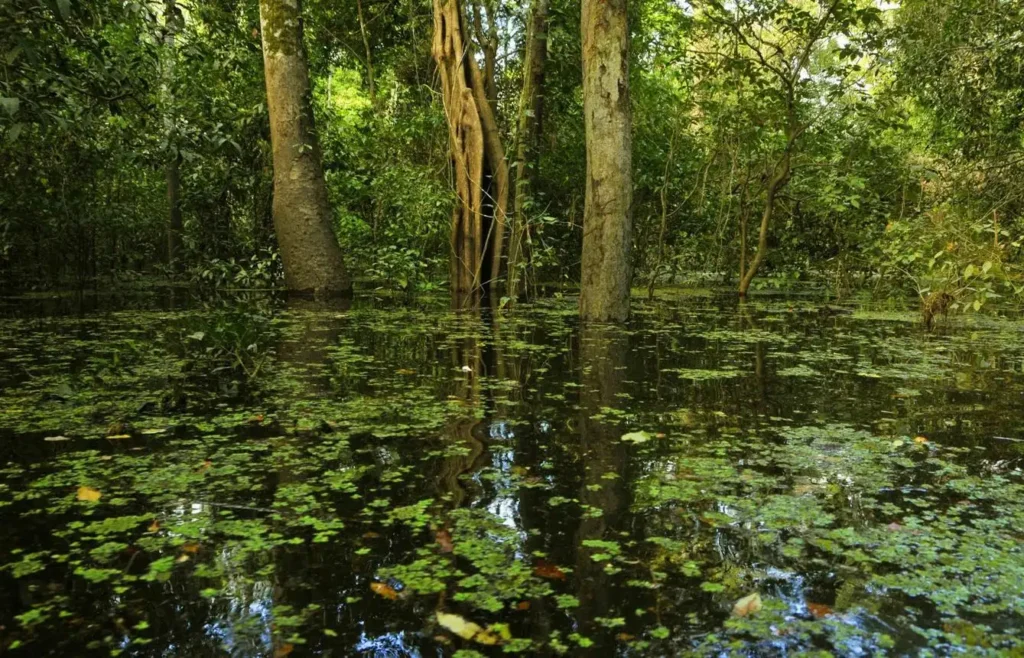
One of the most remarkable Amazon habitats is the seasonally flooded forest.
During high water, the forest floor can disappear beneath several meters of water in some locations. Fish swim between tree trunks, while aquatic plants occupy newly available shallow-water habitats.
When water recedes, the same landscape becomes terrestrial again.
This seasonal transformation means that some Amazon plants are neither strictly terrestrial nor strictly aquatic. They are adapted to an amphibious existence.
Types of Amazonian Aquatic Plants
The most useful way to understand types of Amazonian aquatic plants is to classify them according to where their leaves and stems occur in relation to the water.
Floating Aquatic Plants
Floating plants remain at or near the water surface. Their roots may hang freely in the water while leaves remain above the surface.
Examples include:
- Water hyacinth
- Amazon frogbit
- Salvinia
- Pistia
- Duckweed
- Other free-floating plants
Floating vegetation can reproduce rapidly when conditions are favorable.
Why Floating Plants Float
Many floating plants have specialized structures that help them remain buoyant.
Some contain air spaces within their tissues, while others have leaves or stems designed to spread their weight across the water surface.
Floating plants are particularly successful in calm water because strong currents can break apart mats or carry them downstream.
Submerged Aquatic Plants
Submerged aquatic plants spend most or all of their vegetative growth beneath the water surface.
These plants often have flexible stems and leaves adapted to underwater conditions.
Their leaves may be:
- Thin
- Narrow
- Ribbon-like
- Finely divided
- Flexible
- Less structurally rigid than terrestrial leaves
Underwater plants face a different environment from land plants. Light becomes weaker with depth, carbon dioxide is less readily available, and water movement can influence gas exchange.
Where Submerged Plants Grow
Submerged plants are especially likely in:
- Shallow lakes
- Protected lagoons
- Slow-moving channels
- Floodplain ponds
- Clearer tributaries
- Sheltered river margins
Water clarity is important because sunlight must penetrate far enough for photosynthesis.
Emergent Aquatic Plants
Emergent aquatic plants are rooted in water or saturated soil while their stems and leaves extend above the water surface.
Examples include various:
- Sedges
- Aquatic grasses
- Marsh plants
- Ludwigia species
- Wetland herbs
Emergent plants are particularly common along shallow margins where water is not too deep.
Their roots can remain submerged while leaves receive direct sunlight and atmospheric carbon dioxide.
Why Emergent Plants Are Important
Emergent vegetation can create dense edges between water and land.
These zones are extremely valuable for wildlife because they provide:
- Fish shelter
- Insect habitat
- Amphibian breeding areas
- Nesting locations
- Feeding sites
- Protection from predators
Amazon Sword Aquatic Plants
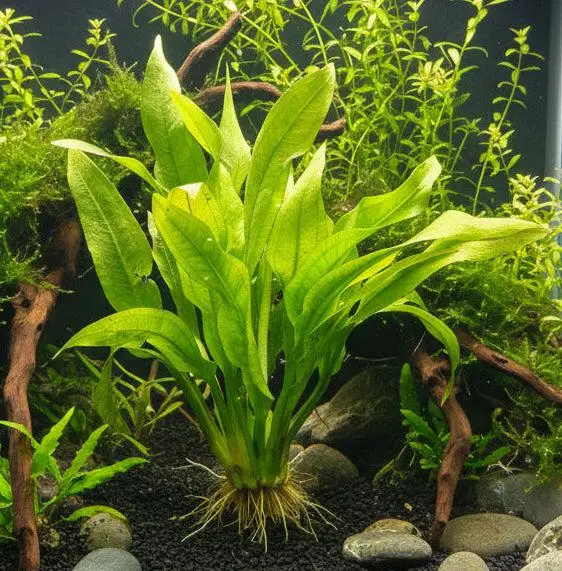
The Amazon sword plant is one of the best-known aquatic plants associated with the Amazon region, particularly among aquarium enthusiasts.
The common name “Amazon sword” is applied to plants in the genus Echinodorus, especially plants historically sold under names such as Echinodorus amazonicus and Echinodorus bleherae. Modern botanical treatment has placed several of these names under Echinodorus grisebachii or related classifications.
Amazon sword plants are recognized by their attractive rosette growth and long, sword-shaped leaves.
They are popular because they can create a dense underwater appearance resembling vegetation found around tropical freshwater environments.
Characteristics of Amazon Sword Plants
Typical characteristics include:
- Long green leaves
- Rosette growth
- Strong root systems
- Broad or narrow leaf forms depending on species and variety
- Ability to grow submerged
- Ability to tolerate emersed conditions
- Preference for nutrient-rich substrate
Amazon sword plants are generally rooted plants rather than free-floating vegetation.
Echinodorus and Amazon Sword Plants
The genus Echinodorus includes a diverse group of aquatic and amphibious plants native to the Western Hemisphere.
Historically, several different Echinodorus species were commonly sold under the name “Amazon sword.” Botanical names used in the aquarium trade have changed over time, which is why older aquarium books and modern plant databases may use different names for what appears to be the same plant.
This is particularly relevant when researching Echinodorus and Amazon sword plants because common names do not always correspond to one single botanical species.
Echinodorus plants are especially interesting because many are adapted to environments where water levels fluctuate.
Some can grow:
- Fully submerged
- Partially submerged
- In saturated mud
- Along shallow margins
- Temporarily out of water
This amphibious ability is a useful adaptation in seasonal wetlands and floodplain environments.
Are Amazon Sword Plants Fully Aquatic?
The answer is not always.
Amazon sword plants are commonly described as aquatic plants because they can grow successfully underwater, especially in aquariums. However, many Echinodorus species are actually amphibious or seasonally aquatic.
They can survive periods when their leaves are above the water.
This is important because Amazonian water levels fluctuate dramatically. A plant living on a shallow floodplain margin may be submerged during high water and exposed or partially emerged when water levels fall.
Some Echinodorus species are therefore better understood as plants adapted to the transition between aquatic and terrestrial environments rather than as plants that must remain permanently underwater.
Why This Matters
An amphibious lifestyle gives plants an advantage in seasonal wetlands.
Instead of dying when the water disappears, a plant can continue growing in wet soil. When flooding returns, it can produce underwater leaves and continue its aquatic growth.
This is one of the most useful adaptations among plants living in flood-prone tropical environments.
Amazon Frogbit and Other Floating Plants
Amazon frogbit is another name associated with floating aquatic vegetation, although common names can be used for more than one plant in the aquarium and horticultural trade.
Floating plants are among the most visually recognizable forms of Amazon aquatic vegetation because they can form green carpets across calm water.
Other floating plants found in Amazonian aquatic environments include members of groups such as:
- Salvinia
- Pistia
- Eichhornia
- Lemna and related duckweeds
- Azolla
- Other small free-floating plants
Water Hyacinth
Water hyacinth is particularly famous for its floating lifestyle.
It forms floating mats with swollen leaf stalks that help provide buoyancy. Its roots hang beneath the surface and provide habitat for microorganisms and small aquatic animals.
Salvinia
Salvinia consists of floating ferns that can form dense mats under suitable conditions.
Unlike flowering plants, these plants reproduce using spores and have specialized floating leaves.
Duckweed
Duckweed consists of extremely small floating plants.
Individual plants can be tiny, but large populations can collectively cover significant areas of calm water.
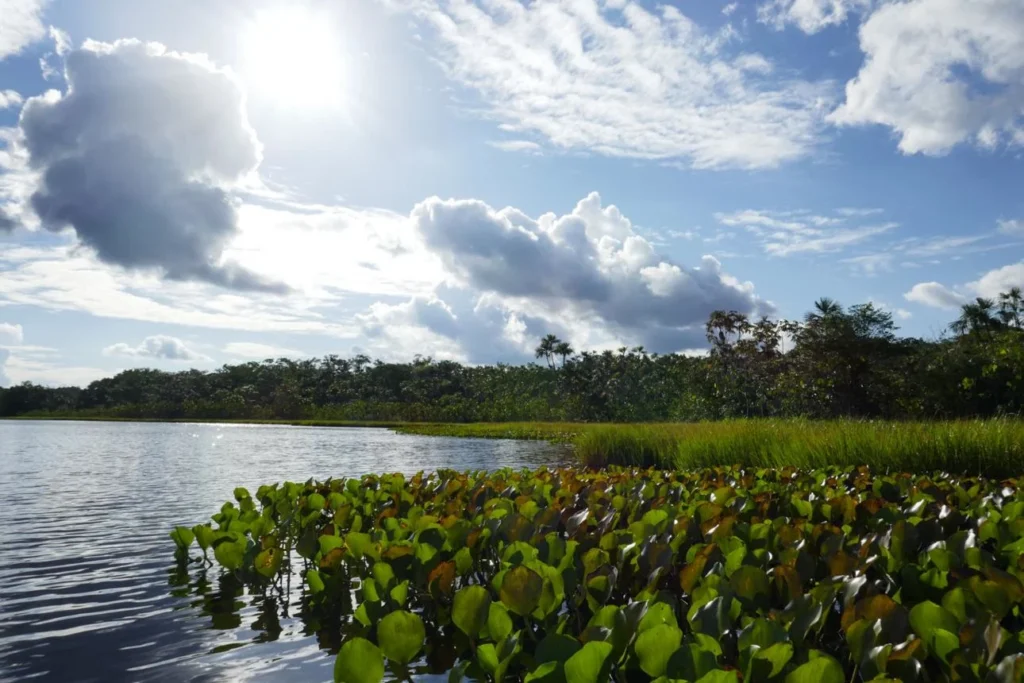
Where Do Aquatic Plants Grow in the Amazon?
Amazon aquatic plants grow wherever water, light, nutrients and suitable physical conditions allow them to establish.
The most important habitats include:
- Rivers
- Streams
- Floodplain lakes
- Oxbow lakes
- Swamps
- Marshes
- Wetlands
- Seasonally flooded forests
- Backwaters
- Shallow lagoons
- River margins
Rivers and Streams
The main Amazon River and its tributaries contain enormous variations in water speed, depth, chemistry and sediment.
Plants generally find it easier to establish in slower areas than in the strongest currents.
Shallow margins may contain emergent vegetation, while sheltered backwaters can support floating mats and submerged plants.
River islands can also create protected environments where aquatic plants become established.
Floodplain Lakes
Floodplain lakes are among the richest habitats for aquatic vegetation.
Many are connected to rivers during periods of high water and become partially isolated when water levels decline.
This seasonal connection allows fish and other aquatic organisms to move between habitats while also transporting seeds, plant fragments and nutrients.
Floodplain lakes may therefore act as biological nurseries for both plants and animals.
Swamps and Wetlands
Wetlands provide ideal conditions for plants adapted to saturated soil.
Some plants grow in shallow water, while others occupy muddy margins.
Amazonian wetlands can also store large quantities of organic carbon, making their vegetation important not only for biodiversity but also for broader ecosystem processes.
Seasonally Flooded Forests
Seasonally flooded forests are among the most unusual habitats in the Amazon.
During flooding, trees may stand in several meters of water while fish swim between their trunks.
Aquatic vegetation can grow in open spaces, channels and shallow areas.
When water levels fall, plants must survive exposure to air and changing soil moisture.
This seasonal rhythm is a major evolutionary force in Amazonian ecosystems.
The Giant Water Lily: One of the Amazon’s Most Unusual Aquatic Plants
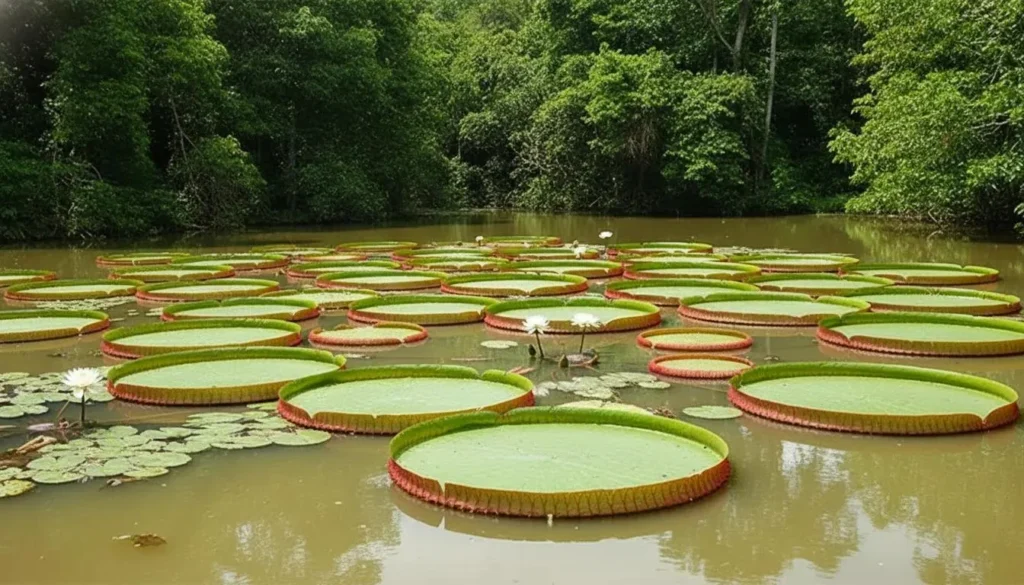
One of the most spectacular Amazonian aquatic plants is Victoria amazonica, the giant water lily.
Its enormous circular leaves can reach up to around 3 meters across under favorable conditions. The leaves float on the surface while long stalks connect them to an underground structure rooted in muddy sediment.
The underside of the leaf contains a remarkable network of ribs and air spaces that contributes to its buoyancy.
Why Are Giant Water Lily Leaves So Large?
Large leaves allow the plant to capture substantial amounts of sunlight while floating on the water surface.
The structure also helps distribute weight across the leaf.
The underside can contain strong ribs and spines, providing structural support and potentially discouraging some herbivores.
A mature plant can produce numerous leaves during a growing season, allowing it to create extensive floating cover.
How Amazon Aquatic Plants Survive Seasonal Flooding
Seasonal flooding is one of the greatest environmental challenges in the Amazon.
A plant may experience:
- Rising water
- Complete submersion
- Prolonged flooding
- Falling water levels
- Exposure to air
- Drying or terrestrial growth
Plants that survive this cycle often possess special adaptations.
Common Adaptations
- Flexible stems
- Air-filled tissues
- Extensive root systems
- Rapid growth
- Floating leaves
- Ability to produce different leaf forms
- Tolerance of saturated soil
- Seasonal dormancy
- Vegetative reproduction
The ability to switch between aquatic and terrestrial growth is particularly valuable.
Aquatic Plants and Amazon Wildlife
Aquatic plants are fundamental to Amazonian food webs.
Fish
Many fish use aquatic vegetation as shelter from predators. Young fish can hide among roots, stems and floating leaves.
Amphibians
Frogs and other amphibians frequently use aquatic vegetation as resting surfaces, breeding habitat or protection.
Insects
Aquatic insects and their larvae can live on or around aquatic plants.
Birds
Birds may feed along vegetated margins, searching for fish, insects, frogs and other small animals.
Mammals and Reptiles
Some aquatic and semi-aquatic animals interact directly with vegetation through feeding or shelter.
Plants therefore create physical habitat in addition to producing organic matter through photosynthesis.
Aquatic Plants and Fish Nurseries
One of the most important ecological functions of aquatic vegetation is the creation of nursery habitat.
Dense vegetation gives young fish places to hide from predators.
Plant roots, stems and leaves also provide surfaces where microorganisms can grow. These microorganisms become part of the food chain supporting small aquatic organisms and fish.
A seemingly simple floating mat can therefore contain a surprisingly complex miniature ecosystem.
How Aquatic Plants Affect Amazon Water
Aquatic vegetation can influence the physical and chemical characteristics of water.
Dense plant communities can:
- Slow local water movement
- Trap sediments
- Provide shade
- Modify oxygen conditions
- Capture nutrients
- Store carbon
- Create microhabitats
- Influence water temperature near the surface
However, the effects depend heavily on plant type, density, water movement and season.
A small patch of floating vegetation behaves very differently from a huge continuous mat.
Interesting Facts About Amazon Aquatic Plants
1. Some Amazon aquatic plants are amphibious
Not every plant associated with Amazonian water must remain underwater throughout its life. Several groups can tolerate both submerged and exposed conditions.
2. The Amazon has plants with enormous floating leaves
Victoria amazonica can produce leaves approaching 3 meters across, making it one of the most spectacular aquatic plants in the world.
3. Floating plants can travel with the river
Unlike rooted plants, floating vegetation can be transported downstream by currents, especially during high water.
4. Flooding can transform forests into aquatic habitats
A forest floor can become submerged during seasonal flooding, allowing fish to enter areas that are dry during other parts of the year.
5. Aquatic vegetation creates underwater architecture
Roots, stems and leaves create three-dimensional structures that small fish, insects and amphibians use as shelter.
6. Amazon sword plants are not as simple as their name suggests
The common name “Amazon sword” covers plants and botanical names that have changed through taxonomic research. Some are strongly associated with the Amazon Basin, while other Echinodorus species occur elsewhere in tropical and subtropical South America.
7. Giant water lilies have structural engineering built into their leaves
The large ribs and air spaces beneath the leaves help them remain buoyant.
8. Some aquatic plants grow incredibly quickly
Under favorable conditions, floating plants can reproduce rapidly and expand across calm water.
9. Aquatic plants can influence entire food webs
They provide food directly in some cases and indirectly by creating habitat for organisms that become food for fish and other wildlife.
10. The Amazon’s water plants change with the flood pulse
The same location can look completely different at high and low water because the available aquatic habitat changes dramatically.
Unusual Amazon Aquatic Plants and Adaptations
One of the most unusual characteristics of Amazon aquatic vegetation is that many species have evolved to exploit a constantly changing environment.
A plant rooted in shallow mud may be underwater for months and exposed later.
Another plant may float freely and travel with currents.
A giant water lily can spread huge leaves across the surface.
A submerged plant may produce delicate underwater foliage optimized for light and nutrient exchange.
This variety demonstrates that “aquatic plant” is not a single lifestyle. It is a collection of strategies for living in an environment dominated by water movement and seasonal change.
Current Perspectives on Amazon Aquatic Vegetation
Modern ecological research increasingly recognizes aquatic vegetation as an important component of the Amazon Basin rather than simply a background feature of rivers and lakes.
Remote sensing and satellite imagery can help researchers identify extensive areas of floating and floodplain vegetation. However, seasonal changes make monitoring difficult because the distribution and density of aquatic plants can change dramatically as water levels rise and fall. Research has estimated that herbaceous vegetation in parts of the Amazon’s white-water floodplains can occupy tens of thousands of square kilometers during high-water periods.
This makes aquatic plants relevant to broader studies of:
- Floodplain ecology
- Carbon cycling
- Fish habitats
- Wetland conservation
- Climate change
- River dynamics
- Biodiversity monitoring
- Seasonal flooding
Understanding these plants can therefore help scientists understand the Amazon ecosystem as a whole.
Why Amazon Aquatic Plants Matter
Aquatic plants are essential components of Amazonian freshwater ecosystems.
They provide habitat, contribute organic matter, influence nutrient cycles and help connect terrestrial and aquatic environments.
They also reveal something fundamental about the Amazon: the forest and the rivers cannot be separated.
When the river rises, the forest becomes aquatic habitat. When the river falls, aquatic and terrestrial environments separate again.
The plants living at this boundary are specially adapted to survive both worlds.
Frequently Asked Questions About Amazon Aquatic Plants
What are Amazon aquatic plants?
Amazon aquatic plants are species adapted to freshwater environments in the Amazon Basin, including rivers, lakes, wetlands, swamps and seasonally flooded forests.
What plants grow in the Amazon River?
Plants found around Amazonian rivers include floating plants, emergent grasses and herbs, submerged plants, water lilies and vegetation growing along shallow river margins.
What are the main types of Amazonian aquatic plants?
The main categories are floating, submerged, emergent, floating-leaved and amphibious plants.
What are floating aquatic plants?
Floating aquatic plants remain at or near the water surface. Their roots may hang freely in the water while their leaves remain exposed to sunlight.
What are submerged aquatic plants?
Submerged plants grow primarily below the water surface and are adapted to underwater photosynthesis and gas exchange.
What are emergent aquatic plants?
Emergent plants are rooted in water or saturated soil but grow their stems and leaves above the water surface.
Is Amazon sword a real Amazonian aquatic plant?
The name “Amazon sword” refers to several Echinodorus plants, some associated with tropical South America and the Amazon region. The common name is not necessarily a precise indication of one species or exact geographic origin.
Are Amazon sword plants fully aquatic?
Not necessarily. Many Echinodorus plants are amphibious and can grow submerged as well as partially or fully emerged under suitable conditions.
What is Amazon frogbit?
Amazon frogbit is a common name associated with floating aquatic vegetation. Like other floating plants, it is adapted to remain at the water surface and obtain light directly from above.
What is the largest Amazon aquatic plant?
One of the most spectacular is Victoria amazonica, whose floating leaves can approach 3 meters in diameter.
Where do Amazon aquatic plants grow?
They grow in rivers, streams, floodplain lakes, oxbow lakes, swamps, marshes, wetlands, shallow lagoons and seasonally flooded forests.
Why are aquatic plants important to Amazon fish?
Aquatic vegetation provides shelter, feeding areas and nursery habitat for many fish, particularly young fish that need protection from predators.
Do Amazon aquatic plants change with the seasons?
Yes. Many species respond directly to the annual flood cycle. Some become submerged during high water and exposed during low water.
Conclusion: The Hidden Green World of the Amazon
The Amazon aquatic plants are an essential but sometimes overlooked part of the rainforest ecosystem. From tiny floating plants and submerged vegetation to enormous Victoria water lilies and amphibious Echinodorus, these plants have evolved remarkable ways to survive the constantly changing conditions of the Amazon Basin.
The most important characteristic of Amazonian aquatic vegetation is its relationship with the flood pulse. Rivers rise, forests become flooded, lakes expand, vegetation spreads, and aquatic animals enter areas that may later become dry land again.
This creates an ecosystem in which the boundaries between forest, river and wetland are constantly changing.
Understanding aquatic plants in the Amazon River and rainforest therefore means understanding much more than individual species. These plants are part of a larger network connecting water, soil, fish, insects, amphibians, birds, mammals and flooded forests.
Perhaps the most unusual fact is that some Amazonian plants have effectively learned to live between two worlds. They can be submerged when the river rises and continue growing when the water retreats.
That extraordinary ability is one of the reasons the Amazon remains one of the world’s most remarkable freshwater ecosystems.


