Amazon Rainforest Fishes
The Amazon Rainforest is home to one of the greatest concentrations of freshwater fish diversity on Earth. From enormous air-breathing arapaima to tiny colorful fish hidden among aquatic vegetation, Amazonian waters contain an extraordinary variety of species adapted to rivers, lakes, flooded forests, swamps, streams, and seasonal wetlands.
Fish are fundamental to the Amazon ecosystem. They are predators, herbivores, seed dispersers, scavengers, and an important source of food for people and wildlife. During the annual flood cycle, many species move between rivers, lakes, tributaries, and flooded forests, following changes in water level and food availability.
The diversity is so great that scientists continue to describe new species and revise the classification of species already known. Modern research also uses techniques such as environmental DNA, which can detect fish from traces of genetic material left in water.
Amazon Rainforest Fishes List: Names and Pictures
There are thousands of freshwater fish species throughout the Amazon Basin. The exact number depends on how researchers define the basin and how recently species have been described, but estimates commonly reach several thousand species.
Some of the best-known Amazon rainforest fishes include:
- Arapaima or paiche
- Red-bellied piranha
- Black piranha
- Tambaqui
- Pacu
- Payara
- Peacock bass
- Giant Amazon catfish
- Redtail catfish
- Electric eel
- Freshwater stingrays
- Silver arowana
- Armored catfish
- Corydoras catfish
- Knifefish
- Leaf fish
- Hatchetfish
- Pencilfish
- Discus
- Angelfish
- Various tetras
- Cichlids
- Small characins
- Numerous species of river catfish
The Amazon fish list is much longer than the familiar species commonly seen in documentaries or aquariums. Many species are small, nocturnal, cryptic, or restricted to particular tributaries and floodplain habitats.
Common Amazon Fish Species
Piranhas
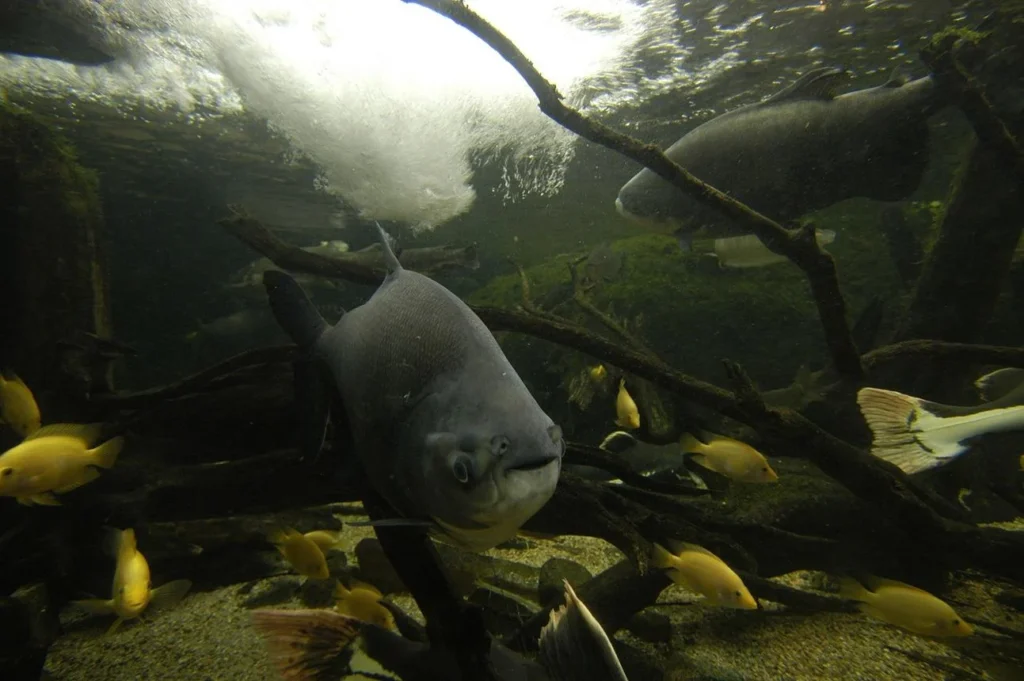
Piranhas are among the most famous Amazon rainforest fishes. Several species occur throughout the basin, and their diets vary considerably.
The red-bellied piranha is one of the best-known species. Although piranhas have a reputation as aggressive predators, their feeding behavior is more complicated than popular stories suggest. Depending on the species and circumstances, piranhas may eat fish, insects, crustaceans, carrion, fruits, seeds, and other organic material.
Piranhas are also important members of Amazonian food webs. They can act as predators and scavengers, helping transfer energy through aquatic ecosystems.
Arapaima: The Giant Fish
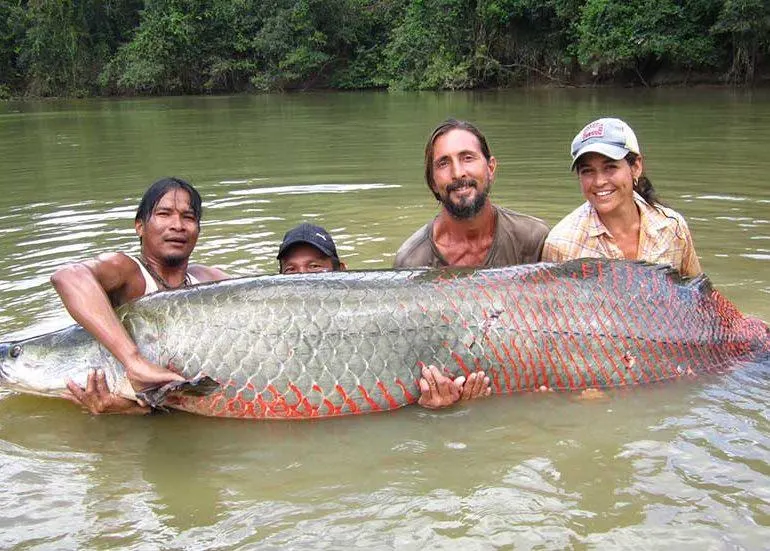
Arapaima, locally known in Peru as paiche and in Brazil as pirarucu, is one of the largest freshwater fish in the world. It is particularly remarkable because it can breathe atmospheric air.
This adaptation allows arapaima to survive in waters where oxygen concentrations can become very low. During seasonal flooding, these fish can move into flooded forests, where water may contain large quantities of decomposing vegetation.
Arapaima can reach enormous sizes. Historical reports describe individuals approaching several meters in length, although fish of such extreme dimensions are uncommon today. Their streamlined bodies, armored-looking scales, large mouths, and powerful tails make them one of the most recognizable fish in Amazonian waters. (National Zoo)
Giant Amazon Catfish
The Amazon contains several species of enormous catfish. Some giant catfish migrate long distances through the river system during their life cycles.
Species of the genus Brachyplatystoma are especially famous for their size and migrations. Some individuals can approach three meters in length and weigh well over 100 kilograms.
These fish demonstrate how connected the Amazon Basin really is. A fish may spend different stages of its life in locations separated by enormous distances, using tributaries, main rivers, floodplains, and other aquatic habitats.
Tambaqui and Pacu
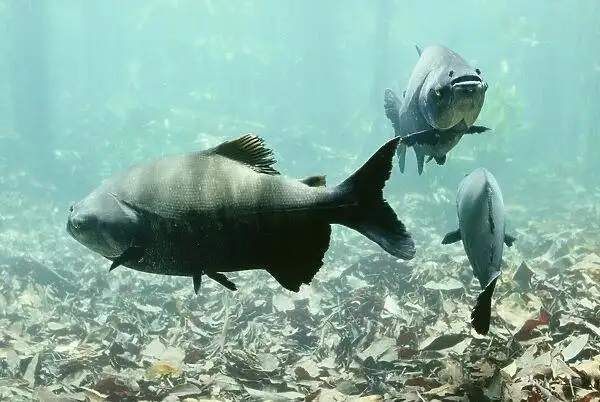
Tambaqui and pacu are important Amazonian fish belonging to groups that are strongly associated with fruits and seeds.
Tambaqui is particularly interesting because it can consume fruits that fall from trees growing along flooded forests. During high-water periods, fish may enter areas that are normally dry forest and feed among submerged vegetation.
Their strong teeth and jaws allow them to process hard fruits and seeds. By eating and later moving away from the parent tree, these fish can contribute to seed dispersal.
Payara
Payara is a spectacular predatory fish recognized by its elongated body and prominent fang-like teeth.
It is a fast predator that can capture other fish in rivers and tributaries. Its appearance has made it popular among sport fishermen and aquarium enthusiasts.
Payara illustrates another aspect of Amazonian fish diversity: adaptations for predation can be extremely specialized, with body shapes, teeth, mouths, and swimming abilities suited to capturing prey in fast-moving water.
Peacock Bass
Peacock bass, known locally in many areas as tucunaré, belongs to the cichlid family. These fish are powerful predators and are particularly important in many lakes and slower-moving waters.
They are also among the most popular sport fish in the Amazon. Their colorful bodies and aggressive strikes make them highly sought after by anglers.
Rare and Unusual Amazon Fish
The Amazon contains many fish that are considerably stranger than the famous piranha or arapaima.
Some species have transparent or highly reflective bodies. Others have elongated shapes, unusual mouths, electric organs, camouflage patterns, or specialized respiratory systems.
Electric Eels
Electric eels are not actually true eels. They are specialized electric fish capable of producing powerful electrical discharges.
They use electricity for several purposes, including sensing their surroundings, communicating, and stunning prey. Some species can produce powerful discharges that make them formidable predators.
Freshwater Stingrays
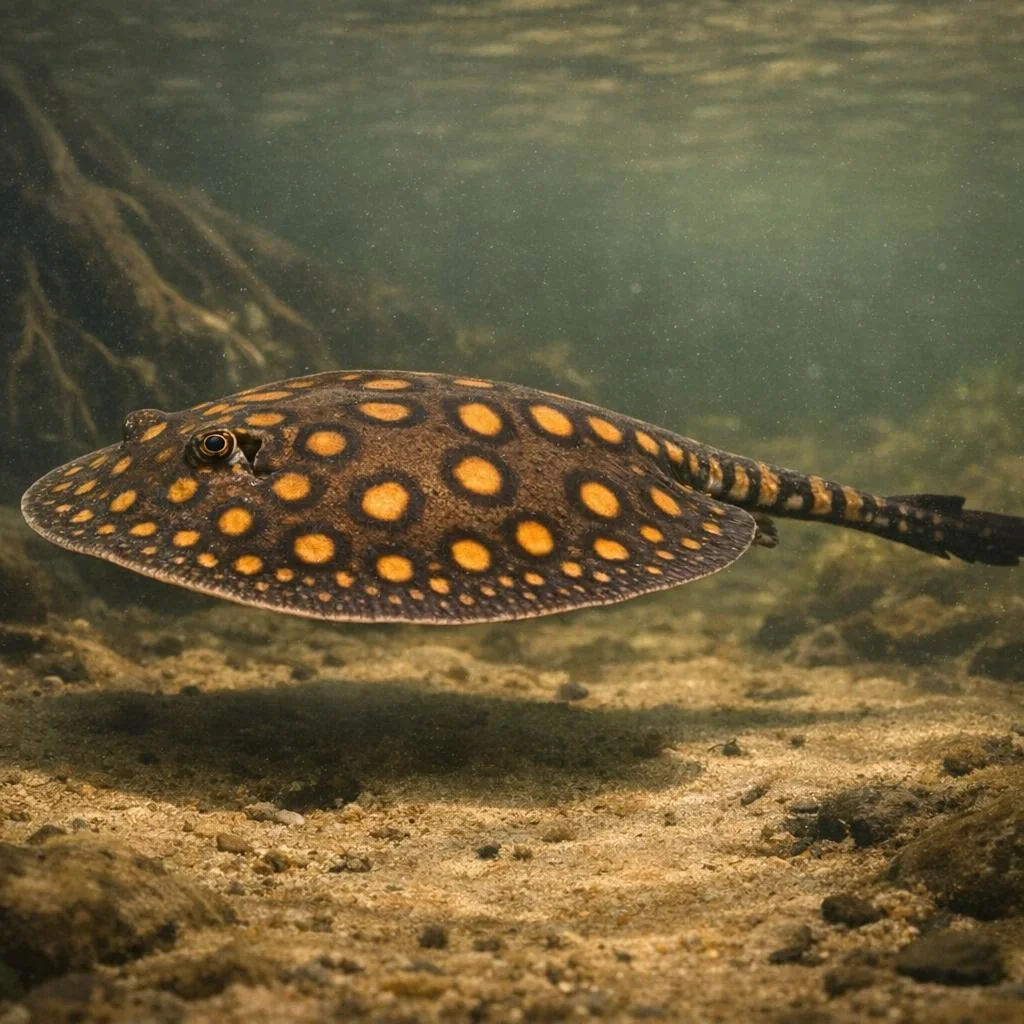
Freshwater stingrays are another unusual component of Amazonian biodiversity. Unlike most marine stingrays, these species have adapted to freshwater environments.
They usually spend much of their time near the bottom, where their flattened bodies help them move across sandy or muddy substrates.
Their venomous spines provide protection against predators, although they generally do not seek confrontation with people.
Tiny Amazon Fish
The Amazon is not only a land of giants. Some Amazonian fish are remarkably small.
Certain species measure only a few centimeters or less when fully grown. Their small size allows them to occupy habitats that larger fish cannot easily use, including shallow vegetation, tiny streams, leaf litter, and narrow forest channels.
This combination of gigantic and miniature fish is one of the most fascinating aspects of Amazonian freshwater biodiversity.
What Fish Live in the Amazon Rainforest?
Fish live throughout almost every type of aquatic environment in the Amazon.
They can be found in:
- Large rivers
- Small tributaries
- Blackwater streams
- Whitewater rivers
- Clearwater rivers
- Floodplain lakes
- Oxbow lakes
- Swamps
- Seasonally flooded forests
- Floating vegetation
- Shallow forest pools
- Rapids
- Sandy river bottoms
- Muddy channels
- Rocky streams
Different species specialize in different environments. A fish adapted to fast-flowing rocky water may be poorly suited to a quiet floodplain lake, while another species may depend on seasonal access to flooded forest.
This habitat specialization is one reason the Amazon can support such an extraordinary number of species.
Fish of Amazon Rivers
Large Amazonian rivers provide permanent aquatic habitats for many species.
These rivers can contain predators, herbivores, detritivores, bottom-dwelling fish, migratory species, and fish that spend much of their time near the surface.
River channels are particularly important during periods when water levels decline. As floodwaters retreat, many fish move back toward deeper channels, lakes, and permanent bodies of water.
Some species undertake extremely long migrations, moving through interconnected rivers and tributaries during different stages of their lives.
Fish of Lakes and Flooded Forests
Floodplain lakes and flooded forests are among the most productive fish habitats in the Amazon.
When rivers rise, water spreads across areas that may have been dry forest only months earlier. Fish can enter these newly flooded areas and exploit food that was previously unavailable.
Fruits, seeds, insects, leaves, terrestrial invertebrates, and other organic material become accessible to aquatic animals.
Flooded forests also provide shelter from predators and areas suitable for reproduction and juvenile development. Studies of Amazon floodplains have shown that fish communities are strongly associated with the extent and structure of flooded forest. (PubMed Central (PMC))
Fish of Smaller Streams and Tributaries
Small streams are often overlooked when people imagine Amazonian fish.
However, tributaries and forest streams can contain specialized communities that differ greatly from those found in large rivers.
Small streams may have:
- Shallow water
- Fallen branches
- Leaf litter
- Dense vegetation
- Rocky areas
- Sandy bottoms
- Slow pools
- Fast-flowing sections
These environments create many ecological niches.
Some fish hide beneath leaves or submerged branches. Others specialize in eating insects that fall from the forest canopy. Small predators may hunt among roots and vegetation.
How Many Fish Species Live in the Amazon River?
There is no single universally accepted number because scientists use different geographic boundaries and taxonomic classifications.
Older estimates documented more than 2,000 species in the Amazon Basin, while newer assessments and broader modern estimates reach several thousand freshwater fish species.
The number continues to change as scientists describe new species, recognize previously overlooked species, and revise classifications.
This is particularly important because some Amazon fish are difficult to distinguish visually. Genetic studies may reveal that populations previously considered one species actually contain multiple distinct species.
The Amazon therefore remains one of the world’s major centers of freshwater fish discovery.
What Is the Biggest Fish in the Amazon Rainforest?
The arapaima is generally considered the largest freshwater fish associated with the Amazon rainforest.
Some individuals can reach several meters in length and weigh around 200 kilograms under exceptional circumstances. Its ability to breathe air is one of its most remarkable adaptations. (National Zoo)
Other giant Amazonian fish include several species of large catfish.
The impressive size of these animals is possible because the Amazon provides extensive aquatic habitats and highly productive floodplain environments.
Dangerous Fish in the Amazon River
The Amazon contains several fish capable of injuring humans, although the danger is often exaggerated in popular culture.
Potentially dangerous species include:
- Piranhas
- Electric eels
- Freshwater stingrays
- Large predatory catfish
Electric eels can deliver powerful electrical discharges, while stingrays have venomous spines.
Piranhas can bite, but attacks on humans are not the constant threat sometimes portrayed in movies.
Many Amazon fish are far more interested in escaping people than approaching them.
Edible Fish in the Amazon River
Fish are an important traditional food resource for many Amazonian communities.
Species commonly consumed in different regions include:
- Tambaqui
- Pacu
- Paiche or arapaima
- Various catfish
- Peacock bass
- Jaraqui
- Bocachico and related species
- Other locally important river fish
Fish provide protein and other nutrients while also playing major cultural and economic roles.
However, sustainable fishing is essential because some large fish grow slowly, migrate long distances, or depend heavily on seasonal habitats.
Amazon Fish and the Flood Pulse
One of the most important concepts for understanding Amazon rainforest fishes is the annual flood pulse.
Water levels naturally rise and fall throughout the year. This changes the size and connectivity of rivers, lakes, channels, and forests.
During high water:
- Rivers expand into floodplains.
- Fish enter flooded forests.
- New feeding areas become available.
- Fruits and seeds become aquatic food resources.
- Fish can access new shelter.
- Some species reproduce or raise young in flooded habitats.
During falling water:
- Fish return toward channels and permanent lakes.
- Food availability changes.
- Predators and prey become concentrated.
- Fishing opportunities may increase.
This seasonal rhythm influences almost every part of Amazonian aquatic ecology. Arapaima, for example, have been documented moving between floodplain habitats as water levels rise and fall. (Wiley Online Library)
Fruit-Eating Fish
One of the most surprising facts about Amazonian fish is that some species eat large amounts of fruit.
When rivers flood forests, fish gain access to fruits growing on trees above the forest floor.
Species such as tambaqui and various pacu-like fishes can consume fruits and seeds.
This creates a fascinating connection between terrestrial and aquatic ecosystems.
The forest feeds the fish, but the fish can also help the forest by dispersing seeds.
In this way, fish are not simply inhabitants of Amazonian rivers. They actively participate in maintaining the rainforest.
Fish and the Flooded Forest
Flooded forests are among the most biologically important habitats in the Amazon.
When water covers the forest floor, the roots, trunks, branches, and fallen vegetation create a complex three-dimensional aquatic environment.
Fish can move between tree trunks, roots, submerged branches, and open water.
For some species, flooded forests provide:
- Food
- Shelter
- Nursery habitat
- Breeding areas
- Protection from predators
- Access to fruits and seeds
- Refuge during different stages of the flood cycle
Research has shown that fish biomass and diversity can be strongly influenced by the amount and structure of flooded forest available. (PubMed Central (PMC))
How Amazon Fish Adapt to Their Environment
Amazonian fishes have evolved an enormous range of adaptations.
Air Breathing
Arapaima are famous for breathing atmospheric air.
This allows them to survive in oxygen-poor waters that would be difficult for many other fish.
Camouflage
Some fish resemble leaves, branches, stones, or the dark river bottom.
Camouflage helps predators approach prey and allows smaller fish to avoid being eaten.
Electric Detection
Electric fish can generate and detect electrical signals, allowing them to navigate and communicate in dark or muddy water.
Powerful Jaws
Predatory fish such as piranhas and payara have specialized teeth and jaws for capturing prey.
Bottom Feeding
Many catfish have sensory structures around the mouth that help them locate food in muddy or dark water.
Blackwater, Whitewater and Clearwater Fish
Not all Amazonian rivers have the same water characteristics.
Whitewater Rivers
Whitewater rivers generally carry large amounts of sediment and nutrients. Their water can appear brown or muddy.
These rivers can support highly productive floodplains.
Blackwater Rivers
Blackwater rivers contain high concentrations of dissolved organic material from surrounding vegetation. The water can appear dark, tea-colored, or almost black.
Blackwater environments can be chemically different from whitewater systems, creating distinctive fish communities.
Clearwater Rivers
Clearwater rivers can have relatively transparent water and different geological and chemical characteristics.
The differences among these environments help explain why fish diversity varies from one part of the Amazon Basin to another.
Rare and Tiny Amazon Fish
Some of the Amazon’s most unusual species are not large enough to attract attention from tourists.
Tiny fish can live among:
- Aquatic plants
- Leaf litter
- Tree roots
- Shallow pools
- Small streams
- Floating vegetation
Some are brightly colored, while others are almost invisible.
Their small size can allow them to exploit ecological niches unavailable to larger fish.
The discovery of tiny and highly specialized species is one reason Amazon fish research remains active.
Current Research and New Fish Discoveries
Scientists continue to discover and describe Amazonian fish.
Modern techniques are changing how researchers study aquatic biodiversity. Environmental DNA, for example, allows scientists to analyze genetic traces left by fish in water.
This can help detect species that are difficult to capture or observe directly.
It is especially useful in small streams, remote wetlands, and habitats where traditional surveys are difficult.
At the same time, DNA reference databases still need improvement because researchers cannot reliably identify every genetic sequence when a species has not yet been properly documented.
The combination of traditional fieldwork, underwater observation, taxonomy, genetics, and environmental DNA is opening new opportunities for understanding Amazonian fish diversity.
Threats to Amazon Rainforest Fishes
Amazon fish face many environmental pressures.
Major threats include:
- Overfishing
- Habitat destruction
- Deforestation
- Mining pollution
- Mercury contamination
- Dams
- Changes in river connectivity
- Climate change
- Extreme droughts
- Changes in flood patterns
- Destruction of floodplain forests
Fish that depend on seasonal migrations are particularly sensitive to changes in river connectivity.
When rivers, floodplains, lakes, and tributaries become disconnected, fish may lose access to important feeding or breeding habitats.
Protecting fish therefore requires protecting the entire river system rather than focusing only on individual species.
Why Protecting Fish Protects the Amazon Forest
The relationship between fish and rainforest is two-way.
The forest provides:
- Fruits
- Seeds
- Insects
- Organic matter
- Shelter
- Breeding habitat
Fish return benefits to the forest ecosystem through seed dispersal, nutrient movement, and their role in aquatic food webs.
Fruit-eating fish are particularly important because they can transport seeds away from parent trees.
This means that conserving Amazonian fish is not simply about protecting aquatic animals. It is also part of protecting the ecological processes that help maintain the rainforest.
Interesting Facts About Amazon Rainforest Fishes
- The Amazon Basin contains thousands of freshwater fish species.
- Arapaima can breathe atmospheric air.
- Some Amazon fish can move deep into flooded forests during high water.
- Piranhas are not all strict meat-eaters.
- Some fish eat fruits and disperse seeds.
- Freshwater stingrays are related to marine stingrays.
- Electric eels are actually electric fish rather than true eels.
- Some Amazon fish are only a few centimeters long.
- Giant catfish can migrate enormous distances.
- Flooded forests provide important feeding and nursery habitats.
- Fish communities can change dramatically between high-water and low-water seasons.
- Blackwater, whitewater, and clearwater rivers support different ecological communities.
- New Amazonian fish species continue to be scientifically described.
- Some fish use camouflage to resemble leaves or other objects.
- Fish can connect aquatic and terrestrial ecosystems through seed dispersal.
Unusual Facts About Amazon Rainforest Fishes
One of the strangest facts about Amazon fish is that some species effectively enter the rainforest itself.
During flooding, the boundary between forest and river disappears. Trees become submerged, and fish swim between trunks and branches.
For an animal adapted to the flood cycle, the forest becomes an underwater feeding ground.
Another unusual fact is that some fish can influence the distribution of rainforest plants. When fruit-eating fish consume seeds and later move through rivers and floodplains, they can transport those seeds to new locations.
The Amazon therefore demonstrates that the forest and the river are not separate ecosystems. They are deeply interconnected.
FAQ About Amazon Rainforest Fishes
What is the most famous fish in the Amazon?
Piranhas are probably the most famous Amazon fish, but arapaima is one of the most impressive because of its enormous size and ability to breathe air.
What is the largest fish in the Amazon?
Arapaima is generally considered the largest freshwater fish associated with the Amazon rainforest. Exceptional individuals can reach several meters in length.
Are there fish in the flooded Amazon forest?
Yes. During seasonal flooding, many fish enter forests that are temporarily covered by water. These areas can provide food, shelter, and breeding habitat.
Are Amazon rainforest fish dangerous?
Some species can be dangerous, including electric eels, freshwater stingrays, piranhas, and certain large predators. However, most Amazon fish are not interested in attacking humans.
Can you eat Amazon River fish?
Yes. Fish are an important traditional food source throughout the Amazon. Tambaqui, pacu, paiche, catfish, and many other species are consumed in different regions.
How many fish species are in the Amazon?
The exact number changes as new species are discovered and classifications are revised. Modern estimates commonly reach several thousand freshwater species across the Amazon Basin.
Do Amazon fish eat fruit?
Yes. Several Amazonian fish eat fruits and seeds, especially during seasonal flooding when forests become accessible.
Can fish really swim through the Amazon rainforest?
Yes. During high-water periods, rivers spread into floodplain forests. Fish can swim between submerged trees, roots, and branches.
Why are Amazon fish important?
Amazon fish are important predators, prey, seed dispersers, nutrient processors, food resources, and indicators of aquatic ecosystem health.
Conclusion
Amazon rainforest fishes represent one of the most extraordinary examples of freshwater biodiversity on Earth. Their variety ranges from tiny stream-dwelling species to enormous arapaima and giant catfish.
What makes Amazonian fish especially fascinating is not simply the number of species, but the way they interact with the entire rainforest ecosystem.
Fish enter flooded forests, consume fruits, disperse seeds, migrate through rivers, survive in oxygen-poor waters, hunt beneath vegetation, and respond to the annual rise and fall of the Amazon’s waters.
The Amazon rainforest and its rivers are therefore part of one interconnected ecological system. Protecting the rivers, lakes, tributaries, wetlands, and flooded forests is essential for protecting the remarkable fish diversity that makes the Amazon one of the world’s greatest freshwater ecosystems.