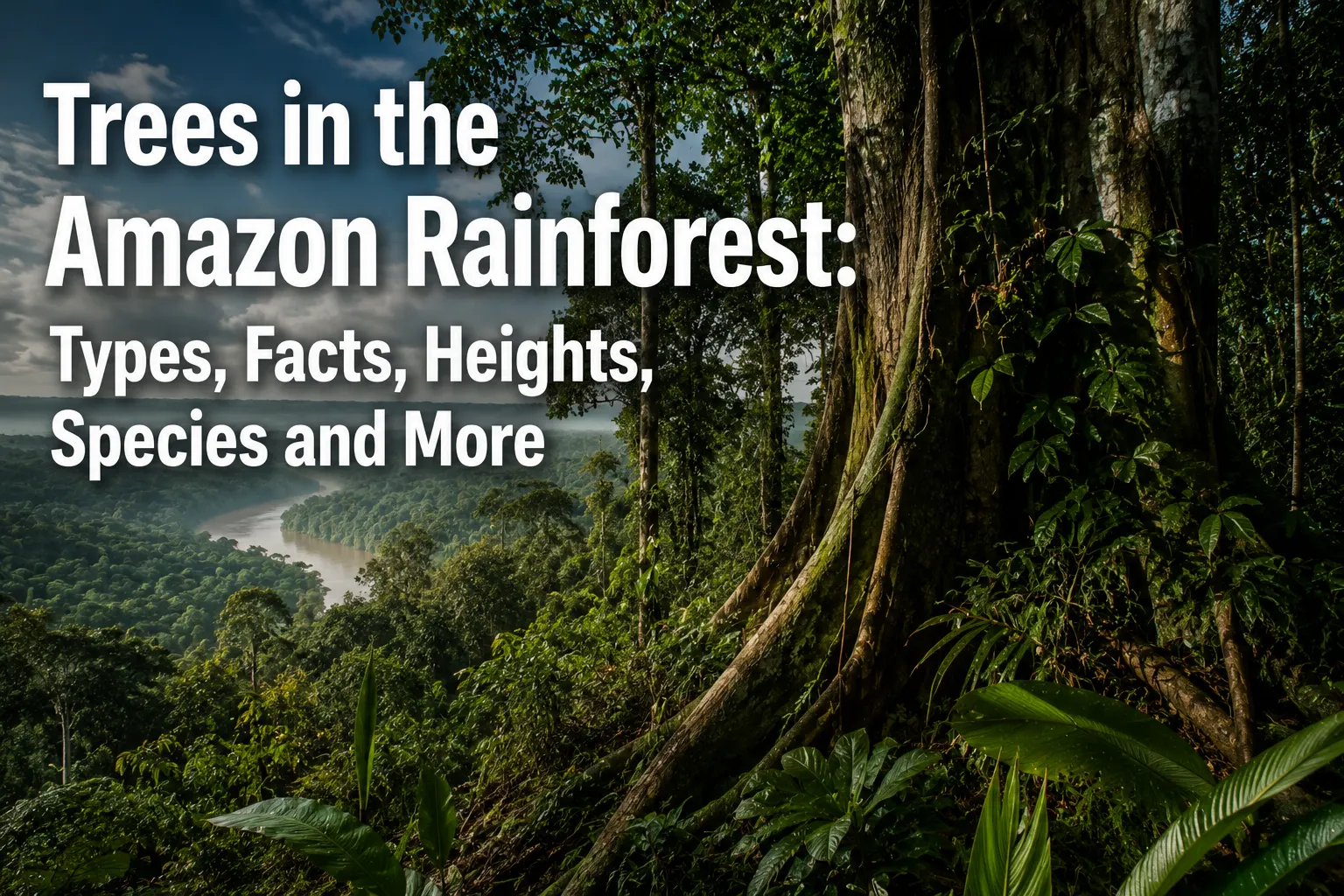
The trees in the Amazon rainforest are among the most remarkable plants on Earth. They form an enormous living structure of trunks, branches, leaves, roots, flowers, fruits, and vines that supports an extraordinary variety of wildlife. From towering emergent trees rising above the forest canopy to palms growing beside rivers and smaller understory trees surviving in deep shade, Amazonian trees come in thousands of forms.
The Amazon rainforest is not a forest made up of just a few dominant tree species. It is a complex mixture of amazon rainforest tree species, tropical hardwoods, palms, fruit-producing trees, flowering trees, and trees adapted to permanently wet, seasonally flooded, or relatively dry environments.
Some Amazon trees can grow more than 50 meters tall, while others remain relatively small because of limited sunlight beneath the canopy. The forest also contains enormous trees with trunks several meters in diameter, unusual root systems, colorful flowers, edible fruits, medicinal plants, and trees that have developed extraordinary relationships with insects, birds, mammals, and fungi.
In this guide, we explore the types of trees in the Amazon rainforest, the most common species, the tallest trees, how many trees grow across the Amazon, interesting facts, palm and fruit trees, unusual pink trees, Amazon forest vegetation, and the continuing threat of deforestation.
Trees in the Amazon Rainforest: An Overview
The phrase trees in Amazon rainforest represents an enormous botanical diversity spread across one of the world’s largest tropical forest regions. The Amazon basin covers several countries and includes different forest environments, from upland terra firme forest to seasonally flooded forests and river-edge vegetation.
Trees are the architectural foundation of these ecosystems. Their trunks support branches and leaves that form the canopy, while their roots stabilize soil, absorb water and nutrients, and interact with fungi and microorganisms. Their flowers and fruits provide food for countless animals, while fallen leaves and branches return nutrients to the forest floor.
The trees of the Amazon are also extremely important for the water cycle. Through transpiration, trees release water vapor into the atmosphere. This moisture contributes to cloud formation and rainfall, helping maintain the humid conditions that characterize much of the rainforest.
Why Amazonian Trees Are So Important
Amazonian trees perform several interconnected ecological functions:
- Provide habitat for birds, mammals, reptiles, amphibians, and insects.
- Produce oxygen through photosynthesis.
- Store large quantities of carbon.
- Release water vapor through transpiration.
- Stabilize soil.
- Reduce erosion.
- Provide fruits, seeds, flowers, and leaves for wildlife.
- Support pollinators and seed dispersers.
- Create nesting and shelter sites.
- Contribute organic matter to the forest floor.
- Help maintain the Amazon’s complex water cycle.
Types of Trees in the Amazon Rainforest
There are thousands of rainforest tree species across the Amazon basin, and they occupy different ecological niches. Instead of thinking of Amazonian trees as one uniform group, it is more useful to classify them according to their position in the forest, habitat, and biological characteristics.
1. Emergent Trees
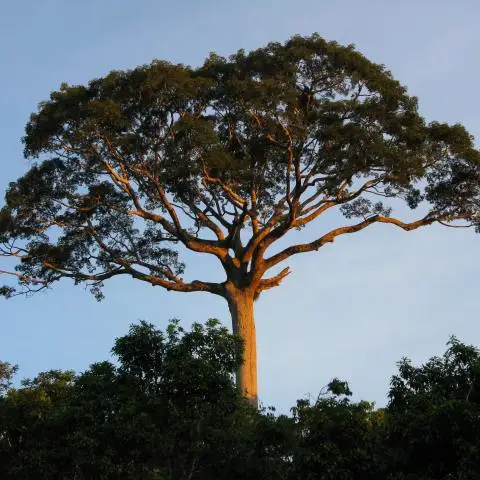
Emergent trees are the giants of the Amazon rainforest. They grow above the main canopy and are exposed to intense sunlight, stronger winds, and greater temperature fluctuations.
These trees can become extremely tall and may have enormous crowns that rise dramatically above surrounding vegetation.
Characteristics of emergent trees
- Extremely tall trunks.
- Large crowns exposed to direct sunlight.
- Strong branches capable of supporting substantial weight.
- Often wider root systems.
- Exposure to wind and intense tropical sunlight.
- Important nesting and observation sites for birds.
Species such as the giant kapok can become spectacular emergent trees.
2. Canopy Trees
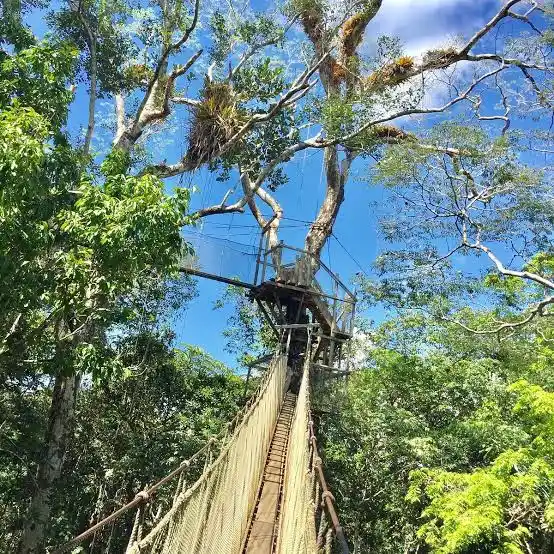
Canopy trees form one of the most important layers of Amazon forest vegetation. Their crowns interlock to create a vast green roof that captures much of the sunlight entering the forest.
The canopy is not a completely solid surface. Gaps occur where branches fall, trees die, or storms damage vegetation. These gaps allow sunlight to reach lower levels and create opportunities for young trees and other plants.
Why the canopy matters
The canopy provides:
- Food for monkeys and birds.
- Nesting sites.
- Shelter from rain and predators.
- Flowers and fruits.
- A habitat for epiphytes, insects, and other plants.
- A major photosynthetic surface for the forest.
Many animals spend most of their lives in this elevated world and rarely descend to the forest floor.
3. Understory Trees
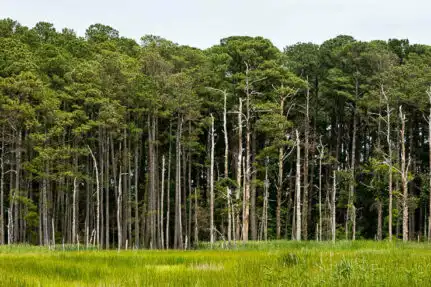
Understory trees grow below the main canopy where sunlight is limited. They are generally shorter than canopy and emergent trees and have adaptations that allow them to survive under shaded conditions.
Some understory species can remain in a suppressed state for years while waiting for a canopy opening. When a large tree falls, sunlight reaches the forest floor, and young plants can rapidly increase their growth.
Understory tree adaptations
Many understory trees have:
- Large leaves designed to capture limited sunlight.
- Shade tolerance.
- Slow growth during unfavorable conditions.
- Specialized flowers that attract particular pollinators.
- Fruits adapted to birds or mammals that live at lower forest levels.
List of Trees in the Amazon Rainforest
A complete list of trees in the Amazon rainforest would contain thousands of species, but several groups are especially well known.
Important Amazon rainforest trees include:
- Kapok tree
- Brazil nut tree
- Rubber tree
- Cacao tree
- Açaí palm
- Aguaje or moriche palm
- Peach palm
- Buriti palm
- Strangler fig
- Ceiba trees
- Mahogany
- Cedar
- Copaiba
- Ironwood species
- Cumaru
- Shihuahuaco
- Andiroba
- Balsa
- Rubber trees
- Various palm species
- Numerous Inga species
- Numerous Ficus species
This list represents only a fraction of the trees found in Amazon rainforest ecosystems.
Most Common Trees in the Amazon Rainforest
Identifying the most common trees in the Amazon rainforest is more complicated than creating a simple worldwide ranking. Tree abundance varies significantly between locations, soil types, elevation, rainfall, flooding patterns, and forest age.
Some genera and species can be locally abundant without being dominant throughout the entire Amazon.
Top 10 Most Common or Widespread Amazon Rainforest Tree Groups
Rather than treating this as an absolute ranking, the following list highlights important and widespread tree groups frequently encountered in Amazonian forests.
1. Inga
Inga trees are particularly important in tropical forests. Many produce pods containing sweet or nutritious pulp around their seeds. Their flowers can attract insects, birds, and other animals.
2. Ficus
Ficus includes figs and strangler figs. Their fruits are an important food source for many rainforest animals.
3. Palm Trees
Palms are among the most recognizable plants in Amazonian forests. They occupy riverbanks, wetlands, flooded forests, clearings, and upland habitats.
4. Cecropia
Cecropia trees are often associated with disturbed areas and forest gaps. Their fast growth allows them to colonize places where sunlight suddenly becomes available.
5. Euterpe
This genus includes important palms such as açaí. Their fruits are consumed by wildlife and people.
6. Dipteryx
Some Dipteryx species are large hardwood trees that can become important components of mature rainforest.
7. Bertholletia
The Brazil nut tree is one of the most famous Amazonian trees and can grow into a very large forest tree.
8. Hevea
Hevea includes the rubber tree, historically and economically one of the most important plants associated with the Amazon.
9. Ceiba
Ceiba trees include some spectacular giants of tropical forests, including the famous kapok tree.
10. Virola and Related Forest Trees
Several Virola species occur in Amazonian forests and are part of the diverse collection of canopy and understory trees.
The exact top 10 most common trees in the Amazon rainforest changes depending on the region and scientific sampling method, so these should be understood as representative groups rather than a definitive Amazon-wide abundance ranking.
Amazon Rainforest Tree Species
The extraordinary number of amazon rainforest tree species is one of the defining characteristics of the ecosystem.
Unlike a temperate forest where a relatively small number of tree species may dominate large areas, tropical forests can contain enormous numbers of species growing within a relatively small area.
A single hectare of mature Amazonian forest can contain dozens, and sometimes well over a hundred, different tree species depending on the location and how the forest is sampled.
This means that two nearby areas can have noticeably different tree communities even when they look similar from a distance.
Famous Amazonian Trees
Kapok Tree
The kapok tree is one of the iconic giants of tropical South America. It can develop a huge trunk and distinctive buttress roots.
Why are kapok trees so large?
Their height allows them to compete for sunlight above neighboring vegetation. Their massive trunks provide structural support for enormous crowns.
The buttress roots spread outward from the trunk and help stabilize the tree in relatively shallow tropical soils.
Brazil Nut Tree
The Brazil nut tree is one of the best-known Amazonian trees because of its valuable seeds.
Brazil nut trees can become extremely large and long-lived. They produce woody fruits containing multiple seeds, which are the familiar Brazil nuts sold as food.
A remarkable relationship
Brazil nut production depends on ecological relationships involving specialized pollinators and seed dispersal. This demonstrates how Amazon trees can depend on animals for successful reproduction.
Rubber Tree
The rubber tree is historically one of the most significant trees of the Amazon.
Its latex is found beneath the bark and can be collected without immediately killing the tree when appropriate harvesting methods are used.
The tree became globally important because natural rubber became a major industrial material.
Cacao Tree
Cacao trees are smaller than many Amazonian canopy giants but are culturally and economically important.
Cacao produces pods directly from the trunk and larger branches, a phenomenon known as cauliflory.
Inside the pods are seeds surrounded by sweet pulp. These seeds are the raw material used to produce chocolate.
How Many Trees Are in the Amazon Rainforest?
The question how many trees in Amazon rainforest has a surprisingly complex answer because scientists cannot simply count every tree individually.
The Amazon contains an enormous number of individual trees distributed across millions of hectares of forest.
A widely cited scientific estimate has placed the number of individual trees with trunks at least 10 centimeters in diameter at roughly hundreds of billions, with estimates around 390 billion trees across the Amazon basin under the methodology used for that assessment.
However, this does not mean there are exactly 390 billion trees today. Forests change continuously, trees grow, die, regenerate, and are cleared. Different studies also use different minimum trunk sizes and geographic boundaries.
Number of Trees in the Amazon Rainforest
The number of trees in Amazon rainforest is therefore best understood as an estimate rather than an exact count.
The total depends on:
- The geographic boundary used for “Amazon.”
- Minimum trunk diameter.
- Whether plantations are included.
- Whether recently cleared areas are included.
- Forest type.
- Sampling methodology.
- Year of the estimate.
There are also enormous numbers of young trees and seedlings that are not included in many large-scale estimates.
How Tall Are Trees in the Amazon Rainforest?
The height of trees in the Amazon rainforest varies enormously.
Small understory trees may be only a few meters tall, while mature canopy trees commonly reach several tens of meters. Exceptional emergent trees can rise more than 50 meters above the forest floor.
Typical Amazon tree height
A simplified representation is:
- Small understory trees: roughly 5–15 meters
- Medium forest trees: roughly 15–30 meters
- Canopy trees: commonly 25–40 meters
- Large emergent trees: 40–60+ meters in exceptional cases
These are broad ranges rather than fixed limits.
The actual Amazon tree height depends on species, soil, competition, water availability, forest age, disturbance, and local environmental conditions.
Tallest Trees in the Amazon Rainforest
The tallest trees in the Amazon rainforest belong primarily to species capable of growing into the upper canopy and emergent layer.
Some exceptionally tall trees can exceed 60 meters, although trees of this height are uncommon.
One of the challenges in measuring tropical trees is that dense forest makes direct measurement difficult. Modern research can combine ground measurements with technologies that map forest structure from above.
What Allows Amazon Trees to Become So Tall?
Tall trees need to solve several problems simultaneously.
They must transport water upward
Water absorbed by roots has to travel enormous distances to leaves at the top of the canopy.
They must support their own weight
A 50-meter tree represents a huge structural investment. Its trunk, branches, roots, and internal tissues must withstand gravity, wind, heavy rain, and the weight of epiphytes.
They must compete for sunlight
The primary advantage of growing tall is access to sunlight.
A tree that reaches above neighboring crowns can capture direct tropical sunlight that is unavailable to plants growing deep in the understory.
Big Trees in the Amazon Rainforest
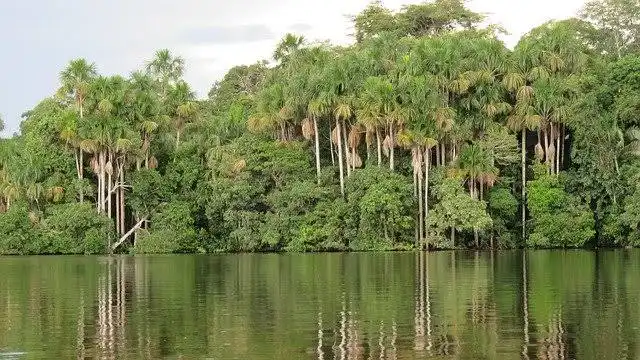
The largest Amazon trees are impressive not only because of their height but also because of their trunk diameter and crown size.
Some mature trees develop enormous buttress roots that extend several meters from the trunk.
What Are Buttress Roots?
Buttress roots are broad, flattened roots that extend outward from the lower trunk.
They are common among large tropical rainforest trees.
These roots can help stabilize tall trees in soils where most nutrients are concentrated near the surface.
A huge Amazonian tree may therefore have a trunk that appears much wider at ground level because of its buttresses.
Palm Trees in the Amazon Rainforest
Palm trees in the Amazon rainforest are among the most recognizable elements of the landscape.
Palms are particularly common around rivers, wetlands, floodplains, and areas with suitable moisture conditions. Some species are also common in upland forests.
Important Amazonian palms include:
- Açaí palm
- Aguaje or moriche palm
- Buriti
- Peach palm
- Ungurahui
- Iriartea
- Various other native palms
Açaí Palm
Açaí palms produce small dark purple fruits that have become globally popular as a food.
In the Amazon, the fruit is an important part of local diets and is also consumed by wildlife.
Aguaje or Moriche Palm
Aguaje palms are especially associated with wetlands and seasonally flooded areas.
Their fruits are consumed by numerous animals and are also used by Amazonian communities.
Peach Palm
Peach palm produces clusters of edible fruits. In some regions, it is cultivated and has considerable cultural importance.
Palm forests can therefore be both ecologically important and highly valuable to people.
Fruit Trees in the Amazon Rainforest
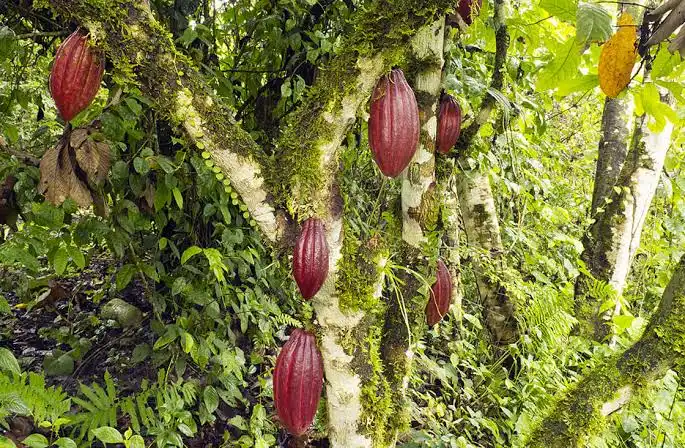
The Amazon contains an enormous variety of fruit trees in Amazon rainforest environments.
Many fruits are specifically adapted for animals that disperse their seeds.
Important Amazonian fruit-producing trees and plants include:
- Cacao
- Brazil nut
- Inga
- Fig
- Açaí
- Aguaje
- Copoazú
- Guava relatives
- Various palm fruits
- Wild citrus relatives
- Numerous locally important native fruits
Why Are Fruits So Important?
Fruits represent a major link between trees and animals.
A tree produces a fruit containing seeds. An animal eats the fruit and moves elsewhere. The seed may later be deposited in a new location with natural fertilizer.
This process is known as seed dispersal.
Animals such as monkeys, birds, bats, rodents, tapirs, and other mammals can all contribute to the movement of Amazonian tree seeds.
Pink Trees in the Amazon Rainforest
The search term pink trees in Amazon rainforest can refer to several different things because there is no single universally recognized “pink Amazon tree.”
Some Amazonian trees produce pink, rose, magenta, or reddish flowers, while others may have young leaves that appear pink or reddish before turning green.
Why do some tropical trees appear pink?
Young leaves sometimes contain pigments that protect developing tissues from intense sunlight or herbivores. As the leaves mature, the concentration and balance of pigments change, producing the familiar green color.
Flowering trees can also create spectacular pink displays during particular seasons.
This is an excellent example of why Amazon vegetation can change dramatically in appearance throughout the year.
Amazon Forest Vegetation
Amazon forest vegetation is much more than trees.
The forest includes:
- Trees
- Palms
- Shrubs
- Vines
- Lianas
- Epiphytes
- Orchids
- Bromeliads
- Ferns
- Mosses
- Aquatic plants
- Seedlings
- Grasses in certain habitats
- Fungi and microorganisms
Trees provide the framework around which these organisms interact.
A single large tree can support hundreds of other organisms on its trunk, branches, leaves, flowers, fruits, and surrounding roots.
Layers of Amazon Rainforest Vegetation
Emergent Layer
The tallest trees rise above the main canopy and experience intense sunlight and wind.
Canopy Layer
The canopy forms the dominant green layer and contains enormous numbers of insects, birds, mammals, and epiphytes.
Understory Layer
This shaded zone contains young trees, shrubs, palms, vines, and shade-adapted plants.
Forest Floor
Very little direct sunlight reaches the floor of mature rainforest. Fallen leaves, branches, fruits, and dead organisms are rapidly decomposed and recycled.
Amazon Rainforest Trees Facts
Here are some of the most interesting trees in Amazon rainforest facts.
1. The Amazon contains hundreds of billions of trees
Large-scale scientific estimates have placed the number of trees at hundreds of billions, although the exact figure changes according to methodology.
2. Some Amazon trees exceed 50 meters
Exceptional emergent trees can rise more than 50 meters above the ground.
3. Trees can communicate chemically
Trees can respond to herbivore attacks and environmental changes using chemical signals and interactions with other organisms.
4. Some trees depend on animals for pollination
Bees, beetles, bats, birds, moths, and other animals can carry pollen between flowers.
5. Some trees depend on animals to disperse seeds
Fruits evolved partly to attract animals that transport seeds.
6. Tree roots are often shallow
Many tropical rainforest nutrients are concentrated near the surface because warm, wet conditions accelerate decomposition and nutrient cycling.
7. Some giant trees develop buttress roots
These structures can extend dramatically outward from the trunk.
8. Trees create their own microclimates
A forest canopy can reduce direct sunlight, moderate temperatures, increase humidity, and protect the lower forest from heavy rainfall.
9. Some trees grow rapidly after disturbance
Species adapted to forest gaps can take advantage of sudden sunlight.
10. Trees can host entire miniature ecosystems
Branches and trunks may support ants, beetles, spiders, frogs, birds, orchids, bromeliads, mosses, lichens, and fungi.
Unusual Things About Amazonian Trees
One of the most unusual characteristics of Amazonian trees is how interconnected they are.
A tree is not an isolated organism. Its roots interact with fungi and microorganisms. Its flowers interact with pollinators. Its fruits interact with seed dispersers. Its leaves are eaten by insects and mammals. Its branches become homes for epiphytes and nesting animals.
Some Trees Have Natural Partnerships With Ants
Certain Amazon plants provide shelter or food for ants, while ants defend the plant against herbivores.
This is an example of mutualism, where both organisms can benefit from the relationship.
Some Trees Flower Directly From Their Trunks
Cacao and certain tropical species exhibit cauliflory, meaning flowers and fruits develop directly from trunks or large branches.
This unusual arrangement can make fruits accessible to particular animals.
Some Trees Are Adapted to Flooding
Floodplain trees can tolerate periods when their roots and sometimes lower trunks are submerged.
This is essential in parts of the Amazon where river levels can change dramatically between seasons.
How Many Trees Are Cut Down in the Amazon Rainforest?
The question how many trees are cut down in Amazon rainforest cannot be answered with one permanent annual number because deforestation changes from year to year and different monitoring systems measure forest loss differently.
It is more accurate to discuss forest area cleared or degraded rather than simply counting individual trees.
When a hectare of mature rainforest is cleared, the number of trees removed can vary enormously depending on forest type, tree density, and the minimum tree size being counted.
Why Are Amazon Trees Cut Down?
Major drivers can include:
- Cattle pasture.
- Agricultural expansion.
- Soy and other crops.
- Infrastructure development.
- Mining.
- Logging.
- Roads.
- Fires.
- Land-use changes.
Not all tree loss is identical. Selective logging may remove valuable individual trees while leaving much of the surrounding forest standing, whereas complete clearing removes nearly all vegetation from an area.
What Happens When Amazon Trees Are Cut Down?
Removing trees changes the ecosystem at multiple levels.
Loss of habitat
Animals lose nesting sites, food sources, shelter, and movement corridors.
Carbon release
Trees store carbon in their trunks, branches, roots, and surrounding soils. When forests are cleared or burned, some of this carbon can enter the atmosphere.
Changes to water cycles
Fewer trees means less transpiration and can affect local moisture movement.
Soil exposure
Without vegetation, heavy tropical rainfall can increase erosion and nutrient loss.
Increased temperatures
Forest removal exposes the ground to direct sunlight and can create hotter, drier local conditions.
Can Amazon Rainforest Trees Grow Back?
Yes, forests can regenerate, but regeneration is not identical to preserving an intact old-growth forest.
After a clearing is abandoned, grasses, shrubs, pioneer trees, and eventually larger forest species may recolonize the area.
Over decades, vegetation can become increasingly complex.
However, an old-growth forest contains ecological structures and species interactions that may take many decades or even centuries to fully develop.
Some large emergent trees require a very long time to reach their maximum size.
How Fast Do Trees Grow in the Amazon?
There is no single Amazon tree growth rate.
Some pioneer species can grow rapidly after a canopy opening. Others grow much more slowly but eventually become enormous.
Growth depends on:
- Species.
- Sunlight.
- Rainfall.
- Soil.
- Competition.
- Herbivory.
- Tree age.
- Forest disturbance.
- Water availability.
A young tree growing in a bright forest gap may experience dramatically different conditions from an old tree beneath a closed canopy.
Why Amazon Trees Are So Tall
The primary reason many Amazonian trees become tall is competition for sunlight.
The tropical rainforest receives abundant solar energy, but most sunlight is intercepted by vegetation above.
A seedling on the forest floor may receive only a small fraction of the light available above the canopy.
Trees capable of growing upward can eventually reach brighter conditions.
This creates a vertical competition that has shaped the architecture of the Amazon rainforest for millions of years.
The Amazon Rainforest Tree Life Cycle
An Amazonian tree begins as a seed.
The seed may be dropped by a bird, monkey, bat, rodent, tapir, or another animal. If conditions are suitable, it germinates.
The young seedling must then survive:
- Shade.
- Herbivores.
- Competition.
- Fungi and pathogens.
- Dry periods.
- Flooding in some habitats.
- Competition for nutrients.
If a nearby tree falls, suddenly creating a canopy gap, the seedling may receive enough sunlight to grow rapidly.
Eventually, some trees reach the canopy.
A small percentage may become giants.
When an old tree finally dies, it creates a new gap and begins another cycle of forest regeneration.
Why the Biggest Trees Matter So Much
Large trees are disproportionately important to forest structure.
They contain substantial amounts of biomass and carbon, produce large crowns, create cavities and nesting opportunities, and can produce huge quantities of flowers and fruits.
When a giant tree falls, the event creates a temporary opening in the forest canopy.
That opening can trigger a burst of regeneration.
Sunlight reaches the forest floor, dormant seedlings begin growing, vines expand, insects colonize the fallen wood, and eventually a new generation of trees begins to occupy the space.
Amazon Trees and Wildlife
The relationship between trees and wildlife is one of the most fascinating aspects of the rainforest.
Monkeys
Monkeys feed on fruits, seeds, flowers, and young leaves while moving pollen and seeds through the forest.
Birds
Macaws, toucans, parrots, and countless smaller birds depend on trees for food and nesting sites.
Bats
Fruit-eating bats are important seed dispersers.
Insects
Beetles, bees, butterflies, moths, ants, and other insects pollinate flowers, consume vegetation, decompose organic material, or live in tree structures.
Tapirs
Large herbivores such as tapirs consume fruits and can move seeds over considerable distances.
Frequently Asked Questions About Trees in the Amazon Rainforest
How many trees are in the Amazon rainforest?
Scientific estimates indicate that the Amazon contains hundreds of billions of trees. A major large-scale estimate placed the number of trees with trunks at least 10 centimeters in diameter at around 390 billion, but the number should be treated as an estimate rather than an exact current count.
What are the most common trees in the Amazon rainforest?
There is no single list that applies equally to the entire Amazon. Inga, Ficus, Cecropia, palms, and numerous other genera can be abundant or widespread, but their abundance varies by region and habitat.
What are the tallest trees in the Amazon rainforest?
Some emergent Amazonian trees can exceed 50 meters, and exceptional individuals can reach more than 60 meters. Their exact maximum height depends on species and local conditions.
How tall are trees in the Amazon rainforest?
Amazonian trees range from small understory species only a few meters tall to enormous emergent trees exceeding 50 meters. Many mature canopy trees are approximately 25–40 meters tall.
What are the biggest trees in the Amazon rainforest?
Large kapok and other emergent species can develop enormous trunks and crowns. Some of the biggest trees are remarkable for both height and trunk diameter.
Are palm trees common in the Amazon?
Yes. Palms are widespread and can be particularly abundant near rivers, wetlands, floodplains, and other moist habitats.
Are there fruit trees in the Amazon rainforest?
Yes. The Amazon contains numerous native fruit-producing trees and palms, including species producing figs, cacao, açaí, aguaje, Inga fruits, Brazil nuts, and many lesser-known fruits.
Why are Amazon rainforest trees important?
They provide habitat, store carbon, regulate water movement, stabilize soils, produce food, support pollination and seed dispersal, and form the physical structure of the rainforest ecosystem.
Final Thoughts on Trees of the Amazon
The trees in the Amazon rainforest are far more than enormous green plants. They form the physical foundation of one of the most complex ecosystems on Earth.
From towering emergent trees more than 50 meters high to tiny understory trees growing in deep shade, Amazonian forests contain an extraordinary range of sizes and adaptations. Palms dominate certain wetlands, fruit trees feed wildlife, hardwoods form the canopy, and giant trees create habitats extending from underground roots to branches high above the forest floor.
The sheer number of trees in the Amazon rainforest is difficult to comprehend. Hundreds of billions of trees may occur across the Amazon basin, representing thousands of species and countless ecological relationships.
Perhaps the most fascinating fact is that no Amazon tree exists entirely alone. A single tree can provide food for insects, fruit for monkeys, nesting sites for birds, shelter for reptiles and amphibians, and habitat for epiphytes. Its roots interact with fungi, its flowers attract pollinators, and its fruits can transport seeds through the digestive systems of animals.
The future of these Amazon rainforest trees is therefore closely connected to the future of the entire ecosystem. Protecting the forest means protecting not just individual trees, but the intricate network of plants, animals, rivers, soils, climate processes, and people that depend on them.
The Amazon is a forest of giants—but its greatest strength comes from the extraordinary diversity of everything growing beneath, within, and above those giants.