The best time to go to the Amazon depends on what you want to experience. The Amazon rainforest is a year-round destination, but changing rainfall, river levels, forest conditions, wildlife behavior, bird activity, and accessibility create noticeably different experiences throughout the year. For many travelers, the drier months are attractive because trails are generally easier to walk and wildlife can be easier to observe around rivers, lakes, and exposed banks. The wetter months, however, transform the forest into a world of flooded waterways where boats and canoes can enter areas that are inaccessible on foot during lower water.
There is therefore no single month that is universally the best for everyone. A wildlife photographer may prefer one period, a birdwatcher another, while someone interested in river exploration may actually prefer higher water. In Peru, the Amazon can be explored from several gateways, including Puerto Maldonado, Tambopata, Manu, and Iquitos, and conditions are not identical throughout the enormous Amazon basin.
For travelers interested in Amazon Rainforest Birds, season is only one part of the equation. Habitat, time of day, weather on a particular morning, forest type, and the experience of the guide can all influence what you see. The Amazon is particularly fascinating because many of its birds are easier to hear than to see, meaning that an early morning in the forest can become an extraordinary experience even when the canopy initially appears empty.
Quick Answer: What Is the Best Time to Go to the Amazon?
For many first-time visitors, May through October is an excellent period for visiting the Amazon, particularly in southern Peru and the Tambopata region. These months generally offer easier hiking conditions, lower water levels in many areas, and good opportunities for wildlife observation. However, the Amazon does not suddenly become “bad” during the rainy season. Higher water creates completely different opportunities, including access by canoe into flooded forest and waterways that may be difficult or impossible to explore during low water.
A useful way to choose your travel dates is to decide first what type of Amazon experience you want:
- Best for easier jungle hiking: generally the drier months.
- Best for low-water wildlife exploration: generally the drier period.
- Best for flooded-forest canoeing: generally the higher-water period.
- Best for birdwatching: possible year-round, especially with early-morning excursions.
- Best for macaws and parrots: conditions depend heavily on weather and the particular clay lick.
- Best for photography: often the drier period, although dramatic rainy-season skies can produce exceptional images.
- Best for avoiding the idea of a single “perfect” season: visit with an itinerary that combines different habitats.
The most important point is that rainforest does not mean rain every minute of every day. Even during a relatively dry period, tropical rain can arrive suddenly, while a wet-season morning can sometimes be bright, warm, and calm.
Understanding Amazon Rainforest Seasons
What Are the Main Seasons in the Amazon?
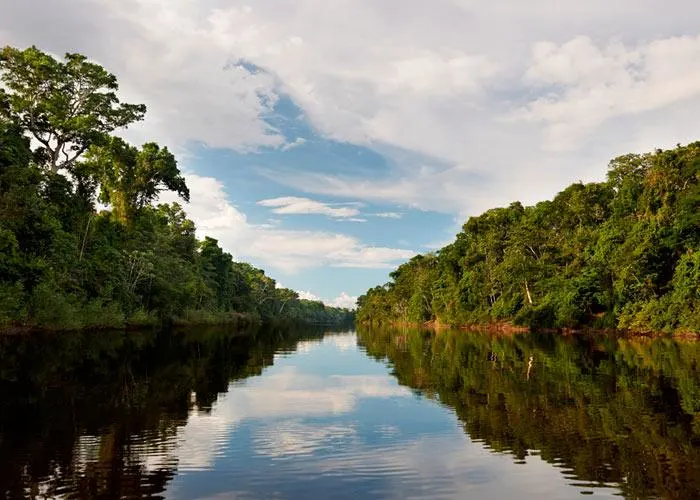
The Amazon does not follow the traditional four-season pattern familiar to many travelers. Instead, rainforest destinations are generally described according to periods of relatively higher and lower rainfall and, importantly, higher and lower river levels.
In southern Peru, including the Tambopata area around Puerto Maldonado, the broad pattern commonly used for travel planning places the drier period around May to October or November and the wetter period around November or December through March or April. The exact timing varies from year to year, so these dates should be considered general patterns rather than fixed boundaries.
The Lower-Water or Drier Period
During the lower-water period, rivers gradually retreat and sections of riverbank, beaches, trails, and forest floor that were previously submerged become accessible. This can make walking excursions more extensive and can change where wildlife is encountered.
For travelers who want to combine jungle trekking with wildlife observation, this period can be particularly appealing. Trails may still be muddy after rain, and tropical storms can occur, but the overall conditions are often more favorable for land-based exploration.
The Higher-Water or Wetter Period
During the wetter months, increased rainfall raises rivers and fills streams, channels, lagoons, and flooded forest. Rather than seeing high water as a disadvantage, experienced Amazon travelers often view it as a different form of exploration.
Canoes can sometimes travel farther into flooded forest, creating the unusual experience of moving between trees rather than simply traveling along a large river. Forest that appears to be ordinary land during low water can become an intricate aquatic landscape during high water.
Best Time to Go to Amazon Rainforest by Month
January: Green, Wet and Full of Life
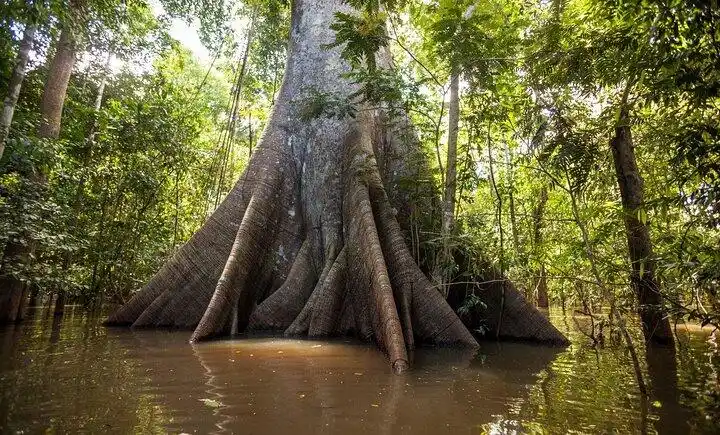
January is part of the wetter period in many Amazon destinations. Rain can be frequent, but the forest is intensely green and waterways can provide excellent opportunities for exploring aquatic habitats.
This is a good month for travelers who do not mind rain and who enjoy seeing the Amazon in a lush, water-rich state. Waterproof bags, quick-drying clothing, and protection for cameras and electronics become especially important.
February: A True Rainforest Experience
February can continue the wetter conditions. Hiking conditions may be muddier, but rivers and streams can be attractive for boat-based exploration.
One unusual aspect of visiting during wetter weather is how quickly the forest can change. A trail can be dry in the morning and muddy after an afternoon storm, while a small stream can rise considerably following heavy rainfall.
March: High Water and Flooded Forest
March can provide opportunities to explore waterways and flooded habitats. For travelers interested in canoeing, the higher-water environment can be fascinating because the forest itself becomes part of the aquatic landscape.
Birdwatchers should not assume that wet weather means fewer birds. Instead, the most productive approach is often to take advantage of clear periods, especially early in the morning.
April: Transition Conditions
April can act as a transition month in some parts of the Amazon. Rainfall patterns begin to change, but local conditions remain highly variable.
This can be an interesting period for travelers who prefer fewer rigid expectations. One day might feel extremely wet while another provides long periods of sunshine.
May: One of the Best All-Around Months
May is often an excellent compromise between wet and dry conditions in southern Peru. Trails can become increasingly manageable as water levels begin to decline, while the forest remains extremely lush.
For visitors interested in wildlife, hiking, photography, and birds, May can offer a particularly attractive balance.
June: Excellent for Jungle Exploration
June is generally associated with the beginning of a more pronounced lower-water period in many southern Amazon destinations.
This can be an excellent month for travelers who want to spend more time walking forest trails. Riverbanks become more visible, and areas that were previously difficult to access by foot can become easier to explore.
July: Popular Dry-Season Travel
July is traditionally a popular travel month because conditions in many parts of the Peruvian Amazon are favorable for outdoor activities.
The forest remains hot and humid, but lower rainfall can make it easier to organize longer excursions. Wildlife photography can also benefit from more predictable opportunities for land-based exploration.
August: Wildlife, Trails and Clearer Conditions
August continues the generally favorable lower-water period in southern Peru. It is a strong month for travelers whose priorities include jungle walks, wildlife observation, photography, and birdwatching.
An important consideration is that “dry season” does not mean a completely rain-free rainforest. Sudden tropical showers remain possible and are part of the ecosystem.
September: Excellent Shoulder-Season Potential
September can be an especially interesting month because it combines many advantages of the drier period with potentially more flexible travel conditions.
Early morning birdwatching can be excellent, and travelers interested in wildlife photography may appreciate clearer periods. The forest remains active, and the absence of heavy continuous rain can make some excursions easier.
October: A Strong Month for Wildlife Travelers
October often remains favorable for exploration in southern Amazon destinations, although rainfall can begin increasing as the wetter period approaches.
It can be a good time for travelers who want a combination of jungle hiking and river excursions without committing entirely to the wetter-season experience.
November: Seasonal Transition
November can bring changing weather conditions. Rain becomes increasingly important, but lower-water characteristics may still remain in some locations.
For photographers and birdwatchers, this transition can create interesting atmospheric conditions. The forest may look exceptionally vibrant after rain, while sunny intervals can produce dramatic light through the canopy.
December: Higher Water Begins to Become More Important
December marks the beginning of the wetter period in many Amazon regions. Higher water can open different possibilities for canoeing and flooded-forest exploration.
Travelers should embrace the fact that the Amazon is not a static destination. The same forest can look and behave differently depending on the amount of water moving through it.
Best Time to Visit the Amazon in Peru
Best Time to Visit Amazon Rainforest Peru
The best time to visit Amazon rainforest Peru depends on the region and the type of experience you want. For southern Peru, especially Tambopata and the area around Puerto Maldonado, May through October or November is commonly favored by travelers who want easier jungle walking and lower-water exploration.
The Peruvian Amazon is particularly diverse because it includes several major rainforest destinations with different geography and access arrangements.
Puerto Maldonado and Tambopata
Puerto Maldonado is a major gateway to the southern Peruvian Amazon. The nearby Tambopata landscape is particularly attractive for travelers interested in wildlife, birds, oxbow lakes, clay licks, monkeys, caimans, river habitats, and jungle walks.
The region is especially interesting for birdwatchers because of its extraordinary diversity. Current regional inventories vary according to survey area and methodology, but Tambopata is consistently recognized as one of Peru’s major bird-rich landscapes. Recent research has emphasized that detecting Amazon birds can be difficult because many species are hidden in dense vegetation or have low detection probabilities.
Manu and Other Amazon Destinations
Manu offers another type of rainforest experience, while northern destinations such as Iquitos have their own seasonal characteristics. This means travelers should not assume that the climate in Puerto Maldonado is identical to the climate in every other Amazon gateway.
Best Time to Go to Amazon Peru for Wildlife
For many wildlife-focused trips in southern Peru, the lower-water period can provide excellent opportunities for observing animals along rivers, oxbow lakes, exposed banks, and forest trails.
However, wildlife does not disappear during the wet season. Mammals, birds, reptiles, amphibians, and insects remain active throughout the year.
The most important advantage of traveling with wildlife as your priority is often not choosing one perfect month, but spending enough time in the forest to experience several habitats and excursions.
Amazon Rainforest Birds
Birds of the Amazon Rainforest
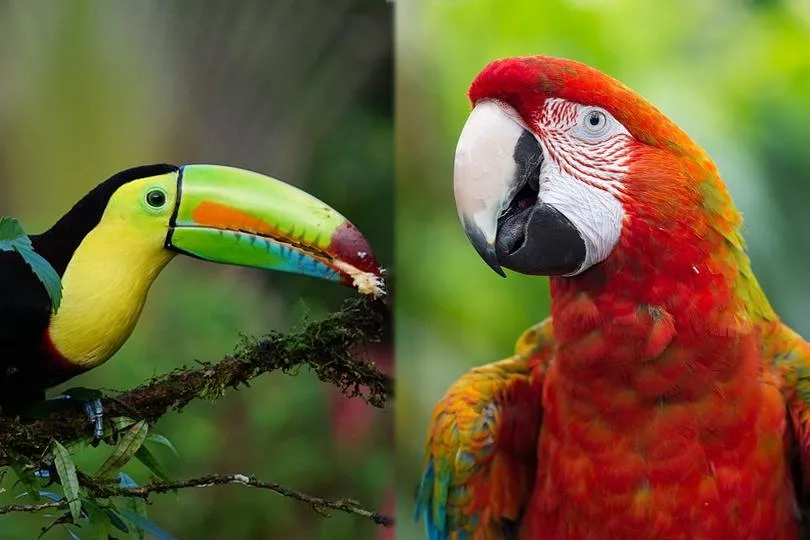
The birds of the Amazon rainforest represent one of the greatest attractions for nature travelers. The forest contains an extraordinary mixture of parrots, macaws, toucans, hummingbirds, raptors, tanagers, antbirds, woodpeckers, kingfishers, tinamous, owls, cotingas, jacamars, puffbirds, and many other groups.
Peru’s lowland Amazon contains some of the country’s highest concentrations of bird species. Research has documented particularly high bird richness in Amazonian parts of Peru, including Madre de Dios.
What makes Amazon birdwatching unusual is that the forest can appear silent and empty to an inexperienced observer while actually being full of birds. A guide may recognize a distant call, stop walking, point toward an apparently ordinary tree, and reveal a bird that would otherwise remain invisible.
Amazon Rainforest Bird Species
The term Amazon Rainforest Bird Species covers an enormous range of ecological strategies. Some birds live high in the canopy, some forage on the forest floor, while others specialize in riverbanks, wetlands, bamboo, palms, fruiting trees, or clay licks.
Important groups include:
- Macaws
- Parrots
- Parakeets
- Toucans
- Hummingbirds
- Trogons
- Kingfishers
- Woodpeckers
- Tanagers
- Antbirds
- Cotingas
- Raptors
- Owls
- Tinamous
- Jacamars
- Puffbirds
A single forest trail can pass through several microhabitats, which explains why bird diversity can be so high even within a relatively small area.
Amazon Birds
Amazon birds are not limited to the famous colorful species. Some of the most interesting birds are brown, gray, green, or cryptically patterned.
The Great Tinamou, for example, may be far less visually spectacular than a macaw, but hearing its haunting call deep in the forest can be one of the most memorable experiences for a birdwatcher.
This is one reason experienced birdwatchers do not judge a rainforest morning only by how many brightly colored birds they see.
Amazon Rainforest Birds Names
Common Amazon Rainforest Birds Names
Travelers searching for Amazon Rainforest Birds Names often begin with the most recognizable species.
Some of the best-known examples include:
- Scarlet Macaw
- Blue-and-yellow Macaw
- Red-and-green Macaw
- Chestnut-fronted Macaw
- Mealy Amazon
- Orange-winged Amazon
- Toco Toucan
- Channel-billed Toucan
- Chestnut-eared Aracari
- Golden-collared Toucanet
- Hoatzin
- Harpy Eagle
- King Vulture
- Black Hawk-Eagle
- Rufescent Tiger Heron
- Ringed Kingfisher
- Amazon Kingfisher
- Green Kingfisher
- Long-tailed Potoo
- Great Potoo
- Amazonian Motmot
- Blue-crowned Motmot
- Wire-tailed Manakin
- Golden-headed Manakin
The precise species encountered depends heavily on location and habitat.
Amazon Rainforest Birds Pictures
Why Pictures Are Important for Identifying Amazon Birds
Amazon Rainforest Birds Pictures are particularly useful because bird identification often depends on small details.
A photograph can help distinguish species by showing:
- Bill shape
- Eye color
- Crown markings
- Wing patterns
- Tail length
- Chest coloration
- Leg color
- Size
- Feather texture
- Sexual differences
However, photographs can sometimes be misleading. Light filtering through the canopy can change the apparent color of feathers, while juvenile birds may look substantially different from adults.
For this reason, a photograph is most useful when combined with location, habitat, behavior, vocalization, and the time of observation.
Amazon Rainforest Birds Facts
Fascinating Facts About Amazon Birds
One of the most interesting Amazon Rainforest Birds Facts is that bird diversity does not mean birds are always easy to see. Dense vegetation creates an enormous visual barrier.
Another unusual fact is that some species occupy extremely specific ecological niches. Certain birds specialize in following army ants and catching insects fleeing from the advancing swarm. Others depend heavily on fruiting trees or palms.
More Interesting Facts
- Many rainforest birds are most active around sunrise.
- Some birds communicate through calls that travel surprisingly far through dense vegetation.
- Mixed-species feeding flocks can contain several different bird species moving together.
- Fruit-eating birds can help disperse seeds.
- Hummingbirds play important roles as pollinators.
- Raptors can occupy large territories because suitable prey may be spread over extensive areas.
- Some forest birds spend most of their lives high in the canopy.
- Clay licks can attract large numbers of parrots and macaws.
- Some Amazon birds are much easier to identify by sound than by appearance.
Amazon Rainforest Bird Sounds
Why Amazon Rainforest Bird Sounds Matter
Amazon Rainforest Bird Sounds are among the most distinctive aspects of the jungle. Before visitors see a bird, they often hear it.
A rainforest morning can contain layers of sound:
- Distant macaw calls
- Parrot chatter
- Toucan calls
- Hummingbird wingbeats
- Woodpecker drumming
- Tinamou calls
- Monkey vocalizations
- Insects
- Frogs
- Running water
- Wind moving through leaves
For serious birdwatchers, learning bird sounds can dramatically increase the number of species they detect.
When Is the Best Time to Hear Amazon Birds?
The best time is generally early morning, often shortly after sunrise. Temperatures are cooler, bird activity is high, and the forest has not yet become as hot and noisy as it can become later in the day.
This is one reason a jungle lodge located deep in the forest can provide an advantage: travelers can begin excursions early without spending hours traveling from a distant city.
Most Beautiful Amazon Birds
Which Are the Most Beautiful Amazon Birds?
The Most Beautiful Amazon Birds are largely a matter of personal preference, but several groups are famous for spectacular colors.
Scarlet Macaw
The Scarlet Macaw is one of the most recognizable rainforest birds, with brilliant red plumage combined with blue and yellow wing markings.
Blue-and-Yellow Macaw
The Blue-and-Yellow Macaw combines intense blue upperparts with golden-yellow underparts, creating one of the most dramatic color combinations in the rainforest.
Toucans
Toucans are famous for enormous bills and contrasting plumage. Their bills may appear disproportionately large, but they are highly adapted for feeding and handling food.
Hummingbirds
Hummingbirds are tiny compared with macaws and toucans, but their iridescent feathers can produce extraordinary colors when sunlight reaches them at the right angle.
Colorful Amazon Rainforest Birds
Why Are Amazon Birds So Colorful?
Colorful Amazon Rainforest Birds often use bright plumage for communication, mate attraction, species recognition, or social signaling.
The rainforest’s three-dimensional structure also influences bird coloration. A bird moving through the canopy may appear brilliantly colored for a moment and then disappear completely when it enters shadow.
Some colors are created not simply by pigments but by the microscopic structure of feathers. This is particularly noticeable in iridescent birds, where the apparent color can change depending on viewing angle and light.
The Most Colorful Groups
- Macaws
- Parrots
- Toucans
- Trogons
- Tanagers
- Cotinga species
- Hummingbirds
- Motmots
- Manakins
Rare Amazon Rainforest Birds
Rare Amazon Rainforest Birds and Difficult-to-See Species
Rare Amazon Rainforest Birds are not necessarily rare because there are only a few individuals. Some are considered difficult to observe because they are secretive, live in dense vegetation, occupy the canopy, have large territories, or occur at low population densities.
This distinction is important. A bird may be relatively widespread but extremely difficult for visitors to see.
Some of the most challenging rainforest birds include:
- Harpy Eagle
- Crested Eagle
- Black-and-white Hawk-Eagle
- Rufous Potoo
- Great Jacamar
- Certain antbirds
- Some tinamous
- Specialized understory species
The search for rare birds also demonstrates why a knowledgeable local guide can be so valuable. Knowing where a species normally feeds or which call it makes can save hours of searching.
Best Time to Visit the Amazon for Birdwatching
Is There a Best Birdwatching Season?
Birdwatching is possible throughout the year, and there is no single month that guarantees the greatest number of species.
The most important factors are:
- Early morning activity
- Habitat diversity
- Length of stay
- Local guide knowledge
- Weather
- Seasonal food availability
- Access to different ecosystems
The drier period may make trails easier to explore in southern Peru, but wet-season birdwatching can also be excellent.
The real advantage comes from visiting several habitats rather than relying on one trail.
Best Time to See Macaws and Parrots
Clay Licks and Amazon Birds
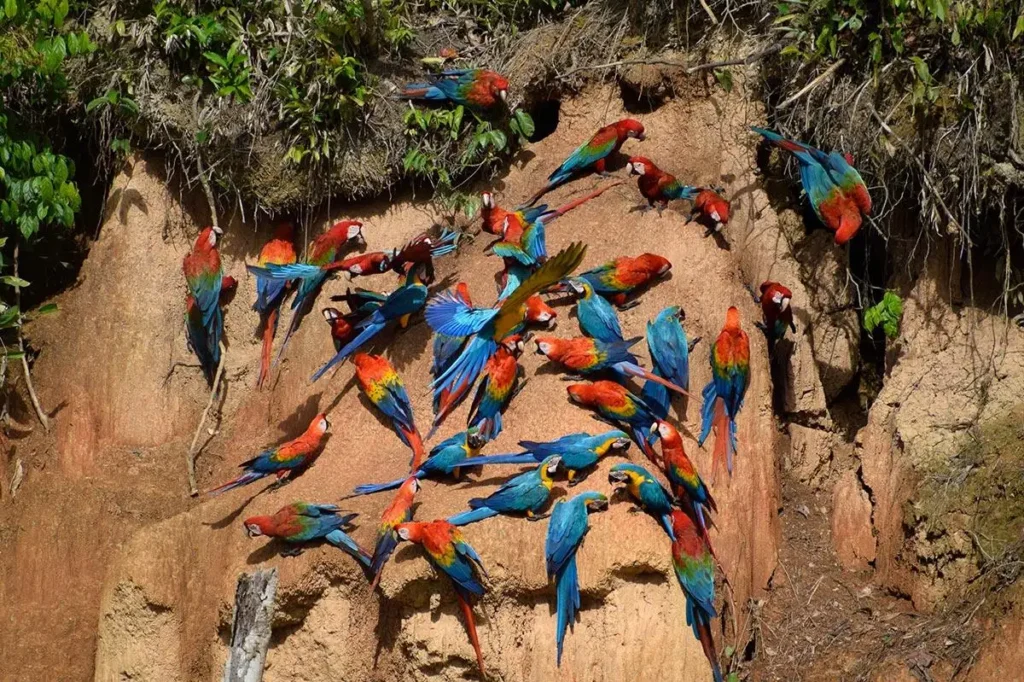
Clay licks are among the most spectacular places to observe Amazon parrots and macaws. Birds may gather at exposed clay walls or other mineral-rich locations, creating one of the rainforest’s most memorable wildlife spectacles.
However, weather matters. Rain can delay or reduce bird activity at exposed clay licks. Therefore, a trip designed around macaws should include flexibility.
In Tambopata, parrot and macaw diversity is particularly notable. Research focused on the area’s parrots has documented numerous species, including macaws, parrots, parakeets, and related birds.
Best Time for Wildlife in the Amazon
Mammals, Reptiles and Birds
The Amazon should not be considered a destination where wildlife appears according to a fixed schedule. Animals respond to food, water, temperature, predators, breeding, and habitat conditions.
During lower water, exposed riverbanks and shrinking water sources can change animal distribution. During higher water, flooded forests create additional aquatic pathways.
This means both seasons can produce excellent wildlife encounters.
Why Early Morning Is So Important
One of the biggest mistakes first-time visitors make is assuming that a rainforest excursion at noon will produce the same experience as an excursion at dawn.
The early morning is cooler and often more active. Birds are calling, monkeys are moving between feeding areas, and the forest has a completely different rhythm.
For this reason, serious wildlife travelers should prioritize at least one early-morning excursion during their stay.
Best Time for Amazon Rainforest Photography
Photography During the Dry Season
Lower-water periods can be excellent for photography because trails may be easier to access and riverbanks can provide open viewpoints.
Wildlife may also be easier to photograph when it is visible along exposed areas.
Photography During the Rainy Season
Rain creates its own photographic opportunities.
Wet leaves become highly reflective, clouds create dramatic skies, and mist can give the forest a mysterious appearance. Macro photographers may also find extraordinary opportunities with frogs, insects, spiders, mushrooms, and plants after rain.
The important lesson is that bad weather does not necessarily mean bad photography.
Best Time for Amazon River Exploration
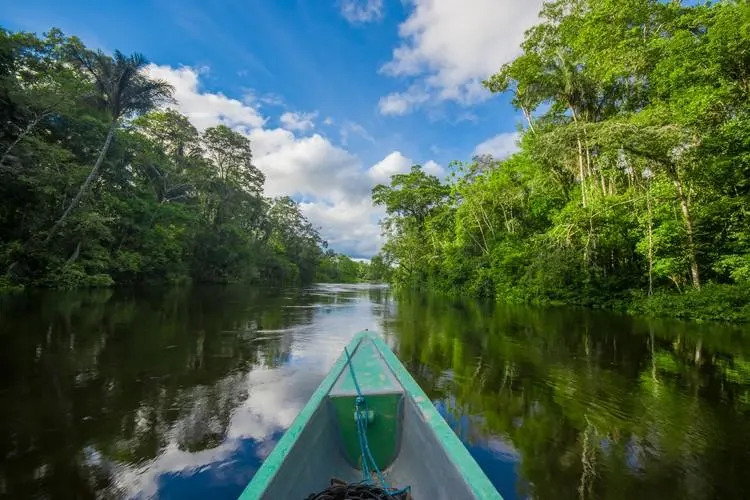
High Water Versus Low Water
The difference between high and low water can completely change how travelers experience the rainforest.
During high water, boats and canoes can sometimes enter flooded forest channels. During low water, beaches, riverbanks, and trails become more accessible.
Therefore:
Choose higher water if you want:
- Canoeing through flooded forest
- More water-based exploration
- Access to narrow channels
- Aquatic landscapes
Choose lower water if you want:
- More jungle hiking
- Exposed riverbanks
- Easier trail access
- More land-based exploration
- Certain wildlife-viewing opportunities
Neither season should automatically be considered superior.
What Is Unusual About Visiting the Amazon?
The Amazon Changes Without Moving
One of the strangest things about the rainforest is that the landscape can appear to remain in the same place while its accessibility changes dramatically.
A forest can be dry land during one part of the year and become partially flooded during another.
This seasonal transformation affects:
- Animal movement
- Bird feeding
- Fish distribution
- Canoe routes
- Hiking trails
- River beaches
- Fruit availability
- Insect activity
- Fishing opportunities
The Amazon is therefore not one fixed ecosystem but a constantly changing network of forests, rivers, lakes, wetlands, islands, and seasonal habitats.
The Forest Is Often Heard Before It Is Seen
Another unusual characteristic is that sound can be more informative than sight.
A traveler may walk through apparently empty vegetation while a guide hears several species calling from different directions.
This is especially important for Amazon Rainforest Bird Sounds, because many birds remain hidden high in the canopy or deep within vegetation.
How Long Should You Stay in the Amazon?
Is Three Days Enough?
Three days can provide a good introduction, especially when the itinerary includes several different habitats and begins early each morning.
However, a longer stay increases the probability of encountering more species and experiencing different weather conditions.
Three Days
Good for:
- First-time visitors
- Short vacations
- Basic wildlife experience
- Jungle walks and river excursions
Four to Five Days
Better for:
- Serious wildlife travelers
- Birdwatchers
- Photographers
- Travelers wanting more relaxed exploration
- Multiple habitats
Longer Expeditions
Longer trips become particularly valuable for specialized birdwatching because some species may require repeated attempts.
A longer stay also increases the chance of experiencing both sunny and rainy conditions, which is useful because weather can influence animal activity.
What to Pack for the Amazon
Regardless of when you visit, preparation is important.
Essential Amazon Packing List
- Lightweight long-sleeved shirts
- Lightweight long trousers
- Comfortable walking shoes
- Sandals or waterproof footwear
- Insect repellent
- Sunscreen
- Wide-brimmed hat
- Lightweight rain jacket
- Waterproof bags
- Dry bags for electronics
- Binoculars
- Camera
- Extra batteries or power bank
- Reusable water bottle
- Small flashlight or headlamp
For birdwatchers, binoculars are among the most valuable pieces of equipment. A compact field notebook can also be surprisingly useful because recording the location, habitat, time, and behavior of a bird can make later identification much easier.
Frequently Asked Questions
What is the best time to go to the Amazon?
For many travelers visiting southern Peru, May through October is an excellent period because lower rainfall and lower water can make hiking and land-based wildlife exploration easier. However, the Amazon is a year-round destination, and wetter months offer different experiences such as flooded-forest exploration.
What is the best time to visit the Amazon rainforest in Peru?
For southern Peru, particularly Tambopata, the drier months are often favored for hiking, wildlife observation, and easier access to land-based habitats. Conditions vary by location, however, so travelers should consider whether they prefer hiking or flooded-forest exploration.
Is the Amazon worth visiting during the rainy season?
Absolutely. The rainy season creates higher river levels and can provide access to flooded forest and waterways that are difficult to reach during low water.
Can you see birds in the Amazon all year?
Yes. Birds inhabit the Amazon throughout the year. Weather, habitat, food availability, and time of day influence sightings, but there is no season when the rainforest simply stops being a birdwatching destination.
What is the best time to see Amazon Rainforest Birds?
Early morning is generally the most important time for birdwatching. Seasonal differences matter, but being in the forest around sunrise can be more important than choosing one specific month.
What are the most beautiful Amazon birds?
Macaws, toucans, hummingbirds, parrots, tanagers, motmots, cotingas, and trogons are among the most visually spectacular groups.
Are Amazon rainforest birds easy to see?
Not always. Many species are hidden by dense vegetation or remain high in the canopy. Learning bird sounds and traveling with an experienced guide can significantly improve identification and sightings.
What are some unusual Amazon rainforest birds?
The hoatzin, potoos, tinamous, antbirds, manakins, and harpy eagle are particularly unusual because of their appearance, behavior, vocalizations, habitat preferences, or hunting strategies.
Final Answer: When Should You Go to the Amazon?
The best time to go to the Amazon is ultimately the season that matches the experience you want. If your priority is comfortable jungle hiking, land-based wildlife observation, photography, and exploring exposed trails and riverbanks, the drier months in southern Peru are an excellent choice. If you want to explore flooded forest, travel deeper into waterways, and experience the Amazon from a canoe, the higher-water season can be equally rewarding.
For Amazon Rainforest Birds, there is no single perfect month. Birds are present throughout the year, and early morning, habitat diversity, patient observation, and knowledgeable guiding can make a greater difference than the calendar alone.
The Amazon is unusual because it changes with water. The forest is never exactly the same from one season to another, and that is part of what makes it so extraordinary. During one visit you may walk beneath towering trees searching for a hidden antbird; during another you may glide by canoe through flooded forest while parrots call overhead. A macaw may suddenly cross the sky, a toucan may appear on a distant branch, or a bird you cannot see may reveal itself through a call from deep inside the vegetation.
For travelers willing to experience the Amazon as a living, changing ecosystem rather than simply choosing a “perfect” month, every season has something remarkable to offer.