The words rainforest and jungle are often used as if they mean exactly the same thing, but they describe different aspects of tropical landscapes. A rainforest is a type of forest defined mainly by its climate, especially abundant rainfall and a relatively continuous tree canopy. A jungle, on the other hand, generally describes an area with extremely dense, tangled vegetation, particularly thick shrubs, vines, young trees, and plants growing close to the ground. This distinction explains why a rainforest can contain areas that feel like a jungle, while not every rainforest is equally difficult to walk through.
Understanding the rainforest and jungle difference is especially useful when discussing the Amazon. The Amazon is fundamentally a vast tropical rainforest, but some areas within it can also be described as jungle because dense understory vegetation makes travel difficult. The terms therefore overlap, but they are not interchangeable in every context.
What Is the Difference Between a Jungle and a Rainforest?
The simplest way to understand the difference is to remember that rainforest refers primarily to an ecosystem and climate, while jungle refers primarily to dense vegetation. A rainforest receives substantial precipitation and contains a complex forest structure with layers ranging from the canopy to the forest floor. A jungle usually describes places where vegetation is exceptionally thick, tangled, and difficult to move through.
A rainforest can have relatively open areas beneath its canopy, particularly where mature trees shade out much of the understory. In contrast, a jungle-like area can develop where abundant light reaches the ground, encouraging shrubs, vines, palms, grasses, and young trees to grow densely. Such conditions can occur along rivers, forest edges, clearings, disturbed areas, and locations affected by falling trees.
The key distinction
- Rainforest: A forest ecosystem characterized by high rainfall and dense biological communities.
- Jungle: An area of very dense vegetation, especially near ground level.
- Forest: A broader ecological term for land dominated by trees.
- Tropical rainforest: A rainforest occurring in warm tropical regions.
- Temperate rainforest: A rainforest occurring in cooler regions with abundant precipitation.
The most important point is that “rainforest” is the more precise ecological term, while “jungle” is often a descriptive term for particularly dense vegetation.
Jungle vs. Forest vs. Rainforest
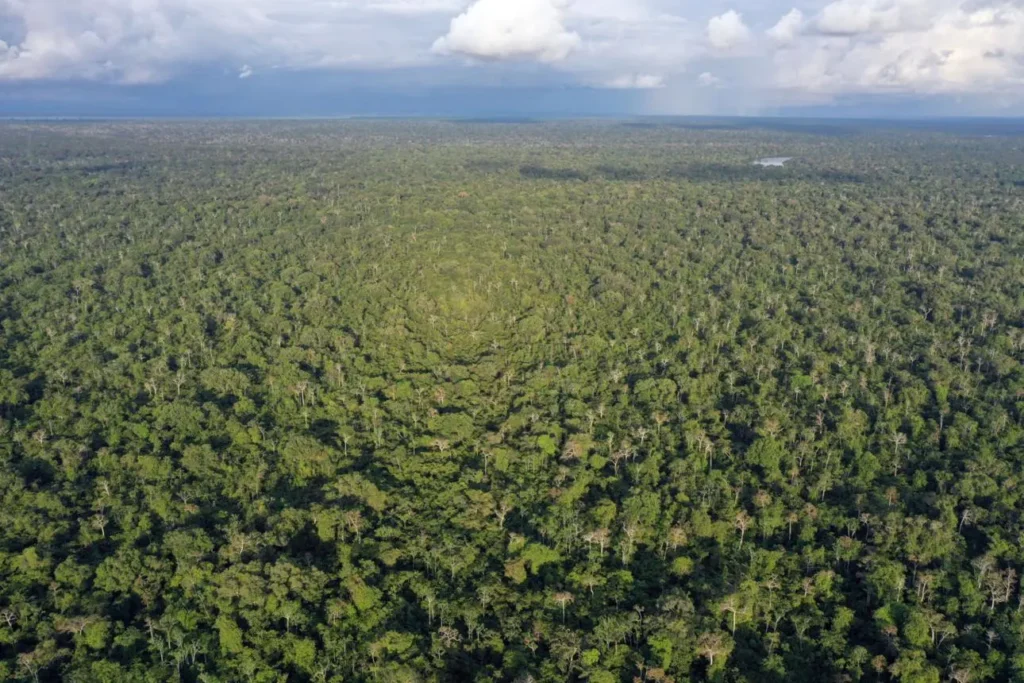
The terms jungle, forest, and rainforest overlap, but they should not be treated as identical.
A forest is the broadest category. It is an ecosystem dominated by trees and can occur in tropical, temperate, boreal, dry, montane, or other environments. A rainforest is a particular type of forest associated with abundant precipitation. A jungle describes exceptionally dense vegetation and does not necessarily identify a specific climatic or ecological classification.
| Term | Main meaning | Typical characteristic |
|---|---|---|
| Forest | Broad ecosystem dominated by trees | Trees form an important part of vegetation |
| Rainforest | High-rainfall forest ecosystem | Heavy precipitation and complex forest structure |
| Jungle | Dense, tangled vegetation | Thick understory and difficult movement |
| Tropical rainforest | Warm, wet forest | High biodiversity and year-round warmth |
| Temperate rainforest | Cool, wet forest | Heavy rainfall and often large trees |
This distinction is useful because it prevents the common misconception that every forest is a jungle or that every rainforest is equally dense at ground level.
What Is a Jungle?
A jungle is generally an area where vegetation grows so densely that movement through it can become difficult. The word commonly evokes images of tangled vines, thick shrubs, palms, broad-leaved plants, fallen branches, and young trees growing close together.
Unlike rainforest, jungle does not have one strict scientific definition that can be applied universally to every location. It is often used descriptively rather than as a precise ecological classification.
What makes vegetation jungle-like?
Jungle vegetation can include:
- Dense shrubs
- Vines and lianas
- Young trees
- Palms
- Large-leaved plants
- Ferns
- Grasses
- Thorny vegetation
- Climbing plants
- Dense ground cover
Jungle-like conditions are particularly common where sunlight reaches the forest floor. A fallen tree can create a large opening in the canopy, allowing sunlight to reach the ground and triggering rapid plant growth.
Why some rainforests feel like jungles
Visitors sometimes expect every part of a rainforest to resemble an impenetrable wall of vegetation. In reality, mature rainforest can have surprisingly open areas beneath the canopy because the dense upper layers block much of the sunlight.
However, areas along rivers, roads, trails, forest edges, abandoned clearings, and natural gaps can become extremely dense. These are the places most likely to produce the classic “jungle” appearance.
What Is a Rainforest?
A rainforest is a forest ecosystem characterized by abundant precipitation and a complex structure of vegetation. Tropical rainforests are warm, humid environments where trees, vines, epiphytes, fungi, insects, birds, mammals, amphibians, reptiles, and microorganisms interact in an extraordinarily complex ecological system.
Rainforests can be classified into different categories, including tropical and temperate rainforests. Tropical rainforests are especially famous for their extraordinary biodiversity.
The Amazon, Congo Basin, and Southeast Asian rainforests are among the world’s major tropical rainforest regions.
What Makes a Rainforest Different?
A rainforest typically has several ecological characteristics:
- High annual rainfall
- High humidity
- Dense tree cover
- Multiple vegetation layers
- Complex food webs
- High biodiversity
- Rapid nutrient cycling
- Specialized plant and animal adaptations
The rainforest is therefore much more than a collection of trees. It is a multilayered ecosystem in which sunlight, water, nutrients, plants, animals, fungi, and microorganisms interact continuously.
Major Differences Between Jungle and Rainforest
Although the words are sometimes used interchangeably, several major differences help explain their proper use.
Vegetation and Plant Density
The most visible difference between jungle and rainforest is often where the vegetation is concentrated.
A rainforest can have enormous trees forming a high canopy while the ground beneath them remains relatively open. A jungle-like environment tends to have dense vegetation close to ground level.
Rainforest vegetation
Rainforest vegetation is organized into layers:
- Emergent layer
- Canopy
- Understory
- Forest floor
Each layer receives different amounts of sunlight and supports different communities.
Jungle vegetation
Jungle-like vegetation tends to be particularly dense in the understory and near the ground.
Vines may climb trees, shrubs can form thick walls, palms may grow close together, and young trees compete for access to sunlight.
This is why two locations within the same rainforest can look completely different.
Climate and Rainfall
Rainforest is fundamentally associated with abundant rainfall, while jungle does not necessarily describe rainfall.
A jungle can occur inside a wet rainforest, but dense vegetation can also develop in other environments where sunlight, water, soil, and disturbance create suitable conditions.
Tropical rainforest climate
Tropical rainforests are generally:
- Warm
- Humid
- Wet
- Biologically productive
- Characterized by substantial rainfall
Some tropical rainforests experience seasonal changes in rainfall, while others receive precipitation relatively evenly throughout the year.
Why rainfall matters
Rainfall supports rapid plant growth, replenishes rivers and wetlands, and helps maintain the complex ecological relationships that characterize rainforest ecosystems.
Canopy and Understory
The canopy is one of the defining features of a mature rainforest. It forms a vast living roof created by the crowns of trees.
The canopy can intercept enormous amounts of sunlight and rainfall before these reach the ground.
Below it is the understory, where smaller trees, shrubs, vines, palms, ferns, and shade-tolerant plants grow.
A jungle-like environment usually refers to areas where the understory becomes particularly thick.
The unusual contrast
One of the most interesting facts about rainforests is that the densest-looking vegetation is not necessarily found where the forest is most mature.
A mature forest canopy can actually shade the ground so heavily that understory growth remains relatively limited. When a large tree falls and creates a canopy gap, sunlight reaches the ground and vegetation can explode into growth.
Habitat and Biodiversity
Both rainforests and jungle-like environments can support extraordinary biodiversity, but the terms describe different ecological characteristics.
A rainforest provides multiple habitats vertically and horizontally. Birds may live high in the canopy, monkeys move through branches, insects occupy bark and leaves, amphibians inhabit damp areas, and mammals forage on the forest floor.
A jungle-like understory creates another specialized habitat for animals that prefer dense vegetation.
Why biodiversity is so high
Rainforests provide:
- Numerous plant species
- Multiple vertical layers
- Abundant food
- Permanent or seasonal water
- Many nesting locations
- Tree cavities
- Leaf litter
- Dead wood
- Complex shelter
This creates countless ecological niches.
Is the Amazon a Jungle or a Rainforest?
The Amazon is a rainforest.
More precisely, the Amazon Basin contains one of the world’s largest tropical rainforest systems. It extends across a vast region of South America and includes an enormous variety of forests, rivers, wetlands, floodplains, lakes, savannas, and other habitats.
Calling the Amazon a “jungle” is understandable in everyday language, but Amazon rainforest is the more accurate ecological description.
Why do people call the Amazon a jungle?
The term “jungle” became strongly associated with tropical forests because many tropical areas contain extremely dense vegetation. Travelers may encounter sections of Amazon forest where vines, palms, shrubs, and young trees form an almost impenetrable wall.
These places certainly look like what people traditionally imagine as a jungle.
However, much of the Amazon consists of mature forest where enormous trees create a canopy above a comparatively open forest floor.
Amazon rainforest and jungle can coexist
The best way to visualize this is:
Amazon Basin → Tropical rainforest ecosystem → Different forest types → Some areas have jungle-like dense vegetation
Therefore, saying “Amazon jungle” is not necessarily meaningless, but “Amazon rainforest” is generally more precise.
Rainforest vs. Jungle Animals
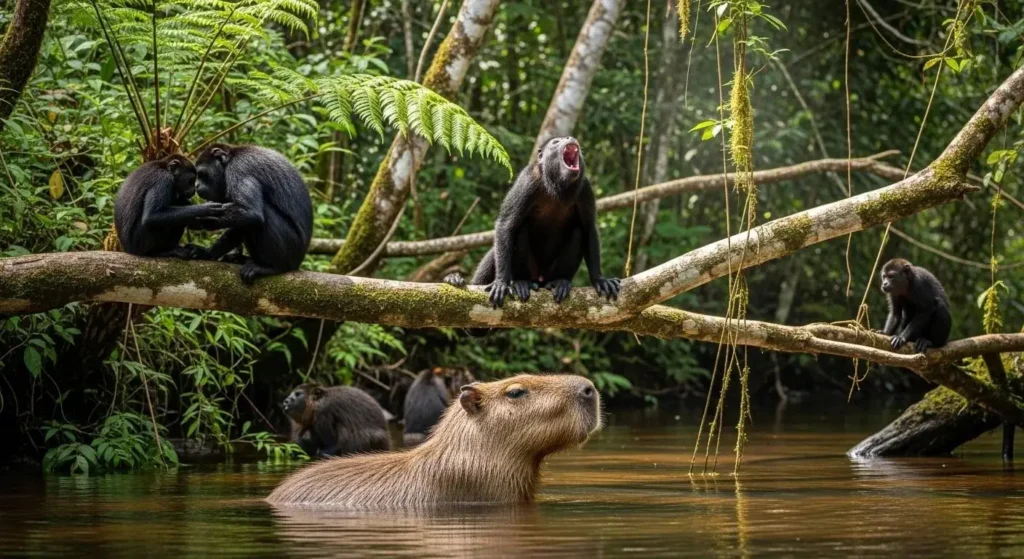
The animals found in rainforests and jungle-like habitats overlap extensively because jungle vegetation is often part of a broader rainforest ecosystem.
Animals do not recognize the human distinction between the words. They respond to food, water, shelter, temperature, predators, breeding sites, and vegetation structure.
Animals commonly associated with Amazon rainforest
- Jaguars
- Ocelots
- Capybaras
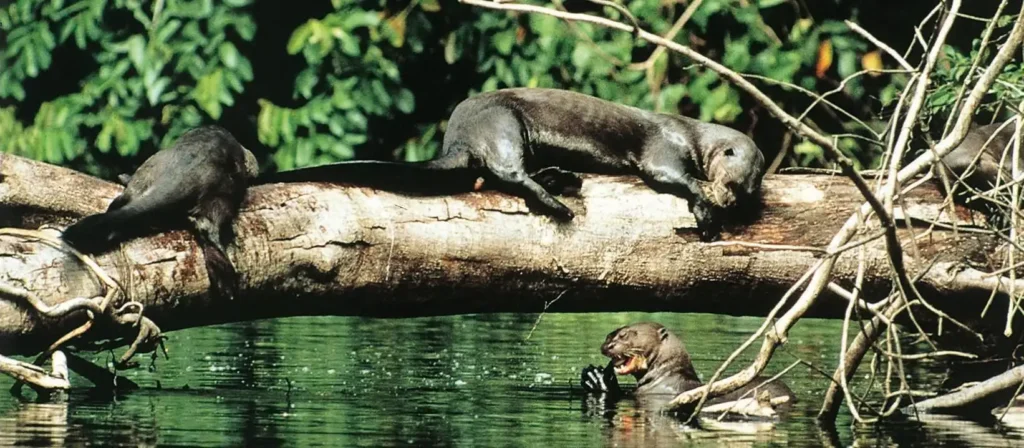
- Giant river otters
- Tapirs
- Peccaries
- Sloths
- Monkeys
- Toucans
- Macaws
- Hoatzins
- Anacondas
- Caimans
- Tree frogs
- Piranhas
- Thousands of insects
Animals using dense jungle-like vegetation
Dense understory can provide excellent shelter for:
- Small mammals
- Reptiles
- Amphibians
- Ground-feeding birds
- Insects
- Spiders
- Snakes
- Young animals
A dense understory can make animals difficult to see even when they are only a few meters away.
Where Are Jungles and Rainforests Found?
Tropical rainforests are primarily located around the world’s tropical regions, particularly close to the equator.
Major rainforest regions include:
- South America
- Central America
- Central Africa
- Southeast Asia
- Parts of Oceania
South American Rainforests
The Amazon Basin contains the largest continuous area of tropical rainforest in the world. Countries within the Amazon region include Brazil, Peru, Colombia, Bolivia, Ecuador, Venezuela, Guyana, Suriname, and French Guiana.
African Rainforests
Central Africa contains extensive tropical forests, particularly around the Congo Basin.
Asian Rainforests
Southeast Asia contains tropical rainforests spread across numerous countries and islands.
Where are jungles found?
Jungle-like vegetation can occur within tropical rainforests but can also appear in other warm, humid environments. It is particularly common in areas where vegetation receives enough light to grow densely.
Riverbanks, disturbed forest edges, abandoned agricultural areas, and canopy gaps can all develop dense vegetation.
Why the Forest Floor Can Be Surprisingly Dark
One of the most unusual facts about tropical rainforests is that they are not uniformly bright and green.
A mature rainforest canopy can block a large proportion of incoming sunlight. As a result, the forest floor may be surprisingly dim despite the intense sunlight above the canopy.
This explains why some mature rainforest trails can feel relatively open.
When a tree falls, however, the situation changes dramatically.
The canopy-gap effect
A fallen tree creates an opening.
Sunlight reaches the ground.
Plants respond quickly.
Seeds germinate, vines grow, shrubs expand, and young trees compete for space.
Within a relatively short period, the opening can become an extremely dense patch of vegetation that looks much more like a traditional jungle.
This natural process is one of the most important reasons rainforest landscapes can vary so dramatically from one location to another.
Rainforest and Jungle Layers
Understanding the vertical structure of a rainforest is one of the best ways to understand the difference between rainforest and jungle.
Emergent Layer
The emergent layer contains the tallest trees, which rise above the main canopy. These trees receive intense sunlight and strong winds.
Birds, insects, bats, and monkeys may use these heights, while large trees provide flowers, fruits, seeds, and nesting opportunities.
Canopy
The canopy forms the main roof of the rainforest.
It contains enormous quantities of leaves, branches, flowers, fruits, insects, birds, and arboreal mammals.
For many species, the canopy is effectively a second world above the ground.
Understory
The understory lies beneath the canopy.
It receives less sunlight and is generally more humid and shaded. Smaller trees, palms, shrubs, vines, and shade-tolerant plants dominate.
This layer is particularly important when discussing jungle because extremely dense understory vegetation creates the classic jungle appearance.
Forest Floor
The forest floor receives the least sunlight in many mature rainforest areas.
It contains fallen leaves, branches, roots, fungi, decomposers, insects, and animals adapted to low-light conditions.
Nutrients move continuously through this layer as dead organic material decomposes.
Jungle vs. Rainforest: Why the Terms Cause Confusion
The confusion exists partly because popular culture has used “jungle” as a general synonym for tropical forest.
Movies, books, tourism advertising, and everyday conversation often describe tropical rainforests as jungles.
The word is vivid and immediately creates an image of dense vegetation.
From an ecological perspective, however, rainforest tells us more about the ecosystem, while jungle mainly tells us something about the vegetation’s density and structure.
This distinction becomes especially important in scientific writing, environmental education, geography, and conservation.
Rainforest and Jungle Difference for Kids
Imagine that the word forest is the big category.
A forest is a place where trees are a major part of the ecosystem.
Now imagine a forest that receives lots of rain.
That can be a rainforest.
Inside that rainforest, imagine an area where plants grow incredibly thick, with vines, shrubs, palms, and young trees covering almost every open space.
That area can be called a jungle.
Easy way to remember it
Rainforest = lots of rain + forest
Jungle = very thick vegetation
A simple example
Think about a huge Amazon rainforest.
Some parts may have tall trees and a relatively open trail beneath them.
Other parts may have vines and plants growing everywhere.
The whole ecosystem can be rainforest, while the very thick area can be described as jungle.
Quick comparison for children
| Question | Rainforest | Jungle |
|---|---|---|
| Is it a forest? | Yes | Often part of a forest |
| Is heavy rain important? | Yes | Not necessarily |
| Is vegetation very dense? | Often | Usually |
| Does it have trees? | Yes | Usually |
| Is it a precise scientific category? | More precise | More descriptive |
| Can they overlap? | Yes | Yes |
Interesting Facts About Jungles and Rainforests
1. The Amazon is not one giant wall of vegetation
The Amazon rainforest contains many different forest environments. Some are dense and tangled, while others are relatively open beneath towering trees.
2. A rainforest can create its own humid environment
Trees release water vapor into the atmosphere through transpiration. This contributes to the movement of water through the rainforest system.
3. Rainforests have multiple worlds stacked vertically
The canopy, understory, and forest floor can contain dramatically different temperatures, light levels, humidity, food sources, and animals.
4. Some jungle-like areas are created by fallen trees
A single fallen tree can create a major opening in the canopy. Increased sunlight can trigger dense plant growth.
5. Jungle vegetation can make wildlife difficult to see
An animal may be nearby but completely hidden behind leaves, vines, palms, or shrubs.
6. The forest canopy is a habitat of its own
Many rainforest animals spend most of their lives above the ground. For them, the canopy is not simply the top of the forest—it is their primary habitat.
7. Rainforest plants compete intensely for sunlight
Although water is abundant, sunlight is limited beneath the canopy. Plants compete for access to light, creating unusual adaptations such as climbing vines and epiphytes.
8. Not every tropical forest is a rainforest
Tropical regions can also contain dry forests, savannas, wetlands, mangroves, and other ecosystems.
9. Jungles can form naturally or after disturbance
Dense vegetation can develop naturally after tree falls or along riverbanks. It can also develop in disturbed areas where sunlight reaches the ground.
10. The word “jungle” can hide enormous ecological complexity
A landscape that appears to be simply “thick jungle” may actually contain hundreds or thousands of interacting species.
Rainforest and Jungle Difference: An Important Ecological Detail
One of the most useful distinctions is that rainforest describes a complete ecosystem, while jungle describes a particular physical appearance of vegetation.
A rainforest may contain areas of mature forest, riverbank vegetation, flooded forest, bamboo stands, natural clearings, regenerating forest, and dense understory. Each can look dramatically different while still belonging to the broader rainforest landscape.
This is particularly important in the Amazon because the word “jungle” can make people imagine a single uniform environment. In reality, the Amazon contains an enormous mosaic of habitats.
Unusual and Fascinating Rainforest Differences
A rainforest can be dense above but open below
This is one of the biggest surprises for people visiting tropical forests for the first time.
The canopy may look almost solid from above, while the forest floor can contain surprisingly open pathways.
A jungle can be dense because of sunlight
It sounds contradictory, but extremely dense ground vegetation often requires more sunlight, not less.
When a canopy gap opens, sunlight reaches the ground and stimulates rapid plant growth.
Water does not always mean permanent rain
Rainforests can have distinct wet and dry seasons. Some Amazonian forests experience substantial seasonal changes while remaining rainforest ecosystems.
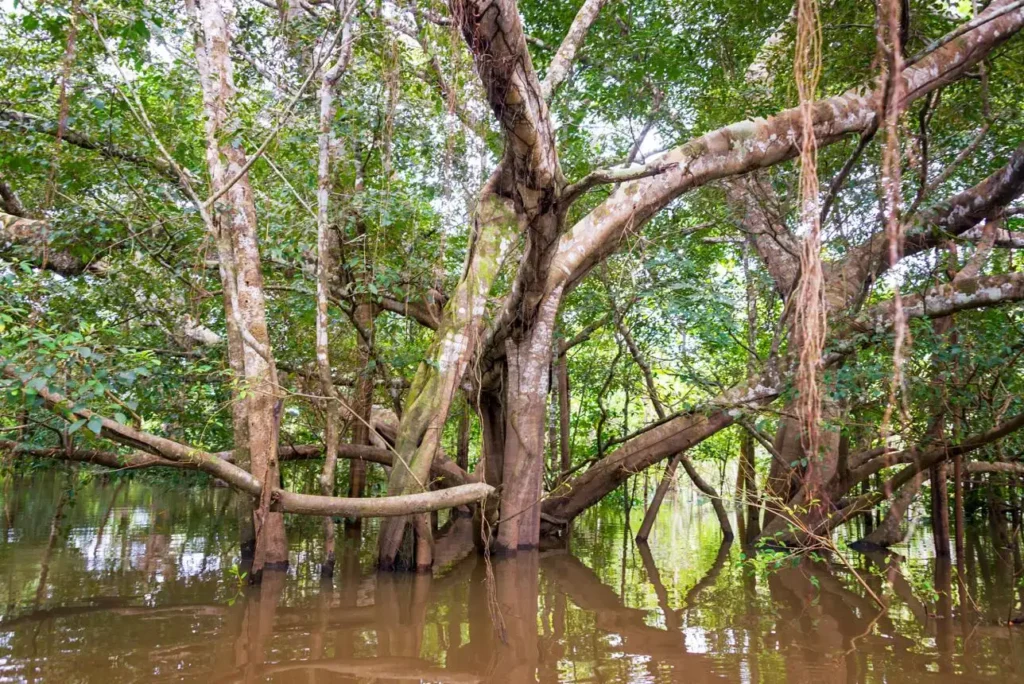
Flooded forests create unusual combinations
In parts of the Amazon, seasonal rivers enter forested areas. Trees may grow directly beside or above water during flood periods, creating habitats where terrestrial and aquatic ecosystems become closely connected.
Rainforest, Jungle, and Conservation
Using the correct terminology can also help people understand conservation.
Protecting a rainforest does not simply mean protecting trees. It means maintaining an interconnected system of:
- Trees
- Rivers
- Soil
- Wildlife
- Insects
- Fungi
- Microorganisms
- Wetlands
- Canopy
- Understory
- Forest-floor habitats
Destroying the canopy can change sunlight levels, humidity, temperature, vegetation structure, and animal communities.
Even if vegetation quickly returns, a regenerating area may not immediately have the same ecological structure as an old-growth rainforest.
Why biodiversity depends on structure
A rainforest’s vertical layers create thousands of habitats.
A canopy bird may need tall trees.
A frog may need humid understory vegetation.
A monkey may need connected branches.
A ground-dwelling mammal may need leaf litter.
A fish may depend on seasonal flooding.
This means that rainforest conservation is about protecting the relationships between habitats as much as protecting individual species.
Frequently Asked Questions About Rainforest and Jungle Differences
Is a jungle the same as a rainforest?
No. The terms overlap, but they have different meanings. Rainforest describes a forest ecosystem associated with abundant rainfall, while jungle generally describes an area with especially dense vegetation.
Is the Amazon a jungle?
The Amazon is primarily a tropical rainforest. Some parts of the Amazon can be described as jungle because they contain extremely dense vegetation.
Why is the Amazon called the jungle?
“Jungle” is commonly used as an informal term for tropical forests with thick vegetation. It is familiar and descriptive, but “Amazon rainforest” is generally more precise.
What is the difference between jungle and forest?
A forest is a broad ecosystem dominated by trees. A jungle generally refers to a particularly dense area of vegetation, often within a forest.
What is the difference between rainforest and forest?
A rainforest is a type of forest characterized by abundant precipitation. Forest is a much broader term that includes many ecosystems with different climates.
Are all rainforests jungles?
No. Some rainforest areas have dense vegetation, but mature rainforest can have relatively open understory because the canopy limits sunlight reaching the ground.
Are all jungles rainforests?
No. “Jungle” is a descriptive term rather than a precise climate classification. Dense vegetation can occur in different environments.
Which has more animals, a jungle or a rainforest?
It is not useful to compare them this way because jungle can be part of a rainforest. The broader rainforest ecosystem contains many different habitats supporting enormous biodiversity.
Why are rainforests so green?
Warm temperatures, abundant water, high plant productivity, and extensive vegetation contribute to the characteristic green appearance of tropical rainforests.
Why is it dark inside a rainforest?
The canopy captures much of the available sunlight. Only a fraction reaches the forest floor in many mature rainforest areas.
Why are some parts of the Amazon extremely dense?
Areas with abundant sunlight, such as canopy gaps, river edges, clearings, and disturbed areas, can support extremely rapid plant growth.
Can you walk through a rainforest?
Yes. Many rainforest areas contain natural openings and trails. However, some sections can have very dense vegetation and require careful navigation.
Is jungle a scientific term?
It is better understood as a descriptive term rather than a precise ecological classification. “Rainforest” provides more information about climate and ecosystem type.
What is the easiest way to remember the difference?
Remember:
Forest = trees
Rainforest = wet forest
Jungle = thick vegetation
These definitions are simplified, but they provide an excellent starting point for understanding the distinction.
Final Thoughts: Rainforest vs. Jungle
The difference between rainforest and jungle is mainly a difference in what the words emphasize. A rainforest is a forest ecosystem associated with abundant rainfall and a complex ecological structure. A jungle describes vegetation that is particularly dense, tangled, and difficult to move through.
The Amazon is best described as a rainforest, although some areas within it can certainly look and feel like a jungle. Its forests contain enormous trees, towering canopies, shaded understories, vines, palms, wetlands, rivers, and countless species that occupy different ecological niches.
Perhaps the most fascinating fact is that a rainforest does not have to look like a stereotypical jungle. The same rainforest can contain an open forest floor beneath enormous trees, a tangled patch of vines around a fallen tree, a flooded forest beside a river, and a dense wall of vegetation along a clearing—all within a relatively small area.
So when someone asks, “Is the Amazon a jungle or a rainforest?”, the most accurate answer is:
The Amazon is a vast tropical rainforest ecosystem that contains many areas of dense, jungle-like vegetation.
Understanding this distinction makes it easier to appreciate the incredible variety of habitats within tropical forests and why the Amazon is far more than simply a place filled with trees and vines. It is a dynamic, multilayered ecosystem where climate, water, plants, animals, soil, and sunlight interact to create one of the most complex environments on Earth.