Fishing in the Amazon Rainforest is one of the most fascinating ways to experience the world’s greatest tropical wilderness. The Amazon is not only a forest filled with monkeys, birds, reptiles, and giant trees; it is also an enormous freshwater ecosystem containing thousands of fish species adapted to powerful rivers, flooded forests, oxbow lakes, streams, and seasonal wetlands.
For travelers, fishing in the Amazon can mean many different things. Some visitors want a relaxed fishing excursion near a jungle lodge, while others are interested in sport fishing, piranha fishing, catching large predatory fish, or exploring remote waterways far from cities. In Peru, destinations such as the Tambopata and Madre de Dios regions provide opportunities to combine fishing with wildlife observation and rainforest exploration.
This guide explains fishing in the Amazon rainforest, the fish found in Amazonian waters, where to go fishing, what techniques are commonly used, what an Amazon fishing trip involves, and how much travelers can expect to pay.
Fishing in the Amazon Rainforest
The fishing in the Amazon rainforest experience is very different from conventional fishing in lakes or rivers elsewhere. Here, the environment itself is part of the adventure.
Instead of fishing from a developed pier or a crowded recreational lake, visitors may travel by wooden canoe or motorized boat through narrow jungle channels surrounded by enormous trees. Depending on the season, water can flow beside the forest or through the forest itself.
Amazon fishing also changes throughout the year. During periods of high water, fish can enter flooded forests and feed among trees and vegetation. During lower-water periods, fish become concentrated in rivers, channels, lakes, and deeper pools.
This seasonal movement is one of the reasons Amazon fishing can never be completely predictable.
Fishing in the Amazon
Fishing in the Amazon is practiced by local communities, commercial fishermen, subsistence fishers, researchers, and recreational travelers. Fishing has been an essential part of Amazonian life for centuries, providing food and supporting communities throughout the enormous river basin.
Traditional fishing can involve nets, lines, hooks, traps, spears, and other techniques adapted to particular species and environments.
Tourist fishing generally uses simpler recreational equipment, with the objective of experiencing the ecosystem rather than removing large quantities of fish.
Why Amazon fishing is different
- Rivers can change dramatically between seasons.
- Fish may move into flooded forests.
- Many species are highly adapted to seasonal flooding.
- Water visibility is often limited.
- Fishing locations may only be accessible by boat.
- Predatory fish can be surprisingly powerful.
- Fish activity changes according to water level and weather.
- Fishing can be combined with wildlife observation.
Can You Go Fishing in the Amazon Rainforest?
Yes, you can go fishing in the Amazon rainforest, provided you choose an appropriate location and follow local regulations and conservation rules.
Fishing opportunities exist throughout many parts of the Amazon Basin. However, not every area permits recreational fishing. Protected areas may have specific restrictions, seasonal closures, species restrictions, or designated fishing zones.
For tourists, the easiest option is usually to join an organized excursion with a local guide who understands the river system and knows where fishing is permitted.
A guide can also explain which species can be kept, which should be released, and which areas should be avoided.
Freshwater Fishing in the Amazon
The Amazon is the largest freshwater drainage system on Earth, and its waterways support an extraordinary variety of fish.
Freshwater fishing in the Amazon can take place in:
- Main rivers
- Smaller tributaries
- Oxbow lakes
- Floodplain lakes
- Jungle streams
- Seasonal channels
- Flooded forests
- Lagoons
- Sandbank areas
- Deep river pools
Each environment can contain a different combination of species.
River fishing versus lake fishing
River fishing can involve stronger currents and larger channels, while lake fishing may provide calmer water and different fish communities.
Oxbow lakes are particularly interesting because they are former river channels that have become separated from the main river system. These isolated aquatic environments can support abundant fish populations.
Can You Fish in the Amazon River?
Yes, you can fish in the Amazon River, although the precise rules depend on the country, region, season, and location.
The Amazon River is not a single uniform fishing environment. It is part of a gigantic interconnected system containing countless tributaries and floodplain habitats.
Fishing in the Amazon River can range from simple line fishing near a lodge to specialized expeditions targeting powerful predatory species.
The experience can be particularly impressive because the river is surrounded by rainforest rather than developed landscapes.
Can You Fish in the Amazon River as a Tourist?
Tourists can participate in fishing excursions in several Amazon destinations.
The most practical approach is to arrange fishing through an established local lodge or tour operator. This provides access to boats, guides, equipment, and local knowledge.
A guide can also identify productive areas while ensuring visitors follow local regulations.
What makes Amazon River fishing special?
The surrounding environment is as important as the catch.
While waiting for a fish, travelers may see:
- Macaws flying above the river
- Kingfishers diving into the water
- Herons along the banks
- Caimans near shallow areas
- Monkeys moving through trees
- Giant river otters in suitable habitats
- Capybaras near river edges
- Dolphins in some Amazon regions
Fishing therefore becomes a wildlife experience rather than simply a sport.
What Fish Live in the Amazon Rainforest?
The question “what fish live in the Amazon rainforest?” has an enormous answer because the Amazon Basin contains an extraordinary diversity of freshwater fish.
Species range from tiny ornamental fish to enormous predators.
Some species are adapted to strong currents, while others live in flooded forests, muddy lagoons, shallow streams, or deep channels.
Among the most recognizable Amazon fish are:
- Piranhas
- Peacock bass
- Arapaima
- Pacu
- Catfish
- Payara
- Electric eels
- Stingrays
- Tetras
- Cichlids
- Various characins
- Armored catfish
Not every species occurs in every Amazon destination.
Are There Fish in the Rainforest?
Absolutely. There are fish in the rainforest, and during high-water periods they can actually swim through areas that appear to be terrestrial forest.
This is one of the most unusual features of Amazonian ecology.
When rivers rise, floodwater can spread beneath trees and between vegetation. Fish follow these temporary waterways to access food.
Seeds, fruits, insects, leaves, and other organic material become available to aquatic animals.
Fish that swim through forests
Some Amazon fish have evolved remarkable adaptations for seasonal flooding.
During high water, a fish may leave the main river and travel through flooded vegetation. This allows it to exploit food resources that are unavailable when water levels are low.
This seasonal connection between forest and river is one of the foundations of Amazon biodiversity.
Common Amazon Fish Species
There are many common Amazon fish species, but several groups are especially famous among travelers and anglers.
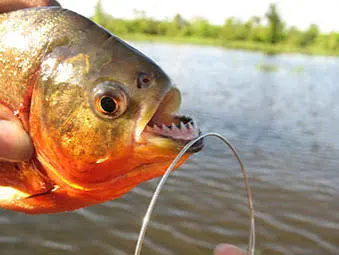
Piranha
Piranhas are perhaps the most famous Amazon fish.
They belong to several species and are not simply the aggressive movie predators often portrayed in popular culture.
Piranhas are important members of aquatic ecosystems and can act as predators, scavengers, and competitors.
Red-bellied piranhas are among the species commonly associated with recreational fishing.
Piranha fishing
Piranha fishing is popular because it is accessible and exciting.
A typical excursion uses a short fishing line and bait, with the guide helping visitors understand how to handle the equipment.
The fish can strike quickly, making even a short fishing session entertaining.
Piranha fishing is also often combined with other Amazon activities.
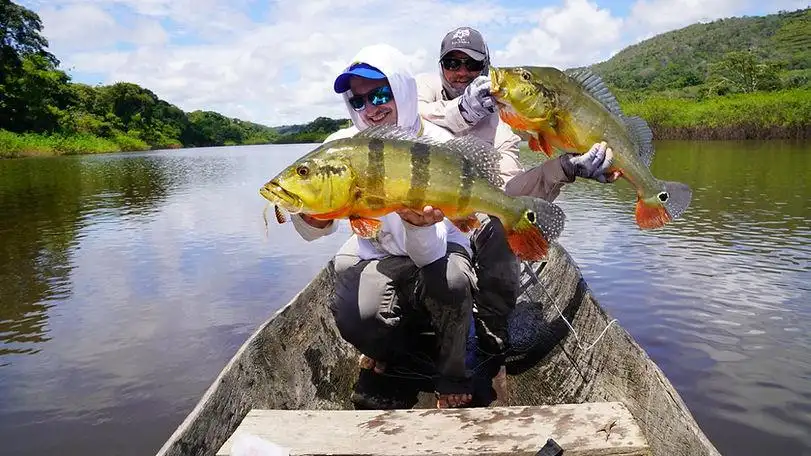
Peacock Bass
Peacock bass, commonly associated with the genus Cichla, are highly prized by sport fishermen.
They are powerful freshwater predators that can make dramatic strikes.
Their strong fight makes them particularly attractive to anglers looking for a more challenging Amazon fishing experience.
Arapaima
The arapaima is one of the most spectacular fish in the Amazon.
It can grow to enormous sizes and is capable of breathing atmospheric air.
This unusual adaptation allows the species to survive in oxygen-poor waters where other fish may struggle.
Arapaima are also culturally and economically important in several Amazonian regions.
Because of their size and conservation status in different areas, fishing rules can be strict.
Pacu
Pacu are powerful fish related to piranhas.
They have distinctive teeth adapted for processing fruits, seeds, and other foods.
During high-water periods, pacu can enter flooded forest environments where seasonal fruits and seeds become available.
Their ecological role is especially interesting because some fish can contribute to seed dispersal.
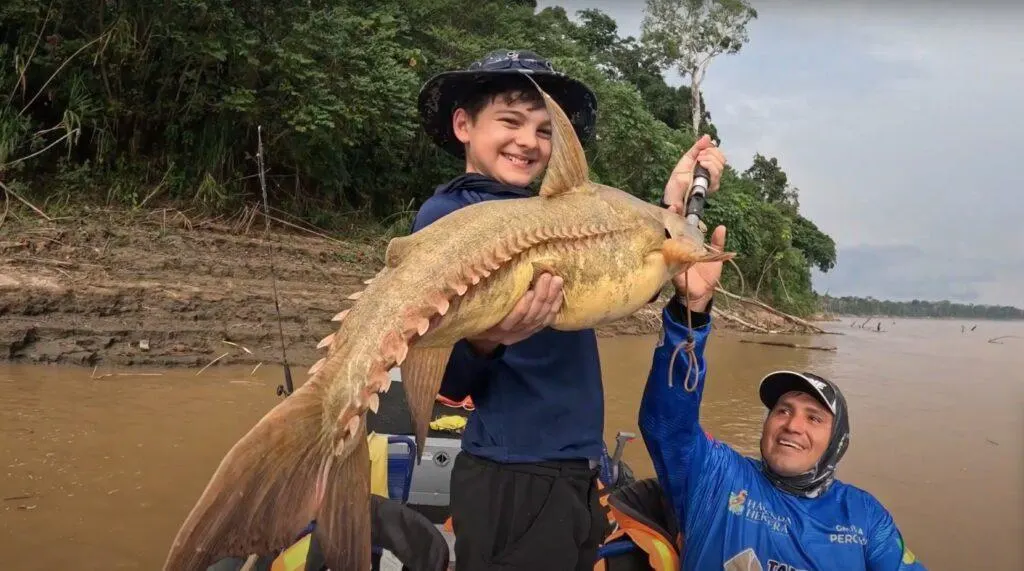
Catfish
The Amazon contains an extraordinary variety of catfish.
Some species are small while others can become very large.
Large Amazonian catfish are particularly important in river ecosystems because they can travel enormous distances during their life cycles.
Some species migrate hundreds or even thousands of kilometers through interconnected river systems.
The Most Common Fish in the Amazon River
The question “what is the most common fish in the Amazon River?” does not have one universal answer.
The Amazon River contains many fish communities, and abundance changes according to habitat, season, water level, location, and fishing pressure.
Species that are abundant in one tributary may be less common somewhere else.
Rather than identifying a single “most common” fish, it is more useful to understand the major fish groups that dominate Amazonian freshwater ecosystems.
Important groups include:
- Characins
- Cichlids
- Catfish
- Piranhas
- Pacu
- Small schooling fish
- Predatory fish
- Bottom-dwelling species
The enormous variety is one reason Amazon fishing can be so unpredictable.
Best Fishing in the Amazon Rainforest
The best fishing in the Amazon rainforest depends on the type of fishing you want.
Someone interested in catching piranhas may prefer a calm oxbow lake.
A sport fisherman searching for powerful predators may want a remote river system.
Another traveler may simply want a short recreational excursion during a jungle tour.
There is therefore no single “best fishing” location for everyone.
Best Amazon Fishing Environments
Oxbow lakes
Oxbow lakes can be excellent fishing environments because they provide relatively calm water and can support abundant fish populations.
Jungle rivers
Smaller jungle rivers offer a more intimate fishing experience and can be surrounded by dense rainforest.
Large tributaries
Large tributaries can provide opportunities for travelers seeking larger fish and stronger currents.
Flooded forests
During high water, flooded forest can become an extraordinary fishing environment.
Fish move between trees and submerged vegetation in search of food.
Amazon Fishing Locations
Some of the most interesting Amazon fishing locations are found in Peru, Brazil, Colombia, Ecuador, and Bolivia.
Within Peru, the Amazon regions around Puerto Maldonado and the Madre de Dios basin are particularly interesting for travelers because fishing can be combined with rainforest wildlife activities.
Other Amazon destinations provide specialized sport-fishing expeditions targeting larger species.
Fishing Around Puerto Maldonado
Fishing in Puerto Maldonado offers an opportunity to combine recreational fishing with a broader Amazon rainforest experience.
Puerto Maldonado is a gateway to several rainforest destinations, including areas associated with the Madre de Dios and Tambopata river systems.
Fishing excursions can include:
- Piranha fishing
- Sport fishing
- River exploration
- Lagoon fishing
- Jungle canoe excursions
- Wildlife observation
- Night river trips
One advantage of fishing in this region is that travelers can combine a fishing excursion with activities such as Sandoval Lake exploration, monkey observation, caiman searches, jungle hikes, and birdwatching.
Amazon Fishing Trips and Tours
Amazon fishing trips range from short excursions lasting a few hours to multi-day expeditions deep into remote jungle.
The right option depends on your budget, fishing goals, physical comfort, and interest in wildlife.
Short Fishing Excursions
A short fishing excursion may last two to four hours.
This is ideal for travelers who want to experience Amazon fishing without dedicating an entire trip to the activity.
Piranha fishing is particularly suitable for this type of excursion.
Typical short-trip experience
A guide may:
- Pick you up from a lodge or meeting point.
- Travel by boat to a fishing area.
- Explain the fishing technique.
- Provide basic equipment and bait.
- Help identify the fish.
- Return to the lodge or starting point.
Full-Day Amazon Fishing Trips
Full-day excursions allow travelers to travel farther from their accommodation.
This provides access to less frequently visited waterways and more time for fishing.
The journey itself becomes part of the adventure.
Multi-Day Fishing Expeditions
Specialized fishing trips Peru can last several days.
These expeditions are designed for travelers whose primary objective is fishing rather than general rainforest tourism.
Remote camps or jungle lodges can be used as bases.
Longer expeditions may provide more opportunities to explore different rivers and fishing environments.
Fishing Trips Peru
Fishing trips Peru can include destinations far beyond the Amazon, but the Peruvian Amazon offers some of the most distinctive freshwater fishing environments in the country.
The advantage of combining fishing with an Amazon tour is that travelers do not need to choose between fishing and wildlife.
A well-designed itinerary can include both.
A typical Peruvian Amazon fishing experience might combine:
- River transportation
- Jungle hiking
- Piranha fishing
- Birdwatching
- Caiman observation
- Monkey encounters
- Lake exploration
- Night excursions
- Traditional communities
- Rainforest interpretation
This makes Amazon fishing particularly attractive to travelers who want a broader adventure.
Fishing in the Peruvian Amazon
Fishing in the Peruvian Amazon is closely connected to the region’s rivers, lakes, seasonal floodplains, and local communities.
Fish have historically been an important food resource throughout Amazonian Peru.
For tourism, fishing can provide visitors with a direct connection to the aquatic side of the rainforest.
Unlike a conventional fishing trip where the landscape may be secondary, here the river is surrounded by an entire ecosystem.
Fishing in the Tambopata Region
The Tambopata region is particularly interesting because rivers and oxbow lakes exist alongside some of the richest rainforest habitats in southern Peru.
A fishing trip can therefore become a wildlife excursion at the same time.
Travelers may hear macaws overhead, observe kingfishers along the shoreline, or see caimans while moving through calm water.
Piranha fishing in Tambopata
Piranha fishing is one of the most popular recreational fishing activities in the region.
It is relatively easy for beginners to try and does not require advanced sport-fishing equipment.
The excitement comes from the quick strikes and the possibility of seeing the fish close to the boat.
How Much Does an Amazon Fishing Trip Cost?
The Amazon fishing trip cost varies considerably according to destination, duration, transportation, accommodation, equipment, guide services, and whether fishing is the main purpose of the expedition.
A short fishing excursion connected to a standard Amazon tour can cost substantially less than a specialized multi-day sport-fishing expedition.
Prices can also vary by season and group size.
Typical Factors Affecting Cost
Duration
A two- or three-hour excursion is generally less expensive than a multi-day expedition.
Distance
Remote fishing locations require more fuel, boat time, and logistical preparation.
Accommodation
A simple jungle lodge costs less than a private luxury lodge or specialized fishing camp.
Equipment
Some tours include rods, hooks, bait, tackle, and other basic equipment, while specialized anglers may bring their own gear.
Private guide
A private fishing guide generally costs more than joining a shared excursion.
Transportation
Boat transfers can represent a significant part of the total cost because remote Amazon destinations may require hours of river travel.
Cheap Amazon Fishing Trips
Travelers searching for cheap Amazon fishing trips should focus on shared excursions and short fishing experiences rather than specialized remote expeditions.
A basic fishing activity can often be added to a larger Amazon tour.
This can be more economical because transportation, guide services, meals, and accommodation are already part of the main itinerary.
How to Reduce the Cost
- Join a shared fishing excursion.
- Choose a shorter fishing trip.
- Stay at a basic jungle lodge.
- Travel during less busy periods.
- Combine fishing with a multi-day Amazon tour.
- Avoid unnecessary private transportation.
- Ask whether fishing equipment is included.
- Confirm whether bait is included.
- Compare what is included in the total package.
The cheapest advertised price is not always the best value.
A slightly more expensive tour may include transportation, meals, equipment, and an experienced local guide, reducing unexpected expenses.
What Is Unusual About Amazon Fishing?
Amazon fishing contains some extraordinary biological stories.
Some Fish Can Breathe Air
Arapaima can surface and gulp air.
This adaptation is particularly useful in warm, slow-moving, oxygen-poor waters.
It is one of the clearest examples of how Amazon fish have evolved to survive challenging environmental conditions.
Fish Can Live Among Trees
During seasonal floods, fish can swim through forest.
A tree that appears completely terrestrial during low water can become part of an aquatic ecosystem months later.
This transformation is one of the most remarkable sights in the rainforest.
Some Fish Help Disperse Seeds
Certain Amazon fish eat fruits and seeds that fall into rivers or become available in flooded forests.
They can subsequently transport seeds away from parent trees.
This means that fish can contribute to the regeneration of rainforest vegetation.
Electric Eels Are Not Actually Eels
Despite their common name, electric eels are not true eels.
They belong to a different group of freshwater fish and are famous for their ability to generate powerful electrical discharges.
This ability is used for hunting, defense, and navigation.
Amazon Fish Can Become Extremely Large
The Amazon supports some remarkably large freshwater species.
Arapaima are the most famous example, but large catfish can also reach impressive sizes.
Some Amazonian fish migrate over extraordinary distances, following seasonal changes in water levels and food availability.
Fishing Responsibly in the Amazon
Responsible fishing is extremely important in an ecosystem as diverse as the Amazon.
Visitors should always follow local regulations and the instructions of their guide.
Where catch-and-release is required or recommended, fish should be handled carefully and returned to the water as quickly as possible.
Responsible fishing principles
- Follow local fishing regulations.
- Respect protected areas.
- Keep only permitted species.
- Respect size limits and seasonal restrictions.
- Avoid unnecessary killing of fish.
- Handle fish carefully.
- Do not leave fishing line or hooks in the forest.
- Never throw plastic or fishing equipment into the river.
- Listen to local guides.
- Respect community fishing areas.
Sustainable tourism helps ensure that Amazon fishing remains available for future generations.
Best Time for Fishing in the Amazon
There is no universal best month for fishing because different fish respond differently to changing water levels.
The high-water season can provide access to flooded forests and expanded channels.
The lower-water season can concentrate fish in particular rivers, lagoons, and deeper channels.
For this reason, the best time depends on the species and fishing style.
High Water Fishing
During high water, fish can spread into flooded forest.
This creates a much larger feeding environment.
Fishing can become more exploratory because the fish are not necessarily concentrated in the main river.
Low Water Fishing
As water levels decline, some aquatic habitats become more isolated.
Fish may concentrate in rivers, channels, and lakes.
This can create interesting conditions for anglers targeting particular species.
Amazon Fishing and Wildlife Tourism
One of the greatest advantages of fishing in the Amazon rainforest is that it can be combined with other experiences.
A traveler does not need to spend an entire vacation fishing.
A multi-day Amazon itinerary can include fishing alongside:
- Sandoval Lake
- Monkey Island
- Jungle hikes
- Night walks
- Caiman searches
- Birdwatching
- Macaw and parrot observation
- Canopy bridges
- Native community visits
- River excursions
This combination makes fishing particularly attractive for families and travelers where only one person is a serious angler.
While one traveler enjoys fishing, others can participate in wildlife activities.
What to Bring on an Amazon Fishing Trip
Packing correctly makes the experience much more comfortable.
Recommended equipment and clothing
- Lightweight long-sleeved shirts
- Long trousers
- Comfortable shoes
- Hat
- Sunscreen
- Insect repellent
- Rain jacket or poncho
- Waterproof bag
- Reusable water bottle
- Sunglasses
- Camera
- Binoculars
- Personal medication
- Dry bags for electronics
If the fishing tour provides equipment, travelers generally do not need to carry a large fishing kit.
Specialized anglers should confirm equipment requirements before departure.
Final Guide to Fishing in the Amazon Rainforest
Fishing in the Amazon rainforest is much more than catching a fish.
It is an opportunity to enter one of the world’s greatest freshwater ecosystems and experience the relationship between rivers, flooded forests, wildlife, and local communities.
The Amazon contains an extraordinary variety of fish, from famous piranhas and pacu to powerful peacock bass, enormous catfish, air-breathing arapaima, electric eels, and countless smaller species.
Yes, you can fish in the Amazon River, and recreational fishing is available in many Amazon destinations when local regulations permit it.
For travelers visiting Peru, fishing in Puerto Maldonado and the surrounding Madre de Dios and Tambopata region can be especially attractive because fishing can be combined with a complete rainforest adventure.
A short piranha fishing excursion may be enough for a first-time visitor, while experienced anglers may prefer a dedicated multi-day expedition.
The Amazon fishing trip cost depends mainly on duration, transportation, accommodation, equipment, group size, and the remoteness of the fishing location. Travelers looking for affordable experiences can often combine a short fishing activity with a regular Amazon rainforest tour.
Ultimately, the best Amazon fishing experience is not measured only by the size or number of fish caught.
It is measured by the journey down the river, the sound of the rainforest, the wildlife appearing along the banks, the excitement of a sudden strike, and the opportunity to experience a living ecosystem where water and forest are constantly changing.
In the Amazon, every fishing trip can become a rainforest adventure.
Leave a Reply