If you have ever watched a group of brightly colored macaws gathered on the side of an Amazonian riverbank, you may have wondered: why do macaws eat clay? It is one of the most fascinating behaviors in the rainforest. Scarlet macaws, blue-and-yellow macaws, red-and-green macaws, and other parrots regularly visit exposed patches of clay, where they scrape, chew, and swallow small amounts of soil.
This unusual behavior is known as geophagy, which simply means eating soil or earth. For Amazon macaws, geophagy may provide important minerals and may also help their bodies deal with certain naturally occurring compounds found in rainforest plants and fruits. But the story is more complicated than simply saying that macaws eat clay for salt or minerals.
Amazon clay licks are also remarkable social gathering places. Dozens or even hundreds of parrots may arrive at the same location, creating spectacular scenes of color, sound, and movement. In Peru, places such as the Chuncho Clay Lick and clay licks around the Tambopata region offer some of the best opportunities to observe this behavior in the wild.
So, why do macaws eat clay licks? The answer involves nutrition, digestion, chemistry, ecology, and social behavior—and there is still more for researchers to discover.
Why Do Macaws Eat Clay?
The simplest answer is that macaws eat clay because it can provide access to minerals and may help them cope with some chemical compounds present in their diet. However, there is no single explanation that accounts for every clay-eating event.
Macaws have a highly specialized rainforest diet. They eat fruits, seeds, nuts, flowers, buds, and other plant materials. Many tropical plants contain defensive chemicals that discourage animals from eating them. Some of these compounds can interfere with digestion or nutrient absorption.
Clay contains extremely fine mineral particles that can interact chemically with substances inside the digestive system. As a result, eating small quantities of clay may help macaws manage some of the challenges associated with their plant-rich diet.
Why macaws eat clay: the main explanations
Researchers generally consider several possible benefits:
- Mineral intake: Clay can contain calcium, sodium, iron, magnesium, and other minerals depending on its geological composition.
- Possible detoxification: Certain clay minerals may bind or reduce the effects of some plant compounds.
- Digestive support: Soil particles may interact with substances in the digestive tract.
- Dietary supplementation: Clay may provide nutrients that are not consistently available from fruits and seeds.
- Social behavior: Clay licks provide predictable locations where macaws gather in large numbers.
The important point is that these explanations are not necessarily mutually exclusive. Macaws may receive several benefits from consuming clay.
Why Do Macaws Eat Clay Licks?
A clay lick is a naturally exposed area of mineral-rich soil, usually found along a riverbank, stream, cliff, or other eroded surface. Macaws repeatedly return to these places because the exposed material is accessible and apparently attractive to them.
The concentration and type of minerals can vary considerably from one clay lick to another. This means that macaws may show preferences for particular locations rather than simply eating any soil they encounter.
The timing of visits can also be influenced by weather, food availability, disturbance, and seasonal conditions. Early morning is often particularly spectacular because many macaws arrive around the same time.
Why are clay licks so attractive?
Amazonian forests contain enormous quantities of soil, but much of it is hidden beneath vegetation, leaf litter, roots, and other organic material. Riverbank erosion naturally exposes deeper layers of soil.
These exposed deposits can contain a different mineral composition from the surface soils surrounding them. Macaws therefore have access to concentrated patches of material that are relatively easy to consume.
What Is Geophagy?
Geophagy is the deliberate consumption of soil, clay, or other earth materials by animals. It is not unique to macaws or even to birds.
Animals from many different groups have been observed consuming soil. Mammals, reptiles, and birds may practice geophagy under different circumstances.
In birds, geophagy is particularly interesting because soil consumption can potentially influence digestion, mineral balance, and exposure to naturally occurring plant chemicals.
Clay Consumption in Birds
Parrots are among the best-known birds associated with clay consumption in the Amazon. Macaws and some other parrot species may visit exposed clay deposits and deliberately ingest small amounts.
The behavior is controlled rather than accidental. A macaw may land at a clay lick, inspect the surface, scrape material with its beak, and swallow it.
This is very different from accidentally swallowing dirt while feeding. The repeated use of particular clay deposits suggests that the behavior serves a biological purpose.
Why do parrots eat clay?
The reasons why do parrots eat clay are probably related to the same nutritional and physiological pressures experienced by macaws. Parrots consume large amounts of plant material, and some of the foods available in tropical forests contain secondary compounds that can affect digestion.
Clay may also provide minerals. However, not all parrots visit clay licks, and the precise benefits may differ between species and locations.
Why Animals Consume Soil and Clay
Geophagy occurs throughout the animal kingdom. Different animals may consume soil for different reasons, which makes it difficult to identify one universal explanation.
Some species consume soil to obtain minerals. Others may use it to influence digestion or reduce the effects of certain compounds in their food.
In tropical environments, soil can therefore become an important part of an animal’s nutritional strategy.
Possible reasons animals practice geophagy
1. Mineral supplementation
Soil can contain minerals that are difficult to obtain consistently from food. Calcium, sodium, magnesium, and other elements may be particularly important for animals with high nutritional demands.
2. Binding plant compounds
Some clay minerals have chemical properties that allow them to interact with molecules in the digestive tract. This has led scientists to investigate whether clay can reduce the biological effects of certain plant compounds.
3. Digestive effects
Soil particles may alter the physical or chemical environment within the digestive system. This possibility is especially interesting for animals that consume large quantities of leaves, fruits, seeds, and other plant material.
4. Supplementing seasonal diets
Rainforest food availability changes throughout the year. During some periods, particular fruits or seeds may become abundant, while other foods become scarce.
Clay consumption could potentially help animals cope with nutritional changes associated with seasonal diets.
What Are Clay Licks?
Clay licks are exposed deposits of clay or mineral-rich soil that are visited repeatedly by animals. In the Amazon, they are especially famous for their large gatherings of parrots and macaws.
A clay lick can look surprisingly simple. From a distance, it may appear to be nothing more than a bare patch of earth on a riverbank. Yet these locations can become extremely important wildlife sites.
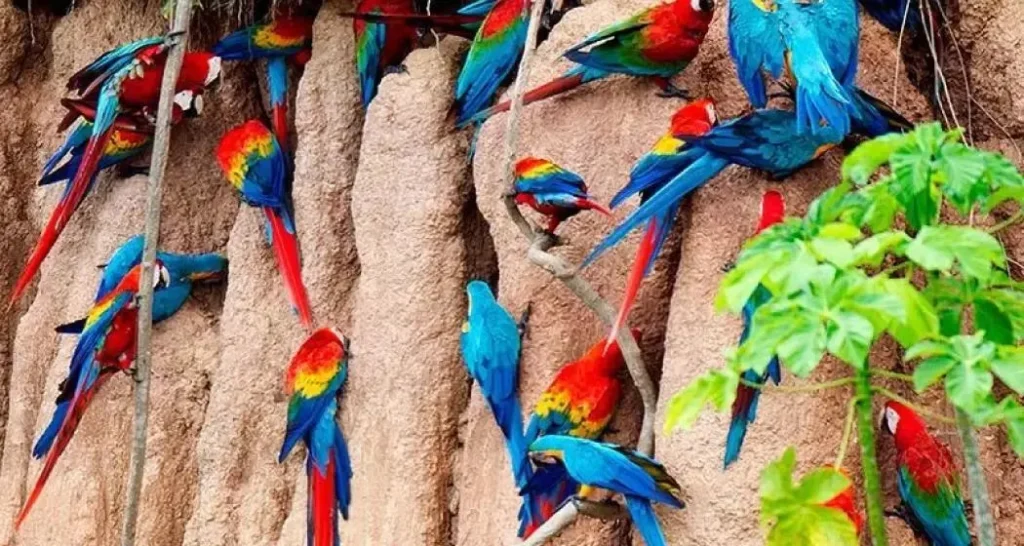
The exposed clay may be located on a vertical wall, sloping bank, or eroded section of forest. Macaws cling to the surface or gather on nearby branches while feeding.
Clay Licks in the Amazon
Amazonian clay licks are particularly associated with major rivers and tributaries. River erosion continually reshapes the landscape, exposing different layers of sediment and soil.
This dynamic environment helps explain why clay licks are often found along waterways.
Macaw Clay Lick Amazon
The phrase macaw clay lick Amazon describes one of the rainforest’s most recognizable wildlife spectacles: large parrots gathering at exposed clay deposits.
At some locations, several macaw species may appear together. Scarlet macaws can be especially conspicuous because their brilliant red, yellow, and blue plumage contrasts dramatically with the green forest.
Why Are Clay Licks Important to Amazon Macaws?
Clay licks may be important because they provide resources that macaws cannot obtain as easily elsewhere. Their importance probably extends beyond a single nutritional function.
For an animal living in a highly competitive tropical ecosystem, access to a predictable mineral source can be valuable.
Nutritional Benefits
One of the strongest explanations for clay consumption is nutritional supplementation.
Amazonian fruits and seeds can provide plenty of carbohydrates, fats, proteins, and other nutrients, but the mineral composition of individual foods varies. Clay may help fill particular nutritional gaps.
Macaws also have strong beaks designed for cracking hard seeds and nuts. Their feeding behavior exposes them to an extraordinary variety of plant foods, each with its own chemical composition.
Mineral Intake
Clay can contain several minerals, although the exact composition differs between deposits.
Potentially important minerals include:
- Calcium
- Sodium
- Magnesium
- Iron
- Potassium
- Other trace elements
The mineral content of a clay lick depends on the geology and sediment history of that particular location. Therefore, not every clay lick should be assumed to have exactly the same nutritional value.
Can Clay Protect Macaws From Plant Compounds?
One of the most interesting scientific questions is whether clay helps macaws deal with potentially harmful compounds in their food.
Rainforest plants cannot simply rely on physical defenses such as thorns. Many also produce chemical defenses. These compounds can discourage herbivores and reduce the nutritional value of plant tissues.
Parrots consume many plant foods that contain naturally occurring secondary compounds. Certain clay minerals can potentially bind with some substances, reducing their activity or preventing them from being absorbed as efficiently.
A Natural Chemical Defense Against Plant Chemicals?
This does not mean clay acts like a universal antidote. It is more accurate to describe it as a possible protective mechanism.
Scientists continue to investigate exactly which compounds clay can bind, how effective this process is inside a bird’s digestive system, and whether macaws specifically select clay deposits based on their chemical properties.
That uncertainty makes the behavior even more fascinating.
Why Do Scarlet Macaws Eat Clay?
Scarlet macaws eat clay for many of the same reasons other Amazonian parrots may visit clay licks. The behavior appears to be associated with mineral intake and potentially with the management of plant-derived compounds.
The scarlet macaw is one of the most recognizable parrots in the Amazon. Its red, yellow, and blue feathers make large clay-lick gatherings spectacular.
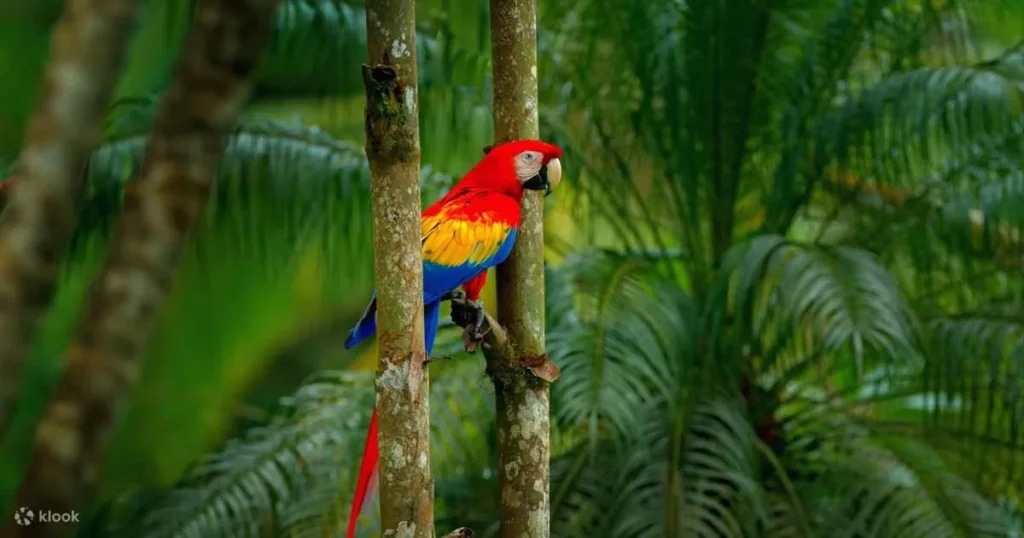
Why do scarlet macaws eat clay?
Scarlet macaws consume an extraordinarily varied plant-based diet. They may feed on fruits, seeds, nuts, flowers, and other vegetation.
Because their diet exposes them to many different plant chemicals, geophagy may provide a useful physiological advantage.
However, it would be misleading to say that every visit to a clay lick is necessarily motivated by detoxification. Mineral requirements, food availability, seasonal changes, and other factors may also influence the behavior.
Social Behavior Around Clay Licks
Clay licks are not just feeding locations. They are also extraordinary social environments.
Macaws are highly social birds. They frequently travel, feed, communicate, and roost in groups. A clay lick creates a predictable gathering point where individuals from surrounding areas can come together.
Communication and social interaction
At a busy clay lick, the rainforest can suddenly become extremely loud. Macaws call to each other while flying, landing, feeding, and leaving.
Birds may appear to compete for the best feeding positions, while others wait in nearby trees.
The gathering provides opportunities for:
- Vocal communication
- Pair interaction
- Group coordination
- Social observation
- Predator awareness
- Movement between feeding areas
This means a clay lick may function as both a nutritional resource and a social hub.
The Unusual Timing of Macaw Clay Lick Visits
One of the most interesting facts about Amazon clay licks is that the birds often appear to follow recognizable daily patterns.
Large groups frequently gather during the morning. This can create an extraordinary spectacle as macaws arrive from different directions and settle into nearby trees before descending toward the clay.
Weather can influence this activity.
Rain, strong winds, and other environmental conditions may change when birds arrive or how long they remain at the site.
Why morning can be so spectacular
Morning offers several advantages for wildlife observation. Temperatures are usually lower than later in the day, and birds are beginning their daily activities.
A clay lick therefore becomes a natural meeting point where many individuals can appear within a relatively short period.
Macaw Clay Licks in Peru
Peru contains some of the world’s most famous Amazonian clay licks. The Madre de Dios region is particularly well known for spectacular concentrations of macaws and parrots.
For visitors exploring the Amazon rainforest near Puerto Maldonado, clay licks can be one of the most memorable wildlife experiences.
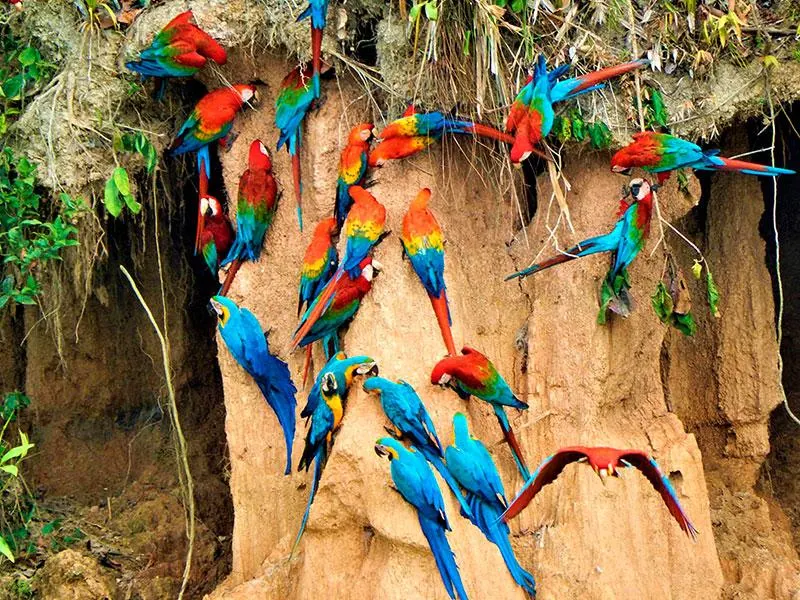
Clay Lick Peru
A clay lick Peru experience can reveal an extraordinary relationship between birds and the geological landscape.
The contrast is remarkable: brightly colored parrots gather against a wall of earth that may appear completely ordinary to a human observer.
Yet to the birds, that patch of soil can represent an important resource.
Macaw Clay Lick Tambopata
The macaw clay lick Tambopata is particularly famous for large gatherings of Amazonian parrots and macaws.
The Tambopata region combines extensive rainforest, rivers, wetlands, and diverse wildlife habitats. Clay licks fit naturally into this ecosystem because erosion along waterways continually exposes different layers of sediment.
A visit to a Tambopata clay lick can involve a combination of wildlife observation and patience. Birds may gather in nearby trees before approaching the clay, and activity can change rapidly depending on weather and disturbances.
Why Tambopata is special for macaws
Tambopata offers a mosaic of habitats rather than one uniform forest. Rivers, oxbow lakes, floodplain forests, terra firme forest, and other environments provide different food sources.
This diversity supports large parrot populations and creates opportunities for dramatic gatherings at clay licks.
Chuncho Clay Lick
The Chuncho Clay Lick is one of Peru’s best-known locations for observing macaws and parrots gathering to consume clay.
The location is famous for the sheer spectacle of colorful birds arriving at the exposed riverbank. Under favorable conditions, multiple species can appear in the same area.
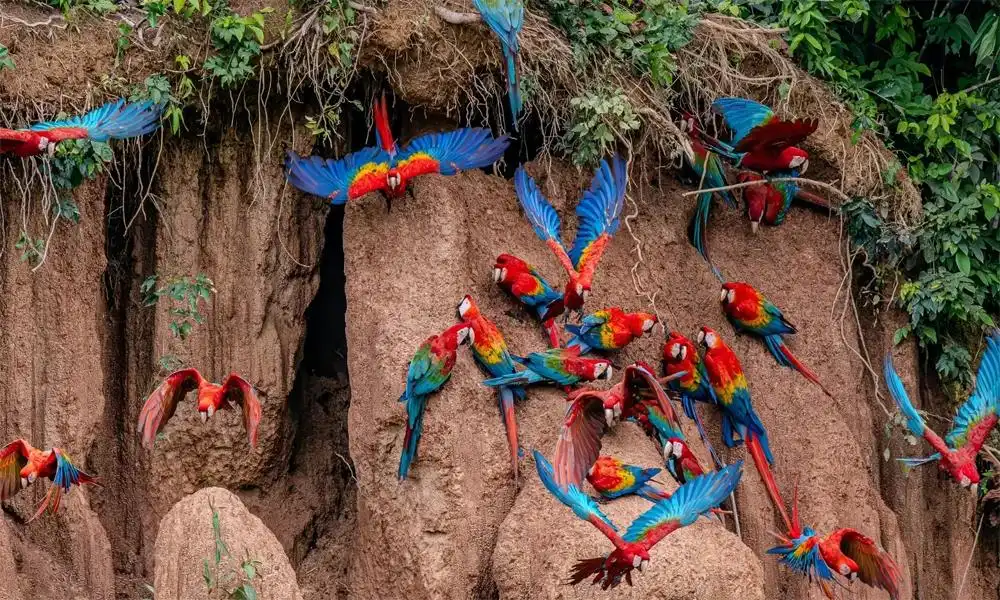
Chuncho Clay Lick: What makes it remarkable?
The appeal of Chuncho is not simply the number of birds. It is the behavior itself.
Watching macaws arrive, call, circle, land in surrounding vegetation, and eventually move toward the clay reveals a complex interaction between wildlife and landscape.
The clay wall may look static, but it is part of a dynamic river system. Water erosion, sediment movement, vegetation, weather, and animal activity continually influence the site.
What Animals Besides Macaws Visit Clay Licks?
Macaws may be the stars of Amazonian clay licks, but they are not necessarily the only visitors.
Different parrot species can use clay deposits, and other wildlife may occasionally investigate exposed mineral-rich soil.
Possible visitors can include:
- Scarlet macaws
- Red-and-green macaws
- Blue-and-yellow macaws
- Mealy parrots
- Parakeets
- Other Amazonian parrots
- Some mammals and other wildlife near suitable deposits
The exact species composition varies between locations.
Top Macaws You May See at Amazon Clay Licks
Several spectacular macaw species can be associated with Amazonian clay-lick environments.
Scarlet Macaw
The scarlet macaw is instantly recognizable because of its predominantly red plumage combined with yellow and blue wing feathers. Its strong beak allows it to handle hard seeds and nuts.
Red-and-Green Macaw
The red-and-green macaw is one of the largest and most impressive Amazonian parrots. Its powerful appearance and vibrant green and red coloration make it especially striking when seen flying over the forest.
Blue-and-Yellow Macaw
The blue-and-yellow macaw has brilliant blue upperparts and yellow underparts. It is highly social and can produce loud calls that carry through the rainforest.
A spectacular mixed gathering
One of the most unusual sights at some clay licks is the presence of several parrot species in the same general area.
This creates a constantly changing display of colors, shapes, calls, and flight patterns.
How Do Macaws Actually Eat Clay?
Macaws do not usually consume large quantities of soil. Instead, they use their powerful beaks to scrape or break small pieces from the exposed surface.
A bird may grip the clay wall with its feet while using the beak to collect material. It then swallows the particles.
The behavior can look surprisingly deliberate.
Why macaws have the perfect tools for the job
Macaws have exceptionally strong hooked beaks. Their beaks are primarily adapted for cracking seeds, nuts, and other tough foods, but the same strength allows them to manipulate hard or compacted soil.
Their feet also help them maintain a secure position while feeding.
How Much Clay Do Macaws Eat?
The amount consumed varies according to the bird, location, food availability, and environmental conditions.
Macaws are not replacing their normal diet with clay. Clay is a supplementary material rather than their primary food.
This distinction is important because geophagy is generally a small but potentially significant part of the animal’s overall ecological strategy.
Do Baby Macaws Eat Clay?
Young macaws eventually participate in many of the same behaviors as adults, but the timing and frequency of clay consumption can vary.
Adults provide food to their chicks, and young birds learn feeding behaviors through observation and experience.
A clay lick can therefore become part of the behavioral repertoire of a bird as it matures.
Interesting Facts About Macaws and Clay Licks
1. Clay licks can become crowded
A single exposed patch of clay can attract large numbers of parrots. The resulting gathering can be one of the loudest and most colorful events in the surrounding forest.
2. The clay is not simply “mud”
The material eaten by macaws has specific physical and chemical properties. The mineral composition can vary significantly from one location to another.
3. Rivers help create clay licks
Many clay licks are associated with riverbanks because erosion exposes deeper layers of soil and sediment.
4. Macaws do not visit randomly
Repeated visits to particular sites suggest that these locations provide valuable resources.
5. Clay eating is not exclusive to macaws
Other parrots and numerous animal species practice geophagy under different circumstances.
6. The behavior combines biology and geology
A clay lick is a perfect example of how animal behavior can depend on geological processes. Without erosion exposing suitable mineral deposits, many of these feeding sites would not exist.
7. The largest birds are not necessarily the only visitors
Smaller parrots can also gather around clay deposits, sometimes creating mixed-species groups.
8. Weather can transform the spectacle
Rain and changing environmental conditions can dramatically affect bird activity around clay licks.
9. Clay licks are social theaters
The birds are not simply eating. They are calling, watching each other, moving between branches, and coordinating their behavior.
10. Scientists are still studying the exact benefits
The mineral and detoxification hypotheses are important areas of scientific investigation, but the precise importance of each mechanism can differ by species and clay deposit.
Are Clay Licks Dangerous for Macaws?
Clay licks can provide important resources, but gathering in large numbers also has potential risks.
A large concentration of birds creates an attractive opportunity for predators. Macaws must remain alert while feeding.
Their social behavior helps because many individuals can watch their surroundings simultaneously.
The open nature of some clay-lick sites can also make birds more visible than they would be inside dense forest.
Why Clay Licks Matter for Amazon Rainforest Ecology
Clay licks illustrate an important principle of rainforest ecology: animals depend on resources that may appear insignificant to humans.
A small patch of exposed soil can influence the movements of hundreds of birds.
This creates connections between:
Rivers → erosion → exposed clay → minerals → macaws → social gatherings → rainforest ecology
The clay lick is therefore not an isolated curiosity. It is part of a much larger ecological network.
What Is Still Unknown About Macaw Geophagy?
Despite decades of interest in clay-lick behavior, several questions remain.
Scientists still investigate exactly how individual clay deposits differ chemically and whether macaws actively select them based on specific mineral or binding properties.
Another important question concerns diet. If macaws consume different plants at different times of year, their need for clay could potentially change with seasonal food chemistry.
Future research may reveal that geophagy is even more sophisticated than currently understood.
Why Do Macaws Eat Clay? The Complete Answer
So, why do macaws eat clay?
The best answer is that clay appears to provide several possible benefits. It can supply minerals, potentially interact with plant compounds in the digestive tract, and supplement the nutritional needs of birds whose diet is dominated by chemically diverse plant foods.
But there is another dimension to the story.
Clay licks are also social gathering places.
Macaws are highly social birds, and a predictable resource creates an opportunity for large numbers of individuals to gather, communicate, and interact.
The behavior is therefore a beautiful example of how nutrition, chemistry, geology, behavior, and ecology can come together in one extraordinary rainforest scene.
Frequently Asked Questions About Macaws Eating Clay
Why do macaws eat clay?
Macaws eat clay as part of a behavior called geophagy. The clay may provide minerals and may help birds manage certain naturally occurring compounds in their plant-based diet.
Why do scarlet macaws eat clay?
Scarlet macaws may consume clay to obtain minerals and potentially reduce the effects of certain plant compounds. Their visits may also be influenced by seasonal diet and the availability of suitable clay deposits.
Why do parrots eat clay?
Some parrots eat clay because it may provide minerals or interact with compounds found in their food. Different species and locations may have different reasons or benefits.
What is geophagy?
Geophagy is the deliberate consumption of soil, clay, or earth materials by animals. It occurs in many species, including birds, mammals, and reptiles.
What are clay licks?
Clay licks are exposed deposits of clay or mineral-rich soil that are repeatedly visited by animals. Amazonian clay licks are particularly famous for large gatherings of parrots and macaws.
Why are clay licks important to Amazon macaws?
Clay licks may provide minerals and potentially help macaws deal with plant compounds. They also serve as predictable locations for social interaction and communication.
Where can I see macaws eating clay in Peru?
Peru’s Amazon region contains several important clay licks. The Tambopata area and the famous Chuncho Clay Lick are particularly associated with spectacular macaw gatherings.
Is the clay a type of food?
Clay is not a primary food source. Macaws continue to rely on fruits, seeds, nuts, flowers, and other plant materials. Clay is consumed as a supplementary material.
Do all macaws eat clay?
Not every macaw necessarily visits a clay lick. Behavior varies by species, location, season, food availability, and environmental conditions.
Is macaw clay eating unusual?
Yes—and that is part of what makes it fascinating. Deliberately eating soil may seem strange to humans, but geophagy is a widespread behavior in the animal kingdom.
Final Thoughts: The Hidden Importance of Amazon Clay Licks
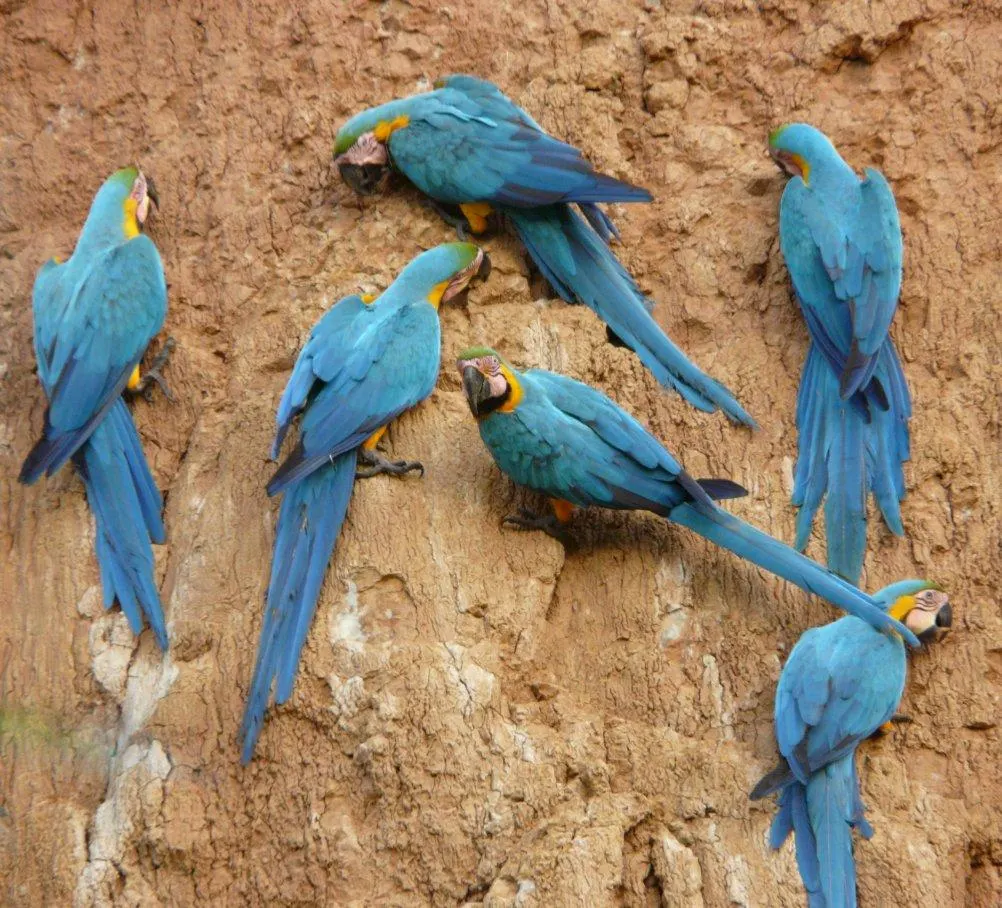
The next time you see a photograph of scarlet macaws gathered against an Amazonian riverbank, remember that the scene represents much more than colorful birds eating dirt.
A clay lick is the product of geology and river erosion, but it becomes biologically important because birds recognize its value. Minerals, plant chemistry, nutrition, digestion, seasonal food resources, communication, and social behavior all meet at this seemingly simple patch of earth.
For anyone exploring the Amazon, watching macaws at a clay lick is therefore an opportunity to witness one of the rainforest’s most fascinating natural behaviors.
And perhaps the most remarkable part is that the question “why do macaws eat clay?” still has layers waiting to be discovered. The more scientists learn about geophagy, the clearer it becomes that this unusual behavior is an elegant adaptation to life in one of the most chemically complex and biologically diverse ecosystems on Earth.
Leave a Reply